
athenaHealth Scheduling Problems: The 7 Most Common Issues (and Where They Actually Get Fixed)
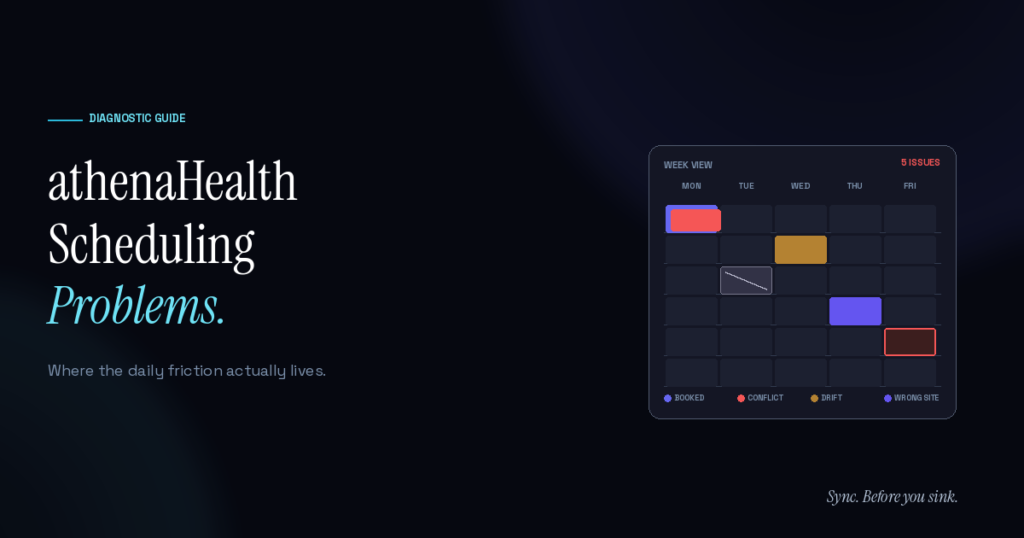
The most common athenaHealth scheduling problems aren’t athenaHealth’s fault — they’re operational gaps that surface anywhere a structured EHR scheduler runs alongside human-driven schedules. Double-bookings, drifted templates, multi-location confusion, and visibility gaps account for most day-to-day friction. Fixable, but the fix isn’t always inside athenaHealth.
A practice manager spends 45 minutes on a Friday afternoon trying to figure out why three patients showed up for the same 9am slot. By the end of the call, they’ve identified four different things that went wrong — none of them obvious from inside athenaHealth itself. This is the texture of the problem. athenaHealth is doing its job; the surrounding system isn’t.
This guide walks through the seven most common scheduling problems athenaHealth practices report, and where each one actually gets fixed.
What are the most common athenaHealth scheduling problems?
Practice managers consistently surface the same patterns:
- Double-bookings caused by invisible provider commitments
- Provider templates that have drifted from reality
- Multi-location chaos — provider booked at the wrong site
- Reschedules that create duplicate or orphaned appointments
- Front-desk overrides that compound into systemic issues
- Cancellation cascade — late cancellations cluster and aren’t replaced
- Visibility gaps between athenaHealth and where providers actually live (Google Calendar, etc.)
Five of these seven are visibility or template problems, not athenaHealth feature problems. That distinction matters because it changes where the fix lives.
AHRQ’s analysis of primary care patient safety notes that system factors — including difficulty scheduling appointments — contribute to diagnostic errors. Scheduling problems aren’t just operational annoyances; they have downstream patient safety implications.
Why do double-bookings keep happening in athenaHealth?
athenaHealth tracks patient appointments. It doesn’t track everything else happening in the provider’s day — surgeries scheduled at hospitals, conferences, OOO commitments, family logistics. The provider keeps those in Google Calendar (or in their head). The front desk doesn’t see them. Patients get booked into time that’s already committed.
This is a visibility problem disguised as a scheduling problem. The fix isn’t better template configuration in athenaHealth (though that helps). The fix is a bidirectional sync between athenaHealth and the calendar where provider commitments actually live.
A peer-reviewed analysis of patient no-show data cited an average cost of $196 per missed appointment. Double-bookings sit on the same revenue line — and they’re usually preventable when the front desk can see what the provider sees.
Why are provider templates so hard to keep current?
Provider templates were probably set up correctly two years ago. Then a provider dropped Wednesdays. Another shifted from full-day to half-day Tuesdays. A new provider joined and inherited a template that doesn’t match how they actually work. None of these triggered an athenaHealth update.
Template drift is silent. Until it isn’t — usually when the front desk books three patients into a slot the provider hasn’t worked in six months.
The fix is process, not technology. Quarterly template audits, a clear owner of template updates, and a feedback loop where front-desk overrides trigger template review.
What goes wrong in multi-location practices?
Multi-location practices have a special class of scheduling problems. Provider was scheduled at the south location Tuesday but is at the north location Wednesday — front desk at south books a Wednesday slot anyway. Or a provider’s “free” slot on the schedule is actually them traveling between locations.
Common multi-location failure patterns:
- Location-blind booking. Front desk books based on provider availability without checking which location the provider is at.
- Location-template misalignment. Provider templates don’t reflect which days they’re at which sites.
- Cross-location reschedules. A patient gets rescheduled and the new location doesn’t match the patient’s preference.
- Aggregation gaps. No single view of where each provider is across all locations on a given day.
These problems compound. A practice with three locations and ten providers has thirty location-provider combinations to keep coherent. Without infrastructure for that coherence, errors are inevitable.
Why do reschedules create duplicate or orphaned appointments?
A patient asks to move from Tuesday 9am to Thursday 11am. The front desk creates the new appointment. The original Tuesday 9am slot doesn’t always get cleared cleanly — sometimes it stays as a ghost appointment, sometimes the provider’s calendar still shows it.
This problem multiplies across hundreds of weekly reschedules. Each rescheduled appointment is a potential ghost. Over time, the schedule diverges from reality.
The fix is a tight reschedule protocol: confirm cancellation of the old slot before creating the new one, document the change, and verify both systems (athenaHealth and any synced calendar) reflect the change.
How do front-desk overrides become systemic problems?
When the front desk has to manually override a template — book outside template hours, force a slot, ignore an apparent conflict — they’re patching a problem in the moment. Each override is a workaround. Workarounds compound.
If a particular override happens repeatedly (e.g., always booking a provider into a “blocked” Wednesday slot because the block is wrong), that’s a template problem masquerading as a daily front-desk task. Tracking override frequency surfaces these patterns.
The AMA’s 2025 physician AI survey found that 57% of physicians cite reducing administrative burden through automation as their top priority for new technology. Front-desk overrides are exactly the kind of manual coordination work that compounds practice-wide friction.
What does cancellation cascade look like?
Same-day and next-day cancellations cluster more than practices realize. A Tuesday morning storm causes five cancellations in a single morning. The practice doesn’t have a fast way to fill those slots — patients on a waitlist aren’t called, walk-ins aren’t routed efficiently, and the schedule ends up with dead time.
Cancellation cascade is partly an external problem (weather, illness, transportation) and partly an infrastructure problem (no efficient backfill mechanism). Practices that handle it well have a confirmation/reminder system that surfaces likely cancellations early, plus a waitlist protocol the front desk can execute on quickly.
How does the visibility gap connect all these problems?
Five of the seven problems above are visibility or template-drift issues. The thread connecting them: the front desk and the provider don’t see the same picture, the schedule of record (athenaHealth) and the calendar where commitments actually live (Google Calendar) don’t communicate, and reality drifts from what’s recorded.
Closing the visibility gap doesn’t solve every athenaHealth scheduling problem. It does solve most of the unexplained ones — the double-bookings nobody can trace, the reschedules that don’t propagate, the multi-location chaos.
For athenaHealth practices specifically, the visibility-gap fix is bidirectional sync between athenaHealth and Google Calendar. Sporo Health is purpose-built for this — appointments flow both directions, PHI never leaves athenaHealth’s BAA scope, setup is 2–3 days white-glove.
Frequently Asked Questions
Q: Are athenaHealth’s scheduling problems different from other EHRs? A: Most EHRs have similar structural challenges — they manage patient appointments well and don’t natively see the provider’s life outside the EHR. The specific pattern of double-bookings, template drift, and visibility gaps shows up across athenaHealth, Elation, eClinicalWorks, and others. The fixes are mostly the same.
Q: Which scheduling problems are athenaHealth’s responsibility versus the practice’s? A: athenaHealth is responsible for the booking engine, template logic, and conflict prevention within the system. The practice is responsible for keeping templates accurate, training the front desk, and handling commitments that live outside athenaHealth. Most “athenaHealth problems” practices report turn out to be practice-side gaps.
Q: How common are double-bookings in primary care practices using athenaHealth? A: Industry data is thin, but practice managers anecdotally report 1–3 double-bookings per provider per week as typical. Practices with calendar sync usually report under 0.5 per provider per week.
Q: Can athenaHealth alert me when something’s wrong with the schedule? A: athenaHealth has built-in conflict detection within the system — it’ll flag two patients in the same slot. The blind spot is conflicts with commitments that live outside athenaHealth, which it can’t see.
Q: What’s the single biggest source of scheduling problems in athenaHealth practices? A: The visibility gap between athenaHealth and the provider’s calendar of record. Roughly 80% of unexplained scheduling errors trace back to commitments athenaHealth didn’t know about.
Q: How long does it take to fix the visibility gap with bidirectional sync? A: Sporo Health’s bidirectional sync sets up in 2–3 days from discovery call to live, including the BAA. Practices typically see double-bookings drop within the first two weeks.
Q: What scheduling problems does calendar sync NOT solve? A: Template configuration errors, front-desk training gaps, and patient-side cancellations are not visibility problems and need their own fixes. Calendar sync is one piece of healthy scheduling, not all of it.
The fix is mostly outside athenaHealth
The most common athenaHealth scheduling problems trace back to gaps the EHR can’t see — provider commitments, multi-location coordination, template drift. Fixing them requires both better practice operations and infrastructure that closes the visibility gap between athenaHealth and the calendars providers actually use.
For the visibility layer specifically, Sporo Health bridges athenaHealth and Google Calendar in both directions, setup in as little as 30 minutes.
Sync. Before you sink.
Click this link to book a call today.

[…] multi-location failures are a specific subset of the broader scheduling problems athenaHealth practices report — amplified by the cross-site coordination layer that single-location practices don’t have […]
[…] The broader scheduling problems athenaHealth practices report generally trace back to visibility-gap patterns. Closing the gap doesn’t solve every problem — but it does close the largest single revenue leak in most practice operations. […]
[…] The broader pattern of scheduling problems athenaHealth practices report traces back to visibility gaps that affect cancellation handling speed alongside double-bookings. […]
[…] hours, sometimes a full half-day) that the front desk should never override with routine visits. Template drift on procedure blocks is a common scheduling problem in OB/GYN practices — front desk under pressure books a routine […]
[…] Many of the broader athenaHealth scheduling problems practices report originate in onboarding gaps — patterns that get baked into a provider’s scheduling behavior in the first 60 days and persist for years. […]
[…] the pattern is unclear, compare it with these common athenahealth scheduling problems. When the evidence points to a widespread incident, stop transaction-level experimentation and use […]