
The True Cost of Double-Booking in athenaHealth Practices: A 2026 Analysis
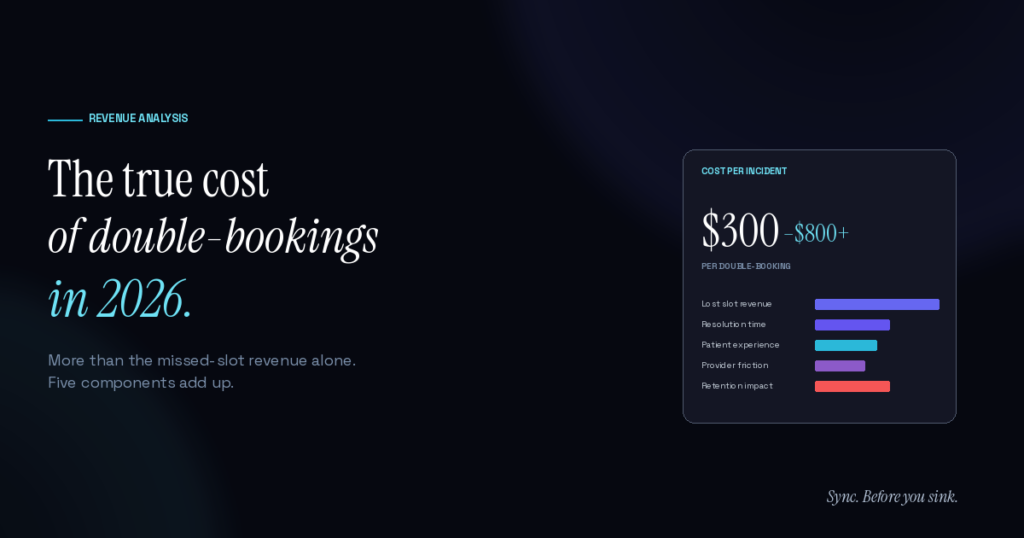
A double-booking in an athenaHealth practice doesn’t just cost the missed slot’s revenue. The full cost includes resolution time, patient experience damage, provider friction, and retention loss — typically $300–$800 per incident depending on practice type and visit value. For practices with even modest double-booking rates (1–3 per provider per week), this represents six-figure annual revenue exposure that’s invisible on most P&L statements.
The reason this cost stays hidden is that no single line on the income statement says “double-booking losses.” It’s spread across compressed encounter time, staff overtime, patient churn, and provider dissatisfaction — each a small leak, none of which trace cleanly back to the source.
Why “lost revenue” understates the cost
When practice managers think about double-booking costs, they typically calculate: missed visit × visit reimbursement = lost revenue. For a $150 wellness visit, that’s $150 in obvious lost income.
This calculation misses 60–80% of the actual cost. The bigger numbers live in the downstream effects:
- The 20–40 minutes of front-desk and clinical staff time spent resolving the situation
- Provider time lost to compressed encounters that follow a double-booking
- Patient experience damage that affects retention and word-of-mouth referral
- Cumulative provider frustration that erodes culture and contributes to burnout
A peer-reviewed analysis of patient no-show data cited an average cost of $196 per missed appointment (Kheirkhah et al.). Double-bookings sit on a similar revenue line but compound additional costs the no-show comparison doesn’t capture — because in a double-booking, two patients show up expecting service that can only fully serve one.
The five cost components of a double-booking
Breaking out the actual cost components:
1. Lost slot revenue. The most visible cost. One patient gets compressed encounter time or gets rescheduled entirely. Direct revenue impact: $100–$300 depending on visit type.
2. Resolution time. Front desk identifies the conflict, contacts both patients, negotiates a solution, updates the schedule, documents the change. Provider may need to be informed mid-clinic. Staff time cost: 20–40 minutes across multiple people = $30–$80 in loaded labor cost.
3. Patient experience damage. Patient who gets compressed time or rescheduled feels deprioritized. Patient satisfaction scores reflect this, which increasingly tie to reimbursement under value-based contracts. Soft cost but real: $20–$100 in long-term reimbursement impact.
4. Provider friction. Compressed encounters create cognitive load. Charting backs up. Provider runs late for subsequent appointments, compounding the problem. Cumulative friction: $50–$150 in productivity loss across the day.
5. Retention impact. A patient who experiences a poorly-handled double-booking is materially more likely to switch practices. According to MGMA’s December 2025 patient access report, scheduling reliability ranks among the top three factors influencing patient retention. Retention cost per incident (averaged across the cohort that doesn’t return): $100–$200.
Total per incident: $300–$830 conservative range, with high-acuity specialties tending toward the upper end.
How often do double-bookings happen?
Industry data is thinner than it should be, but practice manager surveys consistently report:
- Practices without calendar sync: 1–3 double-bookings per provider per week typical, ranging higher in multi-location settings
- Practices with bidirectional calendar sync: Under 0.5 per provider per week typical, with most residual incidents tracing to template configuration or human error rather than visibility gaps
For a 5-provider practice averaging 2 double-bookings per provider per week, the annual incident count lands around 520 per year. At $500 per incident (mid-range), that’s $260,000 in annual cost. Even at the conservative $300 per incident estimate, it’s $156,000 annually.
These numbers reframe the calendar-sync investment question. The “cost of doing nothing” is often higher than practices realize.
The retention impact — the part most practices miss
The component practices most underestimate is retention. A patient who experiences a smooth interaction is a long-term customer; a patient who experiences a botched one is at risk. According to the AMA’s 2025 physician AI survey, 57% of physicians prioritize reducing administrative burden through automation — which downstream-improves the patient experience by removing the kinds of avoidable errors that erode trust.
A practice losing 2% more patients per year than necessary, because of scheduling friction, may not feel that loss for 12–18 months. Then it shows up as flat panel sizes, harder marketing economics, and slowly-eroding revenue per provider. The connection to double-bookings is rarely made because the lag time hides the cause.
The infrastructure ROI calculation
When evaluating calendar sync infrastructure for an athenaHealth practice, the relevant math:
- Annual cost of current double-booking rate: [Frequency per provider per week] × 52 × [providers] × $500 = annual exposure
- Annual cost of infrastructure that reduces double-bookings by 70–80%: Tool cost + setup investment
- Net annual savings: Difference between the two
For most outpatient practices, the math favors infrastructure by a multiple, not a margin. The qualitative benefits (reduced provider stress, better patient experience, less front-desk overtime) are additional.
The broader scheduling problems athenaHealth practices report generally trace back to visibility-gap patterns. Closing the gap doesn’t solve every problem — but it does close the largest single revenue leak in most practice operations.
Frequently Asked Questions
Q: How do I know my actual double-booking rate? A: Track it for 30 days. Have front desk flag every double-booking incident (not just resolved ones — every incident where two patients were initially scheduled in the same provider slot). Most practices are surprised at the number; the second surprise is how consistent it is week to week.
Q: Are some double-bookings “good” — e.g., intentional overbooking to reduce no-show impact? A: Some practices intentionally overbook expecting cancellations. That’s a different operational choice with its own tradeoffs. The cost calculation here applies to unintentional double-bookings caused by visibility gaps and template errors.
Q: Does this analysis apply to specialty practices the same way? A: Roughly, with adjustments. High-acuity specialties (surgery, oncology) tend toward the upper end of cost ranges because each visit value is higher and the patient experience impact compounds faster. Primary care and pediatric practices tend toward the middle of the range.
Q: What about the cost of the calendar sync infrastructure itself? A: Typically per-provider monthly pricing. For most practices, the math against the avoided double-booking cost works out to ROI within 2–3 months.
Q: Are there ways to reduce double-bookings without infrastructure? A: Yes — template discipline, front-desk training, daily huddles, and quarterly audits all help. They typically reduce double-bookings by 20–30%. Infrastructure addresses the visibility-gap subset specifically, which accounts for the remaining 70–80%.
The cost of doing nothing is real
For athenaHealth practices running without calendar sync, the annual double-booking exposure is rarely zero. It’s six figures for most multi-provider practices. The reason it stays invisible is that it’s distributed across small daily events — but the cumulative effect on revenue, retention, and provider satisfaction is significant.
For practices ready to address it, Sync. Before you sink.

[…] choice with separate tradeoffs — when no-show rates drop, the overbooking practice generates more frequent unintentional double-bookings. Practices that reduce no-shows should also reduce intentional overbooking […]
[…] buffer (10–15% of slots held for reschedule absorption) and use waitlists to fill cancellations. The hidden cost of double-bookings and scheduling errors compounds in OB/GYN where prenatal series timing has clinical […]
[…] data crossing the bridge, the smaller the surface area for an incident. That’s the principle Sporo’s bidirectional sync is built […]
[…] caused by calendar drift compound that loss with rushed visits and frustrated patients. The hidden cost of double-booking adds up faster than most practices […]