
No-Show Prevention for athenaHealth Practices: A 2026 Operational Playbook
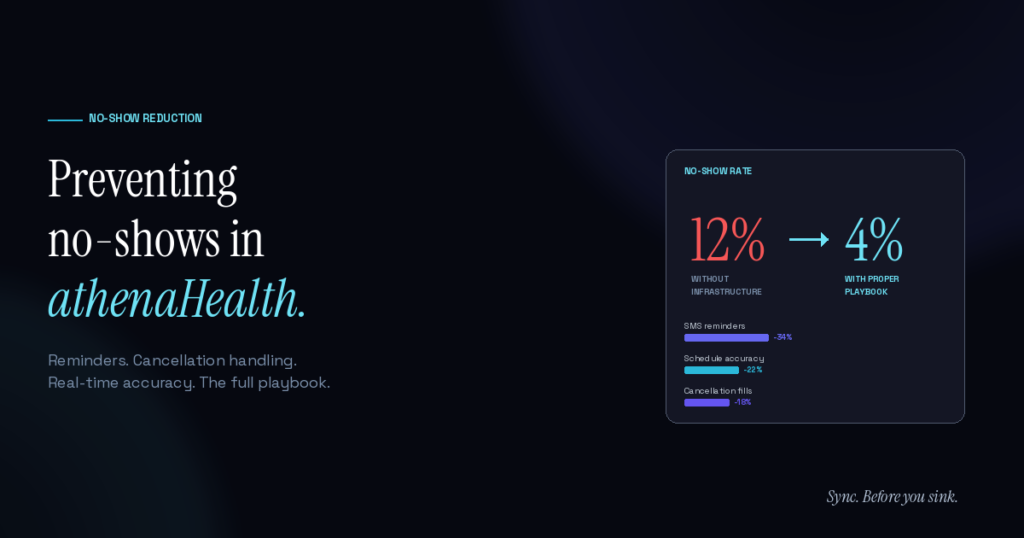
FSNo-show prevention in athenaHealth practices works through three compounding levers: accurate appointment reminders, schedule reliability that earns patient trust, and fast cancellation handling that fills slots before they go dark. Practices that combine all three typically run no-show rates of 3–5% — well below the industry average of 8–12% — and recover six figures of annual revenue per provider as a result.
The math is significant. According to a peer-reviewed analysis, the average no-show costs $196 per missed appointment. A 5-provider practice averaging 100 weekly appointments per provider and a 10% no-show rate loses roughly $510,000 annually. Cutting that rate to 4% with disciplined infrastructure recovers $306,000 of that exposure. Nothing else in practice operations has that return profile.
Why are no-show rates so persistent in 2026?
Three structural reasons keep no-show rates stubborn even at well-run practices:
- Reminder fatigue. Patients receive dozens of reminders weekly across healthcare, retail, services. Generic reminders get ignored.
- Schedule mistrust. When patients have experienced poor scheduling reliability — last-minute provider changes, long waits, scheduling errors — they treat appointments as lower-priority commitments.
- Friction in cancelling. A patient who wants to cancel but can’t easily reach the practice often becomes a no-show by default. They didn’t intend to skip; they just couldn’t reach you.
The interesting insight: no-show prevention isn’t primarily a patient behavior problem. It’s an infrastructure problem. Reduce the friction, improve the reliability, and the rate drops without changing patient demographics or visit types.
What’s a healthy no-show rate for athenaHealth practices?
Benchmarks vary by specialty, but for context:
- Primary care: 5–7% is healthy. 3–4% indicates strong operational discipline.
- Specialty care (most): 7–10% is typical. Under 5% requires deliberate infrastructure investment.
- Behavioral health: 15–20% is typical industry-wide, reflecting patient-condition factors. Under 10% indicates exceptional operations.
- Pediatrics: 4–6%, lower than adult practices because parents tend to keep kids’ appointments more reliably.
For Direct Primary Care practices, the no-show pattern is different — DPC’s membership-driven model creates different patient commitment dynamics than fee-for-service practices, often with no-show rates 30–40% lower than conventional primary care benchmarks.
What’s the single biggest no-show reduction lever?
SMS appointment reminders, by a meaningful margin. A peer-reviewed systematic review of SMS appointment reminders found an average 34% reduction in no-show rates across studied interventions. Practices that don’t use SMS reminders at all leave the largest gain on the table.
Implementation specifics that matter:
- Send timing. 24–48 hours before the appointment is the sweet spot. Earlier reminders get forgotten; later reminders don’t give patients time to reschedule cleanly.
- Two-way capability. Reminders that let patients confirm, cancel, or reschedule via text reduce both no-shows and the call-center load. One-way “appointment tomorrow at 9am” reminders are better than nothing but leave value on the table.
- Personalization. Include the provider’s name, visit type, and location. Generic reminders feel like spam.
- Multiple channels. SMS as primary, email as backup, automated voice call for older demographics. Patient communication preferences vary; meeting them where they are matters.
athenaHealth’s native communications module handles basic SMS reminders. Third-party tools (like Solutionreach, Phreesia, RevenueWell) offer deeper functionality — two-way messaging, customizable timing rules, segmentation.
How does schedule accuracy affect no-show rates?
The second-biggest lever is one most practices underestimate: schedule accuracy. Patients who experience scheduling errors — provider not actually available, reschedule confusion, wait times exceeding expectations — quietly become less reliable themselves. They treat future appointments as flexible commitments because the practice has demonstrated its own commitments are flexible.
Concretely:
- Provider availability gaps (provider has a Google Calendar block the EHR doesn’t see) cause patient frustration when they discover the provider is “unexpectedly out”
- Reschedule cascades create downstream confusion when one rescheduled appointment shifts a whole patient’s care timeline
- Wait times exceeding scheduled appointment times signal disorganization
Closing these gaps requires infrastructure that keeps the EHR’s view of provider availability accurate at all times. For practices using athenaHealth, bidirectional sync with Google Calendar is the single highest-leverage intervention because it eliminates the most common source of “the schedule wasn’t what we said it would be” patient experiences.
How do you handle cancellations to prevent same-day no-shows?
Cancellations and no-shows are operationally linked. Many same-day “no-shows” are actually patients who tried to cancel but couldn’t reach the practice. The infrastructure question: how easily can a patient cancel, and how quickly does the slot fill?
Components of a strong cancellation workflow:
- Multiple cancellation channels. Phone, text reply to reminder, patient portal, web form. Same-day cancellations that get through reduce no-shows mechanically.
- Waitlist protocols. Patients who want earlier appointments call to be added to a waitlist. When cancellations happen, front desk works the list immediately.
- Same-day capacity reservation. 15–25% of daily slots held until day-of release. These absorb cancellation cascade and same-day urgent requests.
- Cancellation handling that propagates cleanly — both in athenaHealth and in any synced calendars. Stale appointments on the provider’s Google Calendar after a cancellation create visibility issues that compound.
The broader pattern of scheduling problems athenaHealth practices report traces back to visibility gaps that affect cancellation handling speed alongside double-bookings.
What about reminder timing for different appointment types?
A common mistake: applying the same reminder schedule to all appointment types. The right pattern varies:
| Appointment type | Recommended reminder schedule |
|---|---|
| Annual wellness / well-child | 1 week before + 24 hours before |
| Standard follow-up | 24–48 hours before |
| Same-day or next-day urgent | 2–4 hours before (if booked >24 hours in advance) |
| Procedure / surgery | 1 week before + 48 hours before + day-of |
| Behavioral health | 24 hours before, with confirmation prompt |
| Telehealth visit | 24 hours before + 30 minutes before (with link) |
The MGMA Dec 2025 patient access report notes that practices customizing reminder timing by appointment type see 15–25% better no-show reduction than those running uniform reminder rules.
How long until no-show prevention shows results?
Component-by-component timeline:
- SMS reminder rollout: Effect visible within 30 days as the first round of reminded patients moves through.
- Schedule accuracy improvements: Effect visible within 60–90 days as patients re-calibrate trust in the practice’s reliability.
- Cancellation handling improvements: Immediate impact on same-day fill rate; cumulative no-show effect within 60 days.
- Combined program: Most practices see meaningful no-show rate reduction within 3 months. Full effect typically lands at the 6-month mark.
Track weekly to catch trend reversals early. athenaHealth scheduling best practices include no-show rate as a core operational metric to monitor consistently.
Frequently Asked Questions
Q: Does athenaHealth’s native reminder system work well enough? A: For basic reminders, yes. For two-way messaging, customizable timing rules, segmentation, and integration with confirmation workflows, most practices add a specialized communications layer (Solutionreach, Phreesia, RevenueWell).
Q: What’s the ROI of a no-show prevention investment? A: Highest in healthcare operations. Per the no-show cost analysis ($196 average), a 5-percentage-point reduction at a 5-provider practice typically recovers $200,000–$300,000 annually. The infrastructure cost is a small fraction of that.
Q: How do you handle chronic no-show patients? A: A small percentage of patients (typically 3–5% of panel) generate a disproportionate share of no-shows. Practices commonly use tiered policies: courtesy reminders for everyone; deposits or pre-payment for chronic no-show patients; eventually discharge from practice for persistent patterns. Discharge is rare but appropriate when patterns persist after intervention.
Q: Do reminders work for older patients without smartphones? A: Automated voice call reminders remain effective for older demographics. Most modern reminder systems support multi-channel delivery; configure voice calls as primary for patients over 75 unless they’ve opted into SMS.
Q: What’s the relationship between no-shows and double-bookings? A: Some practices intentionally overbook expecting no-shows. That’s a different operational choice with separate tradeoffs — when no-show rates drop, the overbooking practice generates more frequent unintentional double-bookings. Practices that reduce no-shows should also reduce intentional overbooking simultaneously.
Q: Does telehealth have higher or lower no-show rates than in-person? A: Mixed evidence. Telehealth removes the friction of physical travel, which reduces no-shows for some patient populations. But telehealth’s lower commitment threshold can increase casual no-shows for others. Most practices see similar overall rates with different distribution by visit type.
Q: How do you measure if your no-show prevention is working? A: Track weekly. Compute: (no-shows) / (total scheduled appointments) per provider, per week, by appointment type. Watch the trend over 8–12 weeks. Step changes (rather than gradual decline) indicate an infrastructure change is working; gradual decline suggests cumulative trust-building.
No-show prevention is operational, not behavioral
The pattern that emerges from successful no-show reduction programs: they treat no-shows as an infrastructure problem rather than a patient behavior problem. Reminders, schedule accuracy, and cancellation handling each remove friction. The compounding effect — when all three are running well — typically halves the no-show rate within a year.
For athenaHealth practices specifically, the schedule-accuracy lever depends on closing the visibility gap between the EHR and the calendars providers actually use. Sporo Health’s bidirectional sync makes that gap-closure automatic.
Sync. Before you sink.
