
athenaHealth + Google Calendar Sync for Direct Primary Care (DPC) Practices
Direct Primary Care practices have specific scheduling characteristics that make calendar visibility especially important — fewer patients per provider, longer encounters, membership-driven access, and physicians who own their schedules in a way that’s rare in larger systems. The result: when athenaHealth and Google Calendar don’t sync, the friction shows up faster and matters more than in conventional practices.
DPC is one of the fastest-growing primary care models in 2026. The infrastructure choices DPC practices make early have outsized impact on their economics, since revenue per visit is locked by the membership model.
What makes DPC scheduling different from conventional practice?
DPC operates on membership, not fee-for-service. Patients pay a monthly fee for unlimited access; providers see fewer patients per day but spend more time with each one. Per the American Academy of Family Physicians’ description of the DPC model, this structure changes what the schedule needs to do:
- Same-day and next-day access is the value prop. Members expect to get seen quickly. Schedule flexibility is a feature, not a luxury.
- Provider-owned schedules. DPC physicians often manage their own calendars personally rather than delegating to a front desk team. Google Calendar is frequently the primary tool.
- Longer appointments. 30–60 minute visits are standard, vs 15–20 in conventional primary care. Schedule density is lower; consequences of double-booking are higher.
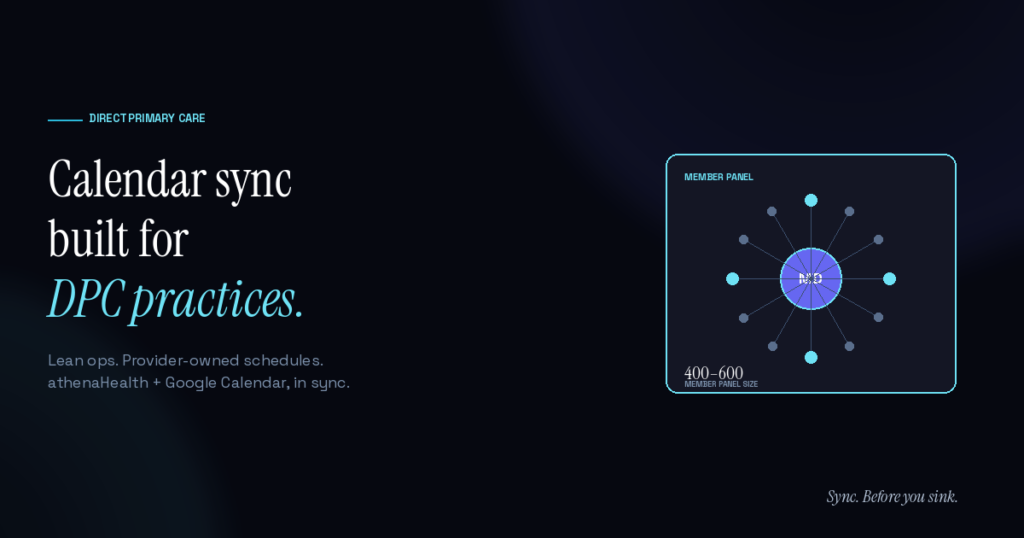
- Lower patient panel size. A DPC physician typically panels 400–600 patients, vs 1,500–2,500 in fee-for-service. Each patient relationship matters more.
- Direct access to the physician outside the clinic. Phone, text, video visits — DPC physicians are reachable in ways that require their personal calendar to stay accurate.
These characteristics make calendar coherence between athenaHealth and the provider’s personal Google Calendar a daily operational matter, not an occasional one.
Why does the visibility gap hit DPC harder?
In a 30-provider conventional practice, one double-booking is a missed slot. In a 2-provider DPC practice with 400-member panels, the same double-booking is a personal interaction the physician will hear about by Tuesday.
DPC physicians often blend work and personal time more than conventional providers. Mid-day blocks for school pickups, exercise, or focused work are common — and they live in Google Calendar, not athenaHealth. When the front desk (or the physician themselves) doesn’t see those blocks, the calendar of record drifts from reality fast.
The other factor: DPC operations usually run lean. Many DPC practices don’t have a dedicated practice manager — the physician or a single staff member handles everything. Time spent reconciling two calendars manually is time taken directly from patient care or membership growth.
How does athenaHealth + Google Calendar bidirectional sync fit DPC specifically?
The structural pattern matches DPC needs cleanly:
- Provider-owned schedules stay provider-owned. Blocks in Google Calendar propagate to athenaHealth without the physician needing to remember to update both.
- Same-day access stays bookable correctly. When a member calls for a same-day visit, the front desk (or self-scheduling tool) sees a current, complete picture of provider availability.
- Personal commitments stay private. Sporo Health’s sync default doesn’t push patient names or clinical detail to Google Calendar, and respects that personal blocks in Google Calendar are private by nature.
- No IT project required. DPC practices generally don’t have IT staff. Sporo’s white-glove setup — as little as 30 minutes for the simplest practices, typically 2–3 days — fits a model where the physician or one staff member is making the decision.
Common DPC scheduling problems calendar sync addresses
DPC-specific patterns that get fixed by closing the visibility gap:
- The “I told my staff person but forgot to update the calendar” problem. Common in 1–3 person DPC practices. Calendar sync makes the verbal handoff redundant.
- Member-facing self-scheduling that overbooks. Some DPC practices offer member-side scheduling. Without sync, those bookings can hit blocks the system doesn’t see.
- Cross-state or remote work blocks. DPC physicians sometimes practice from multiple locations or travel. Provider OOO that lives only in Google Calendar leaves athenaHealth showing them as available.
- Post-visit follow-up time. DPC visits often run long; follow-up time blocks added by the provider personally need to flow back to athenaHealth so the next slot isn’t booked too tight.
Frequently Asked Questions
Q: Is athenaHealth common in DPC practices? A: Yes, though DPC practices use a mix of EHRs including Elation, AthenaOne, AdvancedMD, and DPC-specific tools like Hint Health. athenaHealth’s strength in scheduling logic and revenue cycle management makes it a frequent choice for DPC practices that need a full EHR.
Q: Do I need a practice manager to use Sporo Health if I’m a solo DPC physician? A: No. Sporo’s setup process works with whoever is making the decision — physician, practice manager, or single admin staff. The discovery call is 45 minutes; no IT or technical work required.
Q: Does Sporo handle the unique scheduling patterns DPC uses (longer appointments, same-day access, recurring member visits)? A: Yes. The sync respects athenaHealth’s template logic, so whatever scheduling pattern works inside athenaHealth flows through to Google Calendar correctly.
Q: What about DPC practices using non-athenaHealth EHRs? A: Sporo is currently built for the athenaHealth + Google Calendar pair specifically. Practices on Elation get native sync; practices on AdvancedMD, Hint Health, or others would need to evaluate other options.
Q: How much does Sporo cost for a small DPC practice? A: Per-provider monthly pricing. For solo and 2-provider DPC practices, the cost is structured to make the math work even at low patient volumes. Pricing details via a 15-minute scoping call.
Q: Will calendar sync help me grow my DPC membership? A: Indirectly. Members notice when the schedule works — when same-day requests get accommodated, when reschedules go smoothly, when the physician shows up where they’re expected. The compound effect of operational reliability shows up in retention and referrals over months.
Calendar sync that fits DPC
The DPC model puts more weight on schedule integrity than conventional fee-for-service practices do. For DPC practices on athenaHealth, closing the gap between the EHR and the provider’s personal Google Calendar removes daily manual coordination work — the kind of overhead that compounds across hundreds of patient touches per month.
Sync. Before you sink.
Click this link to book a call today.

[…] Direct Primary Care practices, the no-show pattern is different — DPC’s membership-driven model creates different patient […]