After an athenahealth Calendar Sync Incident: A Recurrence-Prevention Postmortem Template
An athenahealth calendar sync incident postmortem template should begin after service is restored: preserve evidence, reconstruct four clocks, count scheduling impact, separate the trigger from control gaps, and assign actions with recurrence tests. Healthcare IT teams, practice operations leaders, and calendar integration owners should close the review only when fixes are verified or residual risk is explicitly accepted.
When should a calendar sync incident require a postmortem?
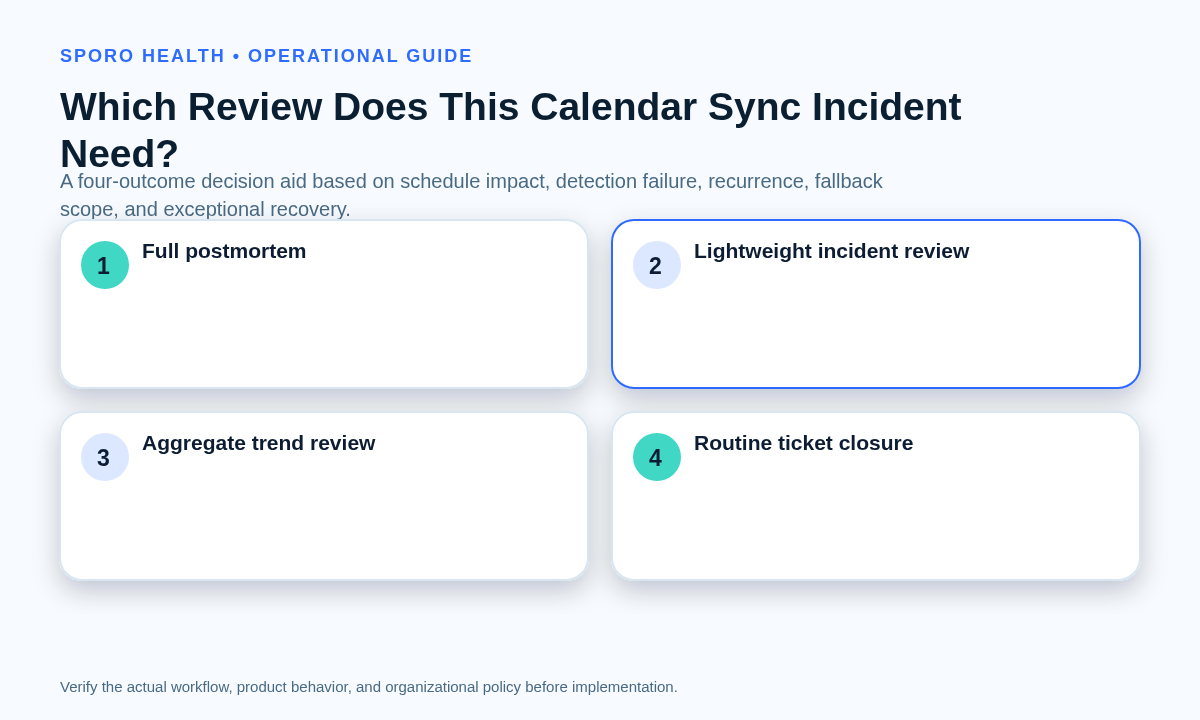
A full postmortem is warranted when an incident creates patient-booking risk, material schedule drift, broad manual fallback, delayed detection, repeated failure, or recovery requiring exceptional intervention. Define these thresholds before the next incident rather than debating review depth after every disruption. Google Cloud likewise recommends setting postmortem criteria in advance and includes monitoring failures, extended resolution, and significant intervention among its examples in its postmortem guidance.
| Review outcome | Choose it when | Required output |
|---|---|---|
| Full postmortem | Schedule exposure is material, detection failed, fallback was broad, recovery was exceptional, or the failure has recurred. | Complete timeline, impact census, control analysis, actions, tests, and closure review. |
| Lightweight incident review | The issue was contained to a narrow scope but revealed a useful monitoring, runbook, or ownership gap. | Short factual record, one or more findings, and proportionate follow-up. |
| Aggregate trend review | Several low-impact events share a fingerprint, although no single event warrants a full review. | Grouped evidence, frequency analysis, and a decision about systemic action. |
| Routine ticket closure | A known isolated fault was promptly detected, contained, reconciled, verified, and did not repeat. | Ticket evidence and a searchable incident fingerprint. |
The routing decision should use observed scheduling exposure and response performance—not the number of technical alerts alone.
What belongs in the incident record before cleanup?
Preserve alert and status timestamps, affected provider-calendar pairs, event identifiers, staff decisions, manual edits, vendor communications, and the exact checks used to declare recovery. Finish active containment through the calendar integration outage recovery runbook, and use the athenahealth calendar sync failure triage matrix for live signal classification. The retrospective review starts after restoration.
- Retain original timestamps with time zones and collection sources.
- Snapshot relevant status, alert, queue, and mapping states before routine cleanup.
- Record who made each containment or recovery decision and what evidence they had.
- Keep uncertain observations labeled as uncertain rather than converting them into facts.
- Store patient-specific work only in systems authorized for that purpose.
If the event also raises privacy or security concerns, route it through authorized processes. This operational review does not replace those assessments; NIST SP 800-61 Rev. 3 provides current cybersecurity incident-response considerations.
How do you reconstruct scheduling impact after a calendar sync outage?
Reconstruct four separate clocks: source-schedule change, integration processing or failure, staff discovery, and booking impact. Do not assume the first alert marks the beginning of schedule exposure. If duplicates contributed to the event, preserve identity and replay evidence using the duplicate calendar event troubleshooting guide.
| Clock | Question | Preferred evidence |
|---|---|---|
| Source change | When was the appointment, cancellation, block, or availability state changed? | Authoritative record history and stable identifiers. |
| Integration processing | When was the change received, processed, retried, missed, or rejected? | Delivery records, processing logs, checkpoints, and error states. |
| Staff discovery | When did a person first recognize the mismatch? | Alert acknowledgment, queue entry, call, message, or support record. |
| Booking impact | When could staff or patients first have acted on an incorrect schedule? | Booking-channel history, appointment actions, and fallback records. |
Record a supported time range when precision is unavailable. Google states that Calendar push notifications are not completely reliable in its push notification guidance, and its incremental synchronization guide says an invalid sync token can require a full synchronization. Microsoft documents missed and removed-subscription lifecycle events and calendar-view delta queries for retrieving scoped event changes. These are platform facts, not proof of what occurred in a particular integration.
How should scheduling impact be measured?
Measure operational exposure in provider-calendar pairs, schedule objects, fallback duration, reconciliation work, and unresolved exceptions—not raw alert volume. Use the calendar sync drift reconciliation framework when sampling beyond the initially reported records.
| Impact measure | Counting rule |
|---|---|
| Affected provider-calendar pairs | Count each confirmed pair once, even if it generated many alerts. |
| Exposed schedule objects | Count appointments or availability blocks that were wrong, missing, stale, duplicated, or not yet verified. |
| Fallback duration | Measure from fallback activation to approved return to normal operations. |
| Reconciliation workload | Count manual changes reviewed, corrected, excluded, or escalated. |
| Open exceptions at restoration | List every unresolved mismatch with an owner and next action. |
Keep confirmed impact, plausible exposure, and unverified scope separate. That distinction prevents an alert storm from overstating impact and prevents a quiet notification gap from hiding it.
How do you separate incident triggers from contributing control gaps?
Name the initiating trigger, then analyze why prevention, detection, containment, recovery, or communication controls allowed the event to matter. Google’s SRE postmortem guidance emphasizes blameless analysis, measurable actions, clear ownership, and investigation beyond the proximate failure.
| Control layer | Review question | Example improvement |
|---|---|---|
| Prevent | What could have blocked the invalid state or limited its scope? | Configuration validation, safer mapping changes, or duplicate-write controls. |
| Detect | Why did monitoring not reveal the mismatch earlier? | Pair-level freshness checks, reconciliation samples, or actionable alerts. |
| Contain | Why could the failure spread or remain bookable? | Pair isolation, one-writer fallback, or faster stale-calendar labeling. |
| Recover | What made restoration or reconciliation uncertain? | Documented checkpoint recovery, bounded replay, or recovery tests. |
| Communicate | Why did staff lack a trusted status, owner, or handoff? | Named update owner, audience-specific notices, and acknowledged transfers. |
A useful finding describes the condition, available information, failed control, and resulting exposure. “A staff member made an error” is not a sufficient causal analysis because it does not explain why the system permitted or failed to detect the action.
How should corrective actions be prioritized?
Prioritize actions by recurrence risk, potential schedule impact, detection weakness, breadth of affected providers, and implementation effort. Effort influences sequencing, but it should not automatically defer a high-impact action when current detection or containment remains weak.
| Factor | High-priority signal |
|---|---|
| Recurrence risk | The fingerprint has repeated or depends on an unresolved condition. |
| Schedule impact | Imminent appointments or availability across important operating periods could be wrong. |
| Detection weakness | Staff or patients can discover the mismatch before monitoring does. |
| Affected breadth | Several providers, calendars, locations, or booking channels share the exposure. |
| Effort | The action requires dependencies, testing, or a staged rollout that must be planned. |
Record a reason for the chosen priority. When work is deferred, document the temporary control, residual risk, approving owner, and escalation condition rather than silently moving it to a backlog.
What is the action-closure contract?
Every corrective action needs one owner, a priority, a due date, a verifiable end state, a recurrence test, a residual-risk disposition, and an escalation path. Collaborators may help, but one person remains accountable for producing closure evidence.
- State the control change precisely.
- Define the observable evidence that will prove it works.
- Name the test environment, sample, or incident scenario.
- Specify who reviews evidence and who accepts remaining risk.
- Define what happens if the due date or test is missed.
This contract follows the measurable, owned, prioritized action-item characteristics described in the Google SRE Workbook.
How do you verify corrective actions after a calendar sync incident?
Close an action only after evidence shows that the changed control works under a relevant scenario. A revised document or completed ticket is not enough. The daily athenahealth schedule reconciliation playbook can provide recurring samples, owners, and closure evidence after the review.
- Run a monitored recurrence scenario that reproduces the former trigger safely.
- Sample affected and unaffected provider-calendar pairs after the change.
- Exercise the fallback and confirm that one trusted schedule and change ledger remain usable.
- Use a negative test to show that an invalid mapping, stale checkpoint, or unauthorized change is rejected or detected.
What belongs in a repeat-incident fingerprint?
The fingerprint should be stable enough to connect similar incidents without assuming they share a cause. Record the failure class, direction, platform, affected object state, provider-calendar scope, detection path, recovery method, and control layer that failed.
Review a new event against prior fingerprints. A match should trigger questions about overdue actions, ineffective tests, changed conditions, or a cause that the earlier review did not reach.
Which review scorecard measures matter?
Track recurrence, detection, impact breadth, fallback use, reconciliation completion, and corrective-action aging with consistent definitions.
| Measure | Definition |
|---|---|
| Repeat incidents | Events matching a reviewed fingerprint. |
| Detection path | Monitoring, reconciliation, staff report, patient contact, or vendor notice. |
| Impact breadth | Confirmed provider-calendar pairs and exposed schedule objects. |
| Fallback use | Duration and operating units placed under manual control. |
| Reconciliation completion | Items verified versus items still open or uncertain. |
| Overdue actions | Actions past due without verified closure or accepted residual risk. |
Baseline these measures before setting local thresholds. Do not convert a small sample or short observation period into an unsupported reliability claim.
When can the postmortem be closed?
Close the postmortem when the factual record has been reviewed, impact is reconciled, urgent fixes are verified, and every remaining action or accepted risk has an accountable owner. Closure means the learning loop is controlled; it does not require pretending that all lower-priority work is already complete.
- Timeline sources and uncertainty have been reviewed.
- Affected schedule objects are reconciled or explicitly dispositioned.
- Trigger, contributing conditions, and response gaps are documented.
- Urgent actions have passed their recurrence or control tests.
- Remaining actions have owners, deadlines, escalation paths, and tracking records.
- Accepted residual risks identify the approver, temporary controls, and review date.
- Lessons have entered monitoring, runbooks, training, operating routines, or vendor requirements.
How do you put the athenahealth calendar sync incident postmortem template into use?
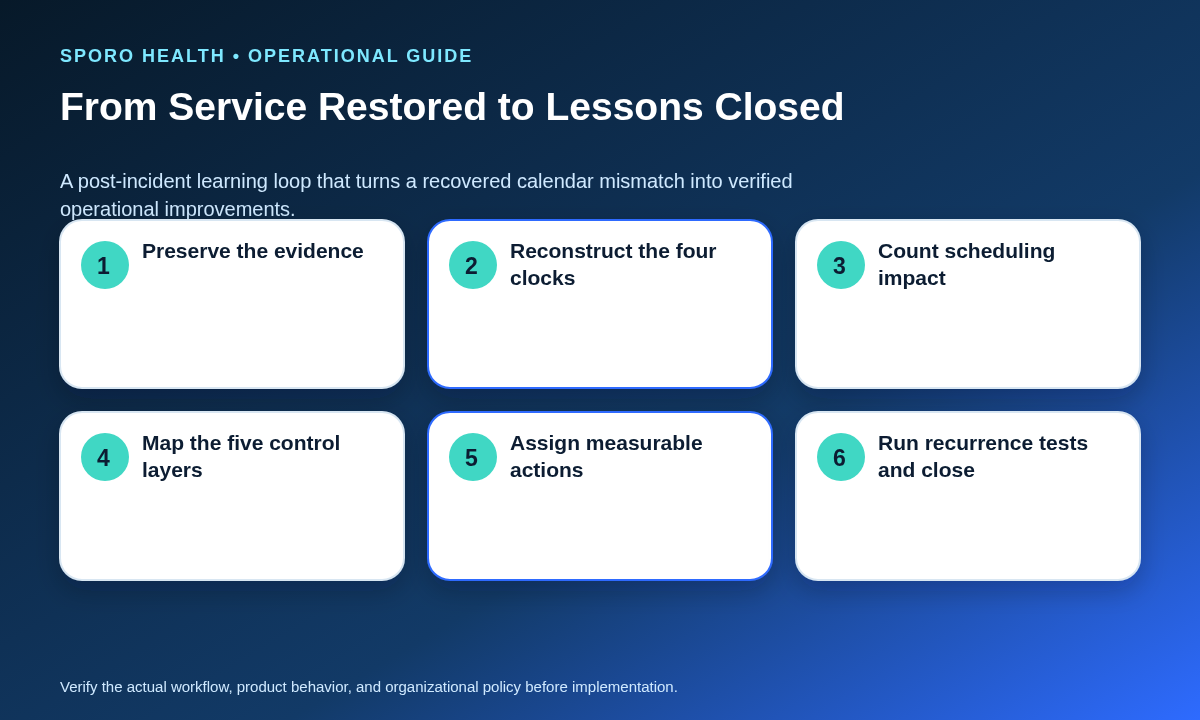
Assign one review owner and move through six evidence gates instead of holding an open-ended discussion. Each gate should produce a documentable output before the review advances.
- Preserve the incident record before cleanup changes it.
- Reconstruct source, integration, discovery, and booking-impact clocks.
- Complete the schedule-impact census and reconcile uncertainty.
- Map findings across the five control layers.
- Approve corrective actions using the action-closure contract.
- Run recurrence tests, disposition residual risk, and record closure.
If your practice is evaluating connected-calendar support, review Sporo Health’s healthcare automation overview, its current pages for athenahealth and Google Calendar and athenahealth and Microsoft Outlook, and the Sporo Health athenaConnect Marketplace listing. Treat these as vendor descriptions and verify monitoring, evidence, fallback, recovery, and test behavior for the intended configuration.
Used this way, the athenahealth calendar sync incident postmortem template becomes a control-verification record: it explains what happened, measures schedule exposure, assigns improvements, and shows whether recurrence risk was actually addressed.
Frequently asked questions
When should a calendar sync incident require a postmortem?
Use a full postmortem when the incident creates booking risk, material schedule drift, broad fallback work, delayed detection, recurrence, or exceptional recovery. Define these thresholds before the next incident.
What belongs in a medical practice calendar sync postmortem?
Include preserved evidence, the four-clock timeline, a schedule-impact census, trigger and control-gap analysis, corrective actions, recurrence tests, residual-risk decisions, and closure evidence.
How do you reconstruct scheduling impact after a calendar sync outage?
Reconstruct source-change, integration-processing, staff-discovery, and booking-impact times separately. Use supported ranges when an exact timestamp is unavailable.
How do you separate incident triggers from contributing control gaps?
Name the initiating event, then map enabling and response gaps across prevention, detection, containment, recovery, and communication. Do not treat the trigger as the entire cause.
How should calendar integration postmortem action items be prioritized?
Prioritize recurrence risk, potential schedule impact, detection weakness, affected-provider breadth, and effort together. High-risk actions need an owner, due date, escalation path, and testable end state.
How do you verify corrective actions after a calendar sync incident?
Run a monitored recurrence scenario, sampled reconciliation, fallback drill, or negative test that exercises the changed control. A completed ticket or revised document alone is not verification.
How should recurring calendar sync incidents be measured?
Use a stable incident fingerprint and track recurrence, detection path, affected pairs, fallback duration, reconciliation completion, unresolved exceptions, and overdue corrective actions.
Sources
- Google SRE Workbook: Postmortem Culture—Learning from Failure
- Google Cloud Architecture Framework: Conduct Thorough Postmortems
- Google Calendar API: Get Push Notifications
- Google Calendar API: Synchronize Resources Efficiently
- Microsoft Graph: Reduce Missing Subscriptions and Change Notifications
- Microsoft Graph: Get Incremental Changes to Events in a Calendar View
- NIST SP 800-61 Rev. 3