
How to Detect Calendar Sync Drift in athenahealth Practices: A Reconciliation Sampling Farmewrk
For healthcare IT teams, the practical answer to how to detect calendar sync drift in athenahealth practices is to maintain an inventory of every provider-calendar pair, rotate a risk-based sample, compare the intended schedule with the external calendar, and close each mismatch with evidence. Connection health, notification delivery, and empty error logs are useful signals, but none proves that paired schedule states match.
What is calendar sync drift?
Calendar sync drift is a persistent mismatch between the schedule state the practice intends to trust and the corresponding external-calendar state while the integration otherwise appears available. It may be silent until a reconciliation sample, a staff report, or a related exception exposes it.
Drift is not a synonym for every calendar problem. The operational response depends on whether the team sees one known transaction exception, discovers an unknown mismatch, identifies a repeated configuration pattern, or loses confidence in change transfer across multiple pairs.
| Condition | Observed pattern | Response |
|---|---|---|
| Known transaction exception | One visible miss tied to a create, reschedule, cancellation, or block | Open a bounded exception and verify the correction |
| Silent calendar drift | A sample finds a mismatch while service appears normal | Classify it, expand the sample, and establish scope |
| Recurring configuration failure | The same pair, mapping, or change state fails repeatedly | Investigate configuration and increase targeted coverage |
| Broad integration outage | Multiple pairs fail or safe correction cannot be verified | Move to incident control and recovery |
This boundary keeps routine sampling from becoming an improvised outage process while preventing a broad failure from being handled as a series of isolated edits.
How do you detect calendar sync drift in athenahealth practices?
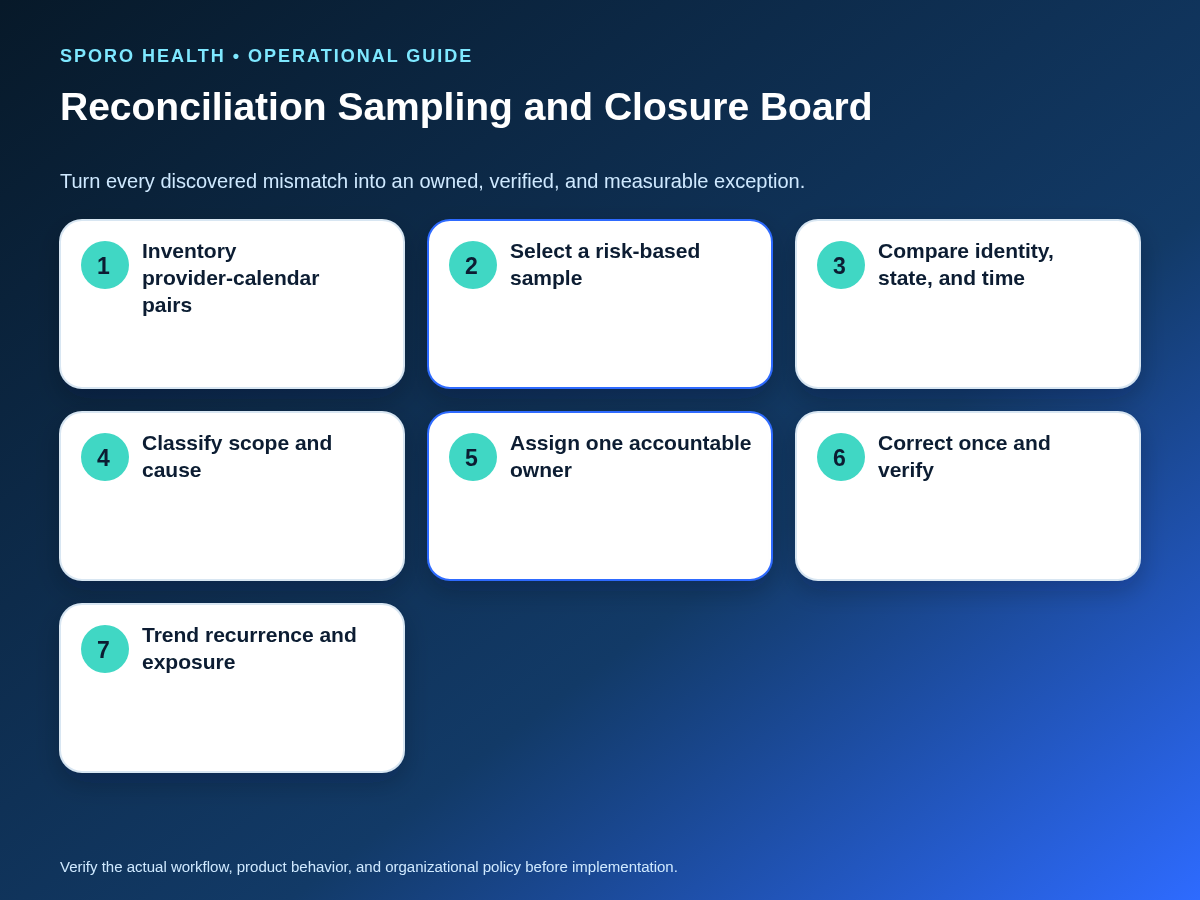
Combine a complete pair inventory, a rotating risk-based sample, and direct schedule-state comparison. Every discovered miss should enter a closed loop of classification, assignment, correction, verification, recurrence review, and escalation.
Which connections belong in the monitoring inventory?
Include every provider-calendar pair and enough context to determine what should synchronize, where it should appear, and who owns the result. Do not assume one provider, department, location, platform, or time zone represents the whole practice.
| Worksheet area | Fields to record |
|---|---|
| athenahealth identity | Provider, department, location, and locally used schedule identifier |
| External destination | Calendar owner or identifier, Google or Microsoft platform, and time zone |
| Expected behavior | Direction, source-of-truth rule, supported change states, and expected visibility |
| Control ownership | Accountable owner, backup, monitoring layers, last sample, and open exceptions |
Pair-level accountability should align with the practice’s wider athenahealth scheduling ownership and audit practices. A shared queue can receive alerts, but the inventory should still name the role responsible for deciding what happens next.
How should a reconciliation sample be selected?
Rotate risk-based samples across providers, locations, platforms, change states, recurrence patterns, and near-term schedule windows. A sample containing only convenient unchanged appointments can produce a reassuring result without testing the paths most likely to drift.
- Start with uncovered or recently changed provider-calendar pairs.
- Include creates, reschedules, cancellations, availability blocks, and recurring-instance exceptions.
- Spread selections across departments, locations, time zones, Google calendars, and Outlook calendars in scope.
- Weight near-term records and previously failed cause classes, then rotate coverage so low-volume pairs are not ignored.
Record the reason each item entered the sample. That makes the sample reproducible and reveals whether the team is repeatedly choosing easy records instead of testing meaningful risk.
What should staff compare in each sampled record?
Compare identity, status, start and end time, time zone, provider-calendar mapping, recurrence instance, last change, and expected visibility. The comparison should answer whether both records represent the same intended schedule state, not merely whether two similarly named entries exist.
| Field | Comparison question |
|---|---|
| Identity | Do the stored source and destination identifiers refer to the intended pair? |
| Status | Are both sides active, changed, or canceled as expected? |
| Time | Do start, end, duration, and time zone resolve to the same interval? |
| Mapping | Did the record reach the correct provider, department, location, and calendar? |
| Recurrence | Was the intended series or individual instance changed? |
| Freshness | Do last-change evidence and observed state reflect the latest intended edit? |
| Visibility | Is the expected busy, free, private, or other configured state present? |
Google documents event identifiers, status, updated time, start and end time zones, and recurring-instance properties in its Calendar Event resource. Microsoft documents calendar-specific, time-bounded change tracking through calendarView delta queries. Map the athenahealth side against the current athenahealth appointment API reference and the fields actually used by the deployed integration. Store masked operational identifiers rather than unnecessary patient details.
What should the three-layer scorecard monitor?
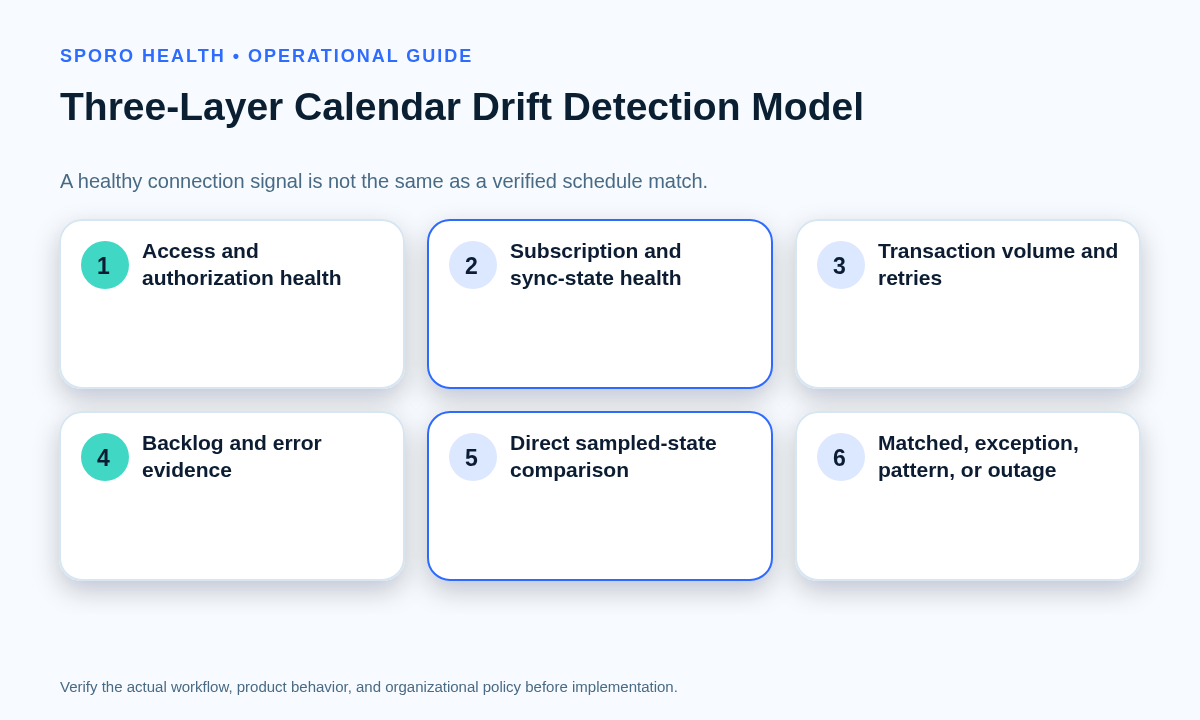
Monitor access and subscription health, transaction and error flow, and direct schedule-state verification as separate layers. A green result in one layer must not automatically make the other two green.
Google states that Calendar push notifications are not completely reliable, carry no specific changed-resource details, and use channels that must be replaced as they approach expiration in its push-notification guidance. Its synchronization guide also documents that an invalid sync token can require a new full synchronization. Microsoft documents missed and subscriptionRemoved lifecycle events and the need to retrieve unobserved changes in its change-notification recovery guidance. The ONC SAFER System Interfaces guide recommends regular monitoring of interface error logs and transaction volume in its interface self-assessment.
| Layer | Signals | Control question |
|---|---|---|
| Access and subscription | Authorization, channel or subscription state, expiration, and sync-token health | Can the integration still observe and access every inventoried pair? |
| Transaction and error flow | Expected volume, retries, backlog, failures, and missing-notification recovery | Are changes moving at the expected volume without unexplained gaps? |
| Direct schedule state | Risk-based comparison results and verified corrections | Do sampled records actually match in both systems? |
If the deployed workflow lacks evidence for these layers, revisit the calendar synchronization evaluation checklist. Microsoft practices should also confirm mailbox, calendar, permission, and subscription ownership through a Microsoft 365 calendar integration preflight.
Which response path applies to a mismatch?
Keep monitoring when samples match, open a bounded exception for one isolated miss, investigate configuration when a pattern repeats, and declare an outage when scope or safe correction cannot be verified.
- Matched sample: record the evidence and continue rotating coverage.
- Isolated exception: assign an owner, preserve identifiers, correct once, and verify both states.
- Recurring pattern: stop repeated manual recreation, inspect mapping and configuration, and expand the sample around the cause class.
- Broad or uncertain failure: control schedule changes, establish an incident owner, and reconcile the affected window.
Use the reschedule and cancellation reconciliation workflow when sampling exposes one bounded transaction. Use the calendar integration outage recovery runbook when failures span multiple pairs or the team cannot prove that a correction is safe.
How should each miss be closed?
Close a mismatch only after it has been detected, classified, assigned, corrected, verified, and reviewed for recurrence. “Changed” is not the same as “closed” unless the expected state is observed in both systems.
- Detect: preserve the sample reason and observation time.
- Classify: identify the pair, change state, affected window, and likely cause class.
- Assign: name one owner and the next required decision.
- Correct: follow the approved edit authority and avoid uncontrolled duplicate creation.
- Verify: re-read both intended states and record who verified them and when.
- Learn: mark recurrence, update coverage, and escalate if the cause remains unresolved.
The miss-to-closure evidence packet should include masked record identifiers, timestamps and time zones, expected and observed states, affected provider-calendar pair, change type, error or transaction evidence, scope checks, actions already attempted, verification result, and the requested next decision. Exclude patient details that are not necessary to investigate the schedule-state mismatch.
Which drift measures are useful?
Use measures that show coverage, outcomes, ownership, closure, recurrence, and near-term exposure. Report denominators and segment results by pair and change state so an overall average does not hide a concentrated failure.
| Measure | Question answered |
|---|---|
| Inventory coverage | What percentage of known provider-calendar pairs has current ownership and monitoring coverage? |
| Sample match rate | What proportion matched, split by create, reschedule, cancellation, block, and recurrence? |
| Open-drift age | How long have verified mismatches remained unresolved? |
| Time to ownership | How quickly did an accountable role accept each miss? |
| Verification completion | What proportion of corrections was rechecked in both systems? |
| Repeated cause classes | Which mappings, pairs, or transitions are failing again? |
| Near-term exposure | How many unresolved mismatches affect the practice’s defined near-term window? |
Do not set a target from an unsegmented match rate alone. A high overall rate can coexist with repeated cancellation drift on one high-risk provider-calendar pair.
How often should calendar drift be checked?
Set the cadence from local schedule volume, operating hours, near-term booking risk, recent configuration changes, and prior failures. There is no universal interval that fits every practice or integration design.
- Increase sampling after onboarding, permission changes, calendar replacement, mapping changes, or recovery work.
- Give near-term schedules and previously failed transitions more frequent coverage.
- Retain periodic coverage for low-volume pairs so silence is not confused with health.
Begin with a documented baseline, measure what the team can complete and verify, and adjust the rotation when recurrence or unresolved exposure shows that current coverage is insufficient.
Put the calendar drift control into practice
The durable answer to how to detect calendar sync drift in athenahealth practices is not a single dashboard light. It is a repeatable control that inventories every pair, samples meaningful risk, separates three monitoring layers, routes each mismatch correctly, and requires evidence before closure.
Teams evaluating integration options can begin with the Sporo Health overview, then review the current athenahealth and Google Calendar product page, the athenahealth and Outlook Calendar product page, and Sporo Health’s athenaConnect Marketplace listing. Treat product-page statements as vendor claims and ask for current monitoring, recovery, and reconciliation evidence against this framework.
Frequently asked questions
How to detect calendar sync drift in athenahealth practices?
Use a complete provider-calendar pair inventory, rotate a risk-based sample, compare both schedule states, classify every miss, assign an owner, and verify the correction. Layer this direct reconciliation over access, subscription, transaction, and error monitoring.
Is a successful API request enough to prove schedules match?
No. It proves that one request received a successful response, not that every intended record reached the correct calendar once and remains in the expected state. Verify the sampled record itself.
Does an empty error log prove there is no drift?
No. A missing, delayed, unobserved, or incorrectly mapped change may not appear as a visible error, so direct record-state sampling remains necessary.
Can reconciliation sampling replace automated monitoring?
No. Sampling tests schedule outcomes, while automated monitoring covers connection, subscription, transaction, and error signals. The controls address different failure modes and should reinforce each other.
What belongs in a vendor-escalation packet?
Include masked record identifiers, timestamps and time zones, expected and observed states, the affected pair, change type, error evidence, scope checks, actions already attempted, and the requested next decision. Keep unnecessary patient details out of the packet.
When does a calendar mismatch become an integration outage?
Treat it as an outage when multiple pairs fail, scope cannot be bounded, change transfer is unreliable, or a safe correction cannot be verified. Move from routine sampling to incident control rather than continuing isolated fixes.
Who should own a provider-calendar sync exception?
Assign one accountable owner for each provider-calendar pair and one backup who can act during operating hours. The owner may be a calendar integration owner, healthcare IT lead, or practice operations designee, but the record must name a role rather than a shared inbox.
Sources
Primary references consulted for the monitoring and reconciliation framework:

2 Comments
Comments are closed.
[…] document ownership. After expansion, transition from bounded acceptance testing to controls that monitor calendar-sync drift after rollout. If Sporo is under consideration, ask its team to walk through the completed matrix with your pilot […]
[…] no technical alert fired, use reconciliation sampling for silent calendar drift. Alert triage and drift detection are complementary controls: one starts with a signal, while the […]