Provider Leave of Absence for athenahealth Practices: A Schedule-and-Access Continuity Checklis
A provider leave of absence checklist for athenahealth practices should keep six controls separate: bookable capacity, future appointments, coverage, account access, external-calendar events, and integration state. Practice managers should assign each control an owner, effective date, evidence requirement, and return action so the absence remains reversible even when the return date changes.
How should practice managers use a provider leave of absence checklist for athenahealth practices?
Use one leave-control record that follows the provider from the last clinic session through tested reopening and stabilization. The record should name the provider, affected departments and locations, leave coordinator, scheduling owner, account administrators, coverage owner, integration owner, approvers, and evidence location.
For each of the six controls, record:
- the approved leave state and effective boundary;
- who executes and who independently verifies it;
- what must remain available during leave;
- the evidence that proves the change occurred;
- the manual fallback if systems disagree; and
- the exact return action and restoration owner.
When does provider leave require more than an out-of-office block?
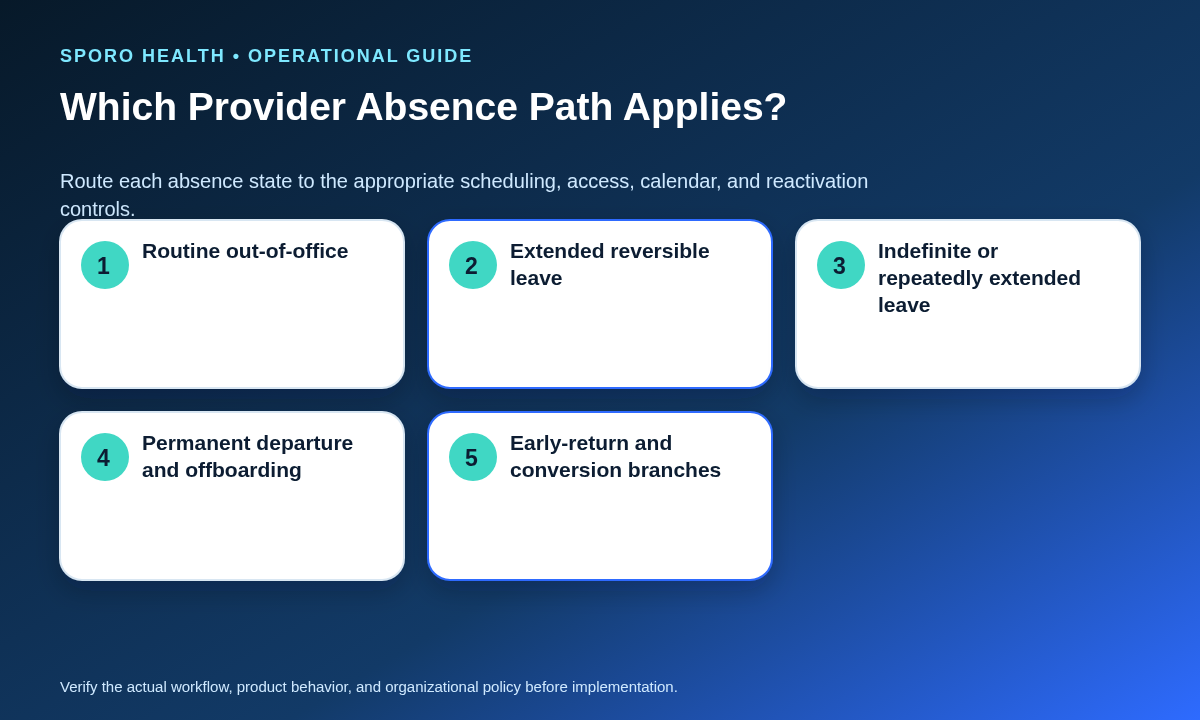
Use the extended-leave path when a returning provider’s absence changes access, ownership, coverage, integration state, or recurring scheduling rules. Do not set an arbitrary day threshold; route the absence according to the lifecycle controls it requires.
| Absence path | Decision signal | Required response |
|---|---|---|
| Routine out-of-office | Return is expected and normal availability controls are sufficient | Close affected capacity, resolve appointments, verify, and reopen through the routine workflow |
| Extended reversible leave | Identity is retained, but access, coverage, events, or integration state changes | Use this checklist with restoration evidence and a reopening gate |
| Indefinite or repeatedly extended leave | Return remains possible but no dependable reopening date exists | Preserve only justified states, tighten review cadence, and maintain a conversion decision |
| Permanent departure | Return is no longer expected | Transfer responsibilities and execute permanent offboarding |
Use the physician out-of-office availability workflow when lifecycle controls do not change. If the provider will not return, move to the provider calendar offboarding checklist.
What are the four clocks of a reversible provider leave?
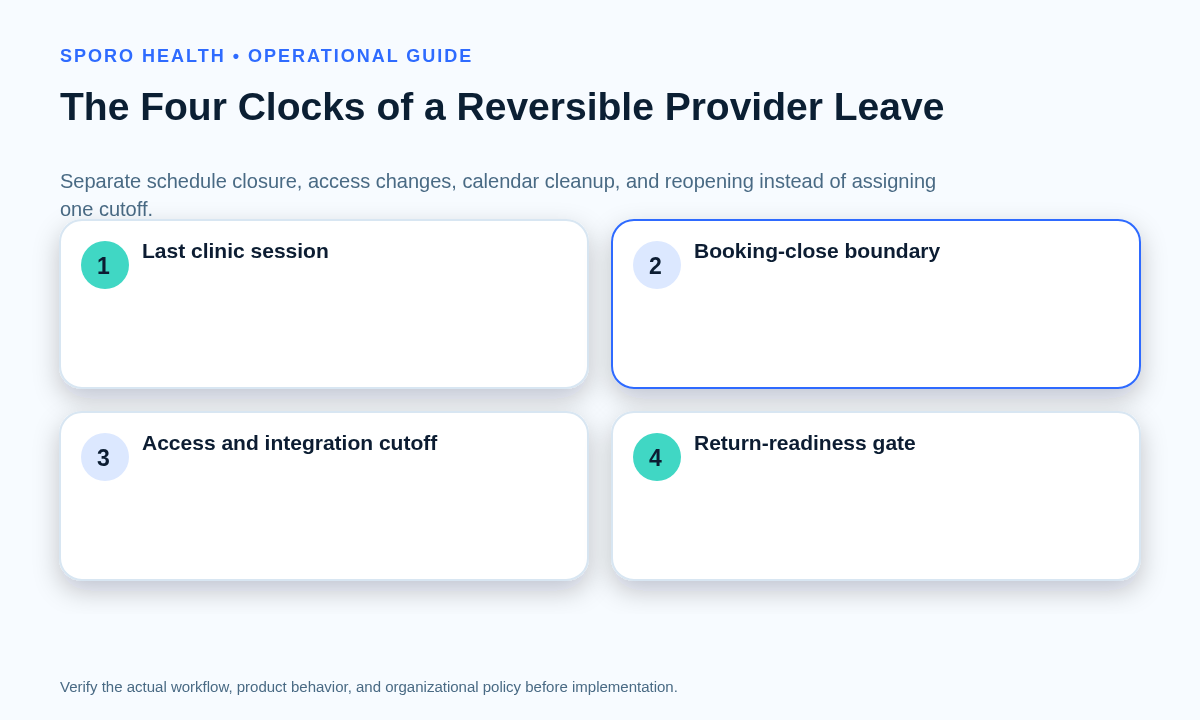
Track the last clinic session, booking-close boundary, access or integration cutoff, and earliest approved reopening as four independent timestamps. Combining them into one cutoff can leave appointments unresolved, terminate access prematurely, or reopen capacity before testing.
| Clock | Control question | Minimum evidence |
|---|---|---|
| Last clinic session | When does the provider’s approved clinical work end? | Final department, location, and session reviewed |
| Booking-close boundary | When must new booking stop for each affected scope? | No capacity is open beyond the approved boundary |
| Access or integration cutoff | When does each account, permission, or connection change? | Approved state and residual-access test recorded |
| Earliest approved reopening | What is the first boundary that may reopen after testing? | Acceptance suite passed for the named scope |
If one clock moves, reassess the others rather than copying the same date across every system.
How should future athenahealth appointments be handled before provider leave?
Inventory every affected appointment and give it one documented disposition, owner, deadline, coverage dependency, and verification result. Search by the full leave horizon and group results by date, department, location, appointment type, and coverage option.
Use current practice procedures and supported athenahealth functions; the athenahealth appointment API reference is a technical reference, not an administrative leave runbook.
| Disposition | Use when | Closure evidence |
|---|---|---|
| Keep | The appointment remains authorized with the same provider | Provider and coverage owner confirm the exception |
| Move to coverage | A named covering provider and valid booking scope are approved | New provider, department, time, and patient workflow verified |
| Reschedule | The patient should remain with the returning provider or move dates | Old state removed and new appointment confirmed |
| Cancel | The approved practice workflow requires cancellation | Cancellation and any required follow-up are complete |
| Hold for decision | Coverage or return information is unresolved | Named owner and deadline prevent an ownerless queue |
Reconcile the inventory total to the completed dispositions before booking closes. Do not treat a blank calendar view as proof that every appointment received an approved outcome.
Which account, permission, event, and integration states should be chosen?
Choose only currently supported states with a documented restoration path; do not default to deleting a reversible provider identity. Retaining an account, restricting access, suspending sign-in, changing permissions, disconnecting an integration, and deleting an identity are separate decisions.
| Layer | Leave decision | Return proof |
|---|---|---|
| athenahealth identity and scope | Retain or restrict only as approved for the provider and administrators | Identity, departments, roles, and schedule scope match the baseline |
| Google Workspace or Microsoft 365 account | Retain, restrict, or suspend using current tenant-supported controls | Authorized sign-in and required services work after restoration |
| Human calendar permissions | Keep, reduce, or remove direct, group, delegated, and administrative paths | Permitted users succeed and prohibited paths fail |
| External-calendar items | Keep, transfer, cancel, release, or reassign according to ownership | Events, attendees, rooms, and recurring boundaries are correct |
| Calendar integration | Keep active, disconnect, or use another vendor-supported state | Mapping and representative schedule changes pass testing |
Google Workspace suspension guidance says suspension blocks the user’s service access without deleting calendar data and blocks new calendar invitations. Microsoft documents sign-in blocking, session sign-out, and email access as distinct administrative controls in its Microsoft 365 access guidance.
Inventory human shares and delegates separately from application access. Microsoft Graph’s calendarPermission resource describes shared and delegated calendar roles, but a complete leave review must also check groups, administrators, applications, devices, and retained sessions. The provider calendar access review workflow provides a fuller topology method.
What happens to provider-organized Google Calendar and Outlook meetings during leave?
Classify calendar items by ownership and downstream effect before changing accounts or events. Personal items, provider-organized meetings, resource reservations, practice-owned blocks, shared-calendar items, and integration-created events should not receive one bulk cleanup action.
For Google Workspace, current event administration guidance warns that suspending or deleting an organizer without managing events can leave meetings and resources difficult to update; it also says suspended-user events remain and only super administrators can modify them. The Google Calendar Events resource exposes identifiers and recurring-instance fields such as event ID, recurring event ID, original start time, status, and transparency. Preserve those boundaries during cleanup.
For Microsoft 365, Remove-CalendarEvents can preview or cancel future meetings organized by a mailbox, including a leave-of-absence date window. Microsoft notes that it does not cancel appointments or meetings without attendees or resources. The Microsoft Graph event resource separately represents organizers, event types, recurrence, series masters, exceptions, and canceled occurrences.
What should happen when the provider return date changes or leave becomes permanent?
Rerun the future-appointment and external-event horizon from the new boundary, then execute the matching exception branch. Do not extend or shorten recurring items blindly.
- Extension: find newly affected appointments, meetings, resources, and availability.
- Early return: preserve closure until the shortened reactivation suite passes.
- Missed leave start: contain new booking and reconcile work created after the planned cutoff.
- Identity change: use the provider email change cutover checklist before remapping accounts or calendars.
- Repeated postponement or indefinite leave: reassess retained access, event ownership, coverage, and review cadence.
- Permanent departure: freeze reversible-leave edits and formally convert the record to offboarding.
What must be tested before reopening provider booking after leave?
Compare the current configuration with the before-leave baseline and reopen only the scope that passes a documented acceptance suite. A restored login alone does not prove scheduling readiness.
- provider identity and expected account identifiers;
- approved departments, locations, and appointment types;
- template start, end, and recurring exception boundaries;
- scheduler, delegate, group, administrator, and application permissions;
- external-calendar ownership and provider-to-calendar mapping;
- representative single and recurring events;
- authorized create, reschedule, and cancel scenarios in both systems; and
- manual fallback, rollback, and evidence capture.
Translate these checks into a calendar sync acceptance-test matrix. The gate should produce go for the tested scope, contain while defects are corrected, or no-go with booking kept closed.
How should the provider’s first day back be stabilized and measured?
Treat the first day back as a controlled stabilization period with a short, owned exception queue. Review stale blocks, missed coverage changes, duplicate or orphaned events, access failures, and booking that appeared outside the approved reopening horizon.
Track unresolved future appointments at cutoff, stale events after cutoff, residual access paths, reactivation-test defects, booking reopened outside scope, and stabilization exceptions. Use the daily schedule reconciliation playbook until each item has an owner, disposition, verification result, and closure time.
How can connected-calendar options fit the leave plan?
Use current vendor documentation to verify supported lifecycle controls instead of assuming a provider-level pause, read-only state, or preserved mapping exists. Begin with the Sporo Health overview, then review the current athenahealth and Google Calendar product page, the athenahealth and Microsoft Outlook product page, and the athenaConnect Marketplace listing for Sporo. Ask for written confirmation of the leave state, event effects, restoration procedure, authorized owner, and tests before changing production.
Frequently asked questions
What is a provider leave of absence checklist for athenahealth practices?
It is a reversible control record that coordinates bookable capacity, future appointments, coverage, access, calendar events, and integration state. Each control receives an owner, effective date, evidence requirement, and return action.
When does provider leave require more than an out-of-office block?
Use extended-leave controls when the absence changes access, calendar ownership, coverage, integration state, or recurring schedules. Routine out-of-office handling is enough when those lifecycle changes are unnecessary.
Should a medical practice suspend or delete provider calendar accounts during leave?
Do not default to deletion when return is expected. Choose a currently supported retain, restrict, suspend, or disconnect state only after documenting event effects, residual access, restoration steps, and the responsible administrator.
How should future athenahealth appointments be handled before provider leave?
Inventory every affected appointment and assign one documented disposition: keep, move to coverage, reschedule, cancel through the approved workflow, or hold for a named decision owner. Verify completion before the cutoff.
What happens to provider-organized Google Calendar and Outlook meetings during leave?
Classify organized meetings separately from personal events, resource reservations, practice blocks, and integration-created items. Google Workspace and Microsoft 365 have different administrative procedures, so test ownership, recurrence, attendees, and resources before changing anything.
Should an athenahealth calendar sync stay active during provider leave?
Only if the vendor-supported state has been tested and matches the practice’s leave policy. Do not assume a provider-level pause or read-only mode exists; record fallback rules and restoration ownership.
What should happen when the provider return date changes or leave becomes permanent?
Rerun the appointment and event horizon from the new boundary. Route extensions, early returns, repeated postponements, identity changes, indefinite leave, and permanent departure through documented branches instead of ad hoc recurring edits.
What must be tested before reopening provider booking after leave?
Verify identity, departments, template boundaries, permissions, calendar mapping, recurring exceptions, and representative create, reschedule, and cancel states. Reopen only the scope that passed testing, then monitor a first-day exception queue.
Sources
- athenahealth appointment API reference
- Google Workspace: Suspend a user temporarily
- Google Workspace: Cancel or transfer events or secondary calendars
- Google Calendar Events API resource
- Microsoft 365: Prevent sign-in and block access
- Microsoft Exchange PowerShell: Remove-CalendarEvents
- Microsoft Graph event resource
- Microsoft Graph calendarPermission resource