
How to Test athenahealth Calendar Sync Before Rollout: A Pilot Acceptance Matrix
Here is how to test athenahealth calendar sync before rollout: select workflow-diverse participants, convert each requirement into a two-system test card, preserve evidence from athenahealth and the connected calendar, classify and retest defects, and make a documented go, extend, pause, or no-go decision. practice managers and healthcare IT and privacy reviewers should judge observed schedule states—not a vendor demo or raw API activity.
How to test athenahealth calendar sync before rollout
Test observable schedule transitions across both connected systems and require evidence for every result. A credible pilot proves where authorized changes begin, where they should appear, how exceptions become visible, and whether staff can contain and recover from failures. The federal SAFER Guides identify configuration, validation, maintenance, and testing of system-to-system APIs as system-management concerns. Use the current athenahealth appointment API reference to confirm the exact states, fields, and identifiers available to the implementation.
Treat each vendor statement as a requirement to verify, not as pilot evidence. A successful request, notification, or log entry is supporting technical evidence; acceptance still depends on whether the expected schedule state is present, correct, visible to the intended role, and recoverable.
Who and what should the pilot cover?
Choose participants for workflow coverage rather than a fixed provider count. A small cohort can be sufficient when it represents the variations the broader rollout must support; a larger but uniform cohort can leave important behavior untested.
| Coverage dimension | Include in the pilot | Reason |
|---|---|---|
| Calendar platform | Google Calendar, Outlook, or both as planned | Separates shared acceptance criteria from platform behavior. |
| Practice structure | Relevant locations, departments, and time zones | Exposes routing and boundary assumptions. |
| Access model | Provider-owned, delegated, shared, and managed calendars in scope | Tests the real authorization path. |
| Schedule pattern | Standard days, recurring blocks, exceptions, and out-of-office periods | Exercises more than simple one-time events. |
| Recovery condition | Reconnect, access removal, missed update, and reconciliation | Proves the workflow can recover safely. |
How do you convert requirements into test cases?
Give every requirement a scenario, expected state in both systems, evidence artifact, owner, defect field, and retest result. Establish the requirements first with a broader calendar-sync evaluation checklist, and define the minimum necessary calendar data before creating visibility and negative tests.
| Requirement | Executable scenario | Expected two-system state | Evidence and disposition |
|---|---|---|---|
| Preserve source-of-truth rules | An authorized user reschedules a pilot appointment in the designated source. | The original slot is released and the new slot appears once in the correct destination. | Before-and-after records, timestamps, owner, defect ID, and retest status. |
| Handle cancellation | Cancel a representative scheduled item through the approved workflow. | The destination no longer presents a stale active commitment. | Both-system capture plus cleanup confirmation. |
| Limit exposed data | Create records containing approved and prohibited test values. | Only approved fields and visibility states reach the external calendar. | Field comparison and reviewer decision. |
| Recover after interruption | Run an approved disconnect, reconnect, or missed-change simulation. | The pilot pair reaches a reconciled state without unexplained duplicates or omissions. | Failure evidence, recovery steps, final comparison, and owner sign-off. |
What belongs on a two-system test card?
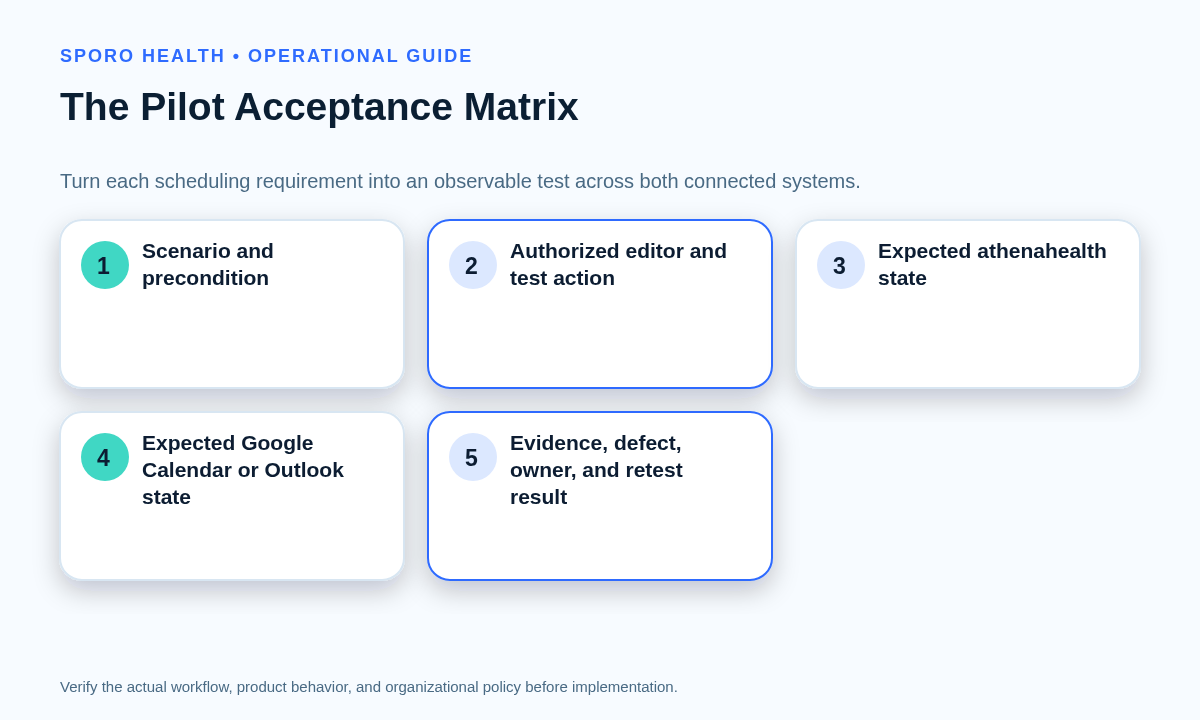
Write the complete test card before anyone performs the action. Record the requirement ID, precondition, test data, authorized editor, action, expected athenahealth state, expected external-calendar state, observation window, evidence location, cleanup step, owner, defect reference, and retest result.
Use one card per meaningful transition, even when several cards belong to the same workflow. The existing front-desk reschedule and cancellation workflow can help pilot owners make test actions resemble controlled daily operations rather than artificial demonstrations.
Which test scenarios belong in the matrix?
Cover normal lifecycle changes, workflow exceptions, access changes, and recovery—not only initial creation. The matrix should contain enough variation to reveal stale, duplicated, missing, misrouted, or incorrectly visible states.
| Scenario group | Representative tests | Evidence target |
|---|---|---|
| Basic lifecycle | Create, update, reschedule, and cancel | Correct time, duration, identity, status, and destination |
| Recurring schedules | Whole series, one occurrence, and future-series change | Correct series scope without unintended exceptions |
| Availability | Out-of-office block, release, and reopening | Bookability and external-calendar state remain aligned |
| Competing edits | Approved changes occur near-simultaneously in both systems | Documented authority rule and visible exception handling |
| Access and identity | Delegation change, revoked access, and reconnect | Expected authorization failure or restored mapping |
| Reliability | Notification gap, time-zone boundary, and recovery reconciliation | Detectable failure, named owner, and reconciled final state |
How should Google Calendar and Outlook tests differ?
Keep the operational acceptance criteria consistent while separating platform-specific implementation tests. Google Calendar and Outlook should face the same schedule outcomes, but permissions, ownership, recurrence, change tracking, and recovery evidence must be recorded independently. Microsoft 365 organizations should prepare Microsoft 365 before an Outlook pilot.
| Control | Google Calendar variation | Outlook variation |
|---|---|---|
| Calendar identity | Confirm calendar ID, owner, and applicable ACL path. | Confirm mailbox, calendar, user identity, and delegated or application path. |
| Recurrence | Distinguish the series from a moved or cancelled instance. | Distinguish series master, occurrence, exception, and cancellation. |
| Change detection | Test incremental synchronization and invalid-token recovery. | Test delta tracking, notifications, and subscription recovery. |
| Reconnect | Verify the intended calendar and event identities remain mapped. | Verify the intended mailbox, calendar, permissions, and tracked range. |
What should Google Calendar test cases add?
Test event identity, recurrence instances, access rules, incremental synchronization, and full-resync recovery. Google documents initial and incremental synchronization with persisted tokens, and an invalid token can require a new full synchronization. Google also documents client-selected event IDs as a way to reduce duplicate creation after an ambiguous create result. Recurring instances expose a parent identifier and original start time that should be included in exception tests. See the official guides for incremental synchronization, API error recovery, event creation and IDs, recurring events, and calendar access-control rules.
What should Outlook test cases add?
Test each mailbox and calendar path, recurring-series exceptions, delta coverage, notification permissions, and subscription recovery. Microsoft states that calendar-view delta tracking is specific to a calendar and date range, while recurring-series APIs return occurrences and exceptions. Its notification guidance distinguishes signed-in-user access from shared or delegated mailbox scenarios and documents lifecycle events for missed or removed subscriptions. Review event delta tracking, recurring event instances, Outlook change notifications, and notification lifecycle recovery.
How should pilot evidence be captured?
Measure expected schedule transitions rather than raw API traffic. Use the required scenario list as the denominator and preserve enough evidence for a reviewer to reconstruct the precondition, action, observed states, defect decision, correction, and retest.
| Scorecard element | What to record |
|---|---|
| Coverage | Required, executed, deferred, and evidence-complete scenarios |
| First-pass result | Passed, failed, blocked, or inconclusive before correction |
| Reproducibility | Whether the finding repeated and under which conditions |
| Correction and retest | Owner, change made, representative rerun, and final result |
| Recovery | Fallback exercised, reconciliation completed, and final state verified |
| Ownership | Operational reviewer, technical owner, and accepted exceptions |
Set required scenarios and decision rules before execution. Do not invent a universal pass percentage: a practice with a launch-blocking source-of-truth defect is not ready merely because many low-risk tests passed.
How should defects be classified and retested?
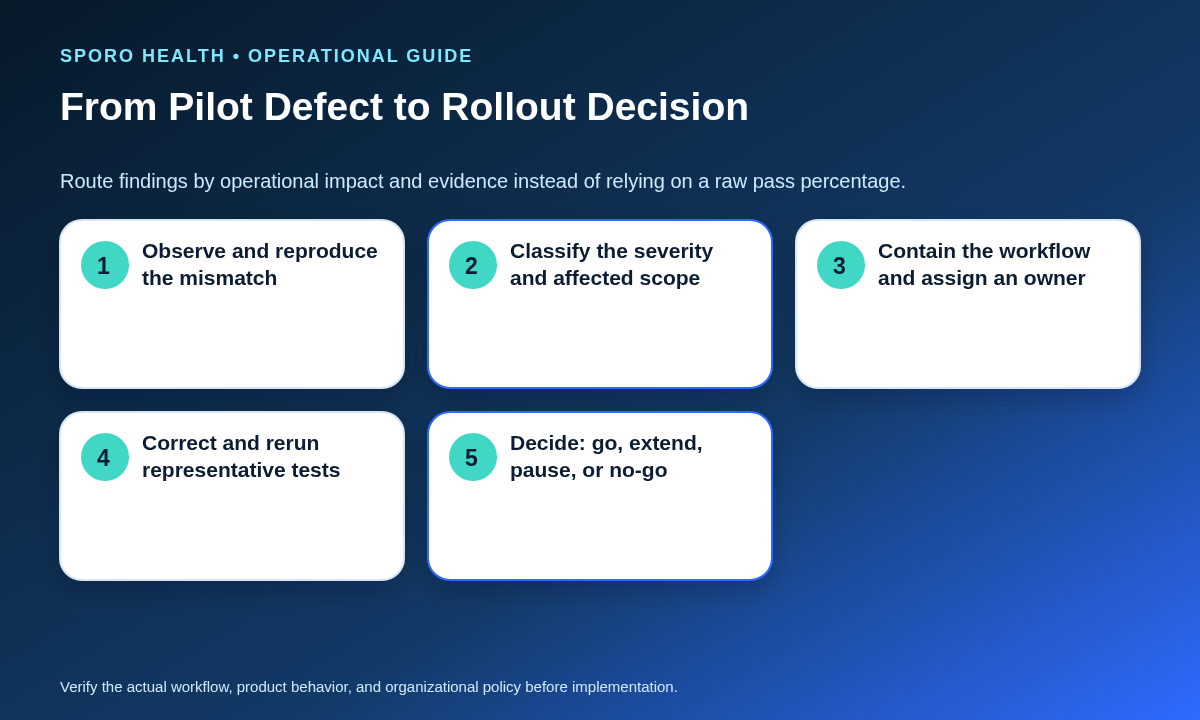
Classify findings by operational impact, affected scope, containment, and recoverability before discussing rollout. Every defect needs an owner and a disposition; every correction that could affect scheduling behavior needs a representative retest.
| Class | Examples | Required disposition |
|---|---|---|
| Launch blocker | Ambiguous authority, unexplained duplicate, missing restriction, unauthorized visibility, or no workable recovery path | Pause expansion, correct, reproduce the fix, and retest affected scenarios. |
| Containable cohort exception | An isolated calendar, access model, or workflow cannot yet be supported safely | Exclude or contain the cohort, assign an owner, and extend testing. |
| Documentation or control gap | The state is correct but evidence, ownership, cleanup, or fallback instructions are incomplete | Complete the control and verify it before approval. |
| Cosmetic finding | A presentation issue with no schedule-state, access, or recovery impact | Record and prioritize without allowing it to hide higher-severity findings. |
When is a physician calendar sync pilot ready to expand?
Approve expansion only when required scenarios have evidence, launch blockers are closed and retested, remaining exceptions are contained, recovery has been exercised, and accountable reviewers accept the result. Once this gate is passed, the next task is to expand a successful pilot in controlled provider waves.
| Gate question | Evidence needed |
|---|---|
| Did the pilot cover the planned operating model? | Coverage map and completed required-scenario denominator |
| Are severe defects closed? | Correction record and successful representative retest |
| Are remaining exceptions controlled? | Affected cohort, containment, owner, and next decision date |
| Can the practice recover? | Exercised fallback and reconciled final-state evidence |
| Who accepts the result? | Named operational, technical, and authorized governance reviewers |
What do go, extend, pause, and no-go mean?
Use four decisions so uncertainty does not get mislabeled as success or failure.
- Go: Begin the approved rollout scope with documented controls.
- Extend: Keep the pilot bounded while gathering missing evidence or retesting a correction.
- Pause: Stop new pilot activity while a blocker or uncontrolled risk is investigated.
- No-go: Reject the current configuration or operating model because acceptance cannot be demonstrated.
What is the end-to-end pilot workflow?
Run the pilot as a traceable control loop rather than a sequence of demonstrations.
- Approve the requirements, source-of-truth rules, data boundaries, and decision authority.
- Select participants and calendar pairs using the coverage map.
- Write and review every two-system test card.
- Capture clean preconditions before executing changes.
- Perform each action through its authorized role and workflow.
- Compare both systems, preserve evidence, and classify findings.
- Correct defects, clean up test records, and rerun representative scenarios.
- Complete the evidence scorecard and record the gate decision.
How do you put the acceptance matrix into practice?
Ask each shortlisted vendor to map its claims to your test cards and let your reviewers observe the resulting schedule states. Buyers evaluating Sporo Health can review the current athenahealth-to-Google Calendar product page, athenahealth-to-Outlook product page, and athenaConnect Marketplace listing, then turn each relevant vendor statement into an observable acceptance test.
This is how to test athenahealth calendar sync before rollout without mistaking activity for acceptance: verify both systems, preserve evidence, close severe defects, exercise recovery, and document ownership. After expansion, transition from bounded acceptance testing to controls that monitor calendar-sync drift after rollout. If Sporo is under consideration, ask its team to walk through the completed matrix with your pilot owners rather than relying on a generic demonstration.
Frequently asked questions
What should an athenahealth calendar sync pilot test?
It should test representative creates, updates, reschedules, cancellations, recurring-series exceptions, competing edits, out-of-office blocks, access changes, reconnects, time-zone boundaries, notification gaps, and recovery reconciliation across both connected systems.
How should pilot participants be selected?
Select participants for workflow coverage rather than a fixed provider count. Include the calendar platforms, locations, access models, recurring patterns, availability rules, and exceptions the broader rollout must support.
What are useful athenahealth calendar integration acceptance criteria?
Useful acceptance criteria specify the expected athenahealth state, expected external-calendar state, evidence artifact, owner, allowed observation window, cleanup step, and retest result for every required scenario.
How should calendar sync pilot results be measured?
Measure executed scenarios against the required scenario denominator, then record first-pass results, defects by severity, reproducibility, completed corrections, retest outcomes, unresolved exceptions, recovery results, and missing evidence.
Can Google Calendar and Outlook use the same pilot matrix?
Yes. Keep the business acceptance criteria consistent, but document platform-specific permissions, ownership, recurrence behavior, change tracking, notification recovery, and reconnect tests separately.
When is a physician calendar sync pilot ready to expand?
It is ready to expand when required scenarios have evidence, launch-blocking defects are closed and retested, remaining exceptions have owners and containment, fallback procedures have been exercised, and operational reviewers accept the result.
Is a high pass percentage enough for rollout approval?
No. A high pass percentage can hide a source-of-truth failure, unauthorized visibility, duplicate creation, or an unrecoverable gap; severity, scope, evidence quality, and containment matter more than one aggregate rate.
Sources
- athenahealth appointment API reference
- Google Calendar incremental synchronization guide
- Google Calendar API error guidance
- Google Calendar event creation guide
- Google Calendar recurring-events guide
- Google Calendar ACL reference
- Microsoft Graph event delta-query guide
- Microsoft Graph recurring event instances
- Microsoft Graph Outlook change notifications
- Microsoft Graph notification lifecycle guidance
- ONC SAFER Guides

2 Comments
Comments are closed.
[…] a course-completion record. Product acceptance should happen first; adapt approved cases from the calendar sync pilot acceptance matrix, then assess each learner’s decisions, execution, verification, escalation, and […]
[…] measurement answer different questions. Confirm controlled transitions and recovery cases through a pilot acceptance matrix for athenahealth calendar sync before interpreting live outcomes. Trace the measures back to the requirements and claims recorded […]