How to Measure an athenahealth Calendar Sync Pilot: An Operational Outcome Scorecard

Practice managers asking how to measure athenahealth calendar sync pilot outcomes should use a predefined, practice-owned scorecard—not one pass rate or a vendor dashboard. Compare a documented baseline with the bounded pilot across implementation coverage, schedule integrity, staff effort, exception recovery, and balancing measures. Normalize results by exposure, annotate contextual changes, and apply decision rules for expand, extend, redesign, or stop.
How to measure athenahealth calendar sync pilot outcomes with one scorecard
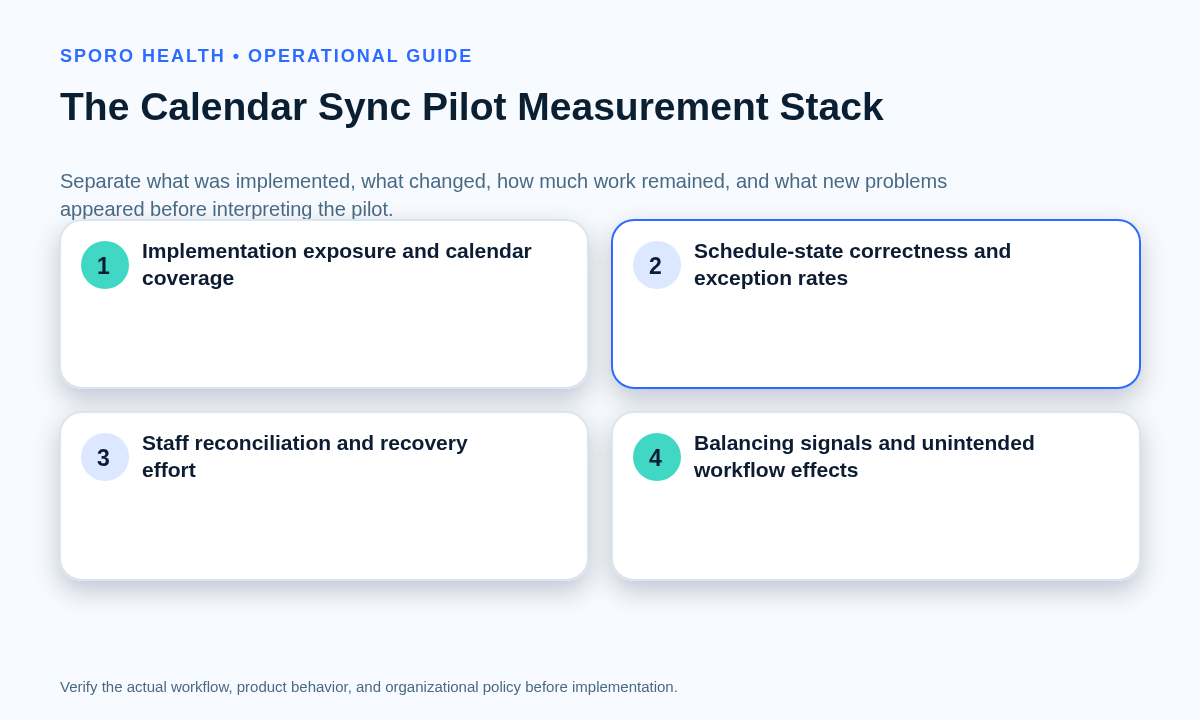
Use a scorecard that separates implementation exposure, schedule-state performance, operational outcomes, and balancing measures. A connection can be active without covering every intended provider-calendar pair, and a functional transition can pass while live staff effort or exception burden remains unfavorable.
Do not collapse those layers into a single success percentage. Improvement guidance commonly distinguishes process, outcome, and balancing measures so a change in one part of a system is not interpreted without checking effects elsewhere, as explained by the Institute for Healthcare Improvement’s measurement guidance.
What evaluation question should the pilot answer?
State the workflow expected to change, the participating provider-calendar pairs, the comparison period, the intended decision, and the required evidence. The CDC Program Evaluation Framework recommends aligning evaluation questions, design, indicators, data sources, expectations, and intended use.
Evaluation-question template: For the named scheduling workflow and exposed provider-calendar pairs, did predefined measures change from the comparable baseline during the pilot, without unacceptable balancing effects, and is the evidence sufficient to expand, extend, redesign, or stop?
Functional acceptance and operational outcome measurement answer different questions. Confirm controlled transitions and recovery cases through a pilot acceptance matrix for athenahealth calendar sync before interpreting live outcomes. Trace the measures back to the requirements and claims recorded during proof-based calendar integration vendor due diligence.
What belongs in the four-layer pilot logic model?
Connect integration exposure to observable schedule states, staff workflow changes, near-term outcomes, and unintended effects without assuming causation. A logic model makes the expected sequence visible while preserving interpretation limits.
| Layer | Question | Example evidence |
|---|---|---|
| Implementation exposure | Who and what actually received the pilot? | Authorized pairs, active provider-days, calendar coverage, and expected transitions |
| Schedule-state performance | Did reviewed states match the defined rule? | Creates, reschedules, cancellations, blocks, recurrence exceptions, and sampled mismatches |
| Operational outcomes | What changed in routine work? | Reconciliation effort, recovery effort, reopened exceptions, and handoff burden |
| Balancing measures | Did new problems appear elsewhere? | False blocks, duplicate work, missed coverage, unresolved outliers, or access findings requiring review |
Movement between layers is a hypothesis to evaluate, not proof that the integration caused every observed change.
How should each pilot metric be defined?
Give every metric a written contract before baseline collection begins. The AHRQ Health IT Evaluation Toolkit emphasizes selecting feasible measures, data sources, and known pitfalls that answer stakeholder questions.
| Contract field | Rule to record |
|---|---|
| Name and purpose | The decision question the metric informs |
| Numerator and denominator | Exact inclusion logic for both values |
| Observation unit | Provider-day, transition, pair, exception, or staffed hour |
| Data source and cadence | Authorized source, extraction method, and collection frequency |
| Owner | Person responsible for collection, quality checks, and sign-off |
| Exclusions and segments | Predefined exclusions plus provider, location, platform, or workflow slices |
| Interpretation rule | Threshold, minimum evidence, uncertainty, and prohibited conclusions |
Confirm implementation-specific appointment fields and transition semantics against the current athenahealth appointment API reference and the practice’s authorized configuration rather than inferring them from a generic label.
| Scorecard measure | Example formula | What it answers |
|---|---|---|
| Implementation coverage | Active exposed provider-days ÷ planned exposed provider-days | Whether the intended pilot was actually delivered |
| Observed mismatch rate | Confirmed mismatched eligible states ÷ reviewed eligible states | How often reviewed schedule evidence disagreed |
| Exception recovery | Due exceptions closed with required evidence ÷ exceptions due | Whether identified problems reached verified closure |
| Reconciliation effort | Sampled minutes by task type ÷ staffed scheduling hours sampled | How much observed work accompanied the pilot |
| Duplicate-work rate | Duplicate actions identified ÷ reviewed transitions | Whether the workflow introduced repeated handling |
| Evidence completeness | Records containing required fields ÷ records expected | Whether the result is sufficiently documented to interpret |
These formulas are starting structures, not universal benchmarks. The practice should set tolerances, minimum sample requirements, and critical-blocker rules before reviewing results.
Which denominators make results comparable?
Normalize each count by the exposure that could reasonably produce it. Raw incidents alone can make a larger or busier pilot appear worse than a smaller pilot even when its rate is lower.
| Denominator | Useful for |
|---|---|
| Exposed provider-days | Coverage, reported conflicts, and near-term exception burden |
| Authorized schedule transitions | Create, update, reschedule, cancel, and block-state performance |
| Provider-calendar pairs | Connection coverage and pair-level outliers |
| Staffed scheduling hours | Verification, investigation, handoff, and recovery effort |
Report the raw count beside the rate, and keep the same denominator definition across the baseline and pilot periods.
How should the baseline and context calendar be built?
Use comparable operating periods and record anything that could materially change the comparison. There is no universal baseline duration; it must contain enough representative schedule cycles and activity for the selected measures.
| Date or range | Context change | Affected cohort | Likely distortion | Analysis handling |
|---|---|---|---|---|
| Defined interval | Holiday, provider leave, or outage | Named pairs or locations | Lower exposure or unusual exceptions | Annotate, segment, or exclude under a predefined rule |
| Defined interval | Template, staffing, or location change | Named workflow | Different workload or transition mix | Analyze separately and assign an owner |
| Defined interval | Training or policy change | Named role or team | Changed reporting or handling behavior | Preserve as a contextual factor |
Match days of week, provider types, locations, and workflow scope where practical. If a comparable pre-pilot period does not exist, document the limitation and use a concurrent comparison only when the practice considers the cohort operationally comparable.
How should pilot data be collected and checked?
Use practice-owned records from multiple sources and reconcile them to a common observation unit. Suitable sources can include authorized schedule records, connection coverage records, exception queues, reconciliation samples, work observations, and the context calendar.
A vendor dashboard can supplement but should not replace practice evidence. The daily athenahealth schedule reconciliation workflow can supply classified exceptions and closure records, while calendar sync drift reconciliation sampling can look for unreported mismatches. AHRQ’s Workflow Assessment for Health IT Toolkit also emphasizes evaluating the administrative workflows changed by health IT.
How can manual reconciliation effort be sampled?
Observe bounded, representative work periods and record task duration, scope, trigger, and outcome. AHRQ describes a time and motion study as a method for capturing task timing and duration.
For each sampled task, record the task type, start and stop points, affected provider-calendar pair, initiating signal, resolution outcome, and whether the work was routine verification, duplicate handling, exception investigation, handoff, or recovery. Apply the same sampling rules in baseline and pilot periods; do not extrapolate sampled minutes into savings without an appropriate design.
Can Google Calendar and Outlook share one scorecard?
They can share operational outcome definitions, but platform-specific diagnostics and exposure records should remain separate. Combine results only after calculating each platform and cohort independently.
| Platform | Shared outcomes | Separate diagnostic evidence |
|---|---|---|
| Google Calendar | Coverage, mismatches, recovery effort, and balancing measures | Calendar identity, event status, transparency, recurrence evidence, and incremental-sync handling |
| Microsoft Outlook | Coverage, mismatches, recovery effort, and balancing measures | Mailbox and calendar scope, show-as state, cancellation state, series evidence, and per-calendar delta tracking |
Depending on the authorized implementation, technical reviewers can consult the current Google Calendar event resource, Microsoft Graph event resource, and Microsoft event delta-query guidance when defining diagnostic evidence. These platform fields do not establish which fields a particular vendor uses.
If Sporo is under review, compare pilot evidence with the vendor’s current athenahealth and Google Calendar product page, athenahealth and Microsoft Outlook product page, and Sporo Health athenaConnect Marketplace listing. Treat these destinations as vendor descriptions to verify, not independent proof.
When should the pilot expand, extend, redesign, or stop?
Combine evidence sufficiency, operational results, balancing measures, cohort differences, and unresolved blockers in one decision grid. A favorable average should not override missing evidence or a material failure in a relevant cohort.
If the evidence supports controlled expansion, use a provider wave-gate rollout plan. Keep that decision separate from the later calendar sync operations acceptance checklist used to transfer a stable service into routine ownership.
| Disposition | Evidence pattern | Required action |
|---|---|---|
| Expand | Sufficient evidence, predefined outcome rules met by relevant segments, acceptable balancing measures, and no unresolved critical blocker | Authorize a bounded next wave with continued measurement |
| Extend | Exposure or sample is insufficient, or contextual disruption prevents a credible comparison | Continue the bounded pilot and close the specified evidence gap |
| Redesign | Evidence identifies a correctable workflow, configuration, coverage, or cohort weakness | Change the defined element and repeat affected tests and measures |
| Stop | Unacceptable balancing effects, repeated critical blockers, withdrawn authorization, or no credible recovery path within practice tolerances | Contain the workflow and document the stop decision and next steps |
Write the disposition rules before results are known. Include minimum exposure, mandatory evidence, critical blockers, balancing-measure limits, segment checks, decision owner, and any conditions attached to expansion.
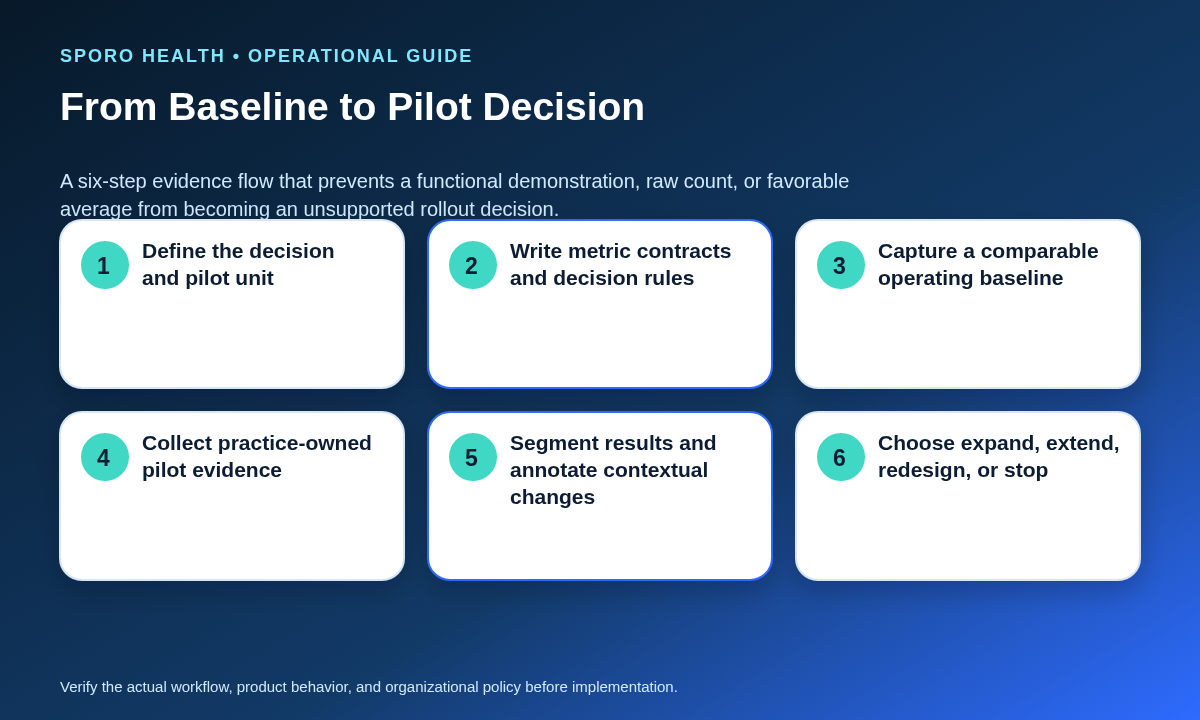
What is the six-step measurement workflow?
Move from a named decision to contracted measures, a comparable baseline, checked evidence, segmented interpretation, and a documented disposition.
- Define the decision, workflow, cohort, and pilot unit.
- Write metric contracts and decision rules.
- Capture a comparable baseline and context calendar.
- Collect practice-owned schedule, exception, and effort evidence.
- Calculate rates, inspect segments, and annotate contextual changes.
- Choose expand, extend, redesign, or stop and record the rationale.
Put the outcome scorecard into use
A useful answer to how to measure athenahealth calendar sync pilot outcomes is not a universal target. It is a reproducible practice-owned method showing what was exposed, what changed, how much work remained, what unintended effects appeared, and whether the evidence is sufficient for the next decision.
Visit Sporo Health to review current scheduling resources or discuss how a bounded product evaluation could be structured. Keep approval authority, metric definitions, data access, and the final disposition with the practice and its authorized reviewers.
Frequently asked questions
How long should an athenahealth calendar sync pilot baseline last?
There is no universal baseline duration. Use enough representative schedule cycles and activity to calculate the selected measures without mixing materially different operating conditions, and document holidays, leave, staffing changes, template edits, and outages that affect comparability.
Is zero reported conflicts enough to call the pilot successful?
No. Zero reports can reflect low reporting, incomplete calendar coverage, or unobserved mismatches, so pair reports with exposure data and authorized reconciliation evidence when feasible.
Can functional acceptance tests replace outcome measurement?
No. Acceptance testing verifies that required transitions work; outcome measurement asks whether live operations changed schedule integrity, workload, and exception patterns.
Should Google Calendar and Outlook results be combined?
Combine shared operational outcome definitions only after calculating platform-specific results separately. Keep calendar coverage, permission paths, event-state evidence, and diagnostic measures distinct.
What denominator should a calendar sync pilot use?
Use the denominator that matches the decision: provider-days for exposure, authorized transitions for state performance, provider-calendar pairs for coverage, and staffed scheduling hours for effort. Report more than one when the pilot question spans multiple layers.
Can this scorecard prove ROI or causality?
No. A bounded before-and-after pilot can support an operational decision, but it does not by itself prove that the integration caused every change or establish ROI; document limits and avoid unsupported extrapolation.
When should an athenahealth calendar sync pilot expand?
Expand only when evidence is sufficient, predefined outcome rules are met across relevant segments, balancing measures remain acceptable, and no unresolved blocker undermines schedule control. Otherwise extend, redesign, or stop.
Sources
- CDC Program Evaluation Framework, 2024
- AHRQ Health IT Evaluation Toolkit
- AHRQ Workflow Assessment for Health IT Toolkit
- AHRQ Time and Motion Study
- IHI guidance on establishing measures
- athenahealth appointment API reference
- Google Calendar Events API reference
- Microsoft Graph event resource
- Microsoft guidance for incremental calendar-event changes