
athenahealth Calendar Integration Vendor Due Diligence: A Proof-Based Buyer Checklist
For practice managers, medical-group buyers, healthcare IT reviewers, and privacy reviewers, an athenahealth calendar integration vendor due diligence checklist should turn every consequential claim into a specific document, witnessed scenario, named owner, and decision rule. Approve a pilot only when the proposed workflow, data boundary, access model, failure recovery, support path, and rollback can be tested within a bounded scope.
What should vendor due diligence prove before a pilot?
Vendor due diligence should determine whether the proposed integration can meet the practice’s approved scheduling requirements, data boundaries, access model, recovery expectations, and ownership rules with evidence strong enough to justify a pilot. Start from the practice’s requirements rather than the vendor’s feature list. A schedule-integrity evaluation checklist can help reviewers define authority, permitted data, event states, conflicts, and rollout boundaries before requesting proof.
Ask the vendor to annotate the current official athenahealth Appointment API reference with the endpoints, fields, permissions, identifiers, and configuration assumptions its proposed workflow uses. A requirement remains open until the evidence reaches the grade established by the buyer and an accountable reviewer accepts it.
How should you grade vendor evidence?
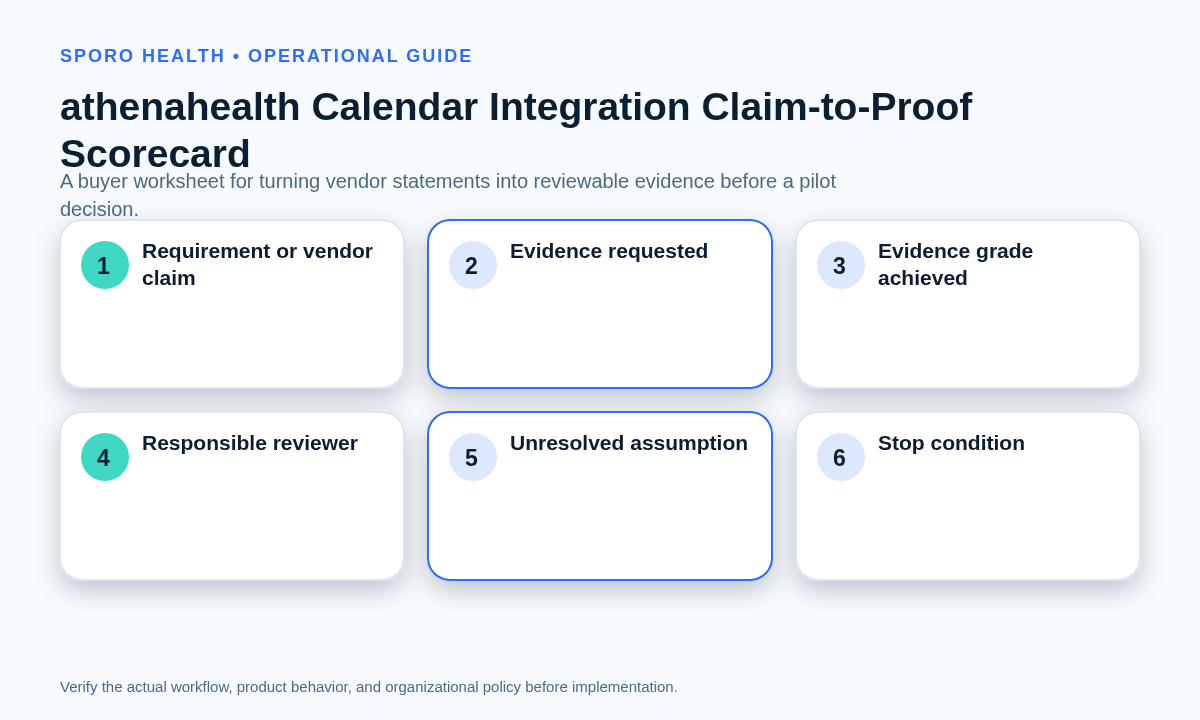
Grade each response as an unsupported assertion, documented claim, witnessed demonstration, or practice-owned pilot result. Consequential requirements need stronger proof than marketing language, and the achieved grade should be recorded separately for every requirement.
| Evidence grade | What it contains | How to use it |
|---|---|---|
| Unsupported assertion | A verbal answer, marketing statement, or unverified slide. | Log it as open; it does not close a consequential requirement. |
| Documented claim | A current diagram, field list, permission specification, contract, runbook, or configuration guide. | Use it for design review after checking its version, scope, and assumptions. |
| Witnessed demonstration | Reviewers observe a scripted scenario and capture the resulting state in both systems. | Use it to decide whether a bounded pilot is testable. |
| Practice-owned pilot result | The practice executes the scenario with approved users, calendars, rules, and evidence capture. | Use it later for rollout decisions; a vendor demonstration cannot supply this grade. |
What evidence should an athenahealth calendar integration vendor provide before a pilot?
Request a current data-flow description, field inventory, permission list, identity model, event-state rules, monitoring and recovery process, support path, lifecycle controls, contractual artifacts, and written configuration assumptions. Privacy and IT reviewers can compare the vendor’s proposed fields with a practice-approved field-level calendar data minimization worksheet.
| Requirement area | Evidence request | Buyer verification |
|---|---|---|
| Workflow states | Rules for creation, updates, reschedules, cancellations, external blocks, recurring exceptions, and competing edits. | Trace each rule to the athenahealth interface used and a witnessed scenario. |
| Data boundaries | Field inventory, transformations, destinations, logs, retention assumptions, and prohibited fields. | Compare the mapping with the approved boundary and run a negative test for excluded data. |
| Permissions and identities | OAuth scopes or Graph permissions, consent model, service identities, provider identities, calendar ownership, and revocation steps. | Compare the request with Google Calendar scope documentation or the Microsoft Graph permissions reference, then witness revocation. |
| Calendar objects | A field-by-field mapping for status, time zone, visibility, availability, identifiers, recurrence, and cancellation. | Compare it with the Google Calendar Event resource or Microsoft Graph event resource and test exceptions. |
| Reliability and recovery | Monitoring, retries, missed-change detection, reconciliation, backlog handling, conflict handling, and restoration criteria. | Interrupt the change path, create controlled changes, restore it, reconcile the backlog, and prove normal scheduling can resume. |
| Support and lifecycle | Severity definitions, escalation path, evidence requirements, provider onboarding, role changes, leave, offboarding, and vendor termination. | Simulate a support case and execute one access-removal or disconnection scenario. |
| Contracts and assumptions | Applicable BAA, data terms, service commitments, subcontractor information, and every practice-side configuration dependency. | Route artifacts to authorized reviewers. HHS guidance pairs applicable BAAs with the organization’s own risk analysis and risk management, rather than treating the agreement as the complete review. |
Do not accept a vague claim that every connected system is the source of truth. Require the vendor to identify which system controls patient appointments, provider availability, competing edits, cancellations, recurring changes, and recovery decisions.
What should the vendor demonstration show?
The demonstration should cover creation, update, reschedule, cancellation, external availability blocks, recurring-event exceptions, competing edits, permission revocation, disconnection, and recovery from missed or delayed changes. Give the script to the vendor in advance, but let buyer representatives choose the records and verify both sides of each result.
| Scenario | Evidence to capture |
|---|---|
| Create | Create an approved test appointment and show the external event, permitted fields, identity, and timestamps. |
| Update and reschedule | Change allowed attributes and time; show that the existing counterpart changes without leaving a stale duplicate. |
| Cancel | Cancel the source record and show the defined counterpart state, audit evidence, and absence of bookable stale capacity. |
| External availability block | Create an approved busy block in Google Calendar or Outlook and show the intended scheduling effect without exposing unnecessary detail. |
| Recurring exception | Change one occurrence and then the series; verify that unaffected occurrences remain correct. |
| Competing edits | Edit both systems before synchronization completes and show the precedence, conflict record, and staff action. |
| Revocation and disconnection | Withdraw permission or disconnect the account; show that access and writes stop and the operational status is clear. |
| Recovery | Delay or miss changes, restore service, find the backlog, reconcile conflicts, and prove the schedule is ready to resume. |
Capture the starting state, action, expected result, observed result, evidence location, reviewer, and unresolved assumption. A polished demonstration proves only what reviewers witnessed under demonstration conditions.
How should Google Calendar and Outlook evidence differ?
Apply the same business requirements to Google Calendar and Outlook, but require separate platform evidence because their calendar objects, authorization models, sharing paths, and change-notification mechanisms are not interchangeable. Outlook buyers can use the Microsoft 365 preflight checklist after the vendor passes this initial screen.
| Control | Google Calendar evidence | Microsoft 365 and Outlook evidence |
|---|---|---|
| Authorization | Exact Calendar API scopes, consent path, account ownership, and why narrower scopes are insufficient. | Delegated or application permissions, admin consent, mailbox scope, and any access-limiting policy. |
| Event behavior | Status, transparency, visibility, recurring-event identifiers, original start time, and event type. | Change key, cancellation state, sensitivity, show-as state, series master, occurrences, and exceptions. |
| Notifications | Watch-channel ownership, expiration and renewal, callback validation, and follow-up retrieval. Google documents push-notification channels separately from event retrieval. | Subscription ownership, expiration, reauthorization, removed subscriptions, missed notifications, and resynchronization. |
| Catch-up recovery | Stored sync tokens, deleted-entry handling, pagination, and response to an invalid token. Google’s incremental synchronization guidance describes a new full sync after certain token failures. | Recovery after a missed or removed subscription, including the separate fetch needed to recover changes. Microsoft documents these change-notification lifecycle events. |
| Revocation | Token, channel, calendar-access, and account-disconnection evidence. | Consent, application access, mailbox or delegation rights, subscription, and account-disconnection evidence. |
Keep one requirement ID, but create separate Google and Microsoft evidence entries. A complete Google demonstration does not prove Outlook behavior, and the reverse is also true.
Who should own each control?
A responsibility matrix should name who configures access, approves data fields, monitors service, reconciles exceptions, handles incidents, reviews permissions, processes provider lifecycle changes, and authorizes rollback. The downstream operations acceptance checklist can later verify whether these responsibilities were transferred into routine operations.
| Control | Accountable practice owner | Required vendor contribution |
|---|---|---|
| Configure access | Healthcare IT administrator | Current permission and identity instructions |
| Approve data fields | Privacy reviewer and operational owner | Field mapping and transformation details |
| Monitor service | Named integration owner | Signals, dashboard definitions, and escalation criteria |
| Reconcile exceptions | Practice manager or scheduling lead | Exception evidence and product-side guidance |
| Handle incidents | IT incident owner with operations lead | Support contact, severity path, and technical investigation |
| Review permissions | IT and privacy reviewers | Current access inventory and change notice |
| Process lifecycle changes | Credentialing, HR, IT, and practice operations | Connection, remapping, revocation, and deletion steps |
| Authorize rollback | Pilot sponsor with IT and operations | Documented disconnection and recovery procedure |
Which red flags should stop or condition the decision?
Stop or condition the decision when a consequential requirement lacks evidence, ownership, a safe test path, or a credible recovery method. Use the calendar integration outage recovery runbook to challenge claims about missed changes, staff fallback, reconciliation, and restoration. A BAA should not be used as a substitute for operational and technical review; HHS cloud guidance expressly discusses an organization’s own risk analysis and ability to seek additional assurances.
| Red flag | Decision response |
|---|---|
| “One source of truth” is asserted without state-by-state authority rules. | Hold until control authority and conflict behavior are documented and demonstrated. |
| Requested access cannot be explained field by field and task by task. | Stop consent until the permission model and affected identities are understood. |
| High-risk scenarios are shown only in slides or a recording. | Require a witnessed demonstration using the agreed script. |
| Monitoring, reconciliation, permission review, or rollback has no owner. | Hold until an accountable practice role accepts each control. |
| The vendor cannot explain how missed changes are found and recovered. | Reject or hold because normal scheduling cannot be proven recoverable. |
| A contract or BAA is presented as complete privacy, security, or operational proof. | Continue the practice’s authorized field, permission, risk, and workflow reviews. |
When should an athenahealth calendar integration vendor move from demonstration to pilot?
The decision gate should produce one of four outcomes: advance to a bounded pilot, advance with named conditions, hold pending consequential evidence, or reject because a critical requirement or ownership boundary remains unresolved. Do not average a critical failure into an otherwise favorable score.
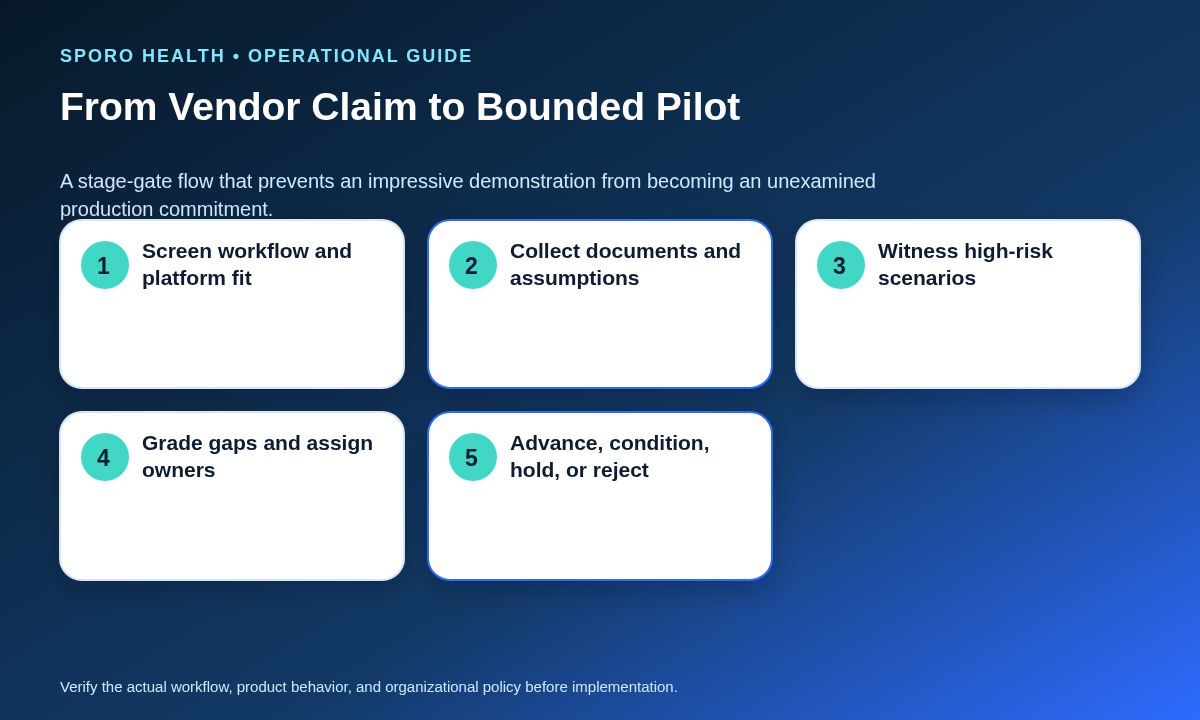
For a vendor that advances, convert accepted requirements into the calendar-sync pilot acceptance matrix. The pilot should define participating providers, calendars, identities, locations, scheduling rules, evidence capture, defect handling, recovery exercises, and rollback authority.
| Outcome | Use it when |
|---|---|
| Advance | Consequential evidence is adequate, critical owners are named, and a bounded, reversible pilot can be executed. |
| Advance with conditions | Remaining gaps are noncritical, have owners and deadlines, and do not require unsafe access or unapproved data. |
| Hold | A consequential document, demonstration, ownership decision, or recovery explanation is still missing. |
| Reject | A critical requirement cannot be met, tested, contained, recovered, or assigned to an accountable owner. |
The unresolved-evidence register should record the requirement, current grade, missing proof, risk, owner, due date, stop condition, and required decision. A live demonstration is not a substitute for a practice-specific pilot using real organizational identities, calendars, rules, permissions, exceptions, and rollback procedures.
How should buyers record the decision?
Record the decision as a signed review packet, not a meeting impression. The completed athenahealth calendar integration vendor due diligence checklist should contain the requirement matrix, evidence grades, demonstration record, platform deltas, responsibility matrix, unresolved-evidence register, conditions, and final outcome.
- Name the decision owner and participating reviewers.
- Define the exact pilot boundary and prohibited expansion.
- Attach approved evidence rather than linking to changeable sales materials alone.
- Record who may pause, disconnect, reconcile, or roll back the pilot.
If Sporo is one of the vendors under review, examine Sporo Health’s current healthcare automation overview, its athenahealth and Google Calendar product page, its athenahealth and Microsoft 365/Outlook product page, and the Sporo Health athenaConnect Marketplace listing. Treat every capability statement as a vendor claim until it earns the evidence grade required by the practice.
Frequently asked questions
These short answers summarize the pre-pilot decision standard. Apply them to each consequential requirement rather than scoring the vendor only at the product level.
What is the purpose of an athenahealth calendar integration vendor due diligence checklist?
It determines whether a vendor has produced enough evidence to justify a bounded pilot, not whether its sales presentation was persuasive. The checklist should connect requirements to proof, owners, gaps, and a recorded decision.
What evidence should a vendor provide before a pilot?
Request a current data-flow description, field inventory, permission list, identity model, event-state rules, monitoring and recovery process, support path, lifecycle controls, contractual artifacts, and written configuration assumptions.
How should an athenahealth calendar integration demo be scored?
Score each response as an unsupported assertion, documented claim, witnessed demonstration, or practice-owned pilot result. Require stronger evidence for requirements that affect schedule integrity, data exposure, access, recovery, or rollback.
Does a BAA make a calendar integration vendor ready for a pilot?
No. A BAA is an important contractual artifact when applicable, but it does not replace field-level data review, permission analysis, operational testing, risk analysis, or the practice’s own privacy and security review.
Can Google Calendar and Outlook use the same due diligence checklist?
They can share one requirement framework, but each platform needs separate evidence for permissions, calendar ownership, event behavior, notifications, sharing paths, revocation, and recovery.
When should a vendor move from demonstration to pilot?
Move to a bounded pilot only when consequential requirements have adequate evidence, critical owners are named, the pilot scope is approved, and rollback and recovery can be exercised without relying on unresolved assumptions.
What outcomes should the pre-pilot decision gate produce?
The gate should record one of four outcomes: advance to a bounded pilot, advance with named conditions, hold pending consequential evidence, or reject because a critical requirement or ownership boundary remains unresolved.
Sources
- athenahealth Appointment API reference
- Google Calendar API authorization scopes
- Google Calendar Event resource
- Google Calendar incremental synchronization
- Google Calendar push notifications
- Microsoft Graph permissions reference
- Microsoft Graph event resource
- Microsoft Graph notification lifecycle guidance
- HHS guidance on HIPAA and cloud computing

One comment
Comments are closed.
[…] the original requirements and evidence grades from the pre-pilot vendor due diligence checklist. Then assign a decision owner and named operations, IT, purchasing, and authorized privacy […]