How to Standardize Provider Schedule Templates Across athenahealth Locations
For growing medical-group leaders asking how to standardize provider schedule templates across athenahealth locations, the practical answer is to standardize reusable rules, not identical provider calendars. Define a versioned enterprise core, preserve justified specialty and location overlays, approve time-bounded provider exceptions, migrate in controlled waves, protect existing appointments separately, and measure approved variance apart from undocumented drift.
How do you standardize provider schedule templates across athenahealth locations?
Build one controlled template system with shared rules, documented overlays, approved exceptions, and version-specific verification. The target is not one universal weekly schedule. It is a governed portfolio in which every active template has a known lineage, scope, owner, rationale, effective interval, and approval state.
athenahealth’s public service description says Schedule Builder can create, copy, edit, and apply templates with appointment types, times, frequencies, date ranges, provider groups, departments, and individual-provider scope. Those capabilities enable configuration, but the medical group must define the governance around them. See the current athenaOne Service Description.
What belongs in the governance baseline?
The baseline should define each template’s scheduling logic, organizational scope, authority, version, and evidence. At minimum, record the template name, appointment-type definitions, slot pattern, recurrence, effective dates, provider and department scope, booking restrictions, exception rules, owner, approver, status, current version, and last verification date.
Use a stable identifier rather than relying on a display name alone. A change record should connect the prior version to the approved replacement, explain what changed, identify affected capacity, and preserve the test result. Copying a template may save configuration effort, but it does not supply these controls.
What is the four-layer provider template architecture?
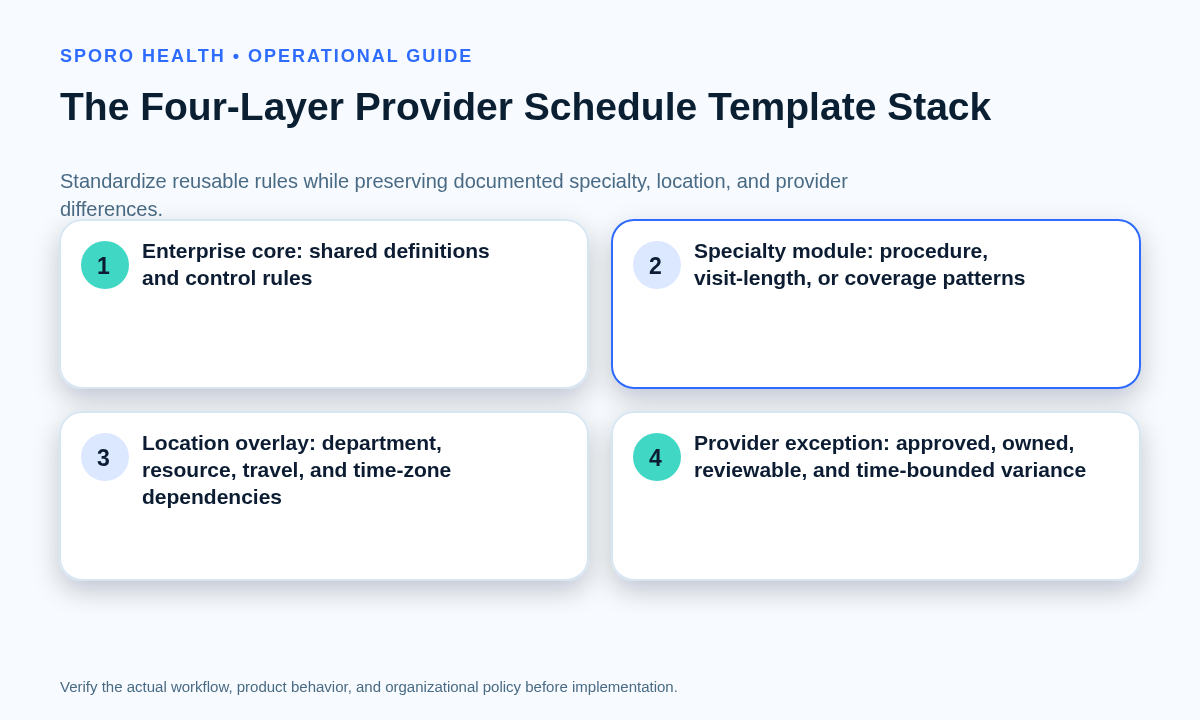
Use an enterprise core, specialty modules, location overlays, and time-bounded provider exceptions. Apply a rule at the broadest layer where it remains operationally correct.
- Enterprise core: shared terminology, appointment-type rules, version conventions, approval states, effective-date controls, and verification requirements.
- Specialty module: justified visit-length, procedure, coverage, resource, or session patterns used by a defined specialty cohort.
- Location overlay: department hours, resources, travel, time-zone, or site dependencies that change usable capacity.
- Provider exception: a narrowly scoped difference with an owner, rationale, approval, start, expiration or review trigger, and verification evidence.
For a concrete specialty-module example, see the recurring procedure-block workflow. When locations cross clock boundaries, apply the cross-time-zone scheduling standard to the location overlay.
How should standardize-or-localize decisions be made?
Classify each difference by its operational cause, reach, capacity effect, and supportability. Ask whether a real dependency exists, how many providers and sites it affects, whether patients see different capacity, and whether the group can test and maintain the rule consistently.
| Observed difference | Disposition | Required evidence |
|---|---|---|
| Common naming or booking rule | Required standard | Enterprise owner and shared acceptance test |
| Repeatable specialty or site dependency | Approved adaptation | Cohort scope, rationale, and module test |
| Temporary provider-specific need | Bounded exception | Owner, dates, approval, and expiration |
| Promising but unproven pattern | Pilot candidate | Limited cohort and decision criteria |
| Unused or duplicated historical rule | Obsolete rule | Future-booking check and retirement approval |
| Difference with no reliable explanation | Unresolved escalation | Containment and accountable reviewer |
For one-provider decisions within this portfolio model, use the guide to choosing a template change versus a bounded exception.
How do you inventory legacy templates before standardizing?
Inventory every active template before selecting a standard or retiring a variation. Record its provider, department, location, appointment patterns, date range, future-booking exposure, local dependencies, exceptions, owner, maintenance status, and apparent parent or copied source.
Compare actual active rules rather than names alone. Two similarly named templates may produce different capacity, while differently named templates may be operationally equivalent. Mark records as confirmed, incomplete, duplicated, orphaned, or no longer used; unresolved records should not enter an automated migration wave.
What belongs in a versioned template migration packet?
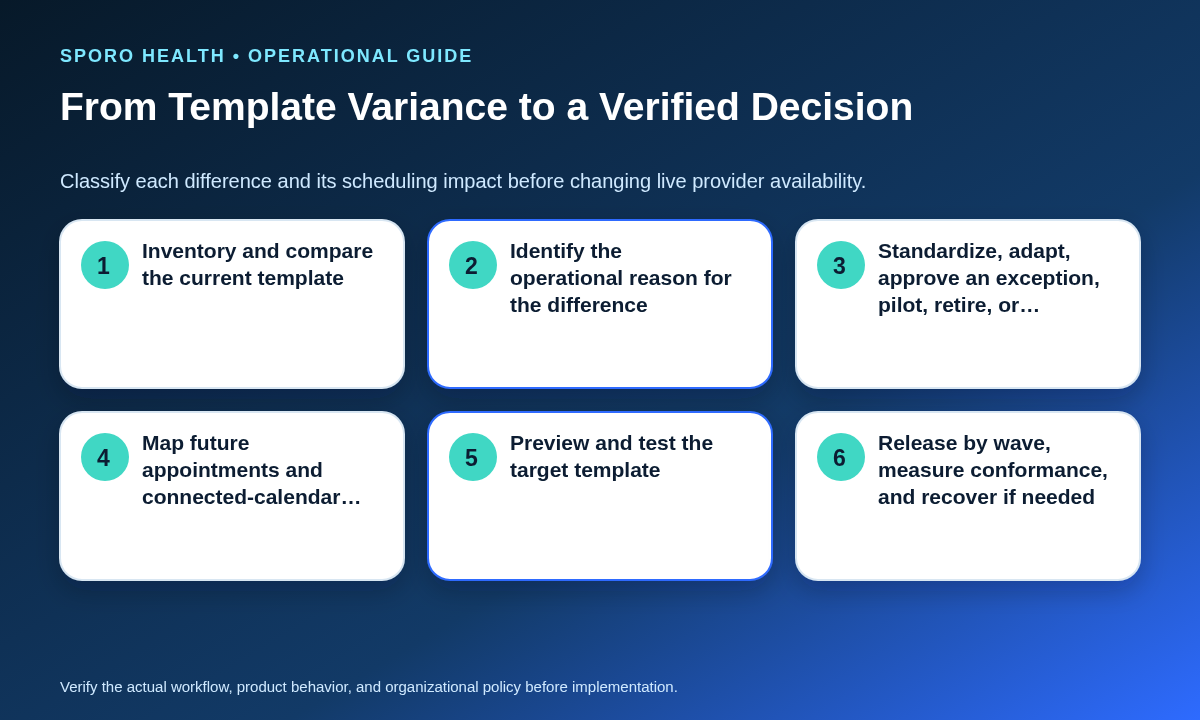
The packet should connect template lineage, affected scope, appointment exposure, acceptance evidence, release waves, and rollback conditions. Do not replace live templates in bulk merely because the target configuration appears cleaner.
- Source template, target standard, version, and approved change rationale
- Affected providers, departments, locations, and effective date range
- Future appointments and connected-calendar events inside the exposure window
- Representative acceptance scenarios, expected results, and evidence owner
- Wave membership, release authority, observation period, and reconciliation owner
- Last reversible state, rollback trigger, and recovery verification
Group providers with similar dependencies, preview the target state, test representative scenarios, and release one bounded wave. The same discipline should extend to a new-location scheduling go-live checklist.
How should existing appointments be preserved?
Treat booked appointments as a separate migration workstream because changing future availability does not resolve existing visits. Assign an owner to find appointments that collide with the target template, use unsupported appointment types, reference the wrong location, or depend on a rule being retired.
For every exposed appointment, document whether it remains valid, needs operational review, requires an authorized change, or blocks the wave. Do not assume a clean template preview proves that booked patient visits are safe.
How should Google Calendar and Outlook affect the standard?
External calendars should create governed availability inputs, not silently rewrite the approved athenahealth template. A recurring event may justify an exception, but its scope, recurrence, time zone, ownership, and effect on existing appointments still need practice-defined rules.
Google represents recurring events through a parent series and instances, including modified or canceled exceptions; it also uses an event time zone to expand recurrence. Microsoft Graph distinguishes series masters, occurrences, exceptions, and canceled occurrences, with availability states such as free, tentative, busy, and out of office. These models support explicit testing of one occurrence, an entire series, and boundary dates rather than treating every recurring item as equivalent. See Google’s Events resource and recurring-events guide, plus Microsoft’s event resource documentation.
Who should approve and apply template changes?
Separate standard ownership, approval, execution, exception ownership, and verification. A practice operations executive may own the portfolio; specialty or location leaders may approve justified modules; an athenahealth scheduling administrator may apply the change; and a different named reviewer should verify the resulting capacity and exposed appointments.
Booking authority is a separate decision from template authority. Document whether routine appointment control is central, local, or hybrid using the guide to centralized, local, and hybrid scheduling authority.
How do you distinguish approved variance from drift?
Put every sanctioned difference in a variance register and treat an unexplained difference as drift. Each register entry needs a template and layer, owner, rationale, provider and department scope, approval, start date, expiration or review trigger, and verification evidence.
| Control | What to measure |
|---|---|
| Current-version coverage | Active templates verified on the approved version |
| Unapproved variance | Differences without a valid register entry |
| Expired exceptions | Exceptions still active after expiration or review |
| Failed applications | Targets that do not match the released version |
| Future-booking collisions | Booked visits requiring intervention after release |
| Repeat reconciliation | Exceptions reopened after prior verification |
Set thresholds from the group’s baseline and risk tolerance rather than adopting an arbitrary universal target. Routine daily athenahealth schedule reconciliation can surface live exceptions that should feed this scorecard.
When should a migration wave pause?
Pause when the target state is unexplained, unsafe to release, or not recoverable through the approved plan. Stop the wave if capacity changes unexpectedly, booked appointments are affected outside the preservation plan, a required specialty or location dependency is missing, external calendars materially disagree, acceptance evidence is incomplete, or rollback cannot restore the defined prior state.
A pause is a control decision, not a failed project. Contain the affected scope, preserve evidence, assign the unresolved question, and resume only after correction and retesting.
How should the standard be implemented?
Implement the standard as a repeatable governance cycle rather than a one-time cleanup.
- Approve the enterprise core and version convention.
- Inventory and compare active templates.
- Classify each difference with the decision matrix.
- Create specialty modules, location overlays, and exception records.
- Build and test the migration packet.
- Release bounded waves and preserve existing appointments.
- Review the variance register and conformance scorecard.
A durable answer to how to standardize provider schedule templates across athenahealth locations is therefore controlled reuse with visible, justified variance. If connected-calendar visibility is part of the operating model, review Sporo Health, the current athenahealth and Google Calendar product page, the athenahealth and Microsoft Outlook product page, and the Sporo Health athenaConnect Marketplace listing. Treat product statements as vendor claims and validate the required behavior with a bounded demonstration and acceptance test.
Frequently asked questions
What belongs in provider schedule template governance for a medical group?
Governance should define the reusable rule, its scope, owner, version, effective dates, approval state, and permitted variance. It should also record appointment types, slot patterns, recurrence, booking restrictions, test evidence, and the process for reviewing or retiring the template.
When should athenahealth schedule templates vary by location or specialty?
Templates should vary when a documented operational dependency cannot be handled by the enterprise core. Examples include specialty visit patterns, required resources, location hours, travel, time zones, coverage duties, or other differences the group can consistently test and support.
How do you inventory legacy provider schedule templates before standardization?
Create one record for every active template before deciding what to retain. Capture its provider and department scope, appointment patterns, effective dates, future bookings, local dependencies, known exceptions, owner, maintenance status, and likely source template.
How do you migrate provider schedules without disrupting future appointments?
Use controlled waves with a separate future-appointment preservation plan. Map the affected interval, preview the target state, test representative providers and locations, assign collision resolution, define a rollback point, and release only after acceptance evidence is complete.
How should recurring Google Calendar or Outlook events affect standardized provider schedules?
Recurring external-calendar events should follow the practice’s documented schedule-authority rules. An approved event may create an availability exception, but it should not silently change the versioned athenahealth template or become an undocumented substitute for template governance.
Do providers need identical schedules to be standardized?
No, providers do not need identical schedules. Standardization means consistent definitions, ownership, versioning, approval, testing, and review while preserving justified differences required by specialty, location, resources, coverage, travel, or provider responsibilities.
Does copying an existing athenahealth template establish governance?
No, copying a template only accelerates configuration. The copy still needs a named standard, defined scope, owner, version, approved variations, acceptance evidence, and review process; it should not become the default merely because another department already uses it.
Sources