Canceled Provider Clinic Session in athenahealth: A Full-Schedule Recovery Playbook
To answer how to reschedule a canceled provider clinic session in athenahealth, front-desk leaders should freeze new booking, appoint one recovery owner, capture a fixed census, and reserve valid replacement capacity before outreach. The session closes only after every appointment has a verified disposition, communication record, reconciled calendar state, and accountable owner for any unresolved exception.
How do you reschedule a canceled provider clinic session in athenahealth?
Treat the canceled session as one controlled incident, not as a collection of unrelated appointment edits. Define the affected provider, location, interval, booking surfaces, and original appointment count. Then move each booking through a common ledger until it is retained with approved coverage, moved to verified capacity, returned to a managed queue, or escalated because no valid destination exists.
This is an operating playbook rather than a claim that every athenahealth configuration has identical screens or bulk controls. Public athenahealth documentation identifies appointment cancellation, rescheduling, scheduling, and update event topics, but practices should verify the current user-interface steps and permissions in their own environment. See the athenahealth event-notification topic documentation.
What should staff do first when the entire session is canceled?
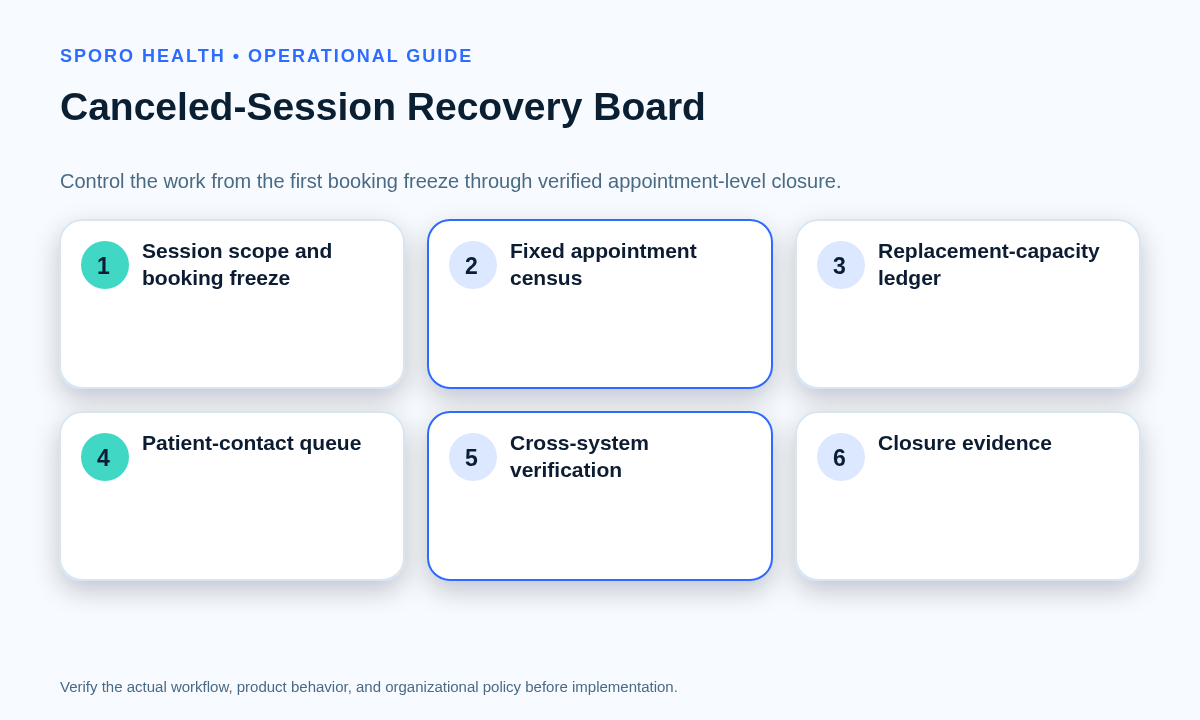
Stop new booking into the affected interval, appoint one recovery owner, and preserve the original schedule before anyone starts editing. The control record should identify the provider, department or location, session start and end, cancellation decision time, effective booking freeze, affected booking channels, recovery owner, verifier, and original appointment count.
- Save or export the original appointment list under local policy.
- Record appointments already checked in, in progress, canceled, or recently moved.
- Define who may approve coverage, destination capacity, schedule edits, and closure.
- Route all work through the control record rather than separate personal lists.
If the cancellation follows an approved absence, connect this response to the physician out-of-office availability-control workflow. If the provider may still complete some visits, first apply the decision rules for same-day recovery when a provider is running late rather than prematurely declaring the full session canceled.
How do you make sure every affected appointment is accounted for?
Create a fixed appointment census and require every row to reach one final disposition. Do not rely on a changing schedule view as the incident list, because appointments may disappear from that view as staff cancel or move them.
| Census field | Purpose |
|---|---|
| Appointment identifier and original time | Preserves the starting population and prevents double counting. |
| Provider, department, location, type, and duration | Defines destination-fit requirements. |
| Current state and proposed destination | Shows whether the booking is untouched, held, moved, queued, or exceptional. |
| Contact status and next action | Keeps outreach aligned with the schedule decision. |
| Editor, verifier, and timestamps | Separates action from confirmation and supports handoffs. |
| Final disposition | Balances the resolved cohort against the original count. |
The athenahealth patient-appointment documentation exposes operationally relevant fields including appointment date, start time, duration, provider, department, cancellation date, and the identifier of a replacement appointment after rescheduling. These fields support record-level reconciliation, but local staff should use only approved interfaces and reports.
Should staff cancel appointments before replacement capacity is reserved?
Reserve and validate replacement capacity before promising a destination or routinely canceling the original booking. A proposed slot is not usable merely because its time appears open. The capacity ledger should validate the provider, location, appointment type, duration, visit mode, required resources, coverage authority, and patient-specific eligibility rule approved by the practice.
Give each proposed slot a state such as available, temporarily held, claimed, released, or invalidated. Record the census appointment that claimed it. This prevents two schedulers from offering the same time and makes capacity loss visible before another patient is contacted.
How should covering-provider, new-date, cross-location, and no-destination cases differ?
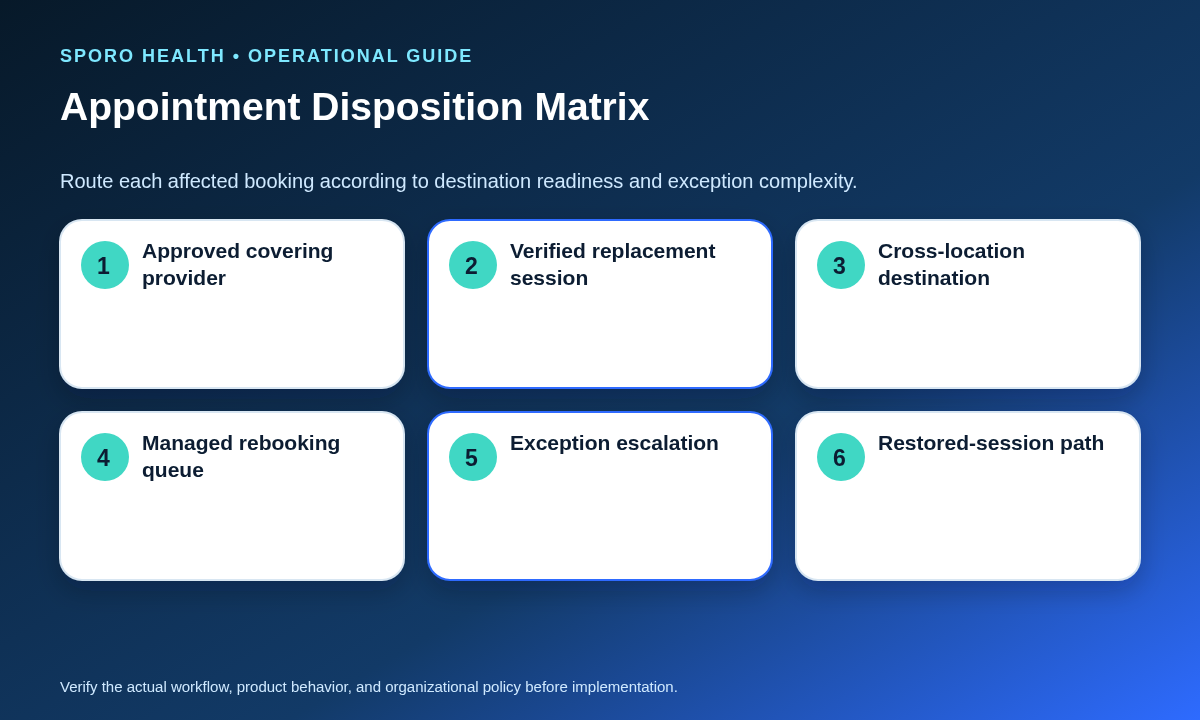
Choose the disposition from destination readiness and exception complexity, not from whichever option is quickest to enter. Apply one of the following paths to every census row.
| Disposition | Required gate | Closure evidence |
|---|---|---|
| Retain with covering provider | Coverage and appointment eligibility are approved. | Provider, time, location, communication, and calendar state verified. |
| Move to a new date | A matching slot is reserved and claimed. | Replacement exists and the original has the intended final state. |
| Move to another location | Destination authority, type, duration, resources, and patient instructions are valid. | No active source-location residue remains. |
| Managed rebooking queue | No immediate valid slot exists, but ownership and follow-up rules are defined. | Queue owner, priority rule, next action, and deadline are accepted. |
| Exception escalation | Eligibility, urgency, resource fit, or operational authority is uncertain. | An authorized owner accepts the case and decision deadline. |
| Restored session | The provider session is formally reinstated before conflicting changes proceed. | Original bookings and booking exposure are reverified. |
For moves between active sites, use the cross-location appointment destination-verification workflow to test the destination and remove source residue.
When is it safe to move multiple appointments as one batch?
Use a batch only when every selected appointment shares one verified destination rule and no appointment requires individual judgment. Stage the selection, review the proposed result, execute through an approved interface, and verify every census row afterward; a completed command is not appointment-level proof of success.
The routine batch path should exclude appointments with recurring-series scope, linked rooms or equipment, telehealth dependencies, cross-location movement, active check-in or visit state, uncertain appointment-type fit, competing edits, or patient-specific escalation. Google distinguishes recurring parents, instances, and exceptions through fields such as recurringEventId and originalStartTime; Microsoft similarly distinguishes series masters, occurrences, and exceptions. Microsoft also documents that some occurrence moves can be rejected when they cross neighboring recurrence boundaries. Review the Google recurring-events guide and Microsoft event-update documentation.
How should patient outreach be controlled?
Use one authoritative contact queue derived from the appointment census and approved disposition plan. Each entry should show the current offer, permitted alternatives, contact attempts, response deadline, next action, and staff owner. Update the schedule and queue together so one employee does not offer a slot another employee has already claimed.
Use practice-approved communication channels and sequencing. Scheduling staff should not infer clinical urgency, decide whether a patient can see a different clinician, or determine whether a different visit mode is appropriate. Route uncertain priority or eligibility to the authorized clinical or operational owner.
How should each appointment change be executed?
Claim the verified destination, confirm the intended change scope, apply the approved transaction, and have a named verifier compare the result with the census. Preserve appointment identity and timestamps where available, record whether the original was moved or canceled and rebooked, and do not close the row merely because the replacement appears.
- Reconfirm the destination is still reserved for this appointment.
- Check for a competing edit or changed patient response.
- Apply the smallest authorized appointment change.
- Verify the replacement provider, location, time, duration, type, and dependencies.
- Confirm the original appointment has the intended state.
- Update the census, capacity ledger, and contact queue.
Use the transaction-level athenahealth reschedule and cancellation workflow for the detailed execution and verification of each individual change.
How should Google Calendar or Outlook be checked after a full-session reschedule?
Compare the original and replacement event identities rather than checking only whether the provider’s day looks approximately correct. For each appointment, compare provider, location, original time, replacement time, duration, cancellation state, and recurring-instance identity across the approved systems.
Google Calendar documents confirmed, tentative, and canceled event states and notes that canceled recurring exceptions may retain only limited identity fields. Its event resource also separates the event ID, recurring parent ID, and original instance start. See the Google Calendar Events reference.
Microsoft’s event resource includes fields such as isCancelled, seriesMasterId, originalStart, event type, and canceled occurrences. Outlook event IDs may also change when an item moves between containers unless immutable identifiers are requested by the application. See the Microsoft Graph event resource.
Flag duplicate replacements, stale canceled-session events, missing replacements, wrong-provider events, wrong-location events, and orphaned recurring instances. Do not recreate an uncertain event until its identity and authoritative appointment state are established.
What should happen when recovery work fails or conditions change?
Contain the affected appointment, preserve its evidence, and return it to a controlled state with a named owner. Use these recovery branches:
- Competing edit: stop, reload the current state, and decide which approved instruction remains valid.
- Session restored: freeze further moves and reconcile already changed appointments before reopening capacity.
- Patient not reached: retain the approved queue state and follow the practice’s contact policy.
- Destination lost: release the invalid claim and select another verified capacity path.
- Stale calendar event: preserve identifiers, establish the authoritative appointment state, then correct the residue.
- No owner: escalate immediately; an unowned appointment cannot count as controlled.
What evidence proves that canceled-session recovery is complete?
Close the incident only when the fixed census balances and every appointment has either a verified final disposition or an accepted exception owner and deadline. Confirm that patient communication is recorded, replacement bookings are valid, capacity claims match bookings, source-session residue is cleared, and cross-system findings are resolved or explicitly assigned.
| Measure | Definition |
|---|---|
| Census completeness | Original appointment count compared with all final and accepted-exception rows. |
| Final-disposition rate | Verified final dispositions divided by the fixed census. |
| Unresolved backlog | Appointments still awaiting a valid destination or authorized decision. |
| Time to verified replacement | Elapsed time from session declaration to confirmed destination, reported with context. |
| Recontact count | Additional patient contacts caused by changed or invalidated offers. |
| Integrity findings | Duplicate, orphaned, stale, wrong-provider, or wrong-location records found during verification. |
Do not use raw speed as the sole success measure. A fast closure that omits appointments or leaves invalid calendar state is not complete. Any residual case should enter the daily schedule exception queue and handoff playbook with an accepted owner, deadline, evidence, and next action.
Where do connected-calendar options fit?
Connected-calendar tooling can support visibility and reconciliation, but it does not replace the practice’s capacity, outreach, exception, or clinical-authority rules. Practices evaluating this layer can review Sporo Health scheduling resources, the athenahealth and Google Calendar product page, the athenahealth and Microsoft Outlook product page, and the Sporo Health athenaConnect Marketplace listing.
Use those destinations to frame questions about current scope, configuration, evidence, and fit. Confirm product behavior in a demonstration and in practice-owned acceptance tests before relying on it during a canceled-session incident.
Frequently asked questions
How to reschedule a canceled provider clinic session in athenahealth?
Freeze new booking into the session, name one recovery owner, create a fixed appointment census, reserve valid replacement capacity, then give every appointment a verified final disposition.
Should staff cancel the original appointments before replacement slots are reserved?
Usually no. Preserve the original schedule state until a valid destination or managed queue disposition is approved, unless an authorized owner directs immediate cancellation for a specific reason.
When is it safe to move multiple appointments as one batch?
Use a batch only when every selected appointment follows the same verified destination rule and none has recurrence, location, resource, telehealth, active-visit, or other exception complexity.
Who decides whether an appointment can move to another provider or location?
The practice-designated clinical or operational authority decides eligibility; scheduling staff apply the approved rule and escalate uncertainty rather than making clinical-priority decisions.
How should Google Calendar or Outlook be checked after the session is rescheduled?
Compare each original and replacement event by provider, location, start, end, status, and recurring-instance identity, then clear stale, duplicate, orphaned, or wrong-provider entries.
What proves that canceled-session recovery is complete?
Recovery is complete when the fixed census balances, every appointment has a verified disposition, communication is recorded, source residue is cleared, and every remaining exception has an accepted owner and deadline.
Sources