How to Set Service Levels for athenahealth Calendar Sync: A Schedule-Risk SLO Framework
For healthcare IT teams asking how to set service levels for athenahealth calendar sync, measure whether each intended schedule change reaches the approved external-calendar state within a risk-based window—not whether an API merely answered or a webhook arrived. Separate creates, reschedules, cancellations, and availability changes; define convergence, freshness, containment, reconciliation, and recovery objectives; then attach an error budget and predetermined actions to each class.
How to set service levels for athenahealth calendar sync
Set service levels around verified scheduling outcomes, not one uptime percentage. The service boundary should begin when an authorized schedule change is accepted and end only when the expected state is verified, or when an exception has been contained, reconciled, assigned, and closed.
The terminology matters. Google’s SRE guidance distinguishes an indicator, an objective, and an agreement, while emphasizing measures that reflect what users experience rather than whatever is easiest to count. See Google’s service-level terminology and measurement guidance.
| Layer | Calendar-sync meaning | Evidence | Owner | Miss response |
|---|---|---|---|---|
| SLA | Contractual vendor commitment and stated consequences | Contract, support record, status evidence | Commercial owner | Invoke the agreed remedy or escalation |
| SLO | Practice-approved target for acceptable schedule service | Versioned objective and error-budget policy | Practice operations and IT | Apply the approved containment ladder |
| SLI | Quantitative measure of convergence, freshness, coverage, or recovery | Transaction records, comparisons, tests | Measurement owner | Investigate the failed units and evidence |
A vendor SLA may inform the framework, but it cannot replace the practice’s own SLOs, transaction evidence, exclusions, owners, and operational actions.
How should schedule risk be classified?
Score every create, reschedule, cancellation, and provider-availability change as a separate transaction class. The same delay can be tolerable for a distant unbooked block and unacceptable for a same-day cancellation or a change affecting booked patients.
| Dimension | 0: lower consequence | 1: elevated consequence | 2: high consequence |
|---|---|---|---|
| Appointment horizon | Distant planning window | Upcoming operating window | Near-term, same-day, or active session |
| Booked-patient impact | No booked appointment affected | One bounded booking affected | Multiple or time-critical bookings affected |
| Provider or location scope | One event | One provider-day or calendar pair | Multiple providers, calendars, or locations |
| Reversibility | Known automated repair | Controlled manual repair | Ambiguous identity or competing edits |
| Fallback availability | Tested capacity available | Limited manual capacity | No dependable fallback |
| Total | Class | Objective pattern | Minimum containment rule |
|---|---|---|---|
| 0–3 | Routine | Standard evidence-based window | Queue, verify, and reconcile within normal operations |
| 4–6 | Elevated | Tighter freshness and detection objectives | Protect the affected provider-day and increase reconciliation |
| 7–10 | Critical | Shortest target the practice can defend with evidence | Contain immediately, verify booked care, and prepare fallback |
Do not assign one permanent class to every cancellation or reschedule. Recalculate the score when the appointment horizon, patient exposure, affected scope, or fallback capacity changes.
How do you measure end-to-end schedule convergence?
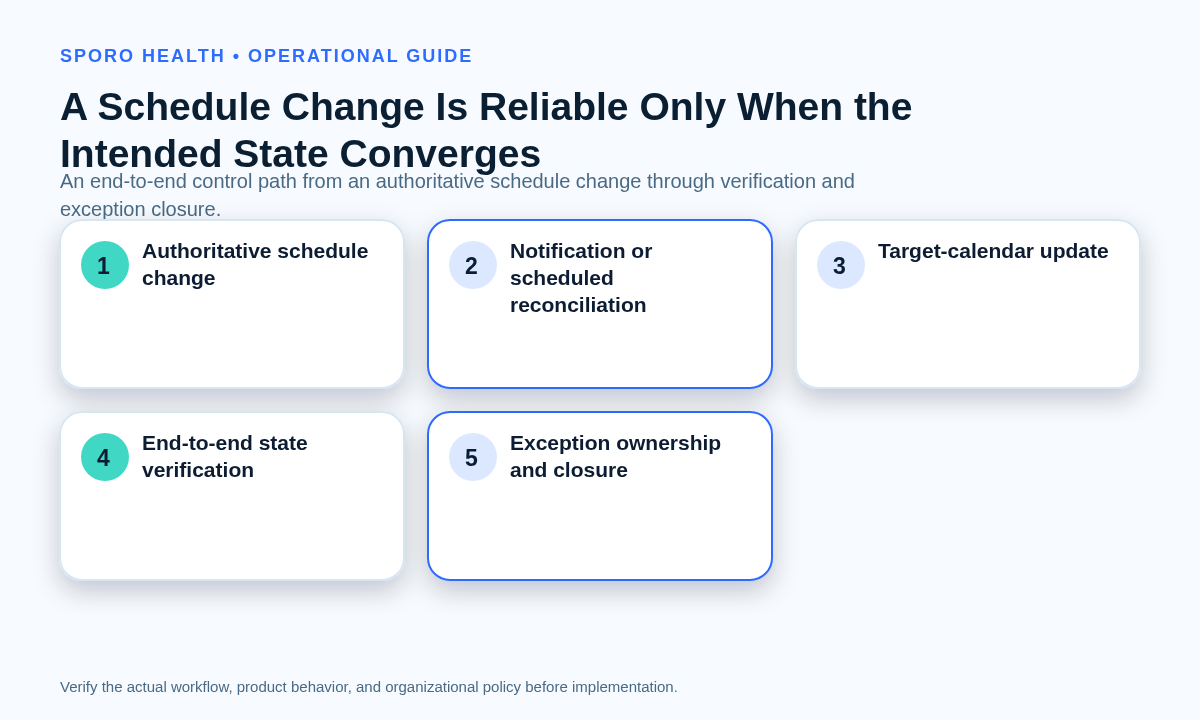
Measure whether the intended athenahealth record and approved external-calendar record reach the same expected state within the class-specific window. They need not contain identical fields, but every approved time, duration, status, identity, and availability outcome must agree.
State-convergence SLI: transactions that reached the expected two-system state within the objective window divided by all eligible transactions. Count a missing target event, an unchanged stale copy, an undeleted predecessor, or multiple true copies where one was expected as a bad transaction.
Automated comparisons should be supplemented by a documented sampling method to detect silent calendar sync drift. Record measurement blind spots rather than silently treating unobserved transactions as successful.
Which indicators belong on the production scorecard?
Use seven complementary indicators so that successful API calls cannot hide stale, missing, duplicated, or unreconciled schedule states. Each indicator needs a numerator, denominator, measurement window, evidence source, owner, exclusion rule, and required response.
Notification delivery is only an input. Google states that Calendar push notifications are not completely reliable and that expiring channels must be replaced; its synchronization guidance also requires a full sync after an invalid token response. See the official Google Calendar push-notification guidance and incremental synchronization guidance. Microsoft documents missed, removed, and reauthorization lifecycle events, followed by resource synchronization such as delta query. See Microsoft Graph lifecycle-notification recovery and event delta queries.
Practices can use a dedicated control to monitor calendar notification coverage, but coverage should never substitute for state verification.
| Indicator | Suggested specification | Primary evidence |
|---|---|---|
| State-convergence success | Converged eligible transactions divided by eligible transactions | Source record, mapping, target state |
| End-to-end freshness | Transactions converged within their risk-class window divided by eligible transactions | Accepted-change and verified-state timestamps |
| Notification coverage | In-scope calendar pairs with active, tested observation paths divided by in-scope pairs | Subscription register, synthetic checks, renewal evidence |
| Drift detection | Confirmed mismatches detected within objective divided by all mismatches eventually confirmed | Alerts, reconciliation samples, staff reports |
| Detection-to-containment | Confirmed exceptions contained within target divided by confirmed exceptions | First signal and containment timestamps |
| Reconciliation completeness | Affected transactions with a final evidenced disposition divided by bounded affected transactions | Replay window and exception ledger |
| Verified recovery | Recovery episodes passing required tests before release divided by recovery episodes | Test results and release approval |
How should initial service objectives be chosen?
Choose initial objectives from schedule consequences, baseline evidence, and the practice’s ability to contain a miss—not from a universal latency claim. Booking horizon, same-day workflows, provider coverage, manual capacity, and reconciliation frequency should shape the target.
- Measure current convergence and freshness over a representative operating cycle.
- Segment results by transaction type, risk class, provider-calendar pair, and appointment horizon.
- Identify the delay at which staff must protect near-term schedules or invoke fallback.
- Approve an objective that can be measured consistently and revised through documented review.
Write each objective as: eligible population, good-event definition, target proportion, measurement window, exclusions, evidence source, accountable owner, and action on miss. Label an unproven tighter target as aspirational rather than treating the service as permanently breached.
What denominator should the error budget use?
Use the denominator that most clearly expresses tolerated schedule risk, and keep raw API errors as supporting diagnostics. A percentage without an operational unit can hide whether the miss affected one distant block or many minutes of near-term bookable capacity.
Budget formula: eligible units multiplied by one minus the approved SLO target equals allowed bad units for the measurement window. Google’s SLO implementation guidance recommends good events divided by total events and a written policy for budget exhaustion.
| Denominator | Use when | Bad unit | Main blind spot |
|---|---|---|---|
| Eligible transactions | Volume is stable and transactions can be classified | Failed or late create, reschedule, cancellation, or availability change | One transaction may expose very different schedule impact |
| Provider-calendar pairs | Coverage and connection health are central | Pair outside objective or lacking verified coverage | May underweight a heavily booked provider |
| Exposed appointment minutes | Duration of unverified near-term schedule state matters | Minutes of appointment or availability exposure | Requires reliable start, end, and scope evidence |
Document exclusions before the window begins. Test records, approved maintenance, out-of-scope calendars, and records lacking sufficient evidence should be reported separately; they should not disappear from the denominator without an owner and rationale.
When should budget burn change operations?
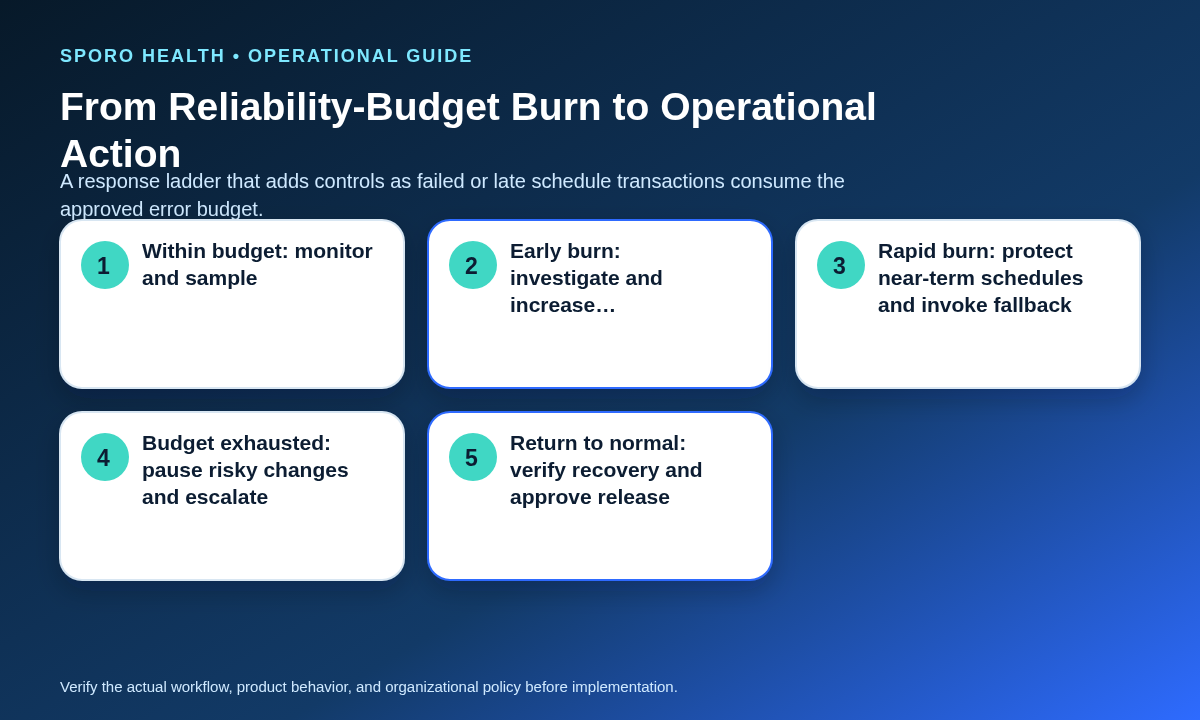
Escalate controls as the service consumes its approved schedule-risk budget faster than planned. Burn rate should trigger predetermined actions, not an improvised debate after near-term schedules are already uncertain.
Google’s SLO alerting guidance uses multiple windows and burn rates to distinguish fast deterioration from slower sustained consumption. Practices can adapt that principle without copying Google’s example thresholds.
| Condition | Required operational action | Exit evidence |
|---|---|---|
| Within budget | Monitor, sample, and review trends | Normal scorecard evidence |
| Early burn | Investigate, increase reconciliation, and narrow the affected scope | Cause bounded and burn stabilized |
| Rapid burn | Protect near-term schedules, invoke tested fallback, and reconcile the exposed window | Critical classes verified or contained |
| Budget exhausted | Pause risky production changes and escalate with an evidence packet | Recovery tests passed and release approved |
Use the practice’s process to triage athenahealth calendar sync failures. If the condition becomes broad or sustained, invoke the calendar integration outage recovery runbook. Resume risky releases only through the production calendar integration change-control checklist.
What evidence and ownership should be required?
Require enough evidence to reconstruct each failed or late transaction from accepted change through final disposition. A green dashboard or aggregate uptime percentage is not sufficient service-level reporting.
- Stable source, target, provider, calendar, and transaction identifiers
- Accepted, observed, attempted, converged, contained, and closed timestamps
- Expected and actual state, including predecessor-event disposition
- Notification, polling, delta, and reconciliation coverage for the affected window
- Retry history, exclusions, manual interventions, and unresolved evidence gaps
- Named technical, operational, vendor, and approval owners
- Recovery tests and the decision authorizing return to normal operation
Material misses should feed a calendar sync incident postmortem template. The vendor may produce technical records, but the practice should retain the objective, denominator, impact classification, response decision, and accepted closure evidence.
How should the framework be put into operation?
Approve the framework as an operating policy, test it against real scenarios, and revise it when evidence shows that targets are too loose, too strict, or poorly measured.
- Define the service boundary and authoritative schedule states.
- Classify each transaction type with the schedule-consequence matrix.
- Implement the seven-indicator scorecard and document blind spots.
- Baseline performance before approving target values.
- Select the error-budget denominator and approve exclusions.
- Rehearse notification loss, rapid burn, fallback, reconciliation, and release decisions.
- Review trends, incidents, operational capacity, and objective fitness on a documented cadence.
If the review includes connected-calendar products, start with the Sporo Health overview, then inspect the current athenahealth and Google Calendar product page, athenahealth and Microsoft Outlook product page, and Sporo Health athenaConnect Marketplace listing. Treat product-page statements as vendor claims and ask for a demonstration using the practice’s proposed SLIs, evidence fields, missed-notification scenario, and burn-response ladder.
That is how to set service levels for athenahealth calendar sync without allowing one uptime number to substitute for schedule integrity, containment readiness, and verified recovery.
Frequently asked questions
What is the difference between an SLA, SLO, and SLI for calendar sync?
An SLA is a contractual commitment, an SLO is the practice’s approved reliability target, and an SLI is the measure used to judge that target. Keep practice-owned SLOs and evidence even when a vendor contract includes uptime, credits, or support-response terms.
Which calendar sync transactions need separate service objectives?
Creates, reschedules, cancellations, and provider-availability changes need separate objectives. Their operational consequences differ by appointment horizon, booked-patient impact, scope, reversibility, and fallback capacity.
How do you measure end-to-end schedule convergence?
Count a transaction as converged only when the intended athenahealth state and approved external-calendar state match within the objective window. Missing changes, stale predecessor events, and true duplicates count as failures.
What denominator should a calendar sync error budget use?
Use the denominator that best represents the practice’s risk: eligible transactions, provider-calendar pairs, or exposed appointment minutes. Document the measurement window, exclusions, owner, and blind spots before approving the budget.
How should Google Calendar and Outlook notification gaps affect service levels?
Treat a notification gap as reduced monitoring coverage, not automatic proof that schedule data is wrong. Increase reconciliation, bound the unobserved window, and count late or failed convergence when state verification finds it.
When should an SLO breach trigger manual fallback or a change freeze?
Trigger manual fallback when near-term schedule integrity cannot be verified with available controls; consider a change freeze when rapid burn or budget exhaustion makes additional production risk unacceptable. The approved ladder should name the decision owner and release criteria.
What evidence should a calendar integration vendor provide for service-level reporting?
Request transaction-level timestamps, mapping identifiers, notification and reconciliation coverage, excluded-event logic, incident timelines, recovery tests, and exportable summaries. The practice should be able to reproduce the numerator, denominator, and disposition of failed items.
Sources
- Google SRE: Service Level Objectives
- Google SRE Workbook: Implementing SLOs
- Google SRE Workbook: Alerting on SLOs
- Google Calendar API: Push notifications
- Google Calendar API: Synchronize resources efficiently
- Microsoft Graph: Lifecycle notifications and missed-change recovery
- Microsoft Graph: Incremental changes to calendar events