Intentional Overbooking in athenahealth: A Capacity-and-Stop-Rule Policy Guide
For practice managers, an athenahealth overbooking policy for medical practices should authorize concurrent patient bookings only for a named provider session, appointment-type cohort, and maximum capacity. It must separate approved overbooks from accidental collisions, confirm provider, room, equipment, and staff feasibility, assign approval and verification roles, pair access measures with waiting and overtime measures, and define stop and rollback rules before a pilot starts.
What is an athenahealth overbooking policy for medical practices?
Intentional overbooking is a preapproved rule that permits more than one patient appointment in a defined provider interval. It is not an accidental collision, duplicate calendar event, or improvised front-desk override. The current athenaOne Service Description says Appointment Schedule manages patient appointments and that user permissions can govern double-booking slots; the practice still must define when that capability is authorized and how it is controlled.
Use the separate guide to preventing accidental double-booking in athenahealth when overlap is unintended. This guide addresses a deliberate, recurring capacity decision rather than a scheduling error.
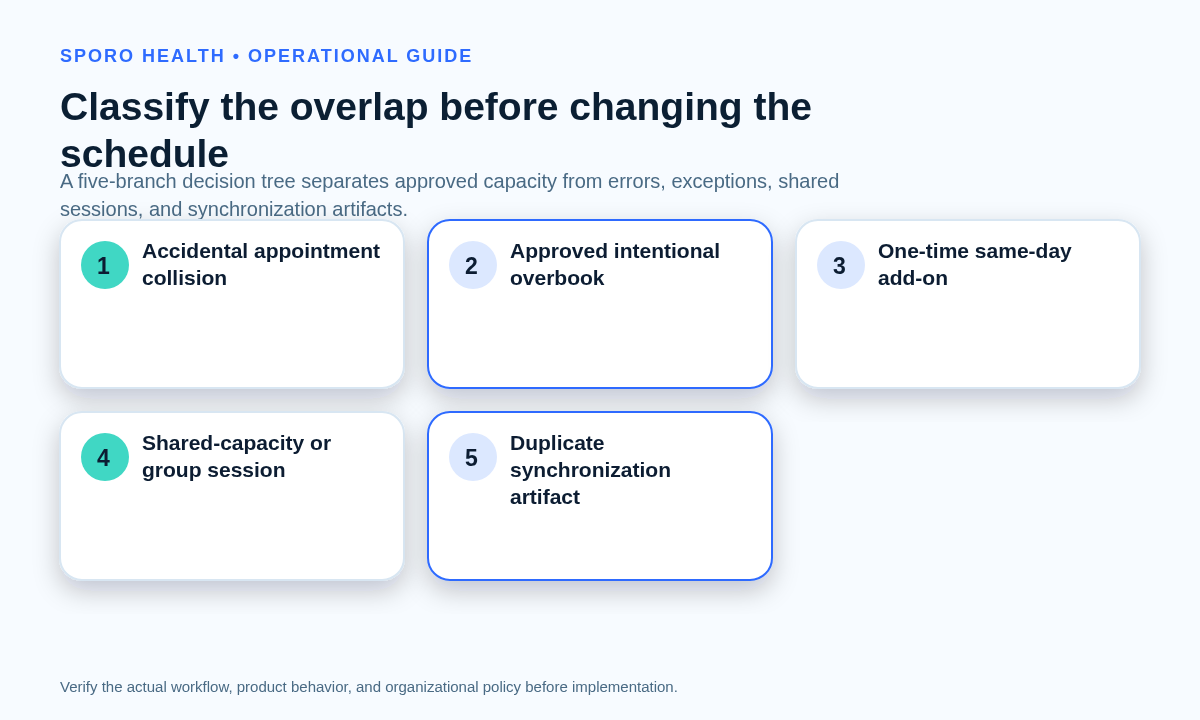
How should staff classify an overlapping appointment?
Classify every overlap before anyone moves, deletes, or adds an appointment. The label determines whether staff should correct an error, execute an approved policy, complete an exception workflow, verify shared capacity, or investigate synchronization.
| Overlap state | Defining signal | First action |
|---|---|---|
| Accidental collision | No valid authorization covers concurrent patient commitments. | Contain new edits and reconcile the affected appointments. |
| Approved overbook | The provider, session, appointment type, and concurrency are inside a current policy record. | Verify resources and record the policy reference. |
| Same-day add-on | One bounded request is being considered for the current day. | Use the approved add-on workflow rather than treating it as standing capacity. |
| Shared-capacity or group session | The care model and resources are designed for concurrent attendance. | Verify the correct appointment and resource model. |
| Synchronization duplicate | Two calendar objects appear to represent one patient-booking record. | Preserve the authoritative appointment and investigate event identity. |
A visible overlap is therefore a signal to classify, not proof that the schedule is wrong or that another patient can be added.
When should a clinic use overbooking instead of an alternative?
Consider overbooking only for a bounded session or appointment-type cohort after measuring demand, attendance, service duration, dependent resources, and less congestive alternatives. A high no-show rate alone is not sufficient. AHRQ describes open or same-day access as a supply-and-demand strategy, illustrating why practices should test the underlying capacity problem before creating concurrent commitments in advance. See AHRQ’s open-access scheduling guidance.
| Option | Problem it best addresses | Minimum evidence | Main operational risk | Rollback difficulty |
|---|---|---|---|---|
| Intentional overbooking | Predictable unused capacity inside a defined session. | Attendance, duration, both-arrive exposure, and resource data. | Waiting, overtime, resource conflict, and unauthorized expansion. | High when many future overlaps already exist. |
| Waitlist fill | A verified cancellation or released opening. | Slot release, eligibility, offer, and acceptance records. | Competing claims or stale openings. | Low because nominal capacity is not exceeded. |
| Same-day reserve | Demand that is predictable by day but uncertain by patient. | Same-day demand and release-time history. | Unused protected capacity or a late release. | Moderate and usually session-bounded. |
| Template redesign | Persistent mismatch between visit duration, demand, and available resources. | Appointment-type demand and service-time distribution. | Disrupting future bookings if scope is poorly controlled. | Moderate to high for recurring changes. |
For one live request, use the same-day add-on appointment workflow. To replace a canceled appointment without exceeding planned capacity, fill canceled slots through a controlled waitlist.
What should an athenahealth overbooking policy include?
The policy should be a session-level capacity authorization card with a clear owner, fixed scope, expiration, resource dependencies, measures, and stop rules. Do not issue general permission to overbook whenever a schedule looks full.
| Required field | What to record |
|---|---|
| Provider and session | Named provider, department, location, weekdays, and time boundary. |
| Eligible cohort | Approved appointment types and explicit exclusions. |
| Maximum concurrency | The greatest permitted patient count in one defined interval. |
| Resource dependencies | Rooms, equipment, support roles, visit mode, and location requirements. |
| Authority | Who approves, who may place an overbook, and who verifies it. |
| Effective period | Start date, expiration date, review date, and pilot exposure window. |
| Communication | How affected providers and operational staff receive the rule and changes. |
| Measures | Access, utilization, both-arrive exposure, waiting, overtime, conflicts, and recovery work. |
| Stop and rollback | Thresholds, decision owner, future-appointment disposition, and closure evidence. |
Only named roles should authorize or place an overbook. Approval, booking, and verification should remain distinguishable so the practice can detect unauthorized overlaps and reconstruct what happened. A narrow exception should instead follow the rules for one-off provider availability overrides.
How should Google Calendar or Outlook show overlapping athenahealth appointments?
Use athenahealth as the authoritative patient-booking record unless the practice has approved another documented design. Google Calendar or Outlook may support visibility checks, but a busy interval alone cannot prove appointment count, authorization, or resource readiness.
| Operational question | Best record | Accountable owner |
|---|---|---|
| Was concurrent capacity authorized? | Session-level policy card | Policy approver |
| How many patient appointments exist? | athenahealth appointment schedule | Booking verifier |
| Does the provider have another commitment? | Approved Google Calendar or Outlook availability view | Provider-calendar owner |
| Are rooms, equipment, and staff ready? | Approved resource and staffing records | Clinic operations owner |
| Does the final state match the policy? | Policy record, athenahealth, and relevant calendars | Independent verifier |
Google documents event transparency and a free/busy response made of busy intervals in its Calendar Events reference and Freebusy reference. Microsoft documents availability states returned by Outlook getSchedule. These are observability signals, not patient-booking or policy-approval records.
What does the evidence support?
The evidence supports cautious, bounded testing—not a general rule that overbooking improves every outpatient schedule. Results depend on specialty, service times, resources, patient population, and the intervention used.
- A rapid systematic review found the effect of predictive model-based overbooking on attendance uncertain, while evidence for targeted reminders and navigator calls was stronger.
- A prospective endoscopy study reported higher utilization during predictive overbooking but also a longer clinic workday. A general outpatient practice should not assume the same tradeoff.
- Research on racial bias in predictive overbooking shows how patient-level no-show predictions can assign worse waiting experiences disproportionately when optimization focuses narrowly on efficiency.
A defensible inference is to test a session or appointment-type rule before using patient-level risk predictions. If predictions are used, compare waiting, access, and policy exposure across relevant patient groups and route the design through authorized organizational review.
Which metrics should a medical appointment overbooking pilot track?
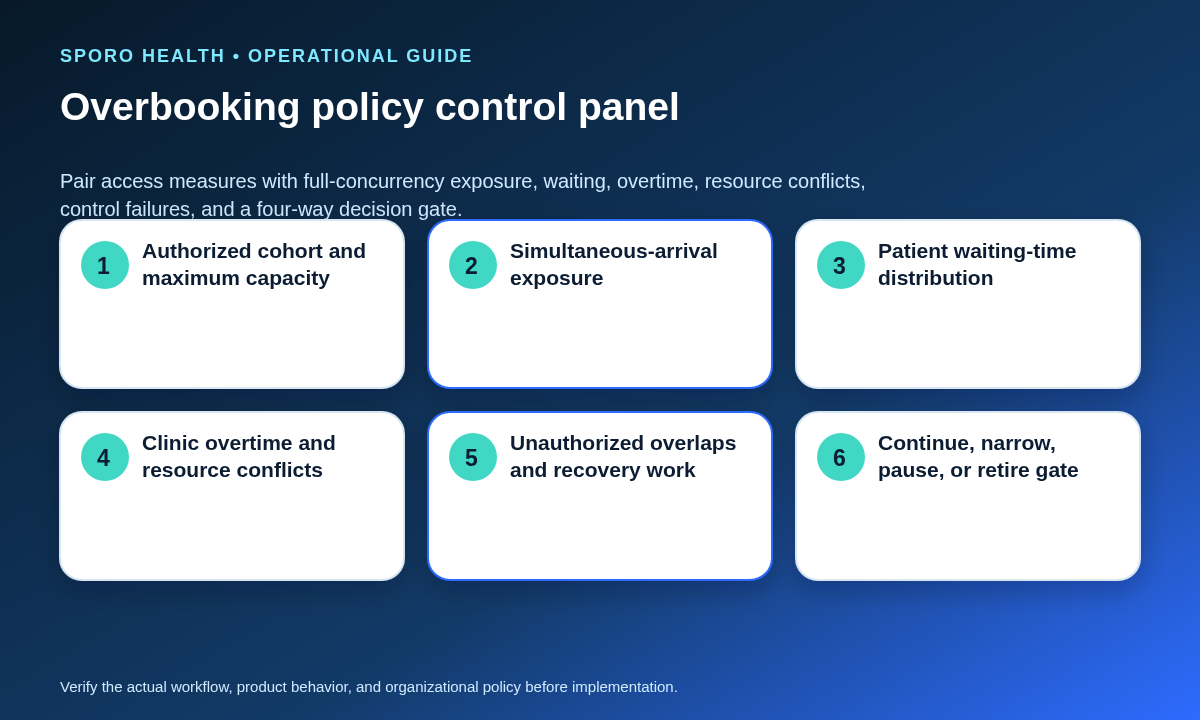
Track access or utilization together with both-arrive exposure, waiting, overtime, resource conflicts, displaced appointments, complaints, recovery work, and unauthorized overlaps. A pilot should have a named cohort, fixed exposure window, baseline, comparison method, daily exception review, and a precommitted decision date.
| Dimension | Measures | Decision question |
|---|---|---|
| Access and use | Eligible demand served, time to next eligible appointment, and completed visits per session. | Did the policy address the stated access problem? |
| Exposure | Overbooked intervals, concurrent bookings, and intervals where every booked patient arrived. | How often did the practice experience full concurrency? |
| Patient flow | Waiting-time distribution, delayed starts, displaced appointments, and delay-related complaints. | Did access improve by shifting burden to patients? |
| Clinic operations | Overtime, room or equipment conflicts, staffing gaps, and session recovery actions. | Could resources support simultaneous arrivals? |
| Control quality | Unauthorized overlaps, missing policy references, and incomplete verification. | Can staff distinguish approved capacity from errors? |
| Recovery workload | Staff minutes spent calling, rescheduling, reconciling, and documenting exceptions. | Did hidden administrative work offset the intended benefit? |
athenahealth lists appointment schedule, reschedule, cancel, and update topics in its event-notification documentation, which may support technical evidence collection. Waiting, overtime, resource readiness, complaints, and recovery work still require practice-owned operational data. Route unresolved overlaps through daily schedule exception reconciliation.
When should a clinic stop overbooking patient appointments?
Stop or narrow the policy when a precommitted threshold is crossed, required resources cannot support concurrent arrivals, staff cannot distinguish approved from accidental overlaps, or reconciliation evidence is incomplete. Do not wait for a severe incident to decide what worsening performance means.
| Gate outcome | Use when | Required action |
|---|---|---|
| Continue | Target measures improve and balancing measures remain inside approved limits. | Maintain scope and the next review date. |
| Narrow | Results are acceptable only for certain sessions, appointment types, or resource conditions. | Reduce the authorization card to the supported cohort. |
| Pause | A threshold is crossed, data is incomplete, or a correctable dependency is unavailable. | Stop new overbooks while preserving a controlled review and recovery window. |
| Retire | Harms persist, control cannot be maintained, or alternatives address the problem with less risk. | Remove authority and complete rollback and closure. |
Rollback should:
- Set the final time when staff may create a new overbook.
- List every future interval already carrying concurrent patient appointments.
- Assign an authorized owner to decide each appointment’s disposition.
- Communicate policy withdrawal and restore standard booking instructions.
- Reconcile athenahealth, relevant resources, Google Calendar, or Outlook.
- Verify that no expired authority, training aid, or shadow rule remains.
If simultaneous arrivals have already created live schedule lag, use the separate workflow to recover when an active clinic session falls behind.
How should practice managers implement an athenahealth overbooking policy for medical practices?
Start with classification and alternatives, authorize one narrow cohort, pilot it with balancing measures, and expand only when the evidence supports expansion. The implementation sequence is straightforward:
- Define the capacity problem and baseline.
- Classify current overlaps using the five-state model.
- Compare overbooking with waitlists, same-day reserve, and template redesign.
- Complete and approve the session-level authorization card.
- Train authorized bookers and independent verifiers.
- Run the bounded pilot and review exceptions daily.
- Apply the continue, narrow, pause, or retire gate and document closure.
An athenahealth overbooking policy for medical practices should remain a controlled capacity experiment, not become a standing instruction to squeeze in another patient. If connected-calendar visibility is part of the design, review Sporo Health scheduling resources, the current athenahealth and Google Calendar option, the athenahealth and Microsoft Outlook option, and the Sporo athenaConnect Marketplace listing. Validate any option against the practice’s authority, data, resource, measurement, and rollback requirements.
Frequently asked questions
Does a high no-show rate justify overbooking?
No. A high no-show rate should trigger analysis of reminders, booking lead time, waitlist use, same-day access, and template design before the practice accepts the congestion risk of intentional overbooking.
Can front desk overbook with verbal permission?
No. Repeated intentional overbooking needs a documented scope, maximum concurrency, named approver, effective period, stop rules, and closure evidence; a one-time urgent exception should follow its own approved add-on or override workflow.
Who should be allowed to double-book an athenahealth appointment slot?
Only roles named in the policy should authorize or place an overbook. Approval, booking, and verification should remain distinguishable so unauthorized overlaps can be detected and reconstructed.
Should Google Calendar or Outlook prove that an overbook is safe?
No. Google Calendar or Outlook can show provider busy state and overlapping calendar intervals, but they do not by themselves prove patient appointment count, policy authorization, room availability, equipment readiness, or support-staff capacity.
How many patients can be booked into one interval?
There is no universal safe maximum. The practice should set a session-specific limit from observed service duration, arrival patterns, provider workflow, rooms, equipment, support staffing, visit mode, and the consequences when every booked patient arrives.
How do you roll back an intentional overbooking policy?
Remove future booking authority at a stated cutoff, identify every already-overbooked interval, assign each appointment a safe disposition, communicate changes, restore standard scheduling rules, reconcile athenahealth and connected calendars, and document verification.
Sources
- athenaOne Service Description
- athenahealth Event Notifications Subscription Topics
- AHRQ Open Access Scheduling Guidance
- Predictive Model-Based Interventions to Reduce Outpatient No-Shows
- Preventing Endoscopy Clinic No-Shows
- Overbooked and Overlooked
- Google Calendar Events Reference
- Google Calendar Freebusy Reference
- Microsoft Graph Outlook Free/Busy Schedule