Replacing a Departing Provider in athenahealth: A Schedule-Succession Cutover Plan
Practice managers asking how to replace a departing provider in athenahealth scheduling should run one paired cutover: census the predecessor’s future work, assign every item a disposition, close old booking exposure, validate the successor’s own dependencies, and release only after negative and positive tests pass. Keep appointments, availability, meetings, calendar identities, permissions, and integration mappings as separate controlled objects.
How to replace a departing provider in athenahealth scheduling
Treat the named predecessor and successor as one controlled cutover. The operating sequence is inventory, approve dispositions, close predecessor exposure, validate the successor, release approved capacity, and stabilize the combined result.
Do not let the predecessor’s departure deadline force an untested successor launch. The two provider records share a transition, but they have different schedules, permissions, calendar identities, appointment-type approvals, and readiness evidence. Clinical suitability decisions remain with authorized practice leaders; this checklist controls scheduling execution.
athenahealth’s public documentation identifies separate appointment update, cancellation, rescheduling, changed-appointment, and event-notification constructs. That supports transaction-by-transaction verification, but it does not establish the exact workflow or permissions in a specific practice configuration. See the athenahealth appointments overview, athenaOne API endpoint list, and appointment notification topics.
Use the existing provider calendar offboarding checklist for detailed predecessor access and identity controls; the succession record below governs the paired handoff to the named replacement.
What belongs in the schedule-succession control record?
Use one authoritative record for both providers and every cutover boundary. A split set of onboarding and offboarding tickets makes it harder to see uncovered appointments, conflicting dates, and ownership gaps.
- Predecessor and successor identities
- Departments, locations, appointment types, and resources
- Notice date, booking cutoffs, service dates, and account cutoffs
- Staff, patient, referral, and self-scheduling channels
- Future-work census and approved disposition totals
- Google Calendar or Microsoft 365 identities and integration mappings
- Decision, configuration, communication, testing, and verification owners
- Open blockers, containment actions, rollback conditions, and closure evidence
Give the record a state such as planning, contained, predecessor closed, successor limited release, successor full release, stabilizing, or closed. A date alone should never imply readiness.
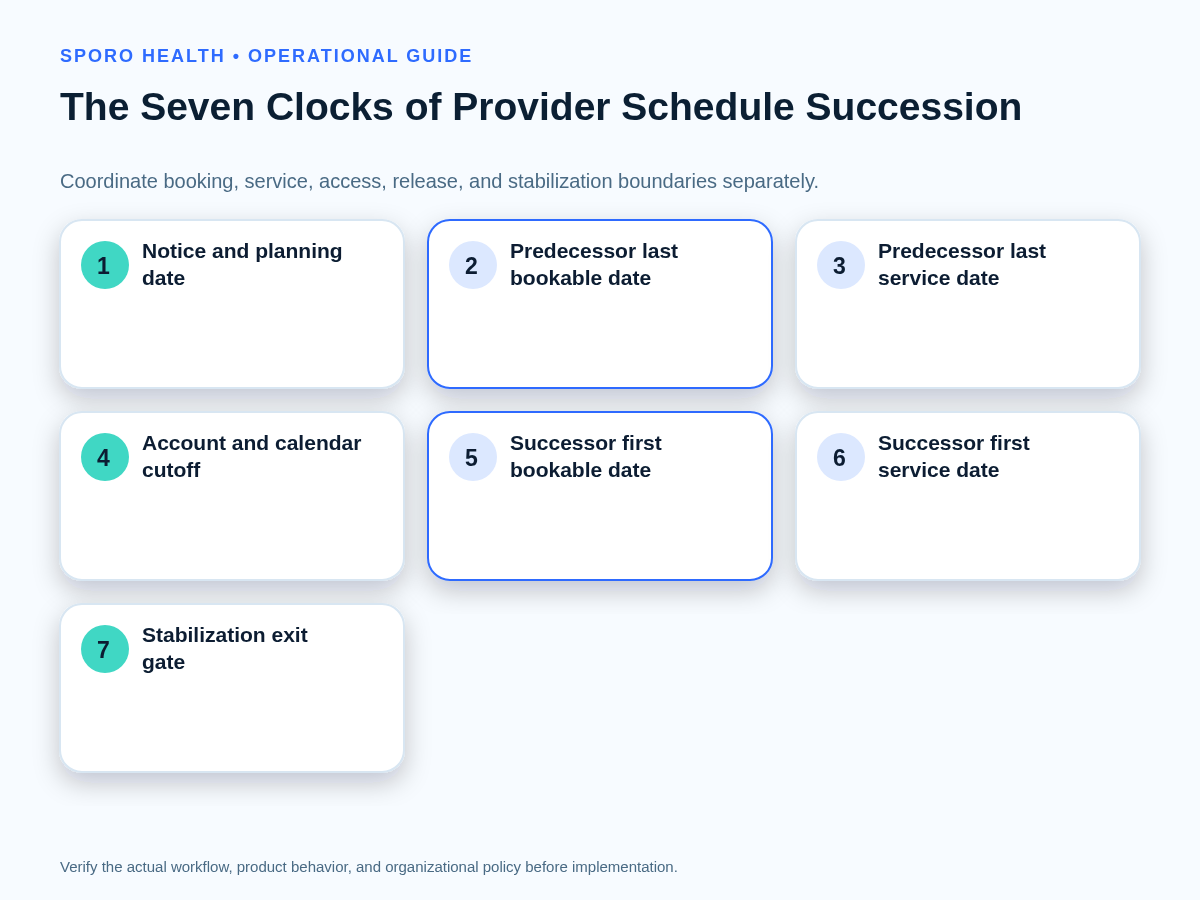
Which seven clocks control provider schedule succession?
Track seven separate clocks because booking, service, access, and stabilization rarely change at the same moment. Each clock needs an owner, approved timestamp, affected scope, and completion test.
| Clock | Control question |
|---|---|
| Notice and planning | When does controlled inventory and change governance begin? |
| Predecessor last bookable date | After what point must no new work be assigned? |
| Predecessor last service date | When does planned patient service end? |
| Account and calendar cutoff | When do access, integrations, and owned assets change state? |
| Successor first bookable date | When may approved channels expose tested capacity? |
| Successor first service date | When does the provider begin the approved schedule? |
| Stabilization exit | When have exceptions and residual exposure been closed? |
Put these clocks on one timeline. If the successor release moves, revise dependent appointments and coverage rather than silently shifting only one date.
Should a replacement provider reuse the departing provider’s schedule template?
Use the predecessor’s template as a reference, not as proof that the successor is ready. Reapprove every element that determines what, where, when, and through which channel the successor may be booked.
The schedule template versus temporary-change decision guide can help separate a durable successor baseline from interim coverage.
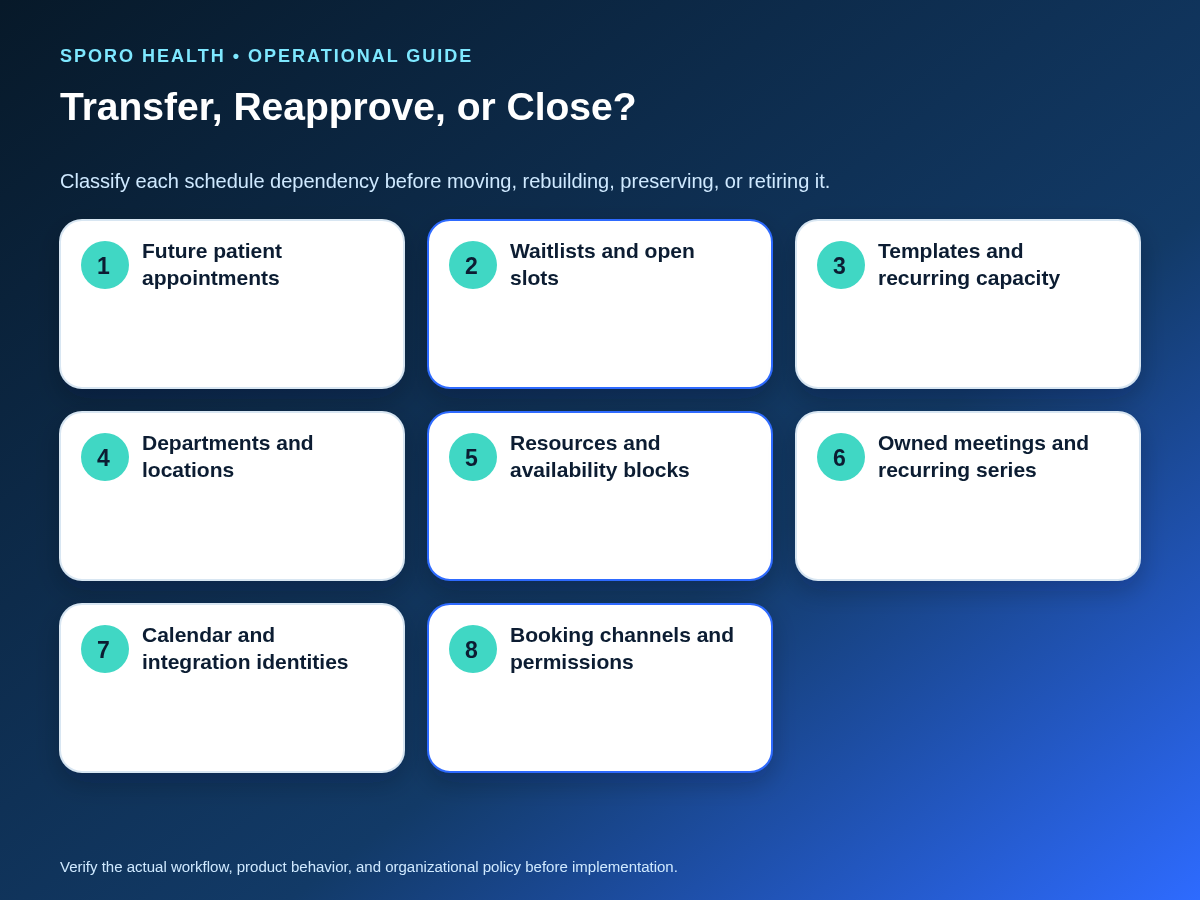
| Dependency | Transferability class | Required decision |
|---|---|---|
| Future patient appointment | Transferable only after validation | Approve one appointment-level disposition. |
| Template or recurring capacity | Reusable only after reapproval | Validate hours, types, dates, and exclusions. |
| Department, location, or resource | Reusable only after reapproval | Confirm successor authorization and availability. |
| Calendar account or integration mapping | Successor-specific | Create or approve the correct target identity. |
| Owned meeting or recurring series | Predecessor-specific | Transfer, recreate, cancel, preserve, or escalate. |
| Old open slots and predecessor blocks | Requires closure | Retire or preserve intentionally; test for residue. |
Any dependency with uncertain authority, ownership, or destination fit is a blocker for that part of the release, not a reason to copy the predecessor state.
How should future appointments be reassigned when a provider leaves?
Do not bulk-transfer future appointments merely because a replacement has been named. Give every appointment and non-appointment obligation an approved disposition, accountable owner, due date, and closure test.
After reassignment is authorized, use the workflow for moving one appointment to another provider to revalidate provider, appointment type, duration, location, resources, communication, source cleanup, and calendar state.
| Future-work class | Allowed dispositions | Closure evidence |
|---|---|---|
| Patient appointments | Retain, reassign, reschedule, cancel, waitlist, escalate | Valid final booking and communication status |
| Waitlists and unresolved requests | Reassign, hold, close, escalate | Named queue owner and next action |
| Open slots | Close, preserve temporarily, replace | No unintended predecessor booking path |
| Availability blocks | Close, recreate, preserve with owner | Correct provider, dates, recurrence, and status |
| Rooms and equipment | Release, reserve, remap | No orphaned or competing reservation |
| Recurring series | Split, recreate, end, escalate | Parent, future instances, and exceptions reconciled |
| Unresolved schedule requests | Complete, return, reject, escalate | One documented final state |
Reconcile register totals to the original census. “In progress” is not a final disposition, and a patient communication task does not close until the resulting schedule state is verified.
What happens to Google Calendar or Outlook meetings during provider succession?
Handle calendar ownership, meetings, recurring series, account access, and integration mappings separately from patient appointments. Moving an athenahealth appointment does not transfer organizer authority or prove that a calendar identity is ready for the successor.
Google distinguishes primary calendars from transferable secondary calendars and provides administrative paths to cancel or transfer future events and secondary calendars before account deletion. Its current guidance also warns that deleting an owner can remove secondary calendars and prevent later transfers. Review Google’s administrator offboarding guidance and calendar and event ownership guidance.
Microsoft documents separate treatment for former-employee mailbox retention and future organized meetings. The Remove-CalendarEvents documentation states that organized meetings with attendees or resources can be canceled while the mailbox can still send cancellations; Microsoft’s former-employee overview covers access, mailbox, calendar, and deletion sequencing.
Use the Outlook organizer-continuity checklist for meeting-level handling. Do not disable or delete an account while an unresolved organizer, resource, retention, or integration dependency still relies on it.
When should the departing provider close and the replacement schedule open?
Close predecessor booking at the approved boundary, but release successor capacity only after the actual target configuration passes representative tests. Departure completion and successor readiness are separate gates within the same cutover.
The new-provider booking-readiness gate provides a deeper successor release method. Add predecessor negative tests so the paired cutover proves both sides.
| Predecessor negative test | Successor positive test |
|---|---|
| Staff cannot create an unintended new booking. | Authorized staff can book an approved type. |
| Closed patient-facing channels expose no capacity. | Approved patient-facing channels expose only released capacity. |
| Old departments, locations, and slots show no residue. | Department, location, duration, and resources are correct. |
| Recurring predecessor blocks do not create false capacity. | Recurring hours and exclusions behave as approved. |
| Old calendar mappings no longer write unexpectedly. | The approved calendar identity and mapping pass verification. |
| Rollback does not reopen retired exposure. | Book, reschedule, cancel, exclusion, and rollback tests pass. |
Test with named owners and captured evidence. A successful login, empty calendar, or visible template is not enough to prove end-to-end booking readiness.
What should happen if the replacement provider’s start date changes?
Pause further release, protect affected appointments, revise the disposition register, and rerun every test touched by the new boundary. Do not leave the predecessor closed while assuming the successor will become ready later.
- Delayed successor: stop new exposure and approve bounded temporary coverage or new destinations.
- Incomplete dependency: hold only the affected appointment types, locations, resources, or channels.
- Wrong-provider booking: contain new booking, correct the transaction, and scan the released cohort.
- Stale calendar mapping: stop the faulty path, repair the identity mapping, and reconcile the affected window.
- Inherited recurring block: verify recurrence scope before removing or recreating it.
- Unavailable destination: escalate rather than forcing reassignment to an invalid slot.
- Unresolved organizer ownership: preserve the required account state or cancel and recreate under an approved owner.
Record the trigger, protected scope, temporary authority, revised dates, retests, and exit condition. Recovery is complete only after the register and both provider states agree.
How do you verify that a provider replacement cutover is complete?
Measure obligation closure, residual predecessor exposure, successor readiness, and stabilization exceptions together. A high appointment-transfer count does not prove that the overall succession is complete.
| Measure | Definition |
|---|---|
| Disposition coverage | Finalized obligations divided by the full future-work census |
| Appointments changed after release | Bookings corrected after successor exposure began |
| Wrong-provider findings | Appointments or slots associated with the wrong provider |
| Residual predecessor exposure | Booking paths, slots, blocks, or mappings still active unintentionally |
| Successor readiness failures | Failed booking, change, location, resource, calendar, or exclusion tests |
| Oldest open exception | Age of the earliest unresolved succession item |
| Stabilization closure | Required observations completed with exceptions closed or accepted |
Set practice-owned thresholds before release. Close the cutover only when every obligation has a final disposition, both provider states pass, calendar assets have accountable owners, and stabilization exceptions are resolved.
How should practice managers put the plan into use?
Start with one control record, one census, one transferability review, and one paired acceptance gate. That is the practical way to document how to replace a departing provider in athenahealth scheduling without treating the successor as a copy of the predecessor.
If connected calendars are in scope, review Sporo Health, the current athenahealth and Google Calendar product page, the athenahealth and Microsoft 365/Outlook product page, and the Sporo Health listing in athenaConnect Marketplace. Treat product-page statements as vendor descriptions and require configuration-specific acceptance evidence before relying on them in a live succession.
Frequently asked questions
How to replace a departing provider in athenahealth scheduling?
Run one paired cutover rather than separate offboarding and onboarding projects. Inventory the predecessor’s future work, approve every disposition, close old booking exposure, validate the successor independently, test both provider states, and keep stabilization open until exceptions are closed.
When should a departing provider stop being bookable in athenahealth?
Stop booking at the approved predecessor booking cutoff. That boundary may differ from the last service date, account cutoff, and calendar cutoff, so record and test each date separately.
Should the replacement provider reuse the departing provider’s schedule template?
No, not without reapproval. Use the old template as a reference, then validate the successor’s hours, appointment types, departments, locations, resources, booking channels, permissions, and effective dates.
Should every future appointment move to the replacement provider?
No. Each appointment needs an approved retain, reassign, reschedule, cancel, waitlist, or escalate disposition based on destination fit and the practice’s authorized decision rules.
What happens to Google Calendar or Outlook meetings during provider succession?
Handle meetings and calendar ownership separately from patient appointments. Transfer, recreate, cancel, preserve, or escalate each owned event or recurring series under the platform’s current organizer and account rules.
What proves that the provider replacement cutover is complete?
Completion requires full disposition coverage, no unintended predecessor booking exposure, only approved successor capacity, accountable calendar ownership, passed acceptance tests, and closed stabilization exceptions.
Sources
- athenahealth: Appointments
- athenahealth: List of athenaOne APIs
- athenahealth: Event Notification Subscription Topics
- Google Workspace: Cancel or Transfer Events or Secondary Calendars
- Google Calendar: Transfer Calendars or Events
- Microsoft Learn: Remove-CalendarEvents
- Microsoft Learn: Remove a Former Employee
- Sporo Health: athenahealth and Google Calendar
- Sporo Health: athenahealth and Microsoft Outlook
- athenaConnect Marketplace: Sporo Health Google Calendar Sync