Provider Availability Overrides in athenahealth: A Front-Desk Decision Guide
Front-desk leaders should override provider availability only when written policy covers the blocker, an authorized owner confirms the exception, existing bookings and dependencies are checked, and the action has exact scope, verification, and expiration. For teams asking when should front desk override provider availability in athenahealth scheduling, the safe default is not “if the screen permits it,” but “only with a bounded, auditable warrant.”
What is a provider-availability override?
A provider-availability override is a practice-authorized exception to normal booking or availability rules. It may permit one booking, release one protected interval, or bypass one blocker without changing the provider’s recurring baseline. The term is an operational-policy label in this guide; it does not assume athenaOne exposes a feature with that exact name.
athenahealth’s current practice-management page identifies scheduling as part of its front-office workflows, but that public page does not establish a named “provider-availability override” function or a universal permission model. Each practice therefore needs to confirm its actual configuration, roles, and approved procedures.
When should front desk override provider availability in athenahealth scheduling?
Front-desk staff should proceed only when the request, blocker, authority, affected interval, dependencies, verification owner, and expiration condition are all known. Capability is not authority: being able to enter or release a slot does not prove that policy permits the action.
- Allow: written policy delegates this blocker type to staff, and every required check passes.
- Require approval: the request may be legitimate, but provider or manager authorization is required.
- Contain: the requested interval stays unavailable while staff resolve uncertain identity, bookings, dependencies, or recurrence scope.
- Do not override: the request conflicts with policy, lacks an authorized source, or would conceal an appointment or unresolved dependency.
What outcomes should the decision matrix produce?
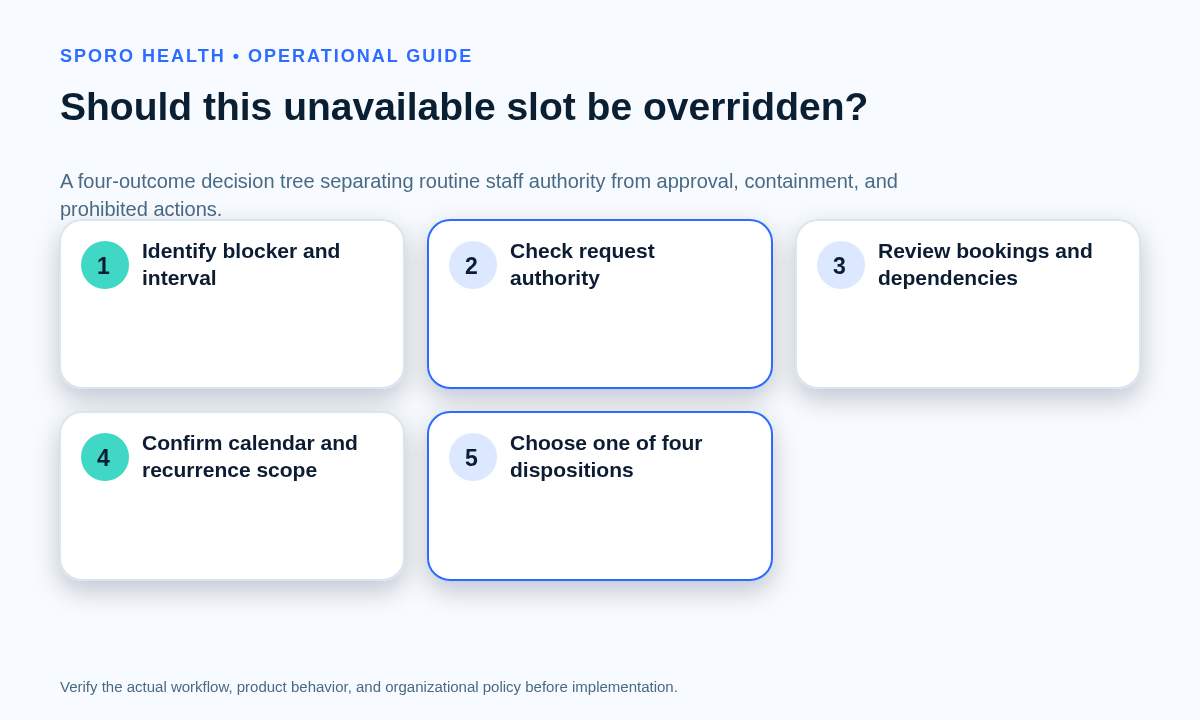
Every request should end in staff-authorized override, approval required, temporary containment, or do not override and escalate. The matrix below evaluates the request before anyone changes capacity.
| Request pattern | Blocker and source | Bookings and dependencies | Calendar and recurrence confidence | Disposition |
|---|---|---|---|---|
| One policy-listed administrative exception | Known blocker; authorized request channel | No conflicting booking; provider, location, and resources cleared | Views agree; one interval only | Staff-authorized override |
| Valid purpose outside routine staff authority | Known blocker; provider or manager confirmation needed | Existing bookings and dependencies reviewed | Scope is clear and bounded | Approval required |
| Uncertain source, identity, or intended state | Blocker or requester cannot yet be validated | Booking, location, or resource state is uncertain | Calendars disagree or recurrence scope is unclear | Contain pending evidence |
| Existing appointment, prohibited restriction, or broad unsupported request | No authorized basis for bypassing the restriction | Conflict exists or dependencies cannot be protected | Low confidence or uncontrolled series impact | Do not override; escalate |
A controlled exception is one control within the broader work to prevent athenahealth double-booking. It must never be used to hide an existing appointment or create a second representation of the same capacity.
What if athenahealth and an external calendar disagree?
Do not override merely to make one screen look correct. Contain the exact interval, confirm the intended schedule and record identity, make one authorized correction, and verify every affected view.
The Google Calendar Events API represents event identity, version, modification time, recurrence lineage, original instance time, and whether an event blocks availability. The Microsoft Graph event resource similarly exposes version, modification time, recurrence relationships, event type, and free/busy status. These fields illustrate why matching only the displayed title and time is weak verification.
- Hold the disputed interval rather than releasing new capacity.
- Confirm provider, location, start and end time, blocker purpose, and recurring-instance identity.
- Ask the authorized schedule owner which state is intended.
- Apply one correction, then recheck athenahealth and each connected calendar.
A separate policy should define physician-calendar availability precedence. Override governance decides who may bypass a restriction; it should not silently redefine which external events count as restrictions.
How narrowly should an override be scoped?
Use the smallest exception that completes the approved task: one slot before a day, one occurrence before a series, and one provider-location interval before a broader schedule change. A narrow action limits the number of adjacent appointments and schedule views that can be affected.
Before execution, mark the proposed interval and check its blast radius:
- the immediately preceding and following slots;
- appointments, holds, waitlist actions, or other booking representations already present;
- provider-location, room, equipment, staffing, or travel dependencies;
- whether the interval belongs to a recurring series; and
- how the interval appears in connected Google Calendar or Outlook views.
If approval covers only a booking exception, preserve the underlying block. Removing the restriction is a separate schedule change that needs its own authority and verification.
What belongs in the override warrant?
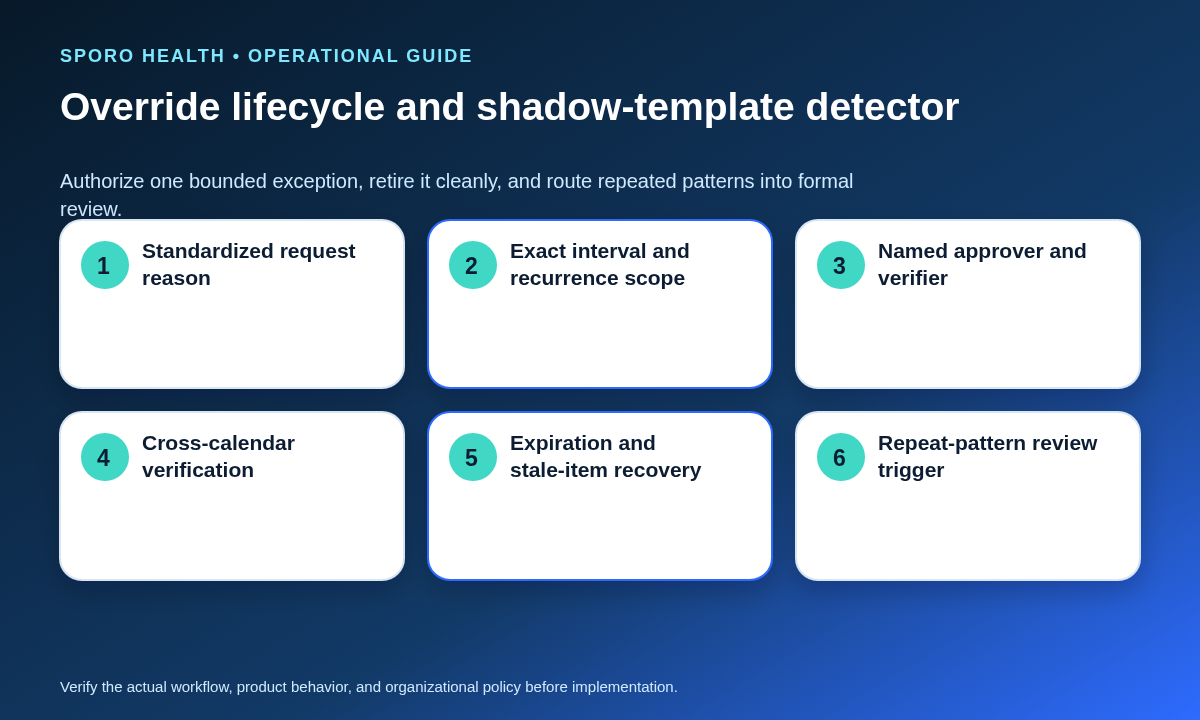
The warrant should record who requested and approved the exception, exactly what may change, how it will be checked, and when permission ends. Keep it as an operational control record rather than duplicating a clinical record or unnecessary patient detail.
| Warrant area | Required fields |
|---|---|
| Request and authority | Requester, request time, standardized reason code, approver, approval channel, and approval time |
| Exact scope | Provider, location, date, start and end time, appointment or block scope, and one-occurrence, future-segment, or whole-series designation |
| Current state | Existing bookings, blocker type, relevant dependencies, and calendars or schedule views affected |
| Compensating check | What must be checked because the normal restriction is being bypassed, plus the named verification owner |
| Expiration and closure | Expiration event or deadline, final verification evidence, outcome, removal or renewal decision, and closure time |
If verification cannot finish promptly, keep the interval contained and manage unresolved schedule exceptions through one owned queue with a deadline and accepted handoff. The warrant should reference that queue item instead of becoming a second tracking system.
How should recurring restrictions be overridden?
Approval must state whether it covers one occurrence, a future segment, or the entire series. If that scope is unclear, contain the requested occurrence and escalate rather than editing the series.
Google’s recurring-events guidance distinguishes individual instances from their parent series and warns that editing many instances individually creates numerous exceptions. Microsoft Graph likewise distinguishes series masters, occurrences, and exceptions, and its instances method retrieves occurrences and exceptions within a defined time range. Operationally, that means “change Tuesday” must never be interpreted automatically as “change every Tuesday.”
How should expired or failed overrides be recovered?
An override is not closed until the permission has expired, the expected schedule state is visible, and the verifier records the outcome. A completed one-time exception should not remain as open authority for future changes.
- Inspect: compare the warrant’s expected state with the current provider, location, adjacent-slot, recurrence, and connected-calendar views.
- Classify: mark the item completed, renew it through fresh approval, remove a stale exception, reconcile a mismatch, or escalate an unresolved conflict.
- Correct narrowly: avoid deleting the underlying restriction unless that separate change was authorized.
- Verify and close: name the verifier, record the evidence checked, and close or hand off the item.
If an override leaves duplicate, stale, or competing states, use the established workflow to reconcile reschedules, cancellations, and competing edits rather than improvising another override.
When do repeated overrides become a shadow template?
Repeated exceptions with the same provider, time pattern, and reason should enter template or policy review instead of becoming routine front-desk work. A practical detector groups warrants by provider, location, weekday or time band, blocker type, and reason code.
Do not invent a universal trigger without local evidence. Review the pattern after collecting a baseline, then set a practice threshold that exposes sustained workarounds. The review should determine whether to keep the restriction, revise staff authority, improve request intake, or choose between a template change and a bounded exception.
How should overrides be measured?
Measure control quality and repetition, not just the number of exceptions completed. Establish a local baseline before setting targets, and segment results by provider, location, reason, and approval lane.
| Measure | What it reveals |
|---|---|
| Overrides per 1,000 bookings | Exception volume normalized for practice activity |
| Approval completeness | Whether required authorization was captured before execution |
| Expired overrides still active | Stale permissions or restrictions that were not retired correctly |
| Reopened items | Exceptions that appeared closed but failed verification or recurred |
| Repeated reason classes | Workflow, policy, or baseline-template problems hidden by manual action |
| Conflicts discovered after an override | Failures in eligibility checks, blast-radius review, or final verification |
Use the scorecard for process improvement, not individual blame. A rising override rate may reflect a changing provider schedule, unclear authority, a location dependency, or a recurring external-calendar mismatch that needs a different control.
How do you put the policy into practice?
Start with one written authority matrix, one warrant format, four dispositions, and one closure standard. Practice managers can then train scheduling teams on representative requests and test whether different staff members reach the same decision from the same evidence.
- List blocker types and the roles authorized to approve each one.
- Adopt the matrix and warrant without creating a second patient record.
- Rehearse calendar disagreement, recurrence uncertainty, existing-booking, expiration, and stale-override scenarios.
- Review open warrants daily and repeat patterns on a defined management cadence.
Practices evaluating connected-calendar visibility can learn about Sporo Health, review the vendor’s current descriptions for an athenahealth and Google Calendar scheduling connection or an athenahealth and Microsoft Outlook scheduling connection, and consult the Sporo Health athenaConnect Marketplace listing. Treat those as vendor destinations and compare their current documentation with your own authority, verification, privacy, and recovery requirements.
The practical answer to when should front desk override provider availability in athenahealth scheduling is simple: only after authority and evidence convert an unavailable interval into a narrow, temporary, verified exception—not merely because someone asks or a screen allows it.
Frequently asked questions
What is a provider-availability override?
It is a practice-authorized exception to normal booking or availability rules. The term in this guide does not assume athenaOne exposes a product feature with that name.
When should front desk override provider availability in athenahealth scheduling?
Only when written policy covers the blocker, an authorized person confirms the exception, existing bookings and dependencies are checked, and the change has exact scope, a verifier, and an expiration condition.
Is verbal provider approval enough?
Only if written policy accepts that channel and staff record the approver, time, interval, reason, and recurrence scope. Otherwise, keep the interval contained until authorization is documented.
What if athenahealth and an external calendar disagree?
Do not override merely to make one screen look right. Contain the interval, confirm intended schedule and event identity, make one authorized correction, and verify every affected view.
Should an override delete the underlying availability block?
Usually not when approval covers only a booking exception. Preserve the underlying restriction unless an authorized owner separately approves changing or removing it.
Can front-desk staff override a physician’s personal-calendar block?
Not solely because staff can see it. The practice’s precedence policy and an authorized owner must determine whether the interval may be bypassed while limiting unnecessary personal detail.
How should provider-availability overrides be measured?
Track overrides per 1,000 bookings, approval completeness, expired overrides still active, reopened items, repeated reason classes, and conflicts found afterward; set targets only after establishing a local baseline.
Sources