Sequential Specialty Appointments in athenahealth: A Dependency-and-Cascade Playbook
For specialty-practice managers asking how to coordinate sequential appointments in athenahealth specialty clinics, manage the visits as one dependency chain while keeping every appointment as its own athenahealth transaction. Record order, timing windows, providers, locations, resources, ownership, and confirmation evidence; then apply cascade rules whenever one step changes. The chain is complete only when every mandatory step is valid or a named exception is actively owned.
What counts as sequential appointments?
Sequential appointments are two or more separate visits that must occur in an approved order or within defined timing windows. Manage them as one operational chain while preserving each athenahealth appointment as its own transaction.
athenahealth’s current documentation names schedule, update, reschedule, and cancellation as distinct appointment lifecycle events and retrieves appointment content by appointment ID. That supports transaction-level verification; it does not by itself establish a practice-wide dependency chain. See athenahealth appointment event-notification topics.
A sequence is different from multi-resource appointment coordination in athenahealth, which aligns several resources for one visit. It also differs from recurring patient appointment series in athenahealth, where similar visits repeat on a stable pattern. Research on patient self-rescheduling describes linked visits that can move together, while a recent multisite study found that inability to move linked or sequential appointments constrained tightly coordinated specialty workflows. See the linked-appointment self-rescheduling study and automated-waitlist evaluation.
Which sequence-control model fits?
Use a hard-order chain when order and timing are mandatory, a bounded-window chain when timing can flex, and independent visits with a checkpoint when coordinated movement is unnecessary. Choose the model before booking so staff know what must move together.
| Model | Use when | Change rule | Confirmation rule |
|---|---|---|---|
| Hard-order chain | Every step has an approved predecessor, successor, or mandatory interval. | Hold or move every affected dependency. | Confirm only when all mandatory steps are valid. |
| Bounded-window chain | Order matters, but one or more gaps may vary inside approved limits. | Move the smallest subset that preserves every window. | Confirm when each interval remains inside its boundary. |
| Independent visits with checkpoint | Visits are related but do not require coordinated movement. | Move one appointment and recheck the shared milestone. | Confirm appointments separately, then complete the checkpoint. |
Operations research on multi-appointment scheduling likewise treats precedence and lead times as separate constraints. The practice must translate those constraints into approved operational rules rather than asking schedulers to invent them during booking. See the multi-appointment dependency and lead-time study.
What belongs in the appointment-chain dependency worksheet?
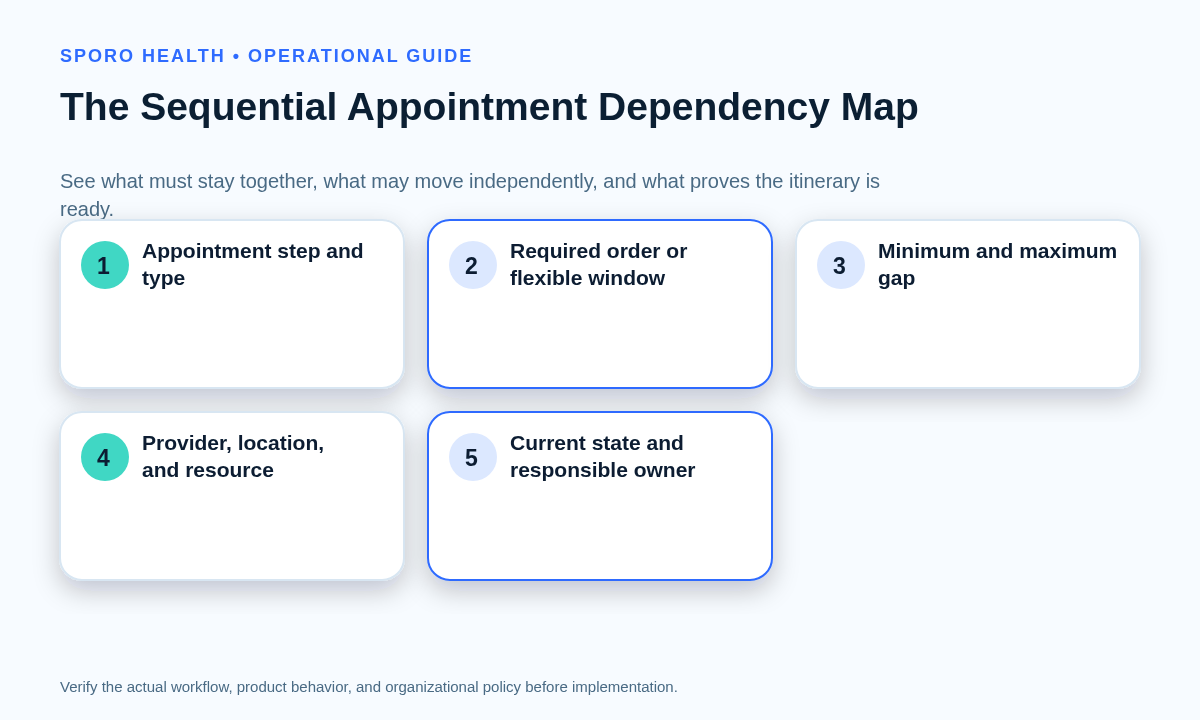
The sequence-control record should make every appointment, dependency, permitted interval, assignment, state, owner, and confirmation test visible on one page. It is an operational control record, not a substitute for the individual athenahealth appointments.
| Worksheet field | What to record |
|---|---|
| Step identity | Chain ID, step number, appointment ID, appointment type, and intended duration. |
| Dependency | Required predecessor, successor, hard-order rule, or checkpoint. |
| Timing window | Minimum gap, maximum gap, same-day boundary, and approved exceptions. |
| Assignment | Provider, department, location, room, equipment, and support resource. |
| Booking channel | Staff, patient portal, waitlist, referral queue, or another approved channel. |
| Control | Current booking state, responsible owner, exception owner, and deadline. |
| Evidence | athenahealth confirmation, required resource confirmation, patient communication status, and calendar verification. |
athenahealth’s FHIR scheduling configuration describes availability for a single appointment type and includes booking-channel and time-window concepts, reinforcing the need to validate each step’s own configuration. See athenahealth Patient Scheduling Configuration. Establish variable appointment length controls for specialty clinics before calculating feasible gaps.
Which appointment should be booked first in the sequence?
Book the most constrained approved step first unless a practice-defined scheduling prerequisite requires another order. Do not confirm the chain until every mandatory step has a valid destination or a documented exception owner and deadline.
Rank each step by scarcity of valid providers, locations, resources, timing windows, and booking channels. Reserve the highest-constraint step, test feasible upstream and downstream destinations, and release temporary holds that are no longer needed. Clinical or authorization prerequisites must come from approved practice policy; scheduling staff should not create them.
How should the six-state sequence ledger work?
The ledger should distinguish a complete itinerary from appointments that merely exist on separate schedules. Use one chain-level state with step-level evidence underneath it.
| State | Meaning | Exit condition |
|---|---|---|
| Proposed | The approved sequence is defined but no valid destination is reserved. | At least one controlled booking or hold exists. |
| Held | One or more destinations are temporarily reserved while dependencies are checked. | All holds convert, expire, or release. |
| Confirmed | Every mandatory step is booked and every dependency passes. | A change starts or the itinerary occurs. |
| Partially changed | One or more steps changed, but chain-wide verification is unfinished. | All affected dependencies pass or enter exception. |
| Exception | A mandatory step or rule is unresolved under a named owner and deadline. | The issue is repaired, accepted, or the chain is rebuilt. |
| Complete | Every expected step has a final disposition and no residual entry remains. | Closed. |
What should happen when one appointment changes?
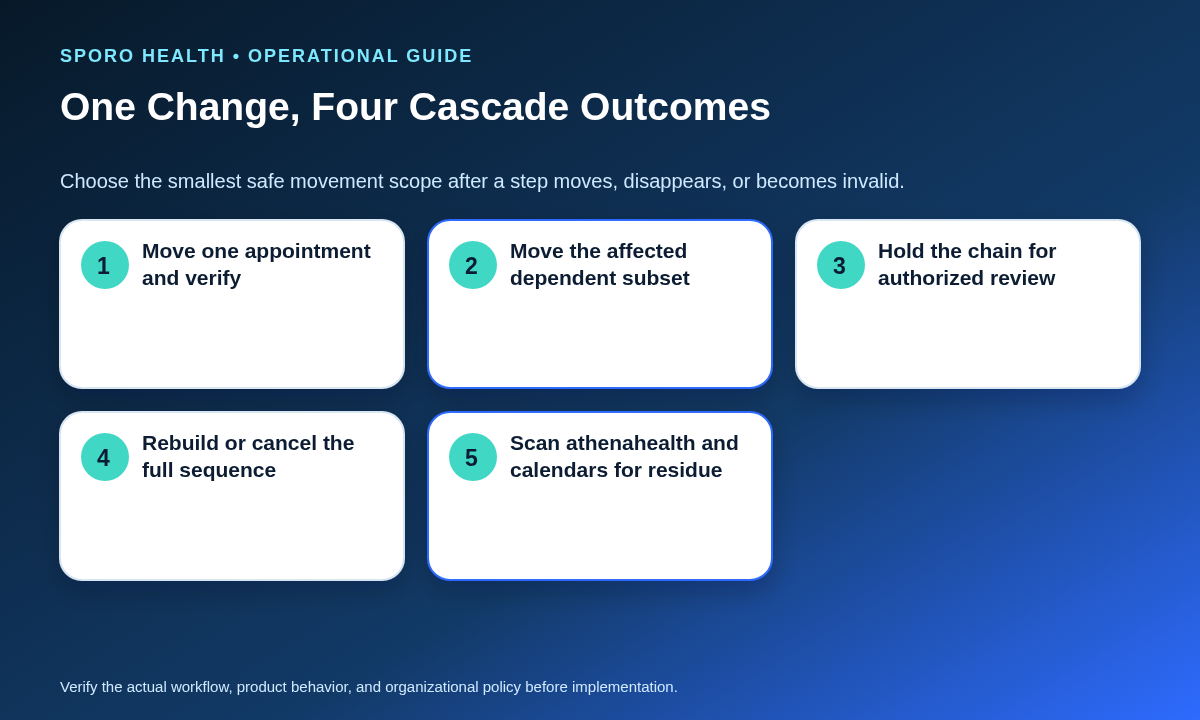
Scan upstream and downstream dependencies before editing, then move only the smallest scope that preserves every approved rule. If the impact cannot be proved, hold the chain for an authorized review.
| Condition after the proposed change | Cascade outcome | Required action |
|---|---|---|
| Order, gaps, assignments, and resources remain valid. | Move one appointment. | Edit the step, verify both neighbors, and return the chain to confirmed. |
| A known upstream or downstream subset becomes invalid. | Move the dependent subset. | Keep unaffected steps fixed and rebook the connected steps under one owner. |
| Authority, destination, prerequisite, or resource evidence is uncertain. | Hold for review. | Stop confirmation, assign an exception owner, and protect existing valid bookings. |
| The foundational step disappears or no compliant sequence remains. | Rebuild or cancel the full chain. | Account for every appointment, communication, hold, and calendar entry. |
If the destination location changes, apply the cross-location appointment reschedule workflow to confirm the provider, department, appointment type, resources, interval, and removal of source-location residue.
How should cancellations and waitlist offers affect the chain?
Do not automatically cancel or preserve the remaining appointments. Classify each remaining step as still valid, needing review, needing coordinated movement, or no longer schedulable.
- Still valid: every dependency remains satisfied.
- Needs review: impact is uncertain or approval is missing.
- Needs coordinated movement: a defined subset must move together.
- No longer schedulable: a required predecessor, destination, or resource cannot be restored.
Waitlist offers require the same dependency check. The multisite waitlist evaluation reported that linked appointments were commonly excluded and that inability to move linked or sequential appointments together limited adoption in tightly coordinated specialties. Use the waitlist workflow for canceled athenahealth appointments, but add a chain-eligibility gate before sending or accepting an offer.
How should Google Calendar or Outlook represent the itinerary?
Show each approved appointment interval according to the practice’s current synchronization rules, but do not make the external calendar the sole record of sequence order, dependencies, or completion. Calendar visibility and chain control are different responsibilities.
The Google Calendar event resource separately exposes event ID, start, end, status, and related fields; Microsoft Graph events likewise expose an ID, start and end, cancellation state, and optional transaction identifier. See the Google Calendar Events reference and Microsoft Graph event resource.
- Verify every expected interval and approved destination calendar.
- Check changed and canceled steps for stale or duplicate entries.
- Keep dependency rules, owners, deadlines, and completion evidence in the sequence ledger unless current product evidence proves otherwise.
Teams evaluating connected-calendar visibility can review the Sporo Health scheduling-automation overview, the vendor-described athenahealth and Google Calendar option, the athenahealth and Outlook option, and the Sporo listing in athenaConnect Marketplace. Confirm exact scope through current documentation and testing.
How should clinics recover common sequence failures?
Contain the uncertain chain, classify the failure, repair the smallest valid scope, reconcile every system, and obtain an accepted handoff before closure.
| Failure | Recovery action |
|---|---|
| Incomplete booking | Return the chain to proposed or held, name the missing step, owner, deadline, and patient-contact rule. |
| Canceled step | Classify every remaining appointment before cancellation, preservation, or coordinated movement. |
| Waitlist offer | Validate the offered slot against the dependency map before acceptance changes the chain. |
| Wrong-location move | Contain the step, verify the correct destination, repair affected dependents, and remove source residue. |
| Calendar residue | Compare approved athenahealth appointments with expected calendar events and resolve stale, missing, or duplicate entries. |
| Unaccepted handoff | Keep the chain in exception until the receiving owner acknowledges scope, deadline, and evidence. |
How should clinics measure broken or incomplete appointment sequences?
Measure whether complete chains reach a valid final state, not merely whether individual appointments exist. Use practice-defined targets and review results by pathway, location, and sequence model.
| Measure | Definition |
|---|---|
| Complete-chain rate | Confirmed or completed chains divided by chains due for confirmation or completion. |
| Partial-booking age | Elapsed time from the first controlled booking until confirmation or exception closure. |
| Broken-sequence rate | Chains with an invalid order, interval, assignment, or missing mandatory step divided by reviewed chains. |
| Cascade rework | Extra appointment edits caused by an initial change that failed to account for dependencies. |
| Residual calendar entries | Stale, missing, or duplicate external-calendar events remaining after chain changes. |
| Exception deadline closure | Exceptions closed by the assigned deadline divided by exceptions due. |
Place overdue partial chains, calendar residue, and unaccepted handoffs into daily athenahealth schedule reconciliation rather than allowing them to disappear into individual staff worklists.
How to coordinate sequential appointments in athenahealth specialty clinics
Start with one approved pathway, define its model and dependency worksheet, train named owners, and test booking, change, cancellation, waitlist, handoff, and calendar-residue scenarios. Expand only after the team can prove complete-chain closure.
- Approve the order and timing rules outside the live booking transaction.
- Build the sequence-control record and six-state ledger.
- Book the most constrained approved step first.
- Use the cascade matrix for every change or cancellation.
- Review chain-integrity measures and repair recurring failure patterns.
No connected-calendar product replaces practice-owned sequence policy. If external visibility is part of the design, document the exact Google Calendar or Outlook behavior required, ask the vendor to demonstrate it, and test one representative chain before broader use.
Frequently asked questions
What is the difference between sequential, recurring, and multi-resource appointments?
Sequential appointments are separate visits with order or timing dependencies; recurring appointments repeat a stable pattern; multi-resource appointments coordinate several resources for one visit.
How should schedulers build an appointment dependency map?
List every appointment, its predecessor and successor, minimum and maximum gap, provider, location, resource, booking channel, owner, state, and confirmation evidence.
Which appointment should be booked first in a specialty appointment sequence?
Book the most constrained approved step first unless a practice-defined prerequisite requires another order, and do not confirm the chain until every mandatory step is valid or explicitly owned as an exception.
What should happen when one appointment in a sequence is rescheduled?
Scan upstream and downstream dependencies before editing; move one appointment only if every rule remains valid, otherwise move the affected subset or rebuild the chain.
How should a cancellation or waitlist offer affect linked appointments?
Classify the remaining appointments before acting, and exclude or review any waitlist offer that would break order, timing, provider, location, or resource requirements.
How should Google Calendar or Outlook represent a multi-appointment patient itinerary?
Represent each approved appointment interval as its own calendar event under current synchronization rules, but keep sequence order, dependency rules, ownership, and completion in the practice’s control record.
How should clinics measure broken or incomplete appointment sequences?
Track complete-chain rate, partial-booking age, broken-sequence rate, cascade rework, residual calendar entries, and exceptions closed by deadline.
Sources
- athenahealth: Event Notifications Subscription Topics
- athenahealth: Patient Scheduling Configuration
- Google Calendar API: Events
- Microsoft Graph: Event resource type
- Automated Waitlists for Ambulatory Appointment Scheduling
- Patient Opportunities to Self-Schedule and Reschedule Medical Appointments
- Advance Multi-Priority, Multi-Appointment Patient Scheduling With Dependent Demand and Lead Times