Consolidating athenahealth Departments: A Many-to-One Scheduling Cutover Plan
To learn how to consolidate athenahealth departments without disrupting schedules, treat the change as a controlled many-to-one cutover. Practice operations executives should select one surviving boundary, inventory every dependency, assign each future transaction a disposition, stop new source bookings, migrate in a tested sequence, and retire source departments only after residual-activity and rollback checks pass.
How do you consolidate athenahealth departments without disrupting schedules?
Use one survivor, one dependency register, one release clock, and one owned exception ledger. A department can influence provider templates, appointment types, time-zone interpretation, permissions, saved views, patient booking, recurring appointments, resources, and follow-up work. The current athenaOne Service Description documents these scheduling relationships, while athenahealth event-notification topics show that appointment activity can be filtered by department. Renaming or hiding a source therefore does not prove its scheduling portfolio has moved.
Treat the source departments as active operational boundaries until every provider, transaction, queue, channel, permission, interface, report, and calendar mapping has a documented destination or authorized temporary exception.
Which athenahealth department should survive the consolidation?
Choose the department that best fits the future operating model with the least unjustified variation and migration risk. Complete the upstream work of deciding whether a separate athenahealth department is still justified before scoring candidates.
| Domain | Approval question | Required evidence |
|---|---|---|
| Operational purpose | Does it match the future service and location model? | Approved boundary statement |
| Provider coverage | Can every in-scope provider be represented correctly? | Provider-to-department map |
| Appointment types | Are eligibility, duration, and resource rules valid? | Destination rule comparison |
| Location and time zone | Will patients and staff see the correct place and time? | Representative schedule tests |
| Authority | Do the right roles have permitted and denied actions? | Permission test record |
| Booking channels | Can every staff and patient pathway target the survivor? | Booking-surface inventory |
| Integrations and reports | Can mappings and outputs be changed and reconciled? | Owner-approved change plan |
| Migration burden | How many exceptions require manual control? | Counted exception backlog |
Mark each domain ready, conditional, or blocked. A critical blocked domain should disqualify the candidate until a safe destination state exists.
What belongs in the department-consolidation dependency register?
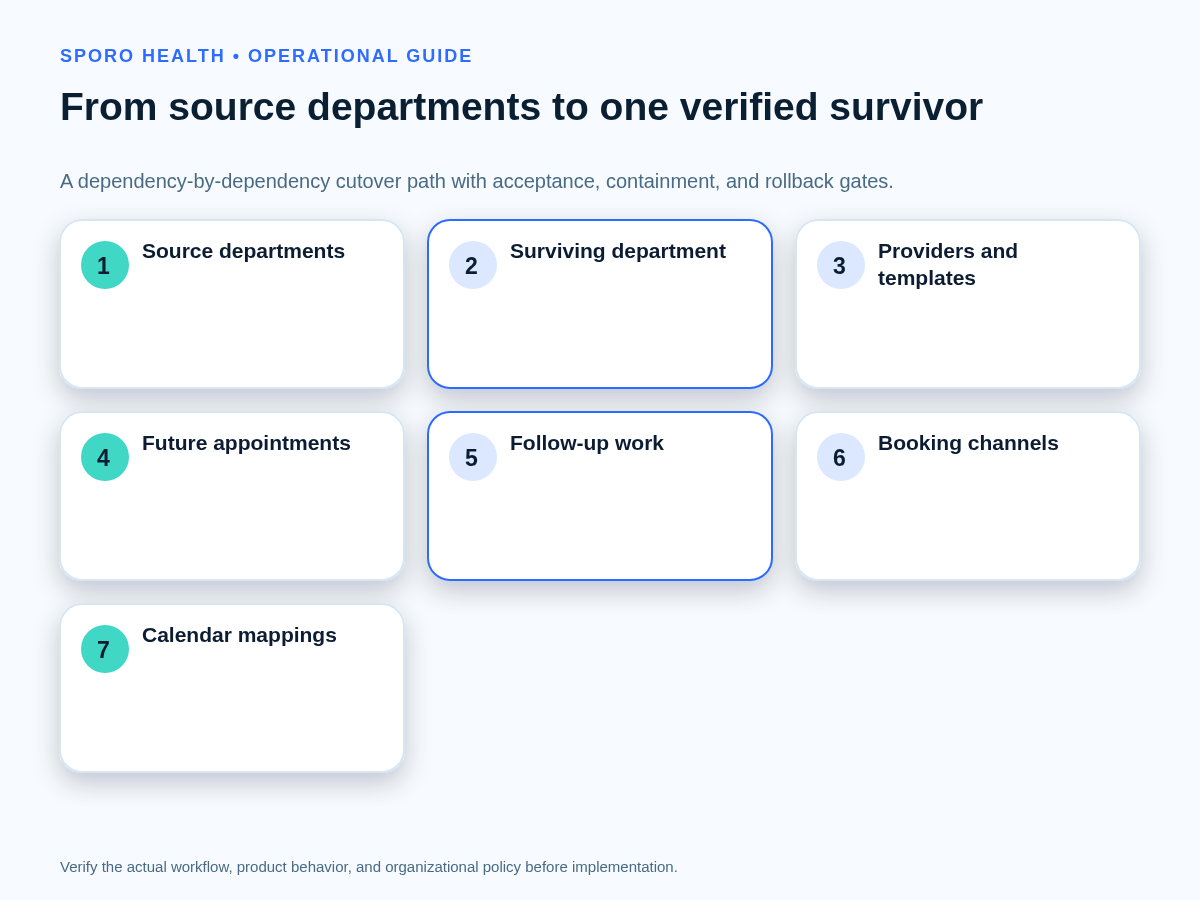
Record every object or workflow whose valid state depends on a source department. Include the existing state, approved destination, owner, migration method, evidence, deadline, and rollback action. If templates differ materially, address standardizing provider schedule templates across locations before asking one survivor to absorb them.
| Area | Inventory | Closure evidence |
|---|---|---|
| Capacity | Providers, templates, appointment types, blocks, resources | Approved destination mappings |
| Transactions | Future appointments, recurring series, cancellations in progress | Source and destination counts reconcile |
| Follow-up work | Reminders, ticklers, waitlists, unresolved scheduling tasks | Each item has a final disposition |
| Booking exposure | Staff views, self-scheduling, requests, referrals, interfaces | No uncontrolled source writer remains |
| Control layer | Permissions, reports, saved views, calendar mappings | Positive and negative tests pass |
The athenahealth Appointment Reminders documentation identifies appointment reminders as ticklers and associates them with department IDs. Do not retire a source while these follow-up obligations remain unowned.
Should departments be consolidated in one window or in waves?
Use one window only when every source shares a ready destination and all writers can switch together. Otherwise, reduce the rollback boundary with provider or workflow waves.
| Model | Use when | Primary advantage | Main risk and rollback boundary |
|---|---|---|---|
| Single window | Rules and dependencies are uniform | Short transition | Broad impact; roll back the full window |
| Provider wave | Readiness varies by provider | Smaller clinical-schedule boundary | Mixed departments persist; roll back one cohort |
| Workflow wave | Channels or work queues differ | Isolates complex pathways | Authority can become unclear; roll back one workflow |
| Extended dual boundary | Temporary exceptions cannot yet move | Preserves unresolved work | Source residue grows; contain named exceptions only |
Dual-boundary operation needs an expiry date, named owner, restricted writers, and daily reconciliation. It is a temporary containment state, not an indefinite operating model.
How should future appointments and scheduling work be classified?
Give every future transaction one of four dispositions before source capacity is removed. Use transaction-level checks rather than assuming that all work can move in bulk. For appointments needing a location or department change, use the controls for verifying individual cross-location appointment moves.
| Disposition | Use when | Required closure evidence |
|---|---|---|
| Preserve in survivor | The appointment remains valid without a patient-facing change | Correct provider, type, time, location, resources, and department |
| Controlled move | Destination rules require an authorized reschedule or rebooking | Source closed, destination verified, patient workflow completed |
| Temporary source retention | No safe destination exists before cutover | Restricted source, owner, expiry, and daily review |
| Authorized review | Operational staff cannot determine a valid destination | Named decision-maker, deadline, and documented resolution |
Track appointment or work-item identity, source, destination, owner, deadline, communication state, and closure evidence. For recurring work, reconcile both the parent series and individual exceptions.
What sequence should the many-to-one cutover follow?
Build and test the destination before stopping source booking, then migrate transactions before retiring the boundary. Provider-level waves can use the more detailed checklist for moving an active provider between athenahealth departments.
- Approve the survivor, cutover scope, decision deadline, and rollback owner.
- Baseline dependency counts and freeze unrelated configuration changes.
- Configure destination providers, templates, appointment types, resources, permissions, and views.
- Test the destination without changing live source authority.
- Publish one release clock for staff, patients, interfaces, and connected applications.
- Stop every source booking path before beginning the affected migration wave.
- Move or contain future appointments, follow-up work, mappings, reports, and saved views.
- Run acceptance tests, reconcile counts, and decide go, contain, or roll back.
Do not delete rollback evidence or remove source access needed for controlled recovery until the acceptance and residual-exposure gates have passed.
How should Google Calendar or Outlook mappings be updated?
Revalidate each provider-calendar connection as a mapping, not as a label-editing exercise. Confirm the provider-calendar pair, availability inputs, event destination, department or location association, recurring behavior, excluded calendars, and authorized writers.
- Test a new appointment and its event destination.
- Test a reschedule across the changed boundary.
- Test cancellation and residual event state.
- Test one recurring-series exception.
- Test an excluded or denied calendar.
- Verify rollback restores the prior mapping.
Google documents event IDs, calendar-specific identity, organizers, recurring-event parents, and instance exceptions in its Calendar Events resource and recurring-events guide. Microsoft documents event containers, identifiers, recurrence, location, and availability state in the Microsoft Graph event resource and event-update documentation. These platform behaviors are why a familiar title or location label is not sufficient mapping evidence.
For vendor-specific evaluation, review Sporo’s current athenahealth and Google Calendar connection, athenahealth and Microsoft 365/Outlook connection, and Sporo Health Google Calendar Sync listing in athenaConnect Marketplace. Treat the described capabilities as vendor claims and require consolidation-specific acceptance evidence.
What must be tested before normal booking reopens?
Test representative success, denial, exception, and rollback paths with traceable records. The athenaOne service description documents staff scheduling, saved views, recurring appointments, self-scheduling pathways, appointment audit evidence, waitlists, resources, and ticklers, so each locally enabled path should be included.
| Scenario | Evidence to retain |
|---|---|
| Create, reschedule, and cancel | Correct surviving department and no source residue |
| Recurring exception | Only the intended occurrence changes |
| Cross-location change | Location, time zone, resources, and provider remain valid |
| Patient self-scheduling | Allowed destination works; retiring source is unavailable |
| Reminder or waitlist work | Item remains owned and reaches the intended destination |
| Permission denial | Unauthorized role cannot edit or reopen source capacity |
| Calendar mapping and rollback | Expected event state appears and prior state can be restored |
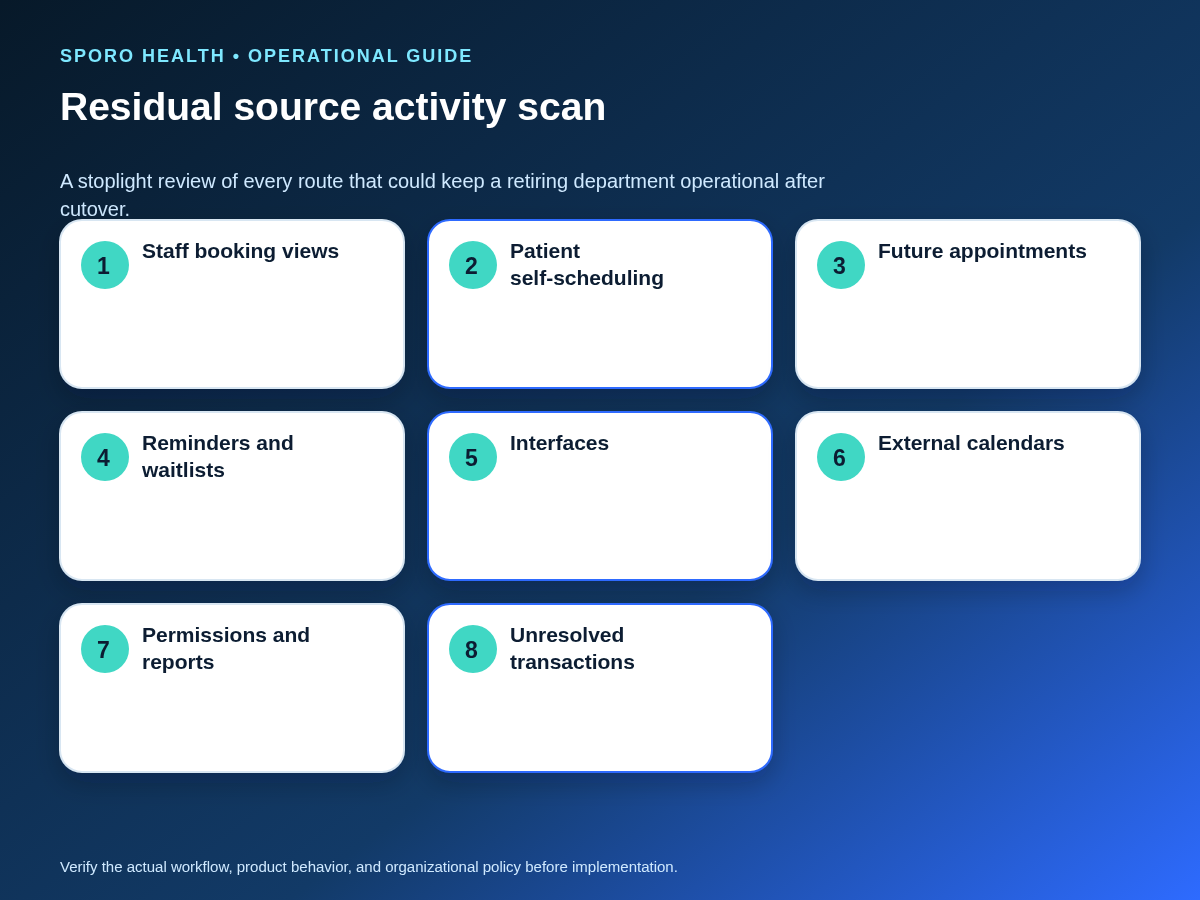
Then scan every route by which the retiring department could still receive work: staff booking, patient channels, appointment requests, future appointments, reminders, waitlists, interfaces, calendars, permissions, saved views, and reports. Any unexplained source activity enters an owned exception queue and holds retirement.
When should the cutover be rolled back or contained?
Roll back or contain the affected wave when the destination cannot preserve a valid, reconcilable scheduling state. Triggers include incomplete destination rules, incorrect provider or resource mappings, unaccounted appointments, an active source writer, uncertain calendar behavior, failed denial tests, or a ledger that cannot close by the decision deadline.
| Measure | What it reveals |
|---|---|
| Source-department booking attempts | Residual channel exposure |
| Wrong-department appointments | Rule or staff-view defects |
| Unresolved migrations | Transaction backlog |
| Calendar-mapping exceptions | Connection or recurrence uncertainty |
| Containment or rollback events | Cutover instability |
| Oldest unreconciled item | Exception-queue aging |
| Verified dependency closure | Retirement completeness |
Set local thresholds from baseline volume and risk rather than claiming a universal target. Use daily reconciliation and exception handoffs after cutover until every source dependency is closed or formally accepted as a bounded exception.
How should leaders put the consolidation plan into use?
Approve retirement only when operational, administrative, integration, and executive owners sign the same evidence packet.
- Operations confirms every future transaction has a disposition.
- The scheduling administrator confirms destination configuration and source restrictions.
- IT or integration owners confirm interfaces and calendar mappings.
- The accountable leader accepts remaining exceptions, expiry dates, and rollback status.
This is how to consolidate athenahealth departments without disrupting schedules: move authority and evidence together, not merely configuration labels. If connected-calendar visibility is part of the future state, review Sporo Health’s scheduling automation options and request a scenario-based demonstration against the register, acceptance suite, and rollback conditions before approving production changes.
Frequently asked questions
Can multiple athenahealth departments be consolidated in one cutover?
Yes, but only when every source shares a tested destination state and the practice can control all booking channels during one window. If dependencies differ, use provider or workflow waves so one failed area does not force a practice-wide rollback.
Which athenahealth department should survive a consolidation?
Choose the department with the strongest fit for the future operating model, not simply the largest appointment volume. Compare provider and appointment-type coverage, location and time-zone rules, permissions, booking channels, integrations, reporting, and justified local variation.
Should every future appointment move to the surviving department?
No. Classify each appointment as valid in the survivor, requiring a controlled move, temporarily retained in the source, or requiring authorized review. Every appointment needs an owner, destination decision, deadline, and closure evidence before source capacity is removed.
When can a source department stop accepting new bookings?
Stop new source bookings only after the destination is ready and every staff, patient, referral, interface, and connected-application channel can switch on the same release clock. Any uncontrolled channel that still writes to the source should hold retirement.
How should patient self-scheduling be verified after consolidation?
Run representative bookings for each permitted patient, provider, appointment-type, location, and department combination, then verify the resulting appointment in staff views and audit evidence. Also test denied combinations so the retiring department does not remain selectable or receive requests.
What must be rechecked in Google Calendar or Outlook?
Confirm the intended provider-calendar pair, availability inputs, event destination, department or location mapping, recurring behavior, excluded calendars, and create, reschedule, and cancellation results. A correct label alone does not prove the underlying athenahealth mapping changed.
When should an athenahealth department consolidation be rolled back?
Roll back or contain the affected wave when destination rules are incomplete, appointment identity cannot be reconciled, providers or resources are mapped incorrectly, a source booking channel remains active, calendar behavior is uncertain, or the transaction ledger cannot be closed by the decision deadline.
Sources
Primary platform sources consulted for the operational and technical claims in this guide: