
Physician Out-of-Office Requests in athenahealth: An Availability-Control Workflow
A physician out-of-office workflow for athenahealth scheduling should move every temporary absence through seven controls: classify the change, authorize it, stop new bookings, identify patient and location impact, assign coverage or disposition, verify every calendar, and schedule reopening. Practice managers should name one control owner so physicians and scheduling teams know who can approve, execute, verify, and close the request.
What is the control standard for a physician absence?
The control standard is one authorized absence record, one accountable owner, one defined window, and one evidence-based closure. A personal calendar event or verbal message can initiate the process, but neither proves that athenahealth capacity, booked appointments, coverage, locations, or reopening were handled.
The request record should capture the physician, absence type, local start and end times, time zone, affected departments and sites, recurrence, coverage needs, approver, schedule-control owner, and intended reopening date. Keep approval separate from execution: the requester describes the need, an authorized leader approves the change, scheduling teams implement it, and a named verifier checks the result.
If the workflow record contains patient information, use an approved system and apply organizational access policies. HHS explains that, where the minimum necessary standard applies, covered entities should limit uses, disclosures, and requests for protected health information to what the purpose requires in its minimum necessary guidance. That source does not replace practice-specific privacy review.
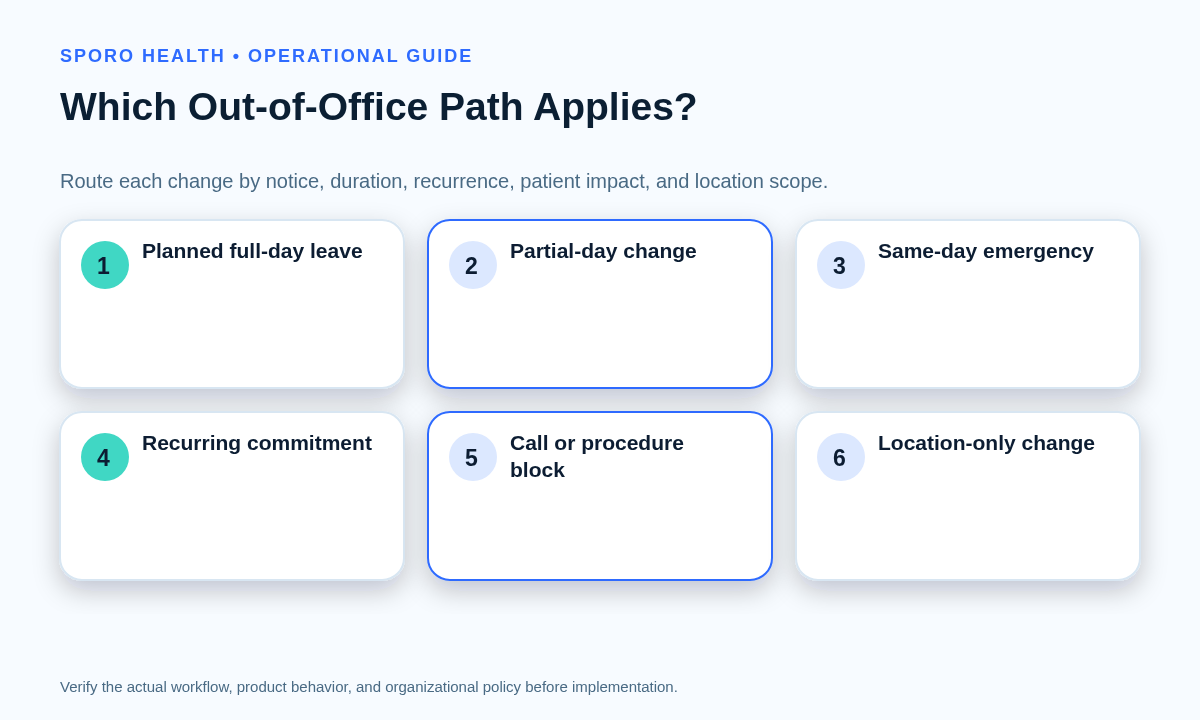
Which physician out-of-office path applies?
Route the request by notice, duration, recurrence, patient impact, and location scope rather than treating every absence as the same calendar block. The route determines how quickly capacity must be protected, which appointments need review, and how reopening is controlled.
| Absence type | First control | Primary closure risk |
|---|---|---|
| Planned full-day leave | Approve dates, then block every affected department before outreach. | A site or template remains bookable. |
| Partial-day or late start | Record exact local boundaries and preserve unaffected capacity. | Boundary slots or time zones are wrong. |
| Same-day emergency | Contain immediately; complete documentation after new bookings stop. | Today’s patients remain ownerless. |
| Recurring commitment | Set start, end, exception rule, series scope, owner, and review date. | The series outlives its purpose. |
| Call, procedure, or meeting block | Define whether the block is fixed, movable, or coverable. | Staff interpret protected time as flexible. |
| Location-only change | Change the named site or department and account for travel. | Other locations are changed unintentionally. |
This routing discipline helps prevent athenahealth double-booking because an external commitment is not considered controlled until the corresponding bookable window has been checked.
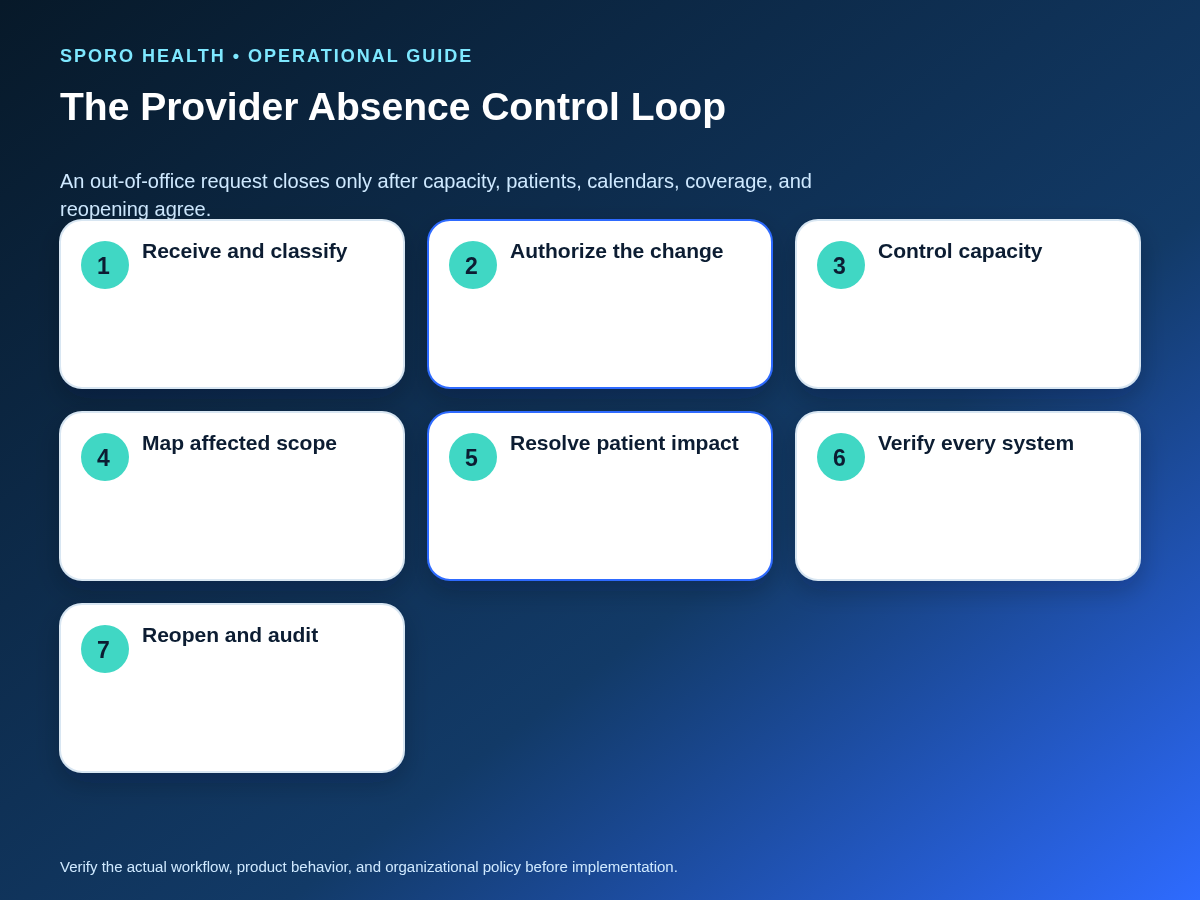
How does the seven-state request-to-reopening control loop work?
The request advances only when the current state has an owner, required evidence, and a defined closure condition. A practice can use a ticket, task record, or approved operations queue, provided the state and responsible person remain visible.
| State | Entry and owner | Evidence required to advance |
|---|---|---|
| Received | Physician or delegate submits the request. | Provider, window, type, locations, recurrence, and urgency are complete. |
| Authorized | Authorized leader confirms scope and priority. | Approval, exceptions, coverage authority, and reopening expectation are recorded. |
| Capacity controlled | Schedule-control owner stops new bookings. | Before-and-after evidence covers every affected athenahealth department or template. |
| Scope mapped | Scheduling lead sweeps patients, sites, travel, calendars, and coverage. | No overlapping window remains unreviewed. |
| Impact resolved | Named appointment owners execute each disposition. | Every appointment is kept with coverage, moved, canceled, or escalated. |
| Verified | A named verifier compares intended and observed states. | The cross-system grid is complete and exceptions have owners and deadlines. |
| Reopened | Reopening owner restores approved capacity. | Restrictions are removed as intended and the first normal session is rechecked. |
Practices can establish provider scheduling rules during onboarding, including who may request, approve, execute, and verify temporary deviations from the baseline schedule.
How should booked patients be triaged after an absence is approved?
Freeze new bookings, generate the affected-appointment list, and assign every appointment one disposition and one owner. Do not close the absence while an appointment is unassigned, even if patient contact or an authorized decision is still pending.
| Disposition | Use when | Minimum worksheet evidence |
|---|---|---|
| Keep with coverage | An authorized covering provider and suitable setting are confirmed. | Coverage provider, location, patient communication owner, and confirmation status. |
| Move | An acceptable replacement slot is available. | Original and new appointment references, contact status, and scheduler. |
| Cancel | No approved alternative will be used. | Authorization, communication status, and follow-up owner. |
| Escalate | The decision exceeds scheduling authority. | Decision-maker, deadline, interim instruction, and responsible owner. |
For same-day emergencies, contain first: protect capacity, identify today’s affected patients, name the decision owner, communicate the coverage plan, and place unresolved work in the end-of-day queue. Staff can then reconcile reschedules and cancellations after an absence without losing transaction-level ownership.
What must cross-system verification cover?
Verification must compare the approved absence with athenahealth capacity, every affected operating context, the external calendar, coverage, and the reopening plan. Checking only the originating calendar can miss bookable time in another department, site, or time zone.
| Control point | What the verifier confirms |
|---|---|
| Provider identity | The restriction belongs to the intended provider and calendar. |
| Department or template | Every overlapping scheduling context reflects the approved window. |
| Location and travel | Affected sites are blocked while unaffected sites remain usable. |
| Time zone | Local times, offsets, and daylight-saving boundaries agree. |
| External calendar | The expected event, status, duration, and visibility are present. |
| Recurring scope | The parent series, individual occurrence, exceptions, and end date are correct. |
| Coverage | The covering provider, site, and responsible scheduler agree. |
| Reopening | A named owner, date, and post-return audit are scheduled. |
Record expected state, observed state, verifier, timestamp, and correction for each row. Use the current athenahealth appointment API reference as a technical cross-check with authorized implementation resources rather than inferring appointment or slot behavior from an external calendar. Practices with several sites should also manage multi-location athenahealth scheduling as a distinct operating problem.
How do Google Calendar and Outlook differ for absence controls?
Use the same governance sequence for Google Calendar and Outlook, but test their event semantics and client behavior separately. An event that communicates location or availability in one platform should not be assumed to produce an equivalent state in another platform or in athenahealth.
| Platform evidence | Operational implication |
|---|---|
| Google documents separate focus-time, out-of-office, and working-location status events. | Test each intended event type; do not classify every status as an absence. |
| Google’s API guidance describes out-of-office events as opaque and working-location events as transparent. | Verify whether the selected event actually blocks time in the practice’s workflow. |
| Google event resources include recurrence, start, end, and time-zone fields. | Test parent series, occurrences, exceptions, and time zones independently. |
| Microsoft documents work-location settings and out-of-office appointments using Free/Busy state. | Test the organization’s Outlook clients, account type, sharing, and intended Show As behavior. |
These distinctions are documented in Google’s Calendar status-event guide, its Events API reference, and Microsoft’s Outlook work-hours and location guidance. They establish platform concepts, not how a particular integration maps them.
How do you reopen a physician schedule and recover stale blocks?
Reopening is a controlled change, not the automatic expiration of an absence record. Confirm the return decision, compare the current schedule with the approved baseline, remove only the intended restriction, verify every location and calendar, and recheck after the first normal clinic session.
- Confirm the approved return window and whether coverage or patient changes remain active.
- Pause competing edits while the reopening owner compares the baseline with current state.
- Remove or shorten the temporary restriction in every affected scheduling context.
- Verify external-calendar events, recurring parents, exceptions, departments, and sites.
- Do not automatically reverse completed patient moves or cancellations; retain their documented disposition.
- Audit the first normal session and assign any mismatch to an owner.
| Stale-block condition | Recovery path |
|---|---|
| Absence ends early | Obtain authorization, shorten the window, rerun the capacity and patient-impact checks, then verify. |
| Recurring series outlives its purpose | Identify the parent and exceptions, end only the intended scope, and inspect future dates. |
| Reopening is incomplete | Compare every department, site, and calendar with the baseline and restore missing capacity. |
| Conflicting edits occurred | Preserve timestamps and references, freeze further edits, obtain an authority decision, and re-verify. |
If temporary leave becomes a departure or indefinite separation, separate temporary leave from permanent provider offboarding; access revocation and asset transfer should not be improvised inside an absence ticket.
Where can calendar synchronization help?
Synchronization can transport an approved availability state where supported, but it cannot supply authorization, patient disposition, coverage, communication, or final verification. The operating workflow must remain valid when a connection is delayed, unavailable, or does not support the selected event type.
Sporo’s current athenahealth and Google Calendar product page and athenahealth and Outlook Calendar product page describe bidirectional calendar connections. Those are vendor claims: practices should validate supported event types, recurrence, department and provider mappings, failure handling, privacy configuration, and reopening behavior during evaluation. The Sporo Health listing in the athenaConnect Marketplace is another commercial destination, not independent evidence.
If the control matrix exposes a visibility problem, review Sporo Health and ask the vendor to demonstrate each absence path against written acceptance criteria rather than relying on a general calendar-sync demonstration.
Implementation checklist
- Name the authorized requester, approver, schedule-control owner, patient-change owners, verifier, and reopening owner.
- Publish the six absence routes and their urgency rules.
- Require provider, window, time zone, department, location, recurrence, and return date.
- Block new bookings before patient outreach begins.
- Assign every affected appointment one disposition and owner.
- Verify provider, department, site, travel, time zone, calendar, coverage, and reopening.
- Give recurring blocks an end condition and review cadence.
- Keep a same-day reconciliation queue.
- Recheck the first normal clinic session.
- Escalate permanent or indefinite departures to offboarding.
Frequently asked questions
What is the physician out-of-office workflow for athenahealth scheduling?
Use seven controls: classify the absence, confirm authorization, stop new bookings, map affected patients and locations, assign coverage or disposition, verify every calendar state, and schedule reopening. Keep one owner accountable through closure.
How should a practice handle a same-day provider absence?
Contain the schedule first: block new bookings, identify today’s affected patients, name the decision owner, communicate coverage, and log unresolved work for end-of-day reconciliation.
Who owns provider schedule changes across athenahealth and external calendars?
Name one schedule-control owner for the absence. The physician or delegate requests the change, an authorized leader approves it, scheduling teams execute patient changes, and a named verifier confirms closure.
How should recurring physician availability blocks be managed?
Require an approved start date, end date, exception rule, series scope, owner, and review cadence. Do not leave a recurring restriction active without a documented end condition.
How should a physician schedule reopen after temporary leave?
Reopen only after athenahealth capacity, every affected location, the external calendar, coverage assignments, and the approved return window agree. Recheck after the first normal clinic session.
Does a physician-created personal out-of-office event complete the practice workflow?
No. A personal out-of-office event should trigger the authorized practice process; it does not by itself prove that athenahealth capacity, affected appointments, coverage, or reopening were controlled.
Put the physician out-of-office workflow into practice
A physician out-of-office workflow for athenahealth scheduling is dependable when closure means more than creating a calendar event. The absence is complete only when approved scope, bookable capacity, affected patients, coverage, locations, external calendars, and reopening evidence agree—and when a named owner checks the first normal session for stale restrictions.
Sources
- athenahealth Appointment API reference
- Google Calendar status-event guide
- Google Calendar Events API reference
- Microsoft Outlook work-hours and location guidance
- HHS minimum necessary guidance
- Sporo Google Calendar product page — vendor source
- Sporo Outlook product page — vendor source
- Sporo Health athenaConnect Marketplace listing — vendor source

2 Comments
Comments are closed.

[…] the change is caused by a temporary physician absence rather than a routine rotation trade, use the physician out-of-office availability workflow to control affected appointments and later […]
[…] the physician out-of-office availability workflow when lifecycle controls do not change. If the provider will not return, move to the provider […]