Physician Call Coverage for athenahealth Practices: A Rotation-to-Clinic Handoff Playbook
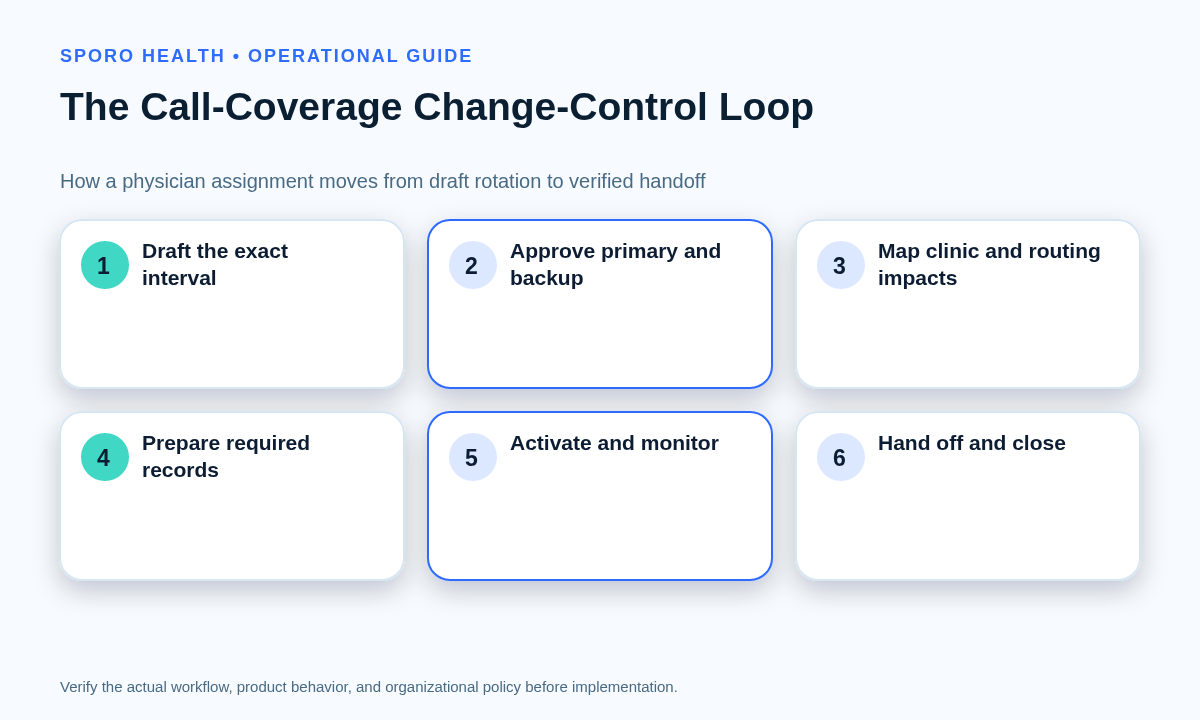
A physician call coverage scheduling workflow for athenahealth practices should treat every assignment or swap as a controlled change. Specialty-practice managers should approve the exact duty interval, name primary and backup coverage, map clinic and routing impacts, update each required record, and verify both boundaries before closure. Calendar visibility can support this process, but it cannot define policy or confirm relief.
What is the physician call coverage scheduling workflow for athenahealth practices?
A reliable workflow moves each assignment through six controlled states: draft, approved, prepared, active, handed off, and closed. One approved roster determines call responsibility, athenahealth governs patient-bookable clinic capacity, and external calendars display commitments. Staff should never decide who is on call by opening whichever calendar is most convenient.
| State | Accountable owner | Exit criterion |
|---|---|---|
| Draft | Rotation coordinator | Primary, backup, and exact interval are proposed. |
| Approved | Authorized practice leader | Coverage and exceptions meet approved policy. |
| Prepared | Coverage coordinator | Clinic, routing, roster, and calendar actions are assigned. |
| Active | Shift coordinator | Start boundary and incoming physician are confirmed. |
| Handed off | Outgoing and incoming physicians | Responsibility transfers at a recorded boundary. |
| Closed | Verifier | End boundary is checked and mismatches are resolved. |
When call duty changes bookable capacity, validate the implementation against the current athenahealth appointment API reference and the practice’s configured scheduling rules.
Which call duties should change clinic scheduling?
Call duty should change clinic scheduling only when an approved call-impact rule says that the duty affects capacity, location, protected time, or another operational constraint. The matrix prevents staff from treating every call shift as an all-day absence or ignoring a duty period that genuinely changes clinic operations.
| Duty pattern | Decision question | Clinic action | Routing and calendar action |
|---|---|---|---|
| After-hours only | Is any clinic restriction preapproved? | None unless the rule requires it. | Update roster, routing, and exact commitment. |
| Overnight with protected time | Which session is protected? | Restrict only the approved interval. | Carry primary, backup, and boundaries. |
| Alternate-site call | Does location affect clinic feasibility? | Adjust location or capacity if approved. | Show site commitment and time zone. |
| Full-shift swap | Does either physician’s clinic plan change? | Apply each physician’s impact separately. | Replace primary and reconfirm backup. |
| Split shift or backup activation | Where does responsibility transfer? | Avoid an all-day block for a partial change. | Use adjacent intervals with no gap or overlap. |
Approve the matrix through the practice’s operational governance. It should not invent clinical, fatigue, employment, or legal rules.
What belongs on a coverage-change transaction card?
The card should preserve the original assignment and record every decision needed to activate, verify, and close the replacement coverage. One card should follow the change across owners instead of allowing separate messages, calendar edits, and verbal approvals to become competing records.
| Card section | Required fields |
|---|---|
| Identity | Parent rotation, original assignment, and change type. |
| Coverage | Relieving physician, backup, and direct acceptance. |
| Interval | Start, end, time zone, and split boundaries. |
| Downstream impact | Affected clinic sessions, locations, routing, roster, and calendars. |
| Authority | Approver, system editors, escalation owner, and decision time. |
| Evidence | Before-and-after records, verifier, closure time, and disposition. |
How do you process a physician call schedule swap without leaving clinic availability wrong?
Retain the original assignment, confirm the relieving physician, apply the impact matrix, update every required record, and verify both ends of the interval. A calendar edit alone does not complete the swap.
- Open one transaction card and freeze informal assumptions.
- Record the original primary, backup, and exact effective interval.
- Obtain direct acceptance from the incoming physician.
- Apply the call-impact matrix to both physicians.
- Update the roster, routing, and affected athenahealth capacity.
- Update external calendars using the correct recurrence scope.
- Verify the start boundary, end boundary, and adjacent assignments.
If the change is caused by a temporary physician absence rather than a routine rotation trade, use the physician out-of-office availability workflow to control affected appointments and later reopening.
How should rotating call coverage appear in Google Calendar and Outlook?
External calendars should display the approved commitment and exact interval, but the approved call roster should remain the authority for primary and backup responsibility. Calendar synchronization must not approve a swap, activate routing, or decide whether clinic capacity changes.
Google documents parent recurring events, individual instances, and exceptions, and warns against editing instances one by one when the intended change affects an entire series or this-and-following occurrences in its recurring-event guide. Google also states that a recurring event needs one defined time zone in its calendar event-time documentation.
The Microsoft Graph event resource distinguishes series masters, occurrences, exceptions, and cancelled occurrences. Microsoft’s Outlook recurring-event instructions describe edit scopes for one event, the entire series, or this and following events.
| Change | Representation rule | Verification |
|---|---|---|
| One-occurrence swap | Create a traceable exception to the parent rotation. | Check the preceding and following occurrences. |
| This-and-following change | Preserve history and replace the future pattern. | Confirm the cutover occurrence and future end date. |
| Full-series replacement | Version the rotation and retire the old series. | Search for active stale copies. |
| Split shift | Use two adjacent, non-overlapping intervals. | Verify the handoff timestamp. |
| Cancellation | Cancel the occurrence and record the disposition. | Confirm backup or escalation if required. |
| Stale copy | Correct it only after comparison with the roster. | Inspect shared calendars and handoff records. |
When call rotations coexist with specialty sessions, align the recurrence decision with the practice’s recurring procedure-block change rules.
For vendor-specific evaluation, review Sporo’s athenahealth and Google Calendar product page and athenahealth and Microsoft 365/Outlook product page. Confirm and test call-related behavior rather than assuming a general calendar block represents approved coverage.
What should staff verify after an on-call coverage change?
Staff should verify the primary, backup, interval boundaries, routing, clinic impact, location, recurrence scope, and adjacent assignments. The verifier should work from the transaction card and approved roster, not from memory.
- Exact start, end, date, and time zone
- Primary and backup on the approved roster
- After-hours routing and contact records
- Affected athenahealth sessions, locations, and capacity
- Google Calendar or Outlook event and recurrence scope
- Assignment immediately before and after the changed interval
- Incoming acceptance and outgoing handoff
- Verifier identity, timestamp, and evidence location
If approved clinic changes require appointment work, route them through the front-desk reconciliation workflow and keep the resulting evidence attached to the coverage transaction.
Who owns physician call coverage schedule changes?
One coverage coordinator should own the transaction, while named system owners complete the edits within their authority. Approval, execution, physician acceptance, and independent verification should remain distinguishable even when a small practice assigns several roles to one person.
| Role | Decision or action |
|---|---|
| Policy owner | Approves impact rules and escalation paths. |
| Coverage coordinator | Owns the card from request through closure. |
| Physician | Accepts or declines the exact interval. |
| Clinic scheduler | Changes authorized athenahealth capacity. |
| Routing owner | Activates and verifies contact routing. |
| Verifier | Checks boundaries and records closure evidence. |
How do you recover from gaps, overlaps, and stale recurring call assignments?
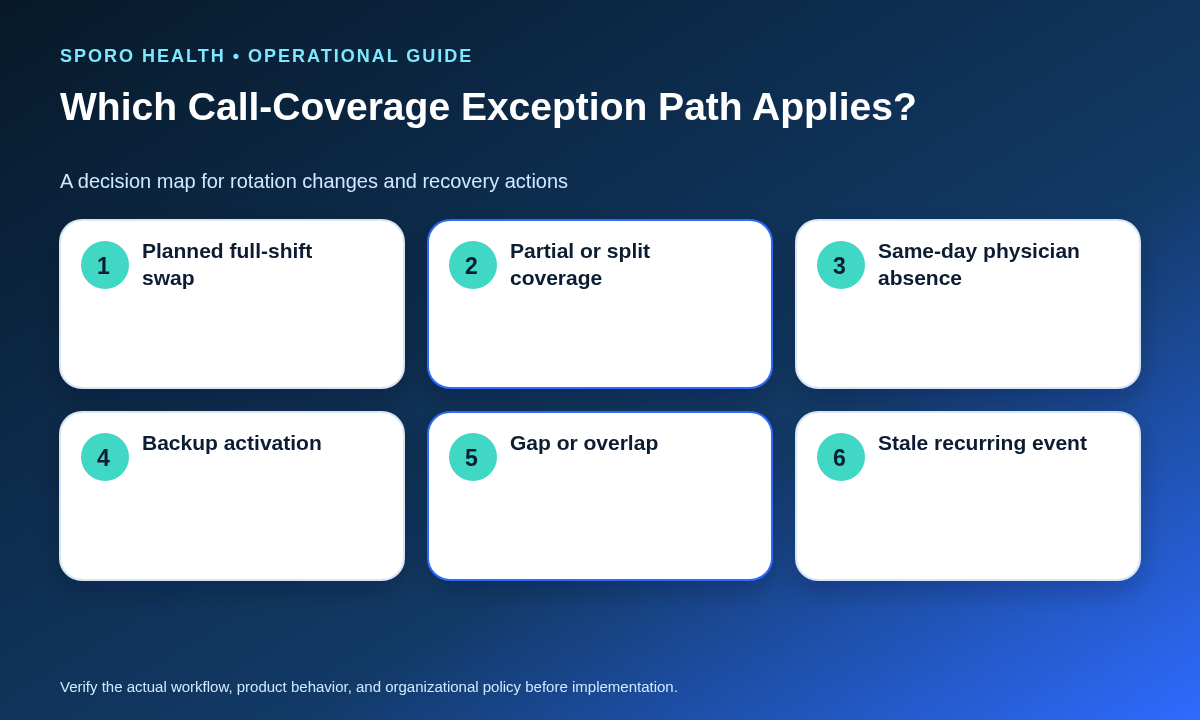
Contain the effective interval first, establish the approved assignment, correct each downstream record, and verify the full interval before closing the exception. If coverage cannot be confirmed, follow the practice’s approved escalation policy.
- Declare the exact disputed interval and one exception owner.
- Compare the roster and transaction card before trusting calendars.
- Confirm primary or backup responsibility directly.
- Contain routing and clinic exposure under approved procedures.
- Reconcile roster, routing, athenahealth, and external calendars.
- Verify both boundaries and reopen the issue if disagreement remains.
| Failure | Required closure evidence |
|---|---|
| Uncovered interval | Named physician and confirmed start and end. |
| Overlapping assignments | One primary plus documented backup. |
| Unconfirmed relief | Direct acceptance or completed escalation. |
| Wrong clinic availability | Corrected session and appointment disposition. |
| Stale calendar or routing record | Corrected copy plus adjacent-interval check. |
Unresolved mismatches should enter the practice’s daily schedule exception handoff with an owner, priority, containment status, and next review time.
How should the call-coverage workflow be measured?
Measure whether the control worked, not whether a calendar event merely existed. Review the worksheet at a stable cadence and investigate repeat causes without implying clinical outcomes.
| Measure | Definition | Operational use |
|---|---|---|
| Advance verification | Assignments checked before activation | Find preparation failures. |
| Gap or overlap count | Disputed responsibility intervals | Test roster and handoff rules. |
| Swap lead time | Approval-to-activation time | Separate planned from urgent work. |
| Next-day clinic corrections | Post-activation capacity fixes | Improve the impact matrix. |
| Stale recurring entries | Old copies found after series changes | Improve recurrence cleanup. |
| Reopened exceptions | Issues returned after handoff | Strengthen closure evidence. |
Use the worksheet alongside broader athenahealth scheduling control basics, including clear edit authority and routine schedule audits.
How do you put the playbook into practice?
Start with one rotation, one coordinator, one approved impact matrix, and one transaction card. Test planned and same-day swaps before expanding. A physician call coverage scheduling workflow for athenahealth practices is dependable only when the roster, routing, clinic capacity, and calendars agree across the full effective interval.
If connected calendar visibility is part of the design, visit Sporo Health and compare the Sporo Health listing in the athenaConnect Marketplace. Treat vendor destinations as evaluation inputs and require practice-specific validation.
Frequently asked questions
What is the physician call coverage scheduling workflow for athenahealth practices?
A physician call coverage scheduling workflow for athenahealth practices controls the assignment and its downstream effects as one change. The approved roster—not an external calendar—should determine who is on call.
How do you handle a physician call schedule swap without leaving clinic availability wrong?
Retain the original assignment, document the replacement interval, and apply only approved clinic changes. Update routing and calendars, then verify both boundaries before closing the swap.
Who owns physician call coverage schedule changes?
One coverage coordinator should own the transaction from request through closure. Named system owners make authorized edits, and the incoming physician confirms acceptance.
How should rotating call coverage be represented in Google Calendar and Outlook?
Represent the exact interval and recurrence scope with a traceable connection to the approved rotation. Check one-occurrence, future-series, and full-series changes for stale exceptions.
What should staff verify after an on-call coverage change?
Verify the primary, backup, boundaries, time zone, routing, clinic impact, calendars, and adjacent assignments. Record who completed the check and when.
How do you fix stale recurring call assignments across calendars?
Compare each copy with the approved roster and identify its parent series before correcting it. Inspect adjacent occurrences and reopen the exception if systems still disagree.
Can calendar synchronization approve or route call coverage?
No. Calendar synchronization can improve visibility but cannot approve a swap, define policy, or activate clinical routing. Those decisions remain with the practice’s approved operating model.
Sources
- athenahealth Appointment API — primary implementation reference.
- Google Calendar recurring events — series, instances, and exceptions.
- Google Calendar event and time-zone concepts.
- Microsoft Graph event resource — recurrence object types.
- Microsoft Outlook recurring-event instructions.
- Sporo athenahealth and Google Calendar page — current vendor description.
- Sporo athenahealth and Outlook page — current vendor description.