
Tentative Physician Calendar Holds in athenahealth: A Confirm-or-Release Workflow
How should tentative calendar events affect physician availability in athenahealth? Practice managers should apply a written confirm-or-release policy: evaluate the event’s RSVP, time-blocking state, lifecycle, calendar source, booking horizon, and patient overlap; then provisionally hold, confirm unavailable, release capacity, or escalate. Every hold needs an owner, a confirm-by deadline, and verified closure in both athenahealth and the external calendar.
The word “tentative” is not a complete booking instruction. It can describe an attendee’s response, an event’s lifecycle, or how time appears in a calendar. The workflow below converts those separate signals into a controlled, expiring decision without letting an uncertain commitment silently override booked patient care.
Is a tentative RSVP the same as a tentative availability status?
No—a tentative attendance response and a tentative or busy availability state are different signals. The practice must inspect RSVP, time blocking, event lifecycle, calendar scope, and the current athenahealth schedule separately before changing bookable capacity.
The Google Calendar Events API separates an attendee’s responseStatus from event status and transparency. Microsoft likewise separates responseStatus, showAs, cancellation state, and recurrence type in its event resource; its responseStatus documentation distinguishes tentative acceptance from no response. Therefore, no single “tentative” label proves that athenahealth capacity should close.
| Signal | What it proves | Operational use |
|---|---|---|
| RSVP | Attendance response only | Identifies pending, tentative, accepted, or declined participation |
| Busy or free effect | External-calendar time blocking | Shows whether that calendar treats the interval as occupied |
| Lifecycle | Confirmed, canceled, moved, or deleted state | Prevents stale or canceled events from retaining holds |
| Calendar source | Which calendar supplied the event | Determines whether the calendar is approved to influence availability |
| athenahealth state | Patient and capacity commitments | Identifies existing care that the external event must not silently displace |
Document eligible calendars and precedence before applying this narrower lifecycle. The broader physician personal-calendar conflict rules provide that surrounding signal contract.
Should tentative physician calendar events block patient booking?
They should not block booking automatically under a blanket rule. Each event should receive one of four outcomes based on approved calendar scope, blocking state, RSVP, booking horizon, recurrence, remaining capacity, and patient overlap.
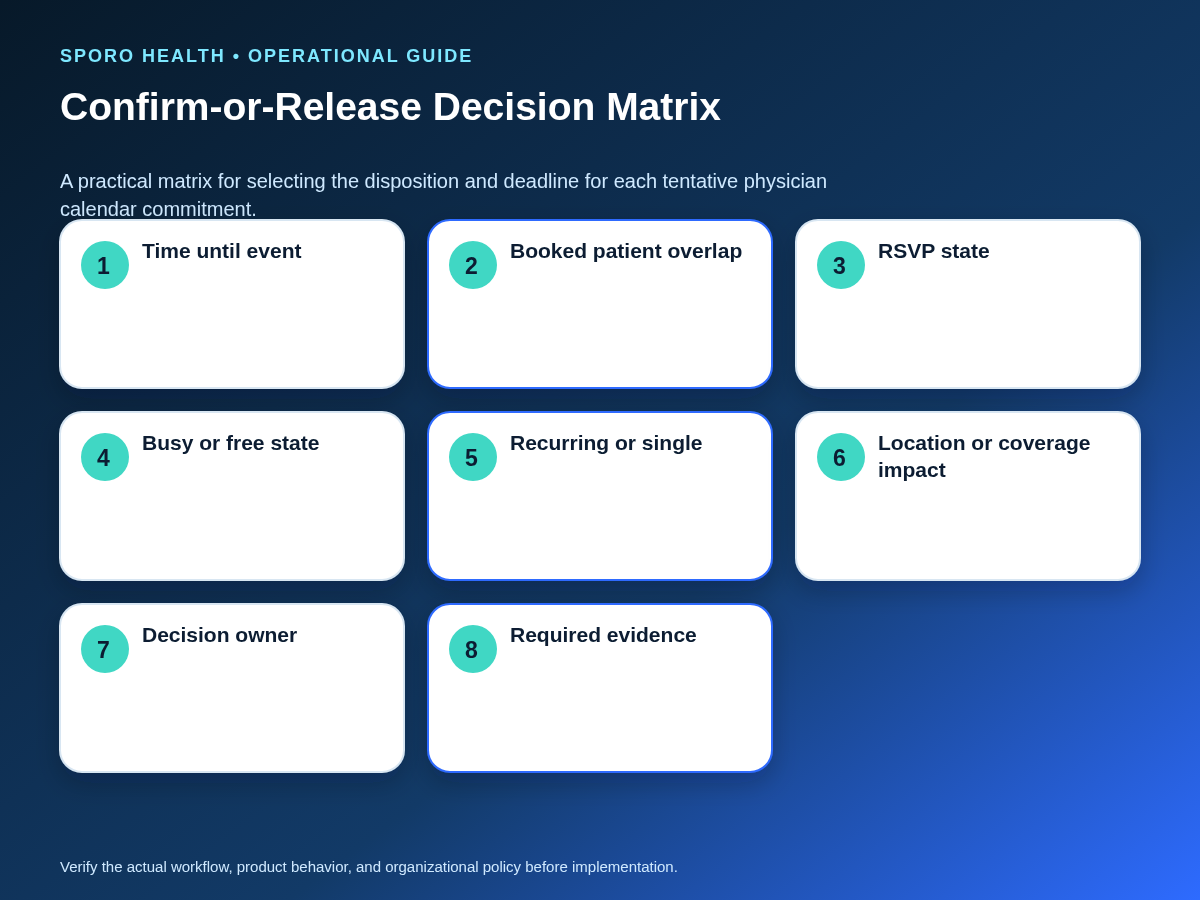
| Outcome | Use when | Required closure |
|---|---|---|
| Hold provisionally | The commitment is credible but unresolved and no booked care overlaps | Owner, exact interval, deadline, and visible provisional status |
| Confirm unavailable | The authorized owner confirms the commitment | Final external state and matching athenahealth availability verified |
| Release as bookable | The event is declined, canceled, out of scope, free, or expired | Hold removed and intended capacity visible again |
| Escalate | Booked care, conflicting signals, coverage, or location duties prevent a routine decision | Authorized disposition and evidence from both systems |
If a tentative event overlaps a booked patient appointment, freeze further automated availability changes and route the conflict to the named owner. Do not cancel, move, or suppress care solely because an invitation is pending or tentative. Use the provider availability override policy for authorized exceptions. If the commitment becomes an approved absence, transition it into the physician out-of-office availability workflow rather than extending a provisional hold indefinitely.
How should a practice set a confirm-by deadline for a provisional calendar hold?
Set the deadline from operational risk rather than one universal number. Shorten the decision window when patient booking is near, open capacity is scarce, an overlap already exists, or the commitment affects recurring sessions, locations, or coverage.
| Factor | Lower-risk condition | Deadline effect |
|---|---|---|
| Booking horizon | Event is distant | Longer review window may be reasonable |
| Booked patient overlap | No overlap | Routine review may continue |
| Remaining capacity | Comparable capacity remains | Less urgency than a scarce session |
| Recurrence | Single occurrence | Lower propagation risk |
| Location impact | One site only | Fewer downstream checks |
| Coverage dependency | No dependent duty | Fewer owners must confirm |
Record the chosen deadline and its rationale. A high-risk event should move quickly to confirmation or escalation; a lower-risk event may remain provisional longer, but it still needs a definite expiration.
How does a tentative calendar hold move from detection to closure?
A tentative hold should move through explicit entry, decision, expiration, and verified-closure states. No hold is complete merely because one calendar changed.
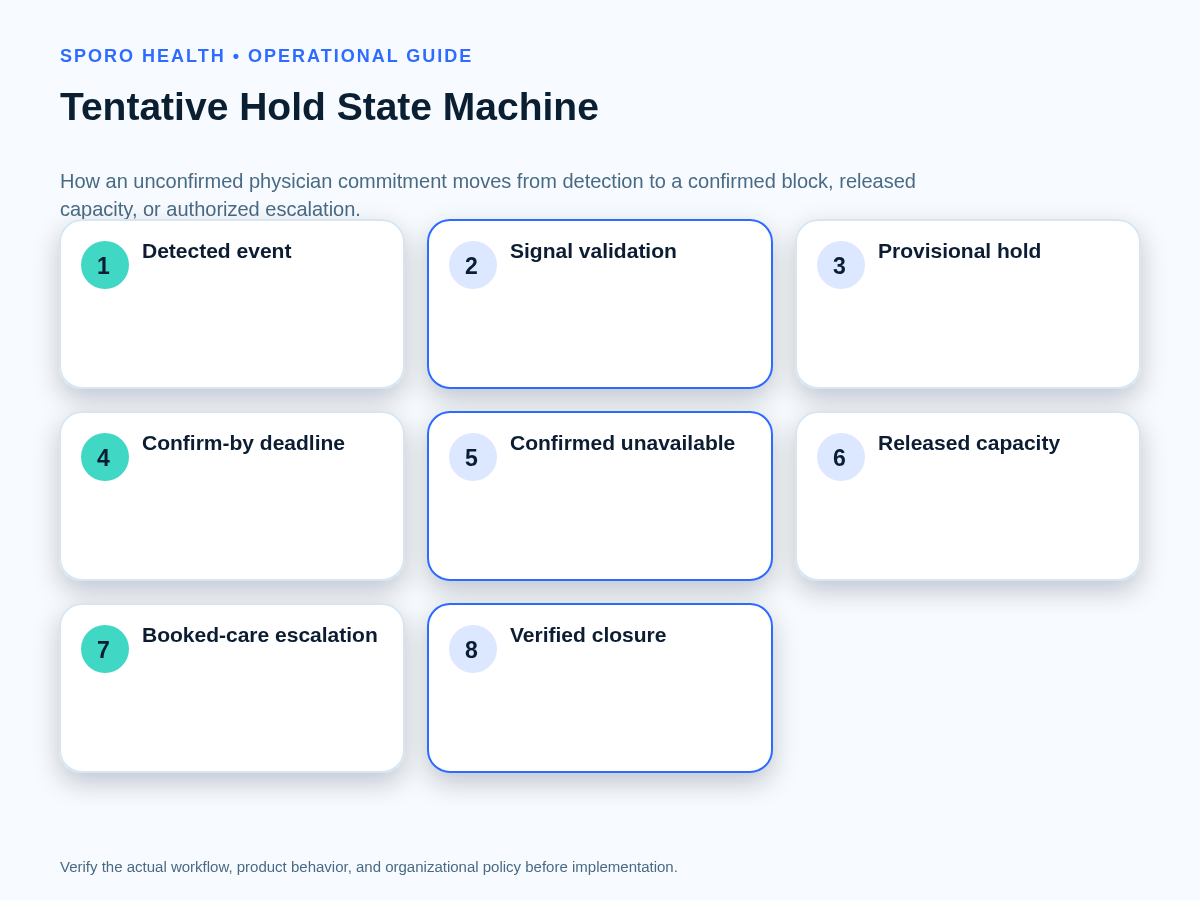
- Detect: capture the provider, source calendar, event identity, interval, recurrence scope, RSVP, blocking state, and lifecycle.
- Validate: confirm that the calendar and event type are eligible to influence athenahealth availability.
- Hold: apply only the intended interval and assign an owner and confirm-by deadline.
- Confirm or release: convert the hold to confirmed unavailability or restore bookable capacity.
- Extend once: require explicit approval, a new deadline, and a documented reason.
- Escalate: stop routine processing when booked care or conflicting duties are involved.
- Close: verify the final interval in athenahealth and the external calendar, including adjacent occurrences.
For recurring commitments, approve the series rule and each exceptional occurrence separately. Google identifies moved recurring instances using their original start time, while Microsoft exposes series masters, occurrences, exceptions, and canceled occurrences. A moved, declined, canceled, or confirmed instance must not change the wrong dates. Keep event-level holds separate from the provider’s baseline by using the schedule template versus temporary change decision rule.
Expired items enter a stale-hold queue. The owner must confirm, release, extend once with approval, or escalate. After action, verify the target interval and neighboring occurrences. Place unresolved items in the practice’s daily athenahealth schedule reconciliation queue until closure evidence is complete.
How should Google Calendar and Outlook tentative events be tested?
Test them separately because their attendance, availability, lifecycle, and recurrence fields are not interchangeable. Use the same policy outcomes, but prove each platform’s field mapping and resulting athenahealth state independently.
For Google Calendar, test needsAction, tentative, accepted, and declined responses separately from opaque or transparent time blocking. Also test confirmed, tentative, and canceled lifecycle states, private visibility, all-day timing, and moved recurring instances using the official Events resource.
For Outlook, inspect responseStatus, showAs, isCancelled, all-day status, and recurrence type. Microsoft’s scheduleInformation resource represents free, tentative, busy, and out-of-office availability distinctly, so a free/busy result should not be treated as a complete RSVP or lifecycle record.
| Test case | Evidence required |
|---|---|
| Pending invitation | No unintended durable block |
| Tentative RSVP with busy time | Policy-selected provisional outcome |
| Tentative RSVP with free time | No automatic block without another rule |
| Private event | Availability decision without unnecessary details |
| All-day event | Exact date and time-zone boundary |
| Secondary calendar | Approved scope before influence |
| Recurring exception | Only the intended occurrence changes |
| Moved occurrence | Old interval released and new interval evaluated |
| Cancellation or stale hold | Capacity released and closure verified |
Limit test records and staff views to the fields needed for the decision. The minimum necessary calendar data worksheet helps define that field-level boundary.
Which measures reveal stale holds and false availability blocks?
Measure aging, incorrect dispositions, and failed closure rather than counting events alone. Review results by provider-calendar pair so repeated mapping or policy problems remain visible.
- Provisional-hold aging: time from detection to confirmation, release, or escalation.
- Stale-hold count: expired holds still restricting capacity.
- False-block rate: released or out-of-scope events that incorrectly closed availability.
- Late confirmations over booked care: commitments confirmed after patient overlap existed.
- Release-verification failures: releases not reflected correctly in both systems.
- Repeat exceptions: recurring failures associated with the same provider-calendar pair.
Use the measures to revise the status map, deadline rules, ownership, or tests—not to infer clinical or financial outcomes.
How should the confirm-or-release workflow be implemented?
Start with a bounded provider cohort, approved status map, named owners, daily expiry review, and documented expansion decision. Do not expose the full practice to an untested tentative-event rule.
- Select a small cohort covering representative calendars and scheduling patterns.
- Approve eligible calendars, signal mappings, four outcomes, and escalation authority.
- Define the hold record, deadline factors, extension limit, and closure evidence.
- Run every negative test for Google Calendar or Outlook.
- Review expirations daily and reconcile unresolved items before near-term booking risk grows.
- Record a go, revise, or stop decision before adding providers or locations.
The federal SAFER guidance on selecting or upgrading health IT emphasizes clear accountability and responsibility for each role. Use the practice’s configured athenahealth views and the athenahealth appointment API reference, where relevant, to define technical verification; the API documentation does not itself create a provisional-hold policy.
If the policy is approved and the practice wants to evaluate connected-calendar support, review the Sporo Health overview, the athenahealth and Google Calendar product page, the athenahealth and Outlook product page, and the Sporo Health athenaConnect Marketplace listing. Treat product descriptions as vendor claims and require a demonstration of the approved status map, expiration rules, recurrence cases, and two-system closure evidence.
How should tentative calendar events affect physician availability in athenahealth?
They should trigger a controlled decision, not an automatic permanent block. Apply the dual-status map, choose one of four outcomes, set a risk-based deadline, protect booked care, and verify closure across both systems. The operational goal is not to eliminate uncertainty; it is to keep uncertainty owned, time-limited, visible, and reversible.
Frequently asked questions
Is a tentative RSVP the same as a tentative availability status?
No. RSVP records the attendee’s response, while availability records whether the event blocks time; lifecycle and calendar scope are separate signals too.
Should tentative physician calendar events block patient booking?
Not automatically. Apply the written signal map and choose provisional hold, confirmed unavailability, released capacity, or escalation.
How should a practice set a confirm-by deadline for a provisional calendar hold?
Set it from operational risk. Shorten the deadline as booking gets closer, capacity tightens, recurrence grows, or location and coverage dependencies increase.
What should happen when a tentative meeting overlaps a booked patient appointment?
Freeze further automated changes and send the conflict to the authorized owner. Do not cancel or move patient care solely because the external event is tentative.
How should recurring tentative calendar events be confirmed or released?
Approve the series rule and each exception separately. Verify moved, declined, canceled, and confirmed occurrences against their original dates.
Do Google Calendar and Outlook represent tentative state the same way?
No. Both expose separate attendance and availability concepts, but their fields and state models differ, so each provider-calendar pair needs platform-specific tests.
Sources
Primary documentation reviewed August 30, 2026:

One comment
Comments are closed.

[…] This matrix prevents a resolved-negative response from being treated like an unresolved commitment. Practices that also need rules for Maybe or provisional responses can use the separate guide to handling tentative physician calendar holds. […]