Customer References for athenahealth Calendar Integration Vendors: A Claim-Verification Guide
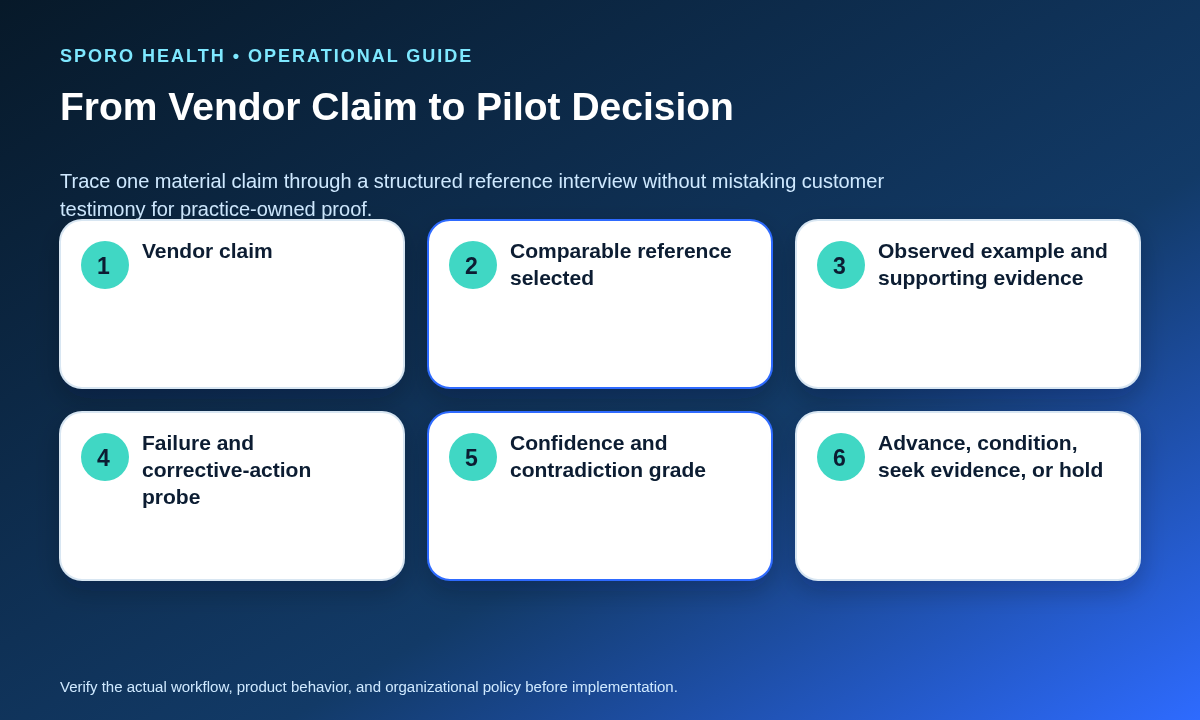
For practice managers, the right questions to ask athenahealth calendar integration vendor customer references are the ones that test a specific claim in a comparable operating context. Prepare the claims and risks first, ask for observed examples and records, probe failures and corrective actions, grade confidence, preserve contradictions, and use the findings to advance, condition, delay, or stop a practice-owned pilot.
What should customer references prove before a pilot?
Customer references should reduce uncertainty about specific vendor claims in a comparable context; they should not be treated as proof that your practice will achieve the same result. A useful interview establishes what the customer directly observed, how similar its operating model is, what went wrong, and which risks remain open.
A useful transferable benchmark comes from Federal Acquisition Regulation 15.305, which tells federal evaluators to consider the currency, relevance, source, context, and trends of past-performance information, along with problems and corrective actions. It is not a rule for private medical practices, but its evaluation logic is sound.
NIST SP 1326 likewise describes supplier due diligence as researching pertinent information so an acquirer can make an informed decision. For a reference call, that means replacing “Are you satisfied?” with “Which claim are we testing, in what context, using what evidence?”
How many references should a practice request?
No universal number of references proves vendor fit. For a consequential pilot decision, two comparable references are a practical starting point; add a third when the proposed Google Calendar or Outlook model differs materially, the first interviews conflict, or a critical workflow remains untested.
One enthusiastic customer may be atypical, but many shallow calls do not repair poor comparability. Ask how the vendor selected each contact, whether the reference approved disclosure of problems, and whether you may request a customer closer to your highest-risk configuration.
What makes an athenahealth calendar integration customer reference comparable?
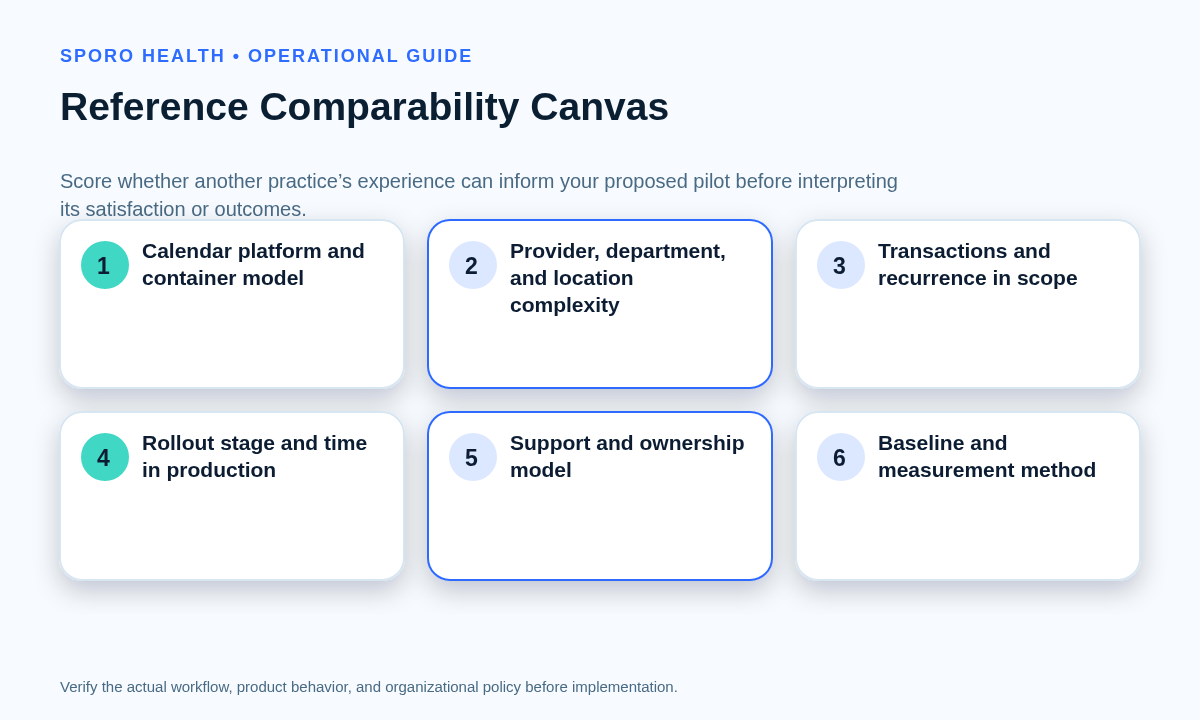
A useful reference resembles the proposed platform, ownership model, practice complexity, workflow scope, rollout maturity, and operating duration closely enough to illuminate your material risks. Satisfaction from a simple single-provider deployment may have little evidentiary value for a multi-location group using shared calendars and recurring exceptions.
To practice separating narrative from proof, review an example of a vendor-published customer case study and score it as vendor-provided evidence before requesting a direct interview or corroborating records.
| Factor | Close fit | Lower-confidence signs |
|---|---|---|
| Calendar platform | Same Google Workspace or Microsoft 365 environment | Different platform, account type, or calendar container |
| Calendar ownership | Similar provider-owned, practice-owned, or shared model | Different edit authority or ownership boundary |
| Practice complexity | Similar providers, departments, locations, and scheduling roles | Materially simpler operating context |
| Transaction scope | Same creates, changes, cancellations, blocks, and recurrence | Reference uses only a narrow one-way workflow |
| Rollout maturity | Comparable pilot or production stage | Experience limited to a demonstration or early setup |
| Operating duration | Long enough to observe incidents and lifecycle changes | Too recent to test support, onboarding, or offboarding |
Score each factor 0 for unknown or mismatched, 1 for partial fit, and 2 for close fit. The total supports comparison, but a critical mismatch must remain visible rather than being averaged away. Record support ownership and measurement method as additional context.
How should buyers prepare customer-reference interviews?
Prepare the claims, operational risks, and intended pilot decision before contacting a reference. Without that preparation, the call can become an unstructured testimonial. Place references within a broader proof-based athenahealth calendar integration vendor due diligence checklist, and trace questions back to the workflow scope in your requirements-to-evidence RFP workbook.
Create one row for every consequential claim. Prioritize claims that affect schedule integrity, staff workload, recovery, permissions, onboarding, offboarding, or the conditions under which a pilot may proceed.
| Vendor claim | Reference question | Requested example | Corroborating artifact | Unresolved risk |
|---|---|---|---|---|
| Reschedules and cancellations remain aligned | Walk us through the last real change that crossed both systems. | Before-and-after schedule state | Ticket, timestamps, or event identifiers | Could stale source entries remain? |
| Recurring exceptions are handled correctly | What happened when one occurrence changed? | One moved or canceled instance | Series and instance records | Could the entire series be altered? |
| Conflicts or reconciliation decreased | How was the outcome defined and measured? | Baseline and observation period | Worksheet or source report | Are denominators or exclusions missing? |
Send the reference broad topic areas in advance, not preferred answers. Use the same core matrix for every vendor so differences come from evidence rather than interviewer improvisation.
Which questions to ask athenahealth calendar integration vendor customer references expose workflow truth?
Ask for the last observed example of each material transaction, including what failed, how the customer knew, and what record remains. General statements such as “the sync works” conceal meaningful differences among creation, change, cancellation, recurrence, recovery, and lifecycle workflows.
Official athenaOne documentation lists distinct appointment cancel, reschedule, changed-appointment, and subscription capabilities in its API inventory and event-notification topics. Reference questions should therefore test states separately rather than treating calendar synchronization as one transaction.
Recurring workflows deserve their own questions. Google documents parent events, instances, and exceptions in its recurring-events guide, while Microsoft Graph distinguishes single instances, occurrences, exceptions, and series masters in its event resource.
- Create and identity: What creates the external event, and how are retries prevented from creating another copy?
- Reschedule and cancel: What happens to the old time, event identity, notifications, and residual entries?
- Availability blocks: Which busy, free, private, secondary, or shared-calendar states actually affect booking?
- Recurring exceptions: How is one occurrence distinguished from the whole series, and what evidence verifies scope?
- Failure and support: Who detects a missed change, protects the schedule, opens the case, and confirms recovery?
- Lifecycle: What changes during provider onboarding, role changes, leave, calendar migration, and offboarding?
How should buyers ask about failures, support, and corrective actions?
Reconstruct one real failure from impact through residual risk instead of asking whether support was good. A negative experience can be highly valuable when the reference explains the operational effect, response, correction, recurrence test, and remaining limitation.
Platform event flows can have lifecycle and recovery requirements. For example, Microsoft documents created, updated, and deleted event notifications plus subscription-lifecycle handling in its Outlook change-notifications guide. Do not assume a vendor uses that design; use the platform documentation to ask informed questions about detection and missed changes.
- Impact: Which providers, intervals, transactions, or staff tasks were affected?
- Detection: Who noticed first, and did monitoring or a person find it?
- Containment: How was unsafe booking or editing limited?
- Support response: What evidence was requested, and who owned communication?
- Root cause: Was a cause established or only a symptom corrected?
- Corrective action: What changed in software, configuration, monitoring, or workflow?
- Recurrence test: Which scenario was rerun, including a denied or failure path?
- Residual risk: What can still recur, and what fallback remains necessary?
How can buyers verify fewer conflicts or less manual reconciliation?
Require the complete measurement definition behind every outcome claim. If the vendor advances, replace third-party recollection with the practice-owned methods in an operational outcome scorecard for a calendar sync pilot.
- Baseline value and baseline period
- Exact measure definition
- Denominator or exposure unit
- Observation period after launch
- Data source and collection method
- Exclusions, missing cases, or workflow changes
- Person or team that performed the measurement
For example, “fewer conflicts” is incomplete without defining a conflict and its exposure denominator. “Less reconciliation” needs a repeatable sampling method rather than a general impression. Record unsupported recollection as lower-confidence evidence.
How much confidence should each reference finding receive?
Grade evidence by relevance, recency, source independence, directness of observation, and corroboration. Confidence describes how much weight a finding deserves; it is not a customer-satisfaction score.
| Level | Evidence | Appropriate use |
|---|---|---|
| 1 | Vendor-published narrative, quote, or case study | Identify claims and questions |
| 2 | Customer recollection without supporting records | Form a provisional hypothesis |
| 3 | Records directly observed with the customer | Support a finding in that customer’s context |
| 4 | Corroborated records or consistent comparable references | Reduce uncertainty and set pilot conditions |
| 5 | The buyer’s own bounded pilot result | Decide fit for the buyer’s actual workflow |
A vendor-selected reference may be knowledgeable but is not fully source-independent. Maintain a contradiction-and-unknowns register with the claim, each reference’s account, missing denominator, unexplained exclusion, materiality, next action, owner, and due date. Never average a critical unresolved risk into an otherwise favorable total.
How should customer-reference findings affect the pilot decision?
Reference findings should produce one of four explicit outcomes: advance to pilot, advance with conditions, seek additional evidence, or hold or reject. References can shape the scope and safeguards of an athenahealth calendar sync pilot acceptance matrix, but they cannot replace buyer-run tests. Claims ultimately relied upon should later trace into a claim-to-obligation contract matrix.
| Outcome | Use when | Required record |
|---|---|---|
| Advance to pilot | Relevant evidence is consistent and no critical risk is unresolved | Pilot scope and acceptance questions |
| Advance with conditions | Evidence is promising but requires limits, monitoring, or a named test | Conditions, owner, and release criteria |
| Seek additional evidence | References conflict, lack records, or do not match the proposed context | Evidence request and decision deadline |
| Hold or reject | A critical risk remains unsupported, contradicted, or unacceptable | Reason, unresolved risk, and reconsideration trigger |
If a vendor has no relevant references, request alternative evidence such as anonymized incident records, measurement definitions, or a more restrictive pilot. Absence of a reference is not automatic proof of poor performance, but it increases uncertainty and may justify a hold.
Where do current Sporo destinations fit?
Use current product destinations to identify vendor claims for evaluation, not as proof that those claims will hold in your environment. Review the Sporo Health homepage for company context, the athenahealth and Google Calendar product page, the athenahealth and Microsoft Outlook product page, and the athenaConnect Marketplace listing for Sporo Health Google Calendar Sync. Treat each as commercial material and verify consequential claims through current documentation, references, and practice-owned testing.
Practical conclusion
The most useful questions to ask athenahealth calendar integration vendor customer references connect one claim to one comparable context, observed example, supporting record, failure history, and unresolved risk. For the next shortlisted vendor, select three material claims, interview two comparable references, maintain one contradiction register, and document one four-outcome gate. Then use a bounded pilot to establish what is true for your own practice.
Frequently asked questions
How many customer references should a medical practice request from a calendar integration vendor?
No universal number proves fit. A practical starting point is two comparable references, with a third when workflows differ, evidence conflicts, or a material risk remains unresolved.
What makes an athenahealth calendar integration customer reference comparable?
A comparable reference resembles the proposed platform, calendar ownership model, practice complexity, transaction scope, rollout maturity, and time in production. Material mismatches should lower confidence even when satisfaction is high.
What workflow questions should buyers ask a vendor’s customer references?
Ask for observed examples of creates, reschedules, cancellations, availability blocks, recurring exceptions, failures, recovery, support, onboarding, and offboarding. Follow each answer with how the reference knows and what record exists.
How should buyers ask about calendar sync failures, vendor support, and corrective actions?
Start with one specific incident and reconstruct impact, containment, support response, root cause, corrective action, recurrence testing, and residual risk. A vague statement that the issue was fixed is not enough.
How can a practice verify claims about fewer scheduling conflicts or less manual reconciliation?
Require the baseline, metric definition, denominator, observation period, data source, exclusions, and measurer. Treat unsupported recollection as lower-confidence evidence and confirm the result in the practice’s own pilot.
Can a vendor case study replace a customer reference interview?
No. A vendor case study is useful for identifying claims and candidate questions, but it is vendor-published narrative and cannot replace a direct interview, corroborating evidence, or buyer-run testing.
What should a buyer do when a vendor has no relevant customer references?
Ask for alternative evidence, such as a closer reference later, anonymized incident and measurement records, or stronger pilot conditions. If a material risk remains untested, seek more evidence or hold the evaluation.
How should customer-reference findings affect the calendar integration pilot decision?
Reference findings should produce one of four outcomes: advance to pilot, advance with conditions, seek additional evidence, or hold or reject. They should shape pilot scope, not replace acceptance testing.
Sources
- Federal Acquisition Regulation 15.305: Proposal Evaluation
- NIST SP 1326: Due Diligence Assessment Quick-Start Guide
- athenaOne API inventory
- athenahealth event-notification subscription topics
- Google Calendar recurring-events guide
- Microsoft Graph event resource
- Microsoft Graph Outlook change notifications