athenahealth Calendar Integration Renewal Checklist: An Evidence-Based Service Review
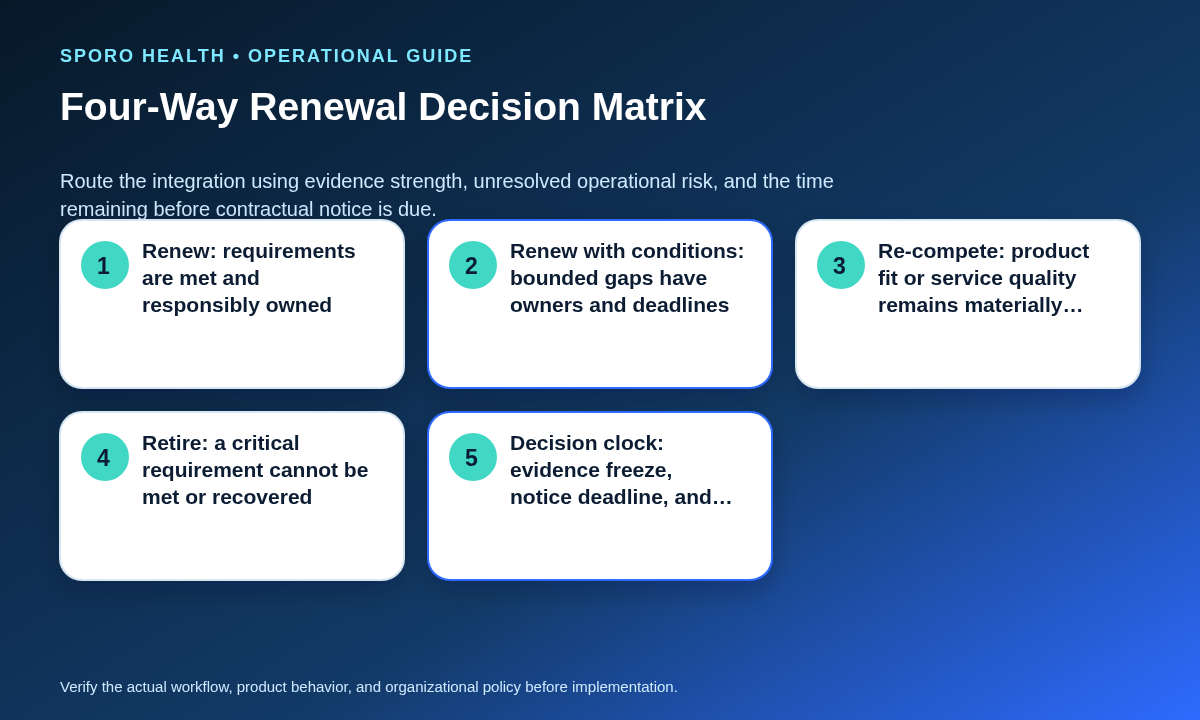
For practice managers, an athenahealth calendar integration renewal checklist should lead to one of four documented decisions: renew, renew with conditions, re-compete, or retire. Reconcile contract promises with live provider-calendar-location scope, production outcomes, incidents, support quality, permissions, current costs, unresolved risks, and exit readiness before the notice deadline—not the original demonstration or a vendor-wide status summary.
How should you use an athenahealth calendar integration renewal checklist?
Use it to produce one of four decisions—renew, renew with conditions, re-compete, or retire—from current production evidence. The signed contract, amendments, approved responsibilities, and live operating record form the baseline; marketing language and memories of the demonstration do not.
Recover the original requirements and evidence grades from the pre-pilot vendor due diligence checklist. Then assign a decision owner and named operations, IT, purchasing, and authorized privacy reviewers. Any consequential claim that cannot be traced to current evidence remains an open gap.
What should the renewal control clock do?
Work backward from the contract’s notice, renewal, data-return, and access-removal dates. Set practice-owned deadlines early enough to obtain missing evidence and preserve a viable transition path without assuming that one universal review timeline fits every agreement.
| Control date | Practice deadline | Required output | Stop rule |
|---|---|---|---|
| Notice deadline | Fixed from the executed agreement | Authorized renewal or nonrenewal notice | Do not let evidence gathering consume the remaining transition option |
| Evidence freeze | Before the decision meeting | Versioned packet with known gaps | Late claims remain unverified unless independently checked |
| Decision date | Before notice is due | One approved outcome and conditions | No implied renewal through inaction |
| Transition window | Before service or access changes | Exit, replacement, communication, and reconciliation plan | Do not retire without confirmed schedule authority |
What belongs in the renewal evidence packet?
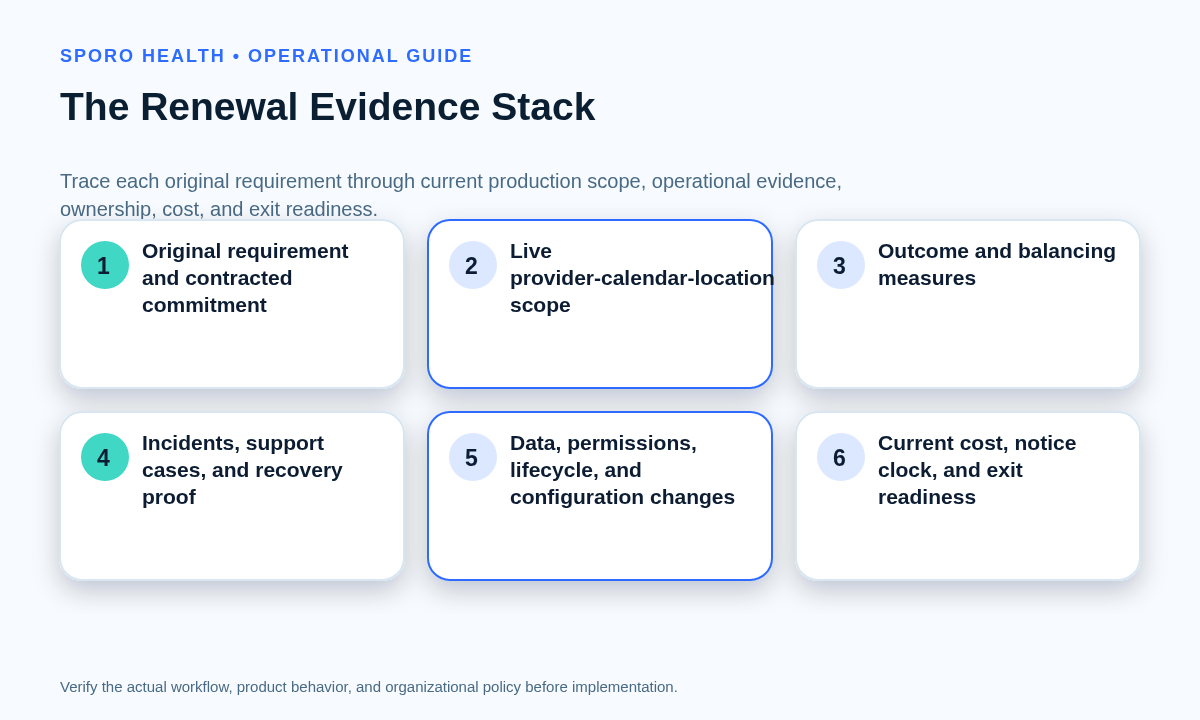
The packet should connect each contracted requirement to current scope, production results, ownership, cost, unresolved risk, and exit responsibility. It should be sufficiently specific that another reviewer can reproduce the decision without relying on a vendor presentation.
Compare current ownership and runbooks with the original calendar sync operations acceptance checklist. For technical scope, identify the actual athenahealth objects and operations used rather than writing only “appointment sync”; the current athenahealth Appointment API reference is one official reference point.
- Executed contract, amendments, service commitments, notice terms, and responsibility matrix
- Live provider-calendar-location inventory, including inactive and exception connections
- Approved data fields, identities, calendars, permission scopes, retention, and revocation paths
- Outcome measures with definitions, denominators, collection methods, and context
- Incidents, detected drift, fallback periods, support cases, and verified recovery evidence
- Configuration, workflow, provider, location, and calendar changes made during the term
- Current fees, variable charges, internal labor, support burden, and plausible exit costs
- Open exceptions, accepted risks, disputed claims, renewal conditions, and accountable owners
- Data return or disposition, artifact handling, access removal, and post-exit responsibilities
How do you reconcile contracted scope with live use?
Reconcile scope at the provider-calendar-location level, not with a single organization-wide connection count. Every row should show what was contracted, what is live, what evidence proves the state, and whether the difference is approved, inactive, unsupported, or unresolved.
Calendar platforms contain operationally distinct states. Google events expose properties such as status, recurrence, visibility, and whether an event blocks time in the Google Calendar Events resource. Microsoft events distinguish recurrence, sensitivity, cancellation, and Show As values in the Microsoft Graph event resource. The renewal inventory should therefore document actual event rules, not merely the platform name.
| Unit | Contracted state | Live evidence | Required disposition |
|---|---|---|---|
| Provider | Named or eligible cohort | Active, paused, departed, or never connected | Confirm, remove, investigate, or amend |
| Calendar identity | Approved account and calendar | Actual owner, address, container, and connection state | Flag shadow or substituted calendars |
| Location or department | Approved scheduling scope | Current provider-location mappings | Resolve unapproved expansion or missing coverage |
| Workflow | Approved create, change, cancel, and block behavior | Observed production behavior and exceptions | Accept, correct, condition, or redesign |
| Data and permission | Approved fields and access | Current configuration and effective access | Reduce, reapprove, revoke, or escalate |
How should production outcomes and reliability be scored?
Use exposure-based denominators that show how much live scheduling activity was actually at risk. Raw incident totals and organization-wide availability percentages can conceal a failure that affected a small but consequential provider-calendar cohort.
Reuse definitions from the calendar sync pilot outcome scorecard only when they still fit production. Normalize financial evidence with the total-cost worksheet for athenahealth calendar integrations rather than presenting fees without equivalent scope.
| Domain | Useful denominator | Evidence to review |
|---|---|---|
| Schedule integrity | In-scope schedule changes or provider-calendar hours | Missed, delayed, duplicated, stale, or unmatched states |
| Operational effort | Exceptions or reconciliation sessions | Staff minutes, handoffs, manual checks, and fallback work |
| Reliability | Affected provider-calendar hours | Detection time, verified recovery time, recurrence, and unresolved drift |
| Balancing measures | Provider-days or booking windows | False blocks, false-open capacity, unsafe workarounds, and deferred changes |
| Current cost | Provider-calendar-month or another fixed live unit | Fees, internal labor, support burden, uncertainty, and exit obligations |
Monitoring coverage belongs in the score. Google states that notification channels can expire and are not automatically renewed in its push-notification guidance. Microsoft documents missed, removed, and reauthorization-required subscription events in its change-notification lifecycle guidance. An incident-free term is weak evidence if notification coverage or reconciliation was incomplete.
How should incidents and support cases be judged?
Judge support by the quality of acknowledgement, diagnosis, containment, restoration, evidence, and recurrence follow-up. A fast first response is not the same as verified service restoration, and a closed ticket is not proof that every affected schedule was reconciled.
Use the transaction-level evidence in the calendar sync incident postmortem template when significant events need to roll into the term-level review.
| Stage | Evidence to request | Renewal concern |
|---|---|---|
| Acknowledgement | Severity, affected scope, owner, and next update | Generic receipt without accountable ownership |
| Diagnosis | Working cause, evidence reviewed, and uncertainty | Repeated speculation or missing scope analysis |
| Workaround | Safety boundary, duration, owner, and reconciliation plan | Manual action that can create duplicates or hidden drift |
| Restoration | Provider-calendar tests and affected-window reconciliation | Vendor status marked green before practice verification |
| Evidence | Timestamps, identifiers, logs, changes, and closure record | No reproducible proof of recovery |
| Prevention | Root-cause follow-up, corrective action, and recurrence test | Aged actions or recurring failure fingerprint |
How do you review data, permissions, and current costs?
Treat data, permissions, lifecycle controls, and cost as current production facts rather than one-time implementation approvals. Compare the approved field set, calendar visibility, identities, OAuth or application scopes, retention, revocation, and offboarding behavior with the live configuration.
Google advises applications to choose the most narrowly focused Calendar API scope possible in its Calendar authorization guidance. Microsoft similarly recommends least-privileged access and distinguishes delegated and application calendar permissions in the Microsoft Graph permissions reference. Route unresolved privacy or security questions to authorized reviewers rather than treating a permission name or vendor statement as a compliance conclusion.
If the service creates, receives, maintains, or transmits ePHI, HHS guidance explains that the agreement, actual cloud configuration, and each party’s risk analysis matter; review the practice’s facts against the current HHS cloud-computing guidance. Separately show contracted fees, current fees, variable charges, internal labor, fallback burden, and exit costs. Do not convert incomplete data into an unsupported ROI or savings claim.
Which renewal outcome fits the evidence?
Choose the outcome that matches requirement coverage, evidence strength, accountable ownership, gap severity, and the remaining transition window. A familiar incumbent should not default to renewal when a critical requirement or exit control remains unsupported.
| Outcome | Evidence pattern | Hard stop or next step |
|---|---|---|
| Renew | Critical requirements are supported, scope is reconciled, ownership is active, and recovery evidence is credible | Approve the next-term baseline and review cadence |
| Renew with conditions | Gaps are bounded, noncritical, owned, measurable, and closable before an explicit deadline | Do not renew conditionally without consequences and stop rules |
| Re-compete | Product fit, service quality, cost, evidence quality, or ownership remains materially uncertain | Preserve incumbent continuity only as needed for a controlled comparison or transition |
| Retire | A critical requirement cannot be met, recovered, or responsibly owned | Do not retire until schedule authority, access removal, artifacts, and reconciliation are controlled |
What makes a renewal condition enforceable?
Every condition needs a specific requirement, owner, evidence target, due date, decision consequence, and stop rule. “Improve monitoring” or “provide better support” is not sufficient because neither statement defines what must change or what happens if it does not.
- Requirement: the exact gap to close
- Owner: the vendor and practice roles accountable for action and verification
- Evidence target: the test, record, report, or reconciliation result that proves closure
- Due date: tied to the renewal clock or another controlled milestone
- Decision consequence: payment hold, escalation, re-compete trigger, or other approved response
- Stop rule: the condition that prevents expansion or ends the renewed arrangement
What does exit readiness require before notice is due?
Confirm that the practice can change schedule authority, stop synchronized writes, resolve artifacts, remove access, reconcile the affected window, and verify the post-exit state. Exit readiness is a renewal control even when renewal remains the likely outcome because it tests whether the practice still owns the operating decision.
Use the controlled calendar integration exit checklist to develop the implementation path before notice is due.
- Name the authoritative schedule during transition and restrict competing edits
- Inventory future events, recurring items, mappings, exports, logs, and other artifacts
- Sequence provider, calendar, application, and administrative access removal
- Define data return, preservation, deletion, and verification responsibilities
- Plan provider, scheduler, IT, support, and vendor communications
- Set rollback boundaries and identify which steps become irreversible
- Reconcile the transition window and test that residual access or writes have stopped
Where a business associate relationship applies, authorized reviewers should interpret the executed agreement and applicable obligations. HHS sample business associate contract provisions address return or destruction of PHI at termination when feasible; they do not replace customer-specific contract review.
Where do connected-calendar options fit the review?
Product pages can identify an offering, but they cannot prove that a specific production deployment should be renewed. Sporo currently describes its athenahealth and Google Calendar connection and athenahealth and Microsoft Outlook connection as bidirectional offerings; treat those descriptions as vendor claims and request evidence for the actual live scope.
The Sporo Health athenaConnect Marketplace listing is another commercial destination, not a substitute for the evidence packet. Review the broader company context on the Sporo Health homepage, then ask the incumbent or any alternative to map current evidence directly to this checklist. The measured next step is an evidence review, not an assumed renewal.
How should the checklist be put into use?
Freeze the evidence, document remaining uncertainty, and make the decision while every contractual option is still available. The final record should be understandable to an approver who did not attend the original pilot or operate the service day to day.
- Lock the notice, evidence-freeze, decision, and transition dates.
- Assemble the versioned evidence packet and identify missing records.
- Reconcile every provider-calendar-location row and permission path.
- Score outcomes, reliability, support quality, balancing measures, and current cost.
- Approve renew, renew with conditions, re-compete, or retire—and preserve the exit path until the decision is executable.
Frequently asked questions
What should an athenahealth calendar integration renewal checklist produce?
It should produce one documented outcome: renew, renew with conditions, re-compete, or retire. The decision should state the evidence used, unresolved gaps, owners, deadlines, and any exit trigger.
How early should the renewal review start?
There is no universal lead time. Work backward from the contract’s notice, renewal, data-return, access-removal, evidence-freeze, decision, and feasible transition dates.
Is an incident-free term enough to justify renewal?
No. Low usage, weak detection, manual workarounds, or unreported drift can hide exposure, so reviewers should test coverage, outcomes, and recovery evidence as well as case counts.
Can pilot metrics be reused for the renewal review?
Yes, but only if their definitions, denominators, scope, and collection methods still fit production. Report context and balancing measures without claiming causality, ROI, or savings the data cannot prove.
What evidence should the vendor provide before renewal?
Request current scope, configuration and permission records, incidents, support cases, monitoring and reconciliation evidence, changes made during the term, open exceptions, current fees, and exit responsibilities.
When should a practice re-compete or retire the integration?
Re-compete when product fit, service quality, cost, or ownership remains materially uncertain. Retire when a critical requirement cannot be met, recovered, or responsibly owned, and a controlled exit is feasible.
Sources
- athenahealth Appointment API reference
- Google Calendar Events resource
- Google Calendar push notifications
- Google Calendar incremental synchronization
- Google Calendar API authorization scopes
- Microsoft Graph event resource
- Microsoft Graph lifecycle notifications
- Microsoft Graph permissions reference
- HHS guidance on HIPAA and cloud computing
- HHS business associate contract provisions
- Sporo Health Google Calendar product page
- Sporo Health Outlook product page