Overlapping Provider Schedules Across athenahealth Departments: A Collision-Audit Framework
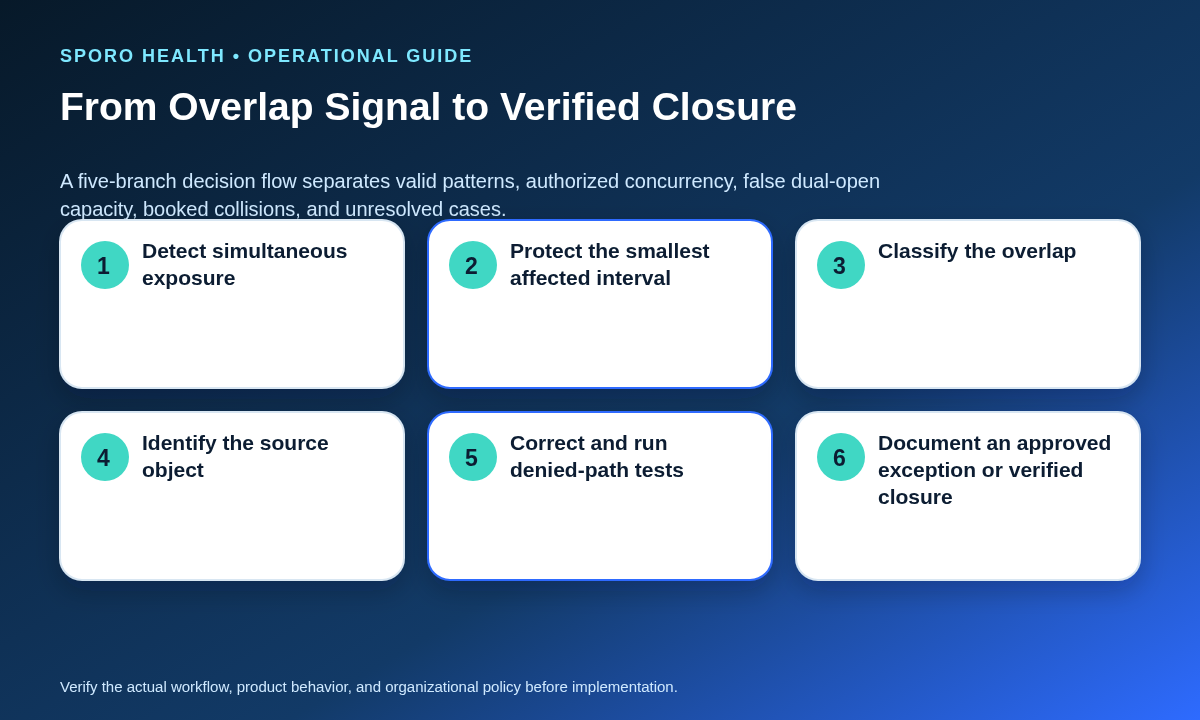
For multi-location practice managers asking how to audit overlapping provider schedules across athenahealth departments, the safest method is to compare every provider’s future availability on one normalized timeline, not one department at a time. Flag simultaneous exposure, classify whether it is valid or unsafe, contain near-term risk, correct the smallest source object, test every booking channel, and measure recurrence.
How to audit overlapping provider schedules across athenahealth departments
A collision exists when one provider is simultaneously bookable or booked in two incompatible department, location, mode, or resource states. Adjacent sessions are not overlaps, and explicitly governed concurrent capacity is not automatically defective, but every allowed exception needs documented boundaries and tests.
Compare intervals using a consistent rule such as start-inclusive and end-exclusive. A session ending at 10:00 and another beginning at 10:00 are adjacent; intervals that both include 9:45 are concurrent. Retain local department time while also converting each interval to a common time basis. The athenaOne Service Description documents templates tailored to departments and providers, department-specific time settings, staff and patient booking pathways, and controls for double-booking and frozen slots.
A documented split-session scheduling at two clinic locations pattern is valid when the sessions and transition boundary do not overlap. Simultaneous exposure without equivalent approval should remain unsafe until reviewed.
How do you build the provider-wide collision ledger?
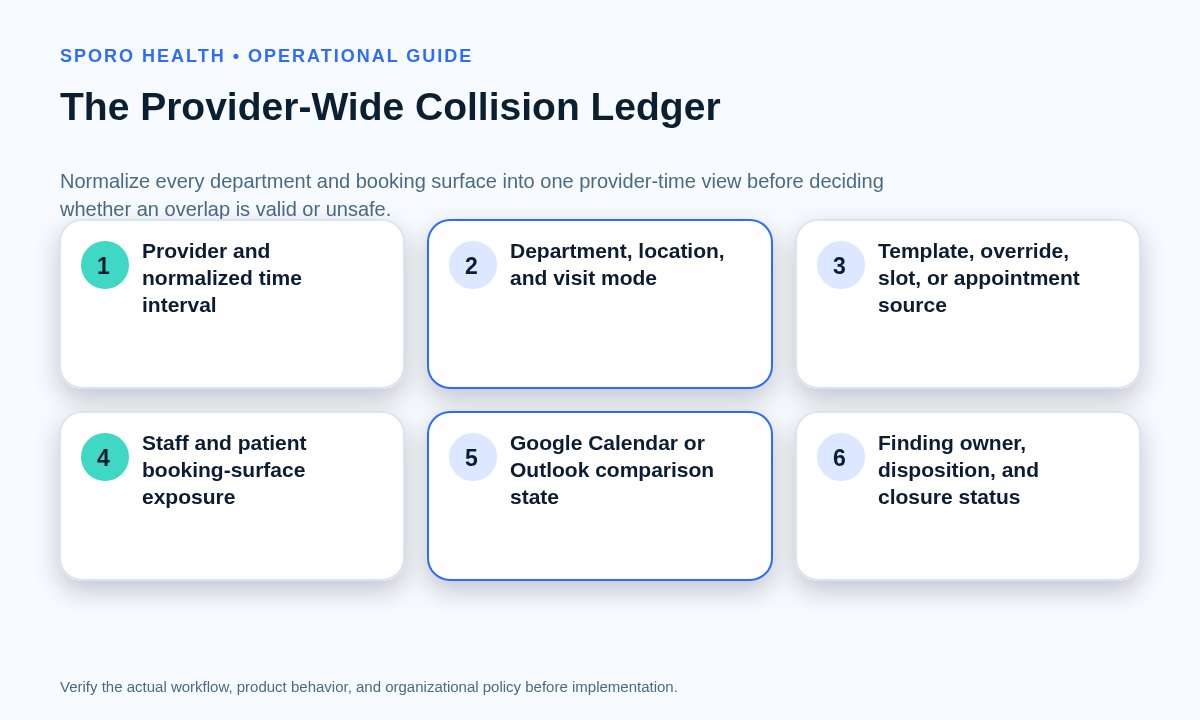
Build one row for every future interval that can open, constrain, or consume a provider’s time, then group those rows by provider and normalized time. Audit by provider rather than running separate department reports that never meet.
Inventory:
- active recurring templates and effective dates;
- date-bounded changes and one-off overrides;
- open slots and booked appointments;
- appointment types, duration, visit mode, and resources;
- staff booking views and patient self-scheduling surfaces;
- provider, department, location, and local time zone;
- connected-calendar constraints and source calendar; and
- recurrence scope, owner, evidence time, and current status.
Create a provider-time key from the provider identifier plus normalized start and end. Preserve the source object, local start and end, department, location, channel, recurrence parent, exception state, appointment type, and effective dates as separate fields. This lets several source records roll into one finding without losing the evidence needed to locate the defect.
athenahealth’s Appointments documentation covers open-slot and booked-appointment workflows, while its athenaOne API list identifies open, booked, report, and multiple-department appointment endpoints. Use the locally approved report, export, API, or administrative review path; do not assume every practice exposes the same access. Document provider-location booking authority separately from descriptive calendar labels.
How should each overlap be classified?
Assign every flagged interval one of five dispositions before anyone edits configuration. The disposition determines whether the team documents, monitors, contains, corrects, escalates, or stops booking.
| Disposition | Meaning | Required response |
|---|---|---|
| Valid non-overlap | Intervals are adjacent or only appear duplicated after time conversion. | Document the comparison and close. |
| Authorized concurrency | Simultaneous capacity is explicitly approved and operationally supported. | Retain limits, owners, tests, and monitoring. |
| False dual-open availability | Two incompatible departments or channels expose the same provider time. | Contain the smallest open surface and correct its source. |
| Booked collision | Two incompatible commitments already consume the provider interval. | Protect further capacity and route patient disposition to an authorized owner. |
| Unresolved evidence | Records disagree or the authoritative source is unknown. | Hold affected capacity until evidence resolves the finding. |
Source-pattern exception map:
- template-to-template: two baselines intersect;
- template-to-appointment: a booking conflicts with another department’s open capacity;
- appointment-to-appointment: two booked commitments intersect;
- channel-only: one staff or patient surface exposes otherwise closed time;
- calendar-only: external availability disagrees without athenahealth exposure;
- recurrence-boundary: one occurrence or effective-date edge is wrong; and
- time-zone: local times align incorrectly after conversion.
Use an intentional overbooking policy to judge approved concurrency rather than normalizing accidental overlap. When the finding crosses visit modes, apply documented hybrid in-person and telehealth session controls.
What should staff do when two departments show the same provider as available?
Protect the smallest affected provider interval or booking surface before changing templates or broad configuration. Containment should prevent new exposure while preserving evidence and booked appointments.
- Record the provider, exact interval, departments, channels, source objects, and known patient exposure.
- Pause or freeze the narrowest unsafe open slot or channel permitted by practice policy.
- Keep booked appointments intact until an authorized owner chooses the patient-disposition path.
- Name an operational owner, verifier, deadline, and temporary staff instruction.
- Expand the hold only if the collision cannot be bounded or another channel remains open.
Scheduling staff should not decide clinical suitability, provider substitution, or patient priority. Their role is to prevent additional claims on uncertain capacity and escalate with complete evidence.
How do you correct the source without widening the change?
Change the smallest object that created the overlap after its dependencies are understood. The source may be a template boundary, copied schedule, temporary override, department assignment, recurrence exception, booking-channel rule, stale block, or time-zone interpretation.
Compare the intended operating model with the active source object and its effective dates. If the problem is an allocation decision, return to the approved rules for provider capacity by clinic location. If copied or divergent templates created the exposure, use the governance baseline for standardizing provider schedule templates across locations.
Avoid rebuilding several templates merely because several records display the same defect. Correct one verified source, recalculate the collision ledger, and proceed to acceptance testing. Broader redesign belongs in separate change control.
How do you test booking channels after fixing overlapping provider templates?
Prove both permitted and denied behavior across every in-scope booking surface. A positive test shows that valid capacity works; a denied-path test shows that the former collision cannot be reclaimed through another channel or exception.
| Test | Evidence required |
|---|---|
| First and last valid slots | Boundary times remain bookable only in the approved department. |
| Former overlap window | Staff and patients are denied on every incompatible surface. |
| Authorized concurrency | Only approved appointment types, limits, modes, and resources are available. |
| Reschedule and cancellation | The released interval returns only to its intended department and channel. |
| Recurrence exception | One occurrence changes without altering unaffected dates. |
| Time-zone boundary | Local and normalized intervals agree across departments. |
| Calendar update | The expected comparison state appears without changing department authority. |
| Rollback | The last accepted configuration can be restored without dual-open residue. |
Record the test identity, expected result, actual result, evidence location, verifier, and defect disposition. Where integrations are involved, athenahealth’s event-notification topics identify appointment schedule, update, reschedule, and cancellation events with department filtering, but event delivery is supporting evidence rather than proof that every user-facing channel is correct.
Where do Google Calendar and Outlook fit?
Use connected calendars as availability context and verification evidence, not as the authority that assigns patient-booking capacity to an athenahealth department. Define the authoritative department, local time boundary, and allowed calendar inputs before comparing intervals.
The Google Calendar FreeBusy API returns busy start and end intervals for selected calendars and supports a response time zone. Microsoft Graph’s getSchedule operation returns free/busy information for selected users or resources over a specified period and time zone. Neither result establishes which athenahealth department owns the provider’s bookable time.
Keep unnecessary event details out of the audit ledger. Record the comparison interval, calendar source, state, time zone, evidence time, and a restricted reference when available.
Teams evaluating tooling can review the Sporo Health scheduling and automation overview, the current athenahealth and Google Calendar connection, the athenahealth and Microsoft Outlook connection, and the Sporo Health listing in athenaConnect Marketplace. Treat those destinations as vendor descriptions and require the product under consideration to pass the practice’s collision and denied-path tests.
How do you measure recurring provider schedule collisions across clinic locations?
Count unique provider collision minutes once, then pair that exposure measure with cause, patient impact, closure age, audit coverage, and recurrence. Raw finding counts can exaggerate one interval when templates, slots, appointments, and channels all describe the same collision.
| Measure | Definition | Use |
|---|---|---|
| Unique collision exposure minutes | Union of incompatible flagged intervals per provider, counted once. | Shows the actual duration of exposed capacity. |
| Findings by cause and department pair | Count by source pattern and the two affected boundaries. | Identifies repeat configuration weaknesses. |
| Booked-patient exposure | Appointments intersecting an unsafe collision interval. | Separates open-capacity defects from active commitments. |
| Oldest unresolved collision | Age of the earliest finding without accepted disposition. | Reveals stalled ownership or evidence gaps. |
| Recurrence after correction | Corrected patterns that generate another collision during the observation window. | Tests whether the source was actually fixed. |
| Audit coverage | Providers that completed and passed the audit divided by in-scope providers. | Prevents clean results from hiding incomplete review. |
Stratify results by department pair, location pair, provider cohort, booking channel, recurrence type, and cause. Set response thresholds from the practice’s operating model and risk tolerance rather than adopting an unsupported universal target.
How should medical-group leaders put the audit into use?
Start with a bounded future horizon, complete one provider cohort, close or formally hold every finding, and then expand. Assign one audit owner, independent verifier, schedule administrator, and escalation owner. Review recurrence after corrections have had enough opportunity to appear across normal and exceptional booking paths.
The practical answer to how to audit overlapping provider schedules across athenahealth departments is therefore a control loop: normalize, detect, classify, contain, correct, test, and measure. If a connected-calendar product is being considered, ask the vendor to demonstrate one authorized concurrency case, one false dual-open case, one booked collision, and one denial on every relevant booking channel before broader release.
Frequently asked questions
How do you find one provider bookable in two athenahealth departments at the same time?
Normalize every open slot and booked appointment for that provider onto one timeline, retain the originating department and booking channel, and flag intersecting intervals. Then inspect templates, overrides, recurrence, time zone, and connected-calendar evidence before deciding whether the overlap is approved or defective.
Is every simultaneous provider slot a defect?
No. Adjacent sessions, multi-resource displays, and explicitly authorized concurrency may be valid. The overlap becomes acceptable only when the operating model, staffing and resource assumptions, booking limits, owners, and allowed and denied test results are documented.
Should staff cancel booked appointments when an overlap is found?
Not automatically. Protect future capacity first, preserve booked appointments while an authorized owner assesses patient exposure, and move or cancel an appointment only through the practice’s approved patient-disposition workflow.
Can Google Calendar or Outlook prove athenahealth capacity is correct?
No. Free/busy or event status is supporting evidence, not proof of department-specific booking authority. Verify athenahealth templates, overrides, open slots, booked appointments, channels, department ownership, and time boundaries as well.
What should be tested after correcting overlapping provider templates?
Test first and last valid slots, attempts inside the former overlap window, staff and patient channels, reschedules, cancellations, recurrence exceptions, time-zone boundaries, connected-calendar updates, and rollback. A correction is incomplete if a denied path still exposes the provider.
Which metric best shows collision exposure?
Use unique provider collision minutes, counting each provider-time interval once even when several records overlap. Pair it with booked-patient exposure, cause, department pair, oldest unresolved finding, audit coverage, and recurrence after correction.
Sources
- athenaOne Service Description, athenahealth.
- Appointments, athenahealth.
- Types of APIs We Offer, athenahealth.
- Event Notifications Subscription Topics, athenahealth.
- Freebusy: query, Google for Developers.
- calendar: getSchedule, Microsoft Learn.
- athenahealth Google Calendar Sync, Sporo Health.
- Connect athenahealth to Microsoft Outlook, Sporo Health.
- Sporo Health Google Calendar Sync, athenaConnect Marketplace.