Changing a Live athenahealth Calendar Integration: A Production Change-Control Checklist
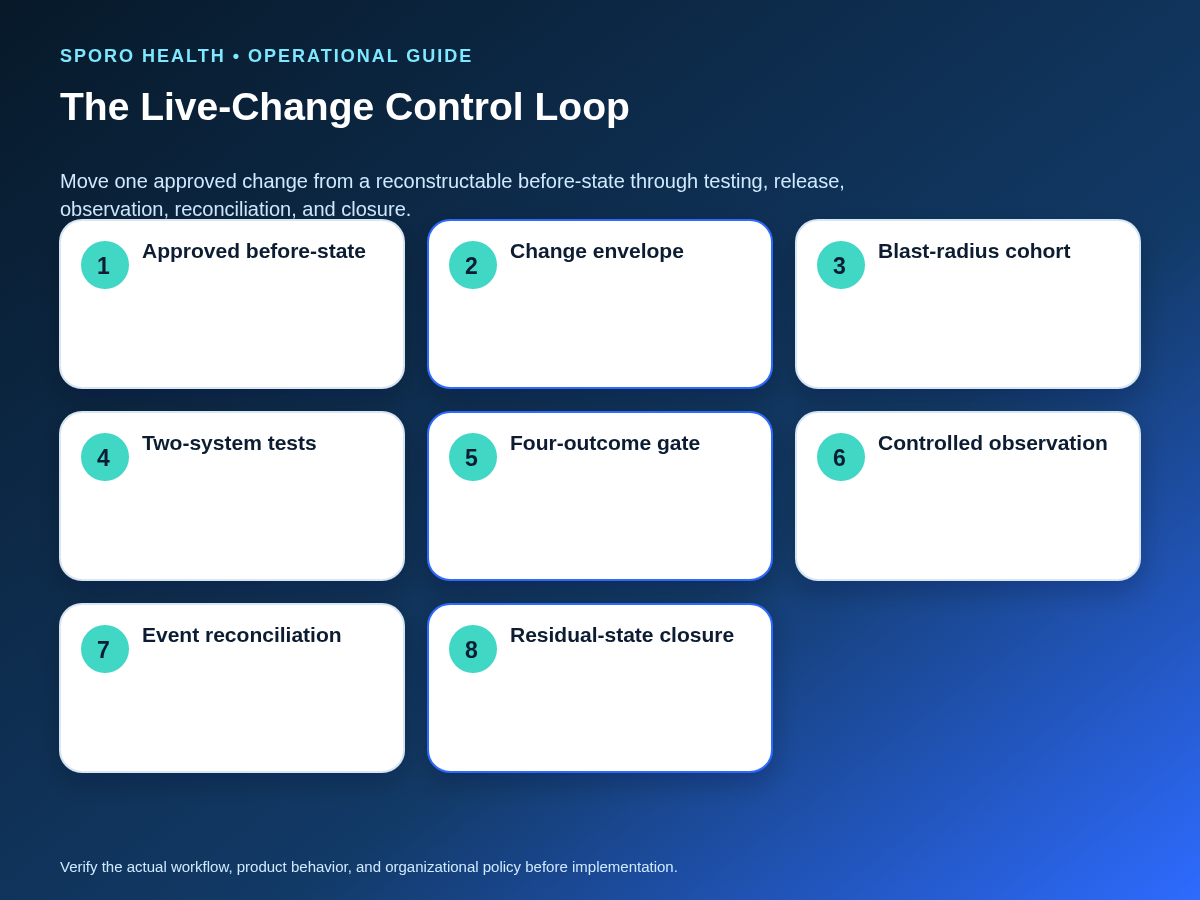
For practice managers deciding how to change a live athenahealth calendar integration safely, the answer is to use one versioned change record that preserves the approved before-state, defines the exact after-state, limits exposure, assigns approval and verification, tests both systems, and preauthorizes rollback. Calendar integration implementation owners should treat this as a production release—not an initial rollout, identity cutover, incident response, or decommissioning project.
How to change a live athenahealth calendar integration safely
Use a single change envelope from request through verified closure. It should connect the business need, approved baseline, affected population, intended result, test evidence, release decision, observation record, reconciliation work, and rollback outcome. NIST configuration-management guidance is not a healthcare implementation recipe, but it supports the underlying discipline: formally request changes, assess their impact, test effectiveness, approve implementation, and retain earlier baselines for restoration. See NIST SP 800-128.
This checklist governs one material change to an integration already operating in production. Use a rollout plan for initial expansion, an incident runbook for unexplained failure, a dedicated identity cutover for provider account changes, and an exit plan when the service is being retired.
What counts as a material production change?
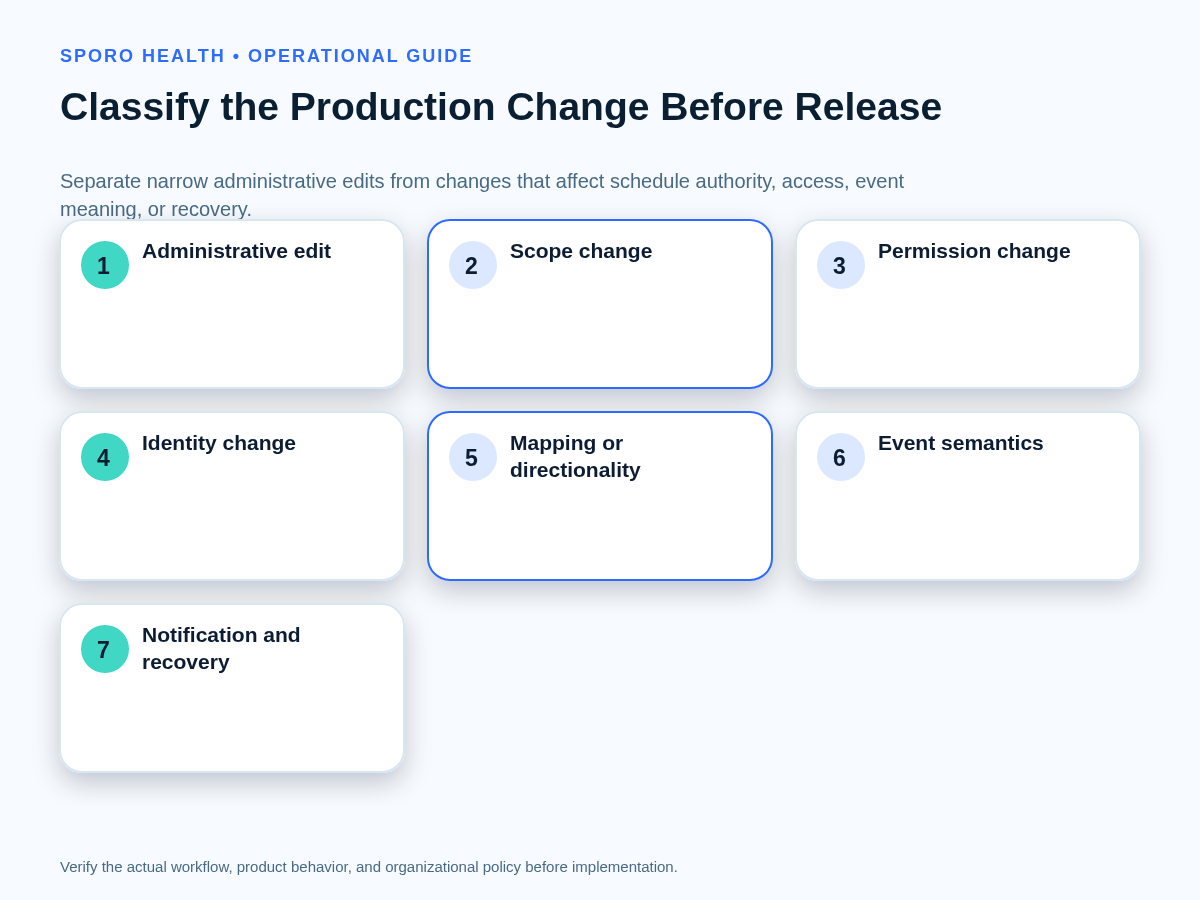
A material change can alter schedule scope, meaning, access, authority, observability, or recovery. The change class determines the minimum review, test cohort, evidence, and release path; the number of configuration fields edited does not determine the risk.
For a provider email, UPN, mailbox, or calendar-identity change, use the provider email change cutover checklist. If analysis shows that the integration or part of its scope should end, use the controlled integration exit checklist.
| Change class | Examples | Minimum control path |
|---|---|---|
| Administrative | Owner name, documentation, contact route, or label with no schedule effect | Record the edit and perform narrow verification. |
| Scope | Provider, calendar, location, department, event class, or scheduling horizon | Baseline every affected provider-calendar pair, use a bounded cohort, and test representative transactions. |
| Authority or directionality | Source-of-truth rule, permitted edit origin, one-way or two-way behavior | Approve operational authority, test competing edits, and preauthorize rollback. |
| Permission | OAuth consent, application scope, delegated access, sharing, or write destination | Review effective access, run permitted and prohibited tests, and scan for residual rights. |
| Identity | Email, username, mailbox, account, provider, or calendar identity | Use an identity-specific cutover with stable identifiers and reconnection evidence. |
| Mapping or data field | Provider-calendar mapping, status translation, title, time, duration, location, or metadata | Inventory existing events, test every affected field, and reconcile historical artifacts. |
| Event semantics | Creation, cancellation, recurrence, availability, all-day, busy/free, or exception rules | Run single-event, series, occurrence, boundary, and negative tests. |
| Notification or recovery | Watch coverage, subscription, retry, alert, replay, or monitoring rule | Prove coverage by calendar, simulate silence, and test resynchronization. |
What belongs in the versioned before-and-after change envelope?
The envelope should make the approved before-state reconstructable and the intended after-state unambiguous. Give it a version, owner, approval timestamp, effective window, and one rollback reference rather than distributing the decision across chat, tickets, spreadsheets, and vendor email.
- Population: every affected provider-calendar pair, location, department, platform, event class, and existing-event population.
- Operating rules: approved calendar, connection owner, booking authority, directionality, write destination, mapping rule, recurrence behavior, and scheduling horizon.
- Access and observation: permission path, authorization owner, notification path, monitoring evidence, known defect, and exception route.
- After-state: the exact values or behaviors that will change, what must remain unchanged, and how each result will be verified.
- Recovery: preserved configuration, event identifiers, restoration sequence, reconciliation window, rollback decision owner, and success evidence.
Record the identifiers and fields available in the practice’s authorized athenahealth environment and verify them against the current athenahealth appointment API reference and current vendor documentation. Do not infer production mappings from display names alone.
How should the blast radius be estimated?
Estimate blast radius by operational unit and event population, not by provider count alone. A one-provider change can still cross locations, calendar platforms, recurring series, future bookings, staff workflows, notification paths, and historical mappings.
If the affected population is too broad for one release, adapt the provider wave-gate rollout plan to create bounded production cohorts.
- Count provider-calendar pairs, not just providers.
- Stratify by location, platform, event class, recurrence type, edit direction, and authorization path.
- Measure existing events inside the affected past and future windows.
- Include normal transactions, known exceptions, unavailable calendars, and staff handoffs.
- Estimate reconciliation burden if every in-scope event must be checked or repaired.
Select a cohort that contains every changed behavior while limiting simultaneous exposure. One successful demonstration is not representative evidence when the change affects several platforms, locations, recurrence patterns, or authority rules.
What should be tested before the changed integration is released?
Test the exact changed scope through both systems, including failure and restoration paths. Each test card should name the provider-calendar pair, starting state, action, expected result in athenahealth, expected result in the external calendar, evidence, verifier, and cleanup requirement.
Convert the approved requirements into executable cases with the pilot acceptance matrix for athenahealth calendar sync, but run it against the approved production baseline rather than treating this as a new-product pilot.
| Scenario | Evidence required |
|---|---|
| Create, reschedule, and cancel | Matching state, time, identity, destination, and status in both systems. |
| Single recurring occurrence and full series | Correct scope, retained exceptions, no unintended neighboring changes, and correct cancellation behavior. |
| Competing or near-simultaneous edits | Documented authority result, no duplicate, and a traceable exception when conflict cannot be resolved automatically. |
| Unavailable calendar or authorization loss | Contained write, visible failure evidence, protected near-term schedule, and successful restoration. |
| Notification gap | Detected missing coverage, bounded unobserved interval, resynchronization, and reconciled missed changes. |
| Rollback | Restored mapping, permissions, authority, notifications, event state, and verified before-state. |
Google Calendar and Outlook need separate platform cards. Google documents full-resource event updates, recurring-event instances, incremental sync tokens, and per-resource notification channels with expiration in its event update reference, recurring-event guide, synchronization guide, and push-notification guide. Microsoft Graph separately documents event PATCH behavior, recurrence, Show As values, and notification lifecycle events in its event update reference and change-notification lifecycle guidance.
How should existing events be handled after a mapping or rule change?
Assign every affected event population a preserve, migrate, rebuild, reconcile, or retire disposition before release. Do not assume that changing a destination, mapping, field, status rule, or recurrence rule will safely reinterpret events created under the earlier configuration.
- Preserve: leave valid events and mappings untouched.
- Migrate: move or transform events while retaining traceable identity.
- Rebuild: create controlled replacements only after preventing duplicate writes.
- Reconcile: compare and repair uncertain or mixed-state populations.
- Retire: remove obsolete artifacts only after authority, retention, and restoration needs are resolved.
Recurring series deserve their own inventory because parent events, individual occurrences, exceptions, cancellations, and future splits may behave differently. Record which layer is changing and verify neighboring occurrences as well as the target interval.
Which outcome should the production release gate produce?
The gate should produce go, conditionally go, hold, or roll back—not an informal “looks fine.” Decide using completed evidence, unresolved exceptions, current booking authority, notification coverage, reconciliation capacity, and the ability to restore the baseline.
Test staff readiness for a failed release with a manual fallback tabletop exercise before relying on manual schedule control as the rollback bridge.
| Outcome | Evidence standard |
|---|---|
| Go | All critical tests pass, scope is bounded, rollback is ready, and no authority or access uncertainty remains. |
| Conditionally go | Only documented noncritical conditions remain, with owners, deadlines, observation controls, and no unsafe schedule ambiguity. |
| Hold | Evidence is incomplete, a dependency is unavailable, or the changed state has not been proved. |
| Roll back | A trigger is met after release or the approved after-state cannot be maintained safely. |
Start rollback when booking authority becomes uncertain, representative tests fail, duplicate or missing events appear, unauthorized data becomes visible, notification coverage is incomplete, or the approved before-state cannot be reconstructed. The trigger should already name who decides, who restores, which writes stop, and what proves recovery.
Who should approve, execute, and verify the change?
Separate the business request, risk approval, technical execution, and outcome verification. This creates a usable evidence chain even when a small organization assigns more than one role to the same person.
- Requester: defines the business need, desired outcome, timing, and affected workflow.
- Authorized owner: approves scope, risk, authority rules, access, release window, and rollback triggers.
- Qualified operator: applies only the approved version and records actual execution details.
- Independent verifier: checks both systems, exceptions, residual state, and closure evidence without relying solely on the operator’s report.
Front-desk staff may help execute representative transactions, but they should not be asked to resolve technical, privacy, contractual, or clinical questions outside their authority.
When is post-change observation complete?
Observation is complete only when all in-scope pairs and scenarios have evidence, exceptions are reconciled, residual states are cleared, owners accept operations, and no rollback trigger remains open. A quiet monitoring window is not proof if expected transactions never occurred.
Use an operations acceptance checklist when the changed service also requires revised runbooks, monitoring ownership, escalation paths, or support responsibilities.
| Measure | Useful denominator or closure question |
|---|---|
| Test coverage | Passed applicable cases divided by all applicable cases. |
| Pair verification | Verified provider-calendar pairs divided by all in-scope pairs. |
| Schedule integrity | Missing, duplicate, stale, or wrong-state events per tested or observed transaction. |
| Exceptions | Reconciled exceptions divided by all discovered exceptions. |
| Access and notification | Pairs with approved access and working coverage divided by all in-scope pairs. |
| Operational burden | Manual review or repair work by pair, event class, and affected time window. |
| Closure stability | Changes closed without reopening an incident or invoking late rollback. |
The final residual-state scan should look for stale mappings, old write destinations, excess permissions, uncovered calendars, duplicate events, unresolved recurring exceptions, abandoned retries, open reconciliation items, and documentation that still describes the superseded baseline.
Where can current connected-calendar options be reviewed?
Use vendor pages to identify current claims, then verify exact production behavior through contracts, documentation, and witnessed tests. Review the Sporo Health overview, the athenahealth and Google Calendar product page, the athenahealth and Microsoft Outlook product page, and the Sporo Health athenaConnect Marketplace listing. These are commercial sources, not independent proof of a practice’s configuration, controls, or results.
Put the production change-control checklist into use
For practice managers deciding how to change a live athenahealth calendar integration safely, the operational standard is straightforward: preserve the approved baseline, classify the change, bound the population, test both systems, decide through a four-outcome gate, observe with denominators, reconcile existing events, and close only after a residual-state scan.
- Open one versioned change envelope.
- Approve the before-state, after-state, scope, roles, and rollback contract.
- Run the representative two-system test set.
- Choose go, conditionally go, hold, or roll back.
- Observe every in-scope pair and reconcile exceptions.
- Record owner acceptance and the new production baseline.
If a vendor will execute any part of the change, bring the completed envelope to the review and ask the vendor to demonstrate the highest-risk scenarios. Do not release solely because a settings page saved successfully or one calendar event appeared as expected.
Frequently asked questions
What counts as a material change to an athenahealth calendar integration?
A material change is any revision that can alter connected providers or calendars, exchanged event states or fields, write destinations, access permissions, notification coverage, mapping rules, recurrence handling, or operational authority. If the change can alter schedule meaning, visibility, reach, or recovery, use the formal control path.
Can a live calendar integration change skip a pilot?
It can skip a separate pilot only when the team still uses a bounded production cohort and representative tests. Administrative edits with no schedule effect may use narrow verification; scope, mapping, permission, identity, directionality, recurrence, notification, or data-field changes need controlled exposure and a release decision.
What should be tested after changing calendar integration scope or mappings?
Test creation, rescheduling, cancellation, one recurring occurrence, the full series, competing edits, unavailable calendars, authorization loss, notification gaps, duplicate prevention, and rollback restoration. Run each applicable scenario in both connected systems for the exact providers, calendars, event classes, and time horizon affected.
How should existing Google Calendar or Outlook events be handled after an integration change?
Assign each existing event population a preserve, migrate, rebuild, reconcile, or retire disposition before release. Do not assume a new mapping, field rule, destination, or recurrence rule will safely reinterpret historical events; verify identifiers, duplicates, cancellations, exceptions, and ownership after the change.
When should an athenahealth calendar integration change be rolled back?
Roll back when booking authority becomes uncertain, a representative test fails, duplicate or missing events appear, unauthorized data becomes visible, notification coverage is incomplete, or the approved before-state cannot be reconstructed. A rollback trigger should name the decision owner and restoration evidence before release begins.
Can Google Calendar and Outlook use the same change-control checklist?
They can share the same governance framework, roles, release outcomes, and closure measures, but they need separate test cases. Event properties, recurrence behavior, permissions, update semantics, notifications, and failure evidence differ across Google Calendar and Microsoft Graph.
Who should approve and verify a production calendar integration change?
The requester defines the business need, an authorized owner approves risk and scope, a qualified operator applies the change, and an independent verifier confirms schedule outcomes and closure evidence. In small organizations, one person may hold multiple titles, but approval, execution, and verification decisions should still be separately recorded.
When is post-change monitoring complete?
Monitoring is complete only when every in-scope provider-calendar pair and scenario has defined evidence, exceptions are reconciled, residual mappings and access are cleared, operational owners accept the result, and no rollback trigger remains open. End observation by evidence, not by elapsed time alone.
Sources
- NIST SP 800-128: Guide for Security-Focused Configuration Management of Information Systems
- athenahealth appointment API reference
- Google Calendar Events: update
- Google Calendar recurring events
- Google Calendar synchronization guidance
- Google Calendar push notifications
- Microsoft Graph event update reference
- Microsoft Graph change-notification lifecycle events