Covering Another Clinic’s athenahealth Schedule: An Authority-and-Handoff Playbook
For teams asking how to manage cross-location scheduler coverage in athenahealth, multi-location practice managers should grant the narrowest temporary authority that meets the staffing need, package the covered clinic’s local rules, and require explicit handoff acceptance before responsibility moves. The workflow should test permitted and prohibited actions, route ambiguity to a local approver, and close only after open work, transactions, and temporary access are verified.
How to manage cross-location scheduler coverage in athenahealth
Use the narrowest authority that can complete the defined work, then transfer responsibility through explicit acceptance. Public athenahealth appointment documentation shows that appointment work can involve providers, slots, appointment types, and departments, but each organization must define its own local permissions and rules. AHRQ TeamSTEPPS handoff guidance offers a useful design principle: clarify when authority changes and confirm that the receiver has accepted it.
- Choose a coverage mode.
- Write a time-bounded coverage envelope.
- Issue the local rule pack and approved access.
- Pass representative and denied-path tests.
- Transfer queues through an accepted-handoff ledger.
- Run every request with one owner and escalation path.
- Hand back open work and close temporary access.
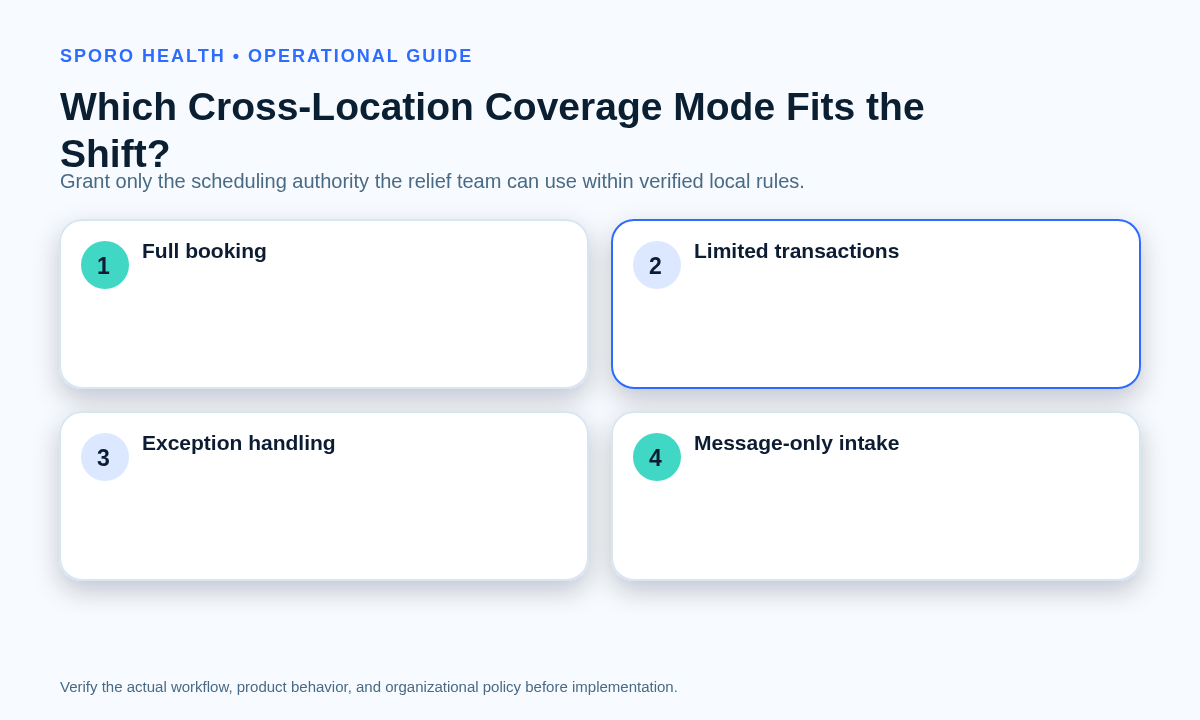
Which coverage mode fits the shift?
Select full booking only when the relief team understands the covered clinic’s routine rules and can pass the strongest tests. Narrower modes reduce the decisions a covering scheduler must make under unfamiliar local conditions.
| Mode | Use when | Permitted work | Control need |
|---|---|---|---|
| Full booking | Rules are stable and well understood | Approved creates, changes, and cancellations | Broad access, full rule pack, supervision |
| Limited transactions | The need is narrow and repeatable | Named appointment types or actions only | Scoped access and focused tests |
| Exception handling | A classified queue needs relief | Only listed exception dispositions | Fast local escalation |
| Message-only intake | Rules, access, or approvers are uncertain | Capture requests without changing schedules | Clear deadlines and routing |
If no mode can pass its readiness gate, do not start coverage. Groups deciding whether temporary relief is occasional or structural should first compare centralized, decentralized, and hybrid scheduling models.
What belongs in the coverage envelope?
The coverage envelope should state exactly where, when, and how the relief team may act. It is the shift-level contract between the originating clinic, covering team, access administrator, and local approver.
| Envelope field | Required entry |
|---|---|
| Effective period | Start, end, time zone, extension owner |
| Covered scope | Departments, locations, providers, appointment types, resources |
| Booking channels | Staff booking, phone, portal, waitlist, or other local paths |
| Permitted actions | Create, reschedule, cancel, route, verify, or message |
| Prohibited actions | Excluded sites, providers, types, overrides, or calendar edits |
| Rule pack | Durations, horizons, eligibility, resource, and exception rules |
| Approvers | Named local decision makers and backup contacts |
| Calendar visibility | Approved calendars, permitted detail, conflict interpretation |
| Closeout | Returning owner, hand-back time, access-removal owner |
Keep the rule pack operational rather than copying unnecessary patient information into portable documents. HHS minimum-necessary guidance explains that organizations should define which workforce roles need access, what information they need, and the conditions for that access. Privacy and compliance conclusions still depend on the actual workflow, contracts, configuration, policies, and authorized review.
What must happen before coverage starts?
Coverage should not begin until the relief team accepts the site rule pack, receives approved access, passes representative and denied-path tests, and confirms ownership of work already in progress. A login test alone does not prove readiness.
- Confirm the envelope version and effective period.
- Test one routine booking, one permitted change, and one cancellation or routing action.
- Verify the originating and covering teams see the same final status.
- Test the prohibited paths below through the real user role.
| Denied-path attempt | Passing result |
|---|---|
| Excluded department or location | Action is denied or the scheduler stops before saving |
| Excluded provider | No booking authority is inferred from visibility |
| Excluded appointment type | Request routes to the named approver |
| Unapproved resource or override | No substitution occurs without approval |
| Conflicting calendar evidence | Interval is held and escalated |
| Action after expiry | Temporary authority no longer works |
Use realistic drills to test front-desk readiness with scheduling scenarios, including the actions staff must refuse.
How should responsibility transfer?
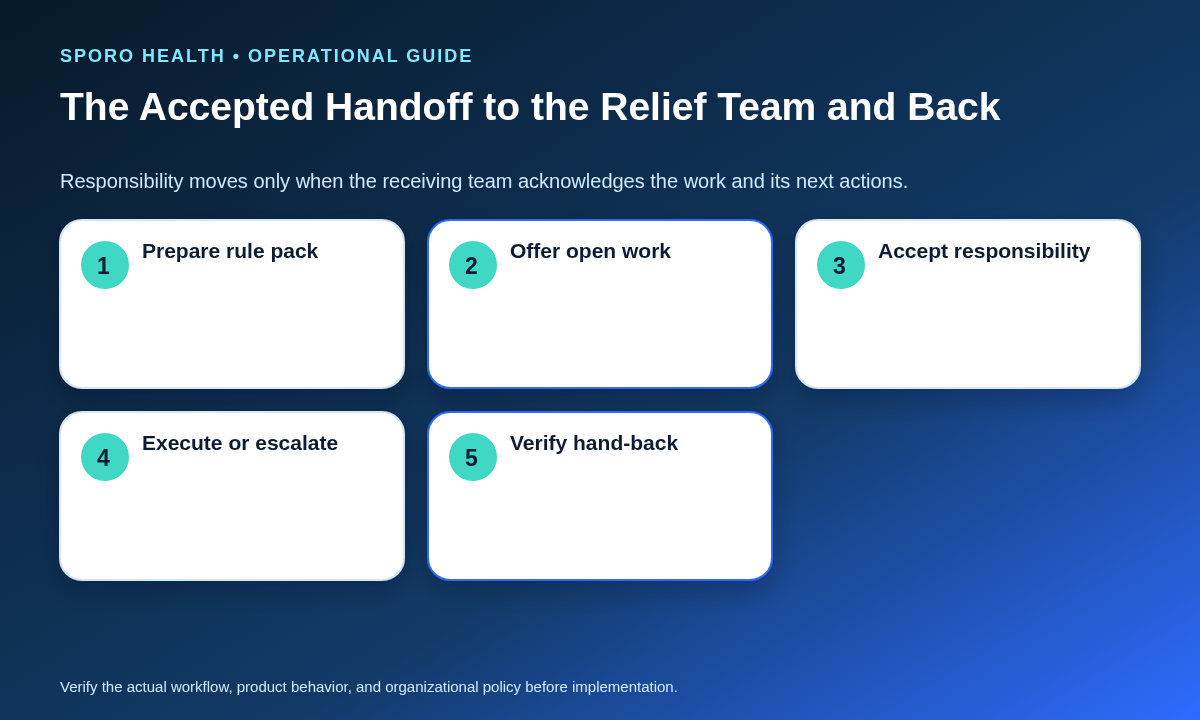
The originating team remains responsible until the covering team explicitly accepts the handoff. This adapts the AHRQ principle that a handoff transfers accountability and should confirm receipt. Record one row for every queue, unresolved transaction, deadline, or contingency rather than assuming a shared inbox equals acceptance.
| Ledger field | What to record |
|---|---|
| Work identity | Queue, request set, or transaction reference |
| Current owner | Named team or individual |
| Authoritative status | Current state and supporting record |
| Deadline | Due time and urgency |
| Next action | Specific step and contingency |
| Acceptance | Receiver, timestamp, questions, exceptions |
For routine queue design, use one exception queue with accepted handoffs so duplicate owners do not work the same request.
How should the relief team run the shift?
Each request should have one current owner, one authoritative status, a deadline, and a recorded next action. Work only inside the active envelope, capture the final athenahealth state before closure, and avoid parallel edits through chat, email, or an external calendar.
- Claim the request before editing.
- Recheck provider, department, location, appointment type, time, and required resources.
- Record the resulting status and any patient-communication owner.
- Return exceptions to the ledger rather than leaving them in personal notes.
When the authorized task changes the clinic site, use the dedicated workflow to move an appointment between athenahealth locations safely.
When should a relief scheduler stop and escalate?
Stop when the evidence conflicts or the decision requires local judgment outside the coverage envelope. A busy shift is not a reason to widen temporary authority.
| Conflict | Required response |
|---|---|
| Provider or location disagreement | Hold the transaction and obtain local confirmation |
| Appointment type, duration, or resource mismatch | Do not improvise a substitute |
| Authorization or eligibility unresolved | Route to the authorized owner without clinical judgment |
| Calendar and athenahealth evidence differ | Preserve both records and escalate |
| Request is outside scope or time | Log the attempt and use the defined intake path |
Covering teams should separate provider-location labels from booking authority; a familiar calendar label does not prove the provider is bookable at that clinic.
How should coverage failures be recovered?
Contain the smallest affected scope, assign a recovery owner, and require evidence before normal work resumes.
| Failure | Immediate containment | Closure proof |
|---|---|---|
| Missing or outdated rule | Narrow to message-only intake | Approved rule version and retest |
| Approver unavailable | Hold judgment-dependent requests | Backup accepts or requests remain queued |
| Wrong-location booking | Stop related transactions | Correct destination and no source residue |
| Competing edits | Freeze further changes | One surviving status and named owner |
| Hand-back rejected | Keep covering owner active | Returning team explicitly accepts |
| Access remains after expiry | Stop use and notify administrator | Removal or dated reapproval is tested |
How should coverage close?
Coverage closes only after work, transactions, residue, and access have been accepted and verified.
- The returning team accepts every unresolved request.
- Completed transactions are sampled against the final schedule.
- Wrong-site, duplicate, and reopened residue is checked.
- Temporary access is removed or formally reapproved.
- The hand-back owner records closure and remaining follow-up.
Which metrics show control quality?
Separate staffing volume from control quality. Report counts and rates by clinic pair, coverage mode, and shift when the denominator is useful.
| Measure | What it reveals |
|---|---|
| Unaccepted handoffs | Work offered but not acknowledged |
| Wrong-location bookings | Destination-control failures |
| Reopened transactions | Premature or incorrect closure |
| Out-of-scope attempts | Envelope clarity or access-control gaps |
| Unresolved at hand-back | Backlog transferred to the returning team |
| Residual access | Temporary rights left active |
| Rule-pack exceptions | Missing, unclear, or outdated local guidance |
Review throughput beside these measures, but do not treat more completed requests as evidence that the coverage was controlled.
Where do connected calendars fit?
Google Calendar or Outlook may provide approved availability evidence, but calendar access does not grant athenahealth booking authority. Google documents sharing levels ranging from free-busy visibility to change and sharing control. Microsoft distinguishes Outlook calendar roles such as AvailabilityOnly, Reviewer, Editor, and delegate behavior. Match the permission to the task and test its removal.
Teams evaluating connected-calendar options can review the Sporo Health overview, the athenahealth and Google Calendar product page, the athenahealth and Microsoft 365/Outlook product page, and the Sporo Health athenaConnect Marketplace listing. Treat capability descriptions as vendor claims and request a witnessed test of the exact envelope, denied paths, calendar visibility, and access closeout before relying on them.
Frequently asked questions
What should cross-location schedulers be allowed to book in athenahealth?
They should perform only the providers, departments, appointment types, channels, and actions listed in the active coverage envelope. Anything outside that boundary should be blocked, held, or escalated to the named local approver.
Which local scheduling rules must accompany a clinic-coverage handoff?
Send the current rule pack for covered providers and departments: appointment-type eligibility, duration and resource rules, booking horizons, channel differences, authorization steps, location exceptions, escalation contacts, and connected-calendar visibility.
How should a covering clinic accept unresolved scheduling work?
The covering team should acknowledge each queue or request set, confirm the current owner, status, deadline, next action, and contingency, and record the acceptance time. Responsibility remains with the originating team until that acknowledgment.
When should a relief scheduler escalate instead of booking an appointment?
Escalate when provider, location, appointment type, resource, authorization, or calendar evidence conflicts; when a required rule is missing; or when the decision requires judgment outside the approved coverage envelope.
How do medical groups prevent wrong-location bookings during cross-site scheduling coverage?
Require destination verification before saving, treat location labels as evidence rather than authority, test excluded sites before activation, and scan completed work for source-site residue and wrong-location transactions before hand-back.
How should Google Calendar and Outlook be checked during temporary scheduler coverage?
Confirm the approved calendar, permitted visibility, relevant free-busy or event state, and any conflicting provider-location signal. Do not treat calendar access or a location label as permission to book in athenahealth.
What metrics show that cross-location scheduling handoffs are controlled?
Track unaccepted handoffs, wrong-location bookings, reopened transactions, out-of-scope attempts, unresolved requests at hand-back, residual access, and exceptions caused by missing or outdated local rules, alongside workload volume.
Practical conclusion
How to manage cross-location scheduler coverage in athenahealth is ultimately a control problem, not simply a staffing assignment. Start with one clinic pair, one coverage mode, one approved rule pack, and one accepted ledger. Expand only after permitted actions work, prohibited actions stop safely, open work returns to a named owner, and temporary access closes as designed.
Sources
Primary and current vendor materials reviewed November 17, 2026:
- athenahealth: Appointments
- AHRQ: TeamSTEPPS communication and handoffs
- HHS: Minimum Necessary Requirement
- Google Calendar Help: Share your calendar
- Microsoft Learn: Calendar and delegate permissions
- Sporo Health
- Sporo Health: athenahealth and Google Calendar
- Sporo Health: athenahealth and Microsoft Outlook
- athenaConnect Marketplace: Sporo Health