Which athenahealth Appointment Types Should Patients Self-Schedule? An Eligibility-Gate Guide
For practice managers asking which athenahealth appointment types should patients self-schedule, the practical answer is: expose only low-ambiguity appointment combinations that patients can identify correctly and that resolve to a valid provider or department, duration, location or modality, prerequisites, channel, and booking horizon. Route anything requiring unresolved judgment to a request-only or staff-only path.
Which athenahealth appointment types should patients self-schedule?
Patient self-scheduling should be enabled only for appointment types patients can identify correctly and that lead to a valid provider, department, duration, location or modality, and exception path. If prerequisites, continuity, resource availability, or appointment-reason interpretation still require staff judgment, do not let the patient claim the slot directly.
athenahealth’s current athenaOne Service Description says patients select reasons that correspond to practice-controlled appointment types and that self-scheduling can be configured for new and/or existing patients. It also describes appointment requests as an alternative when direct scheduling is not offered. That supports a selective release model rather than treating self-scheduling as one practice-wide switch.
What is the safest decision unit for self-scheduling?
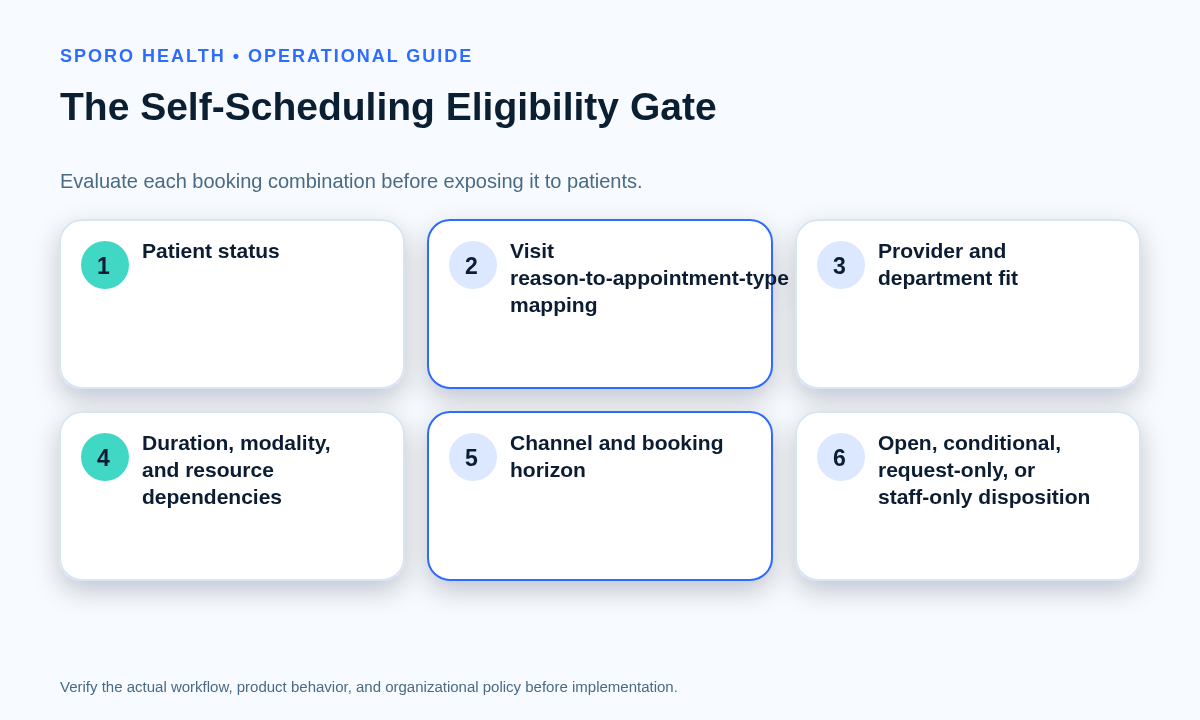
The safest decision unit is appointment type × patient status × provider or department × channel × booking horizon. Add location or modality, duration, resources, and prerequisites to the eligibility envelope because two combinations sharing an appointment-type name may have very different booking risks.
- Patient status: new, established, returning after a gap, or another practice-defined cohort.
- Reason and type: one patient-facing reason mapped to one intended appointment type.
- Destination: eligible provider or department, location, modality, and duration.
- Dependencies: continuity rules, prerequisites, rooms, equipment, linked visits, or approvals.
- Exposure: patient channel, booking horizon, rescheduling rules, and exception path.
Record one owner, disposition, evidence date, and rollback action for every combination. If capacity allocation could be distorted, use the new-patient and follow-up slot-mix guide to check whether self-scheduling would consume capacity reserved for another class.
How should patient visit reasons map to athenahealth appointment types?
Each patient-facing reason should map to a defined appointment type, duration, provider or department scope, location or modality, and exception path before release. Ambiguous labels, duplicate mappings, or missing fallback rules should stop direct booking until they are corrected.
athenahealth’s appointment documentation treats appointment reasons, appointment types, open slots, departments, and booked appointments as distinct scheduling elements. Preserve that traceability in the practice’s decision record. For newly introduced pathways, coordinate this work with the new service-line scheduling readiness checklist.
| Patient-facing reason | Required mapping | Release test | Exception path |
|---|---|---|---|
| Routine follow-up | Specific follow-up type, duration, and continuity rule | Correct provider and timing window appear | Request review if continuity is uncertain |
| New-patient visit | Dedicated type, department, duration, and prerequisites | Only eligible new-patient capacity appears | Request intake if information is incomplete |
| Telehealth follow-up | Mode-specific type and approved provider scope | Correct modality and duration are retained | Route mode exceptions to staff |
| Procedure request | Dependency record rather than a broad visit label | Every required resource can be validated | Keep request-only or staff-only |
These examples are operational placeholders, not clinical eligibility rules. The practice must define its own approved reasons and decision owners.
Which disposition should each appointment combination receive?
Use four dispositions: open, conditional, request-only, or staff-only. Every appointment-type combination should have exactly one documented disposition and owner so patients and staff are not left to infer the rule from an appointment label.
| Disposition | Use when | Required control |
|---|---|---|
| Open for self-scheduling | The reason is unambiguous and every dependency is resolved before booking | Release only the approved provider, department, duration, location, channel, and horizon |
| Open with explicit conditions | Objective conditions can be enforced before the slot is claimed | Test every condition and its denied path; hidden staff judgment is not a condition |
| Request-only | The patient can state the need, but staff must verify fit or prerequisites | Route the request to a named queue with a response owner |
| Staff-only | Booking requires specialized judgment, linked resources, sequencing, or controlled exceptions | Keep the type off patient-facing booking surfaces |
If the live configuration cannot enforce a proposed condition before booking, classify the combination as request-only instead of relying on post-booking correction.
How should new patients, existing patients, and complex visits differ?
New and existing patients need separate eligibility decisions because identity, history, continuity, provider selection, prerequisites, and appointment-reason requirements may differ. A rule that works for an established patient returning to the same provider may be unsafe for a new patient selecting among departments.
The public athenaPatient help page states that self-scheduling is available only when the patient’s practice has enabled it. Practice-level enablement should still be narrowed through documented cohort and appointment-combination rules.
- Allow new-patient self-scheduling only when identity, reason, destination, duration, location or modality, and prerequisites are clear.
- Separate follow-ups when continuity, timing, duration, modality, location, or resources differ materially.
- Keep procedure, multi-resource, sequential, and recurring visits request-only or staff-only unless every dependency is validated before the slot is claimed.
- Keep exception-heavy labels staff-only until recurring exceptions are redesigned into clear appointment paths.
How should Google Calendar, Outlook, and booking horizons affect eligibility?
A connected calendar may contribute an availability signal, but it should not become patient-booking authority. Eligibility, appointment-type mapping, provider and department scope, capacity, and booking horizons should remain controlled by the approved athenahealth scheduling pathway.
Before adding a second booking surface, review how Google Calendar Appointment Schedules alongside athenahealth changes booking authority. Set the time boundary separately with the athenahealth provider booking-horizon guide.
Google documents that an opaque event blocks calendar time while a transparent event does not in its Calendar Events resource. Microsoft’s Graph free/busy documentation returns statuses such as free, tentative, busy, and out of office. Those platform states describe calendar availability; they do not prove that an athenahealth slot is an eligible patient appointment.
Acceptance testing must prove that approved external commitments close the intended interval and that missing, delayed, unsupported, or out-of-scope calendar signals cannot leave self-scheduled capacity falsely open.
What must athenahealth self-scheduling acceptance testing prove?
Testing must prove both that eligible patients can complete the right booking and that ineligible paths fail safely without claiming a slot. Use realistic combinations and retain expected-versus-observed evidence for each test.
When a newly added clinician is included, complete the new-provider booking-readiness gate before testing patient exposure.
| Test path | Expected result |
|---|---|
| Eligible cohort, reason, destination, and horizon | One appointment is booked with the correct type, duration, provider or department, location, and channel record |
| Ineligible patient status | No slot is claimed; the patient receives the approved request or contact path |
| Wrong provider or department | The invalid destination is absent or denied |
| Missing prerequisite or unavailable resource | Booking stops before capacity is claimed |
| Closed horizon or approved calendar conflict | The interval is not offered as patient-bookable |
| Duplicate submission or unsupported change | No unintended second appointment is created; the correct staff or portal path is presented |
Each test record should identify the booking combination, expected outcome, observed outcome, appointment identifier if created, evidence location, defect owner, and retest result. Do not approve release based only on a high aggregate pass rate if a consequential denied path remains unresolved.
How should a bounded self-scheduling launch expand?
Start with a limited set of low-ambiguity combinations, observe staff corrections, and expand only when the evidence supports the next cohort. Do not open every appointment type merely because one pilot path worked.
Use the daily athenahealth schedule reconciliation playbook to assign and close launch exceptions.
- Configuration baseline: approve mappings, dispositions, owners, channels, and rollback actions.
- Shadow testing: run successful and denied paths without broad patient exposure.
- Limited cohort: release selected appointment combinations, providers or departments, and horizons.
- Daily exception review: inspect misrouting, corrections, duplicates, prerequisites, and staff workload.
- Decision gate: expand, hold, redesign, or roll back each combination independently.
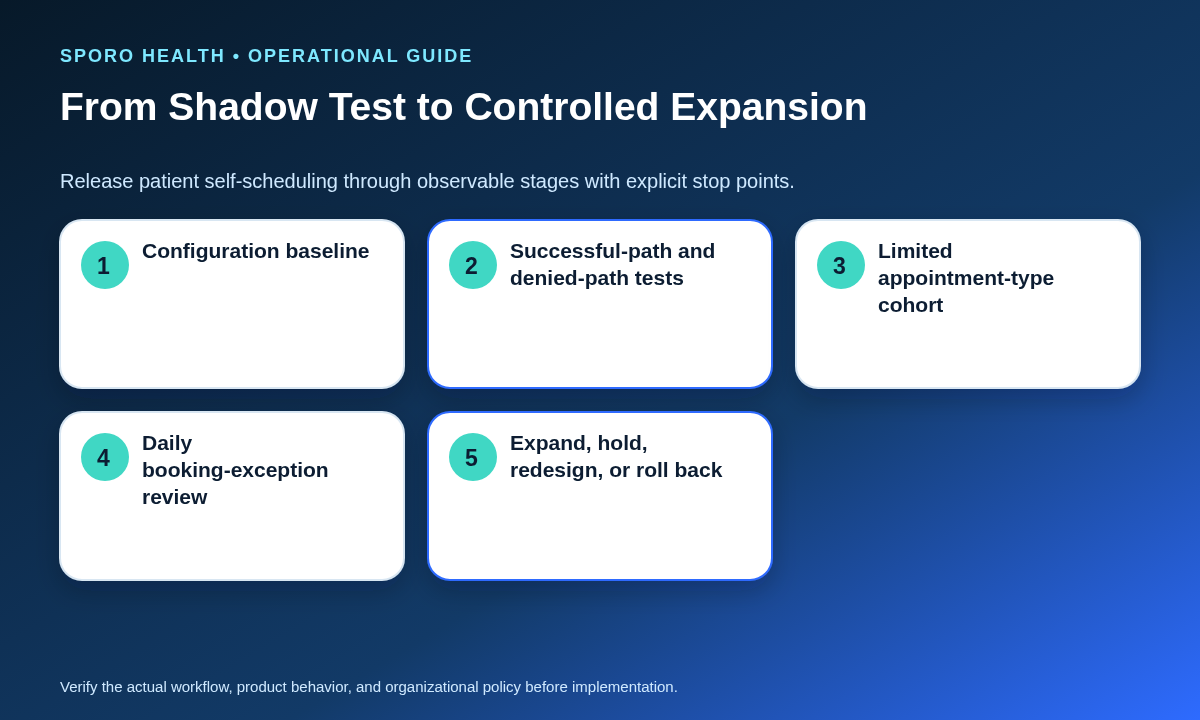
Expansion requires stable mappings, no unresolved high-consequence denied-path defects, accepted exception ownership, and evidence that staff are not routinely repairing the same booking rule after the appointment is made.
What should post-launch measurement and rollback cover?
Measure errors and workload by appointment-type combination, not only as a practice-wide total. This reveals whether one patient cohort, provider, department, channel, or horizon is creating most of the correction burden.
| Measure | Operational definition |
|---|---|
| Wrong-type booking rate | Bookings changed to another appointment type divided by exposed bookings |
| Post-booking correction rate | Bookings requiring provider, department, duration, location, modality, or time correction |
| Unresolved-prerequisite rate | Bookings reaching staff review without required prerequisites completed |
| Duplicate-claim rate | Duplicate or competing appointments linked to one intended request |
| Booking-error cancellation rate | Cancellations attributed to an invalid original booking path |
| Staff review workload | Review volume and handling time by combination and exception reason |
| Displaced-capacity signal | Eligible capacity consumed by the wrong patient class or channel |
When a combination fails its gate, rollback should:
- Remove that combination from patient self-scheduling without broadening the change unnecessarily.
- Preserve already-booked appointments for staff review rather than canceling them automatically.
- Route new demand to a controlled request path with a named owner.
- Verify every portal, app, website, campaign, and external booking surface before declaring rollback complete.
Where do connected-calendar options fit?
Use product review as evidence collection, not as a shortcut around the eligibility gate. If connected-calendar consistency is part of the acceptance plan, review Sporo Health, the athenahealth and Google Calendar product page, the athenahealth and Microsoft Outlook product page, and the Sporo Health athenaConnect Marketplace listing. Confirm actual scope, mappings, data choices, permissions, contracts, and acceptance evidence for the proposed configuration.
Practical conclusion
When deciding which athenahealth appointment types should patients self-schedule, do not approve an appointment type in isolation. Approve a bounded combination with a clear reason mapping, patient cohort, destination, dependencies, channel, horizon, disposition, owner, test evidence, measures, and rollback path. The safest program expands one proven combination at a time.
Frequently asked questions
- Should new patients be allowed to self-schedule?
-
Only for appointment paths with clear identity, reason, provider or department, duration, location or modality, and prerequisite rules. If any of those require staff judgment, use request-only intake.
- Can all follow-up visits use the same rule?
-
No. Separate follow-ups when provider continuity, timing, duration, modality, location, or resource requirements differ materially. A shared label is not enough evidence that every cohort can use the same self-scheduling rule.
- When should an appointment remain request-only?
-
Use request-only when the patient can state a need but staff must verify eligibility, prerequisites, provider fit, resources, or sequencing before a slot is claimed.
- Can Google Calendar or Outlook decide whether a patient can book?
-
No. Google Calendar or Outlook may contribute approved availability signals, but athenahealth appointment eligibility, capacity, and booking rules should remain the authority for patient booking.
- How should athenahealth patient self-scheduling be tested before launch?
-
Test successful bookings and denied paths for patient status, provider, department, resources, prerequisites, horizon, external-calendar conflicts, duplicate submissions, and unsupported changes before exposing a limited live cohort.
- What should rollback do after misrouted bookings?
-
Remove the affected combination from self-scheduling, preserve existing bookings for staff review, direct new demand to a controlled request path, and verify every patient-facing booking surface before reopening.
Sources
Primary sources reviewed November 25, 2026: