How Far Ahead Should athenahealth Provider Schedules Open? A Booking-Horizon Guide
For practice managers asking “how far in advance should athenahealth schedules open for booking,” the safest answer is: only as far as the practice can verify provider hours, location, appointment rules, resources, closures, booking channels, and connected calendars. Use separate horizons where certainty or patient planning needs differ, release future dates on a controlled cadence, and recalibrate from observed instability rather than choosing one universal number.
How far in advance should athenahealth schedules open for booking?
Open only through the farthest date where provider hours, location, appointment types, resources, coverage, and known exceptions are sufficiently confirmed. A single practice-wide number is usually too blunt. Set the boundary for each defined scheduling unit and use a shorter or conditional horizon when evidence is weaker.
Current athenahealth appointment documentation describes workflows for finding open slots, while its complete API list includes operations for open appointments. The reviewed sources do not prescribe one universal number of days for every practice, provider, appointment type, or booking channel. The horizon is therefore an operating-policy decision rather than a general platform constant.
What is a booking horizon?
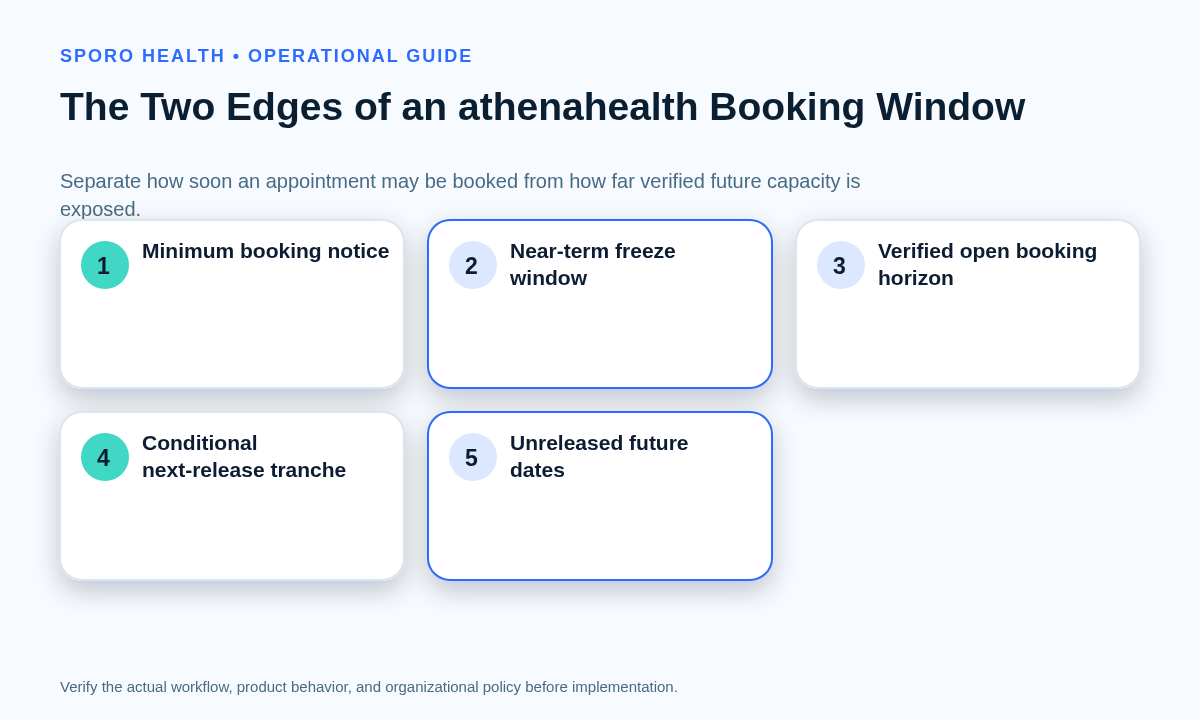
A booking horizon is the farthest future date exposed for booking for a defined provider, department or location, appointment type, and channel. It is different from minimum booking notice, which controls how soon an appointment may be made, and from the near-term freeze window, which increases control over changes to dates that are already open. Use a separate provider schedule change cutoff policy for that near-term boundary.
What is the correct unit for setting a booking horizon?
Set the horizon for a provider × department or location × appointment type × booking channel unit. This prevents one confident workflow from masking another whose hours, resources, location, or booking rules remain uncertain.
| Unit-card field | Record | Hold release when |
|---|---|---|
| Provider | Named provider or governed cohort | Future commitment is unconfirmed |
| Department or location | Exact scheduling boundary and time zone | Site assignment or mapping is unresolved |
| Appointment type | Duration, eligibility, mode, and dependencies | Rules or resources are incomplete |
| Booking channel | Staff booking, patient self-scheduling, or another approved surface | The channel exposes different or stale capacity |
| Boundary and owner | Last bookable date, release cadence, approver, and rollback owner | No one can verify or reverse the release |
One provider may therefore have a longer routine-visit horizon at a stable location, a shorter new-patient horizon, and a conditional procedure horizon. Use tiering only when staff can see, explain, test, and maintain the differences.
How does the booking-horizon decision matrix work?
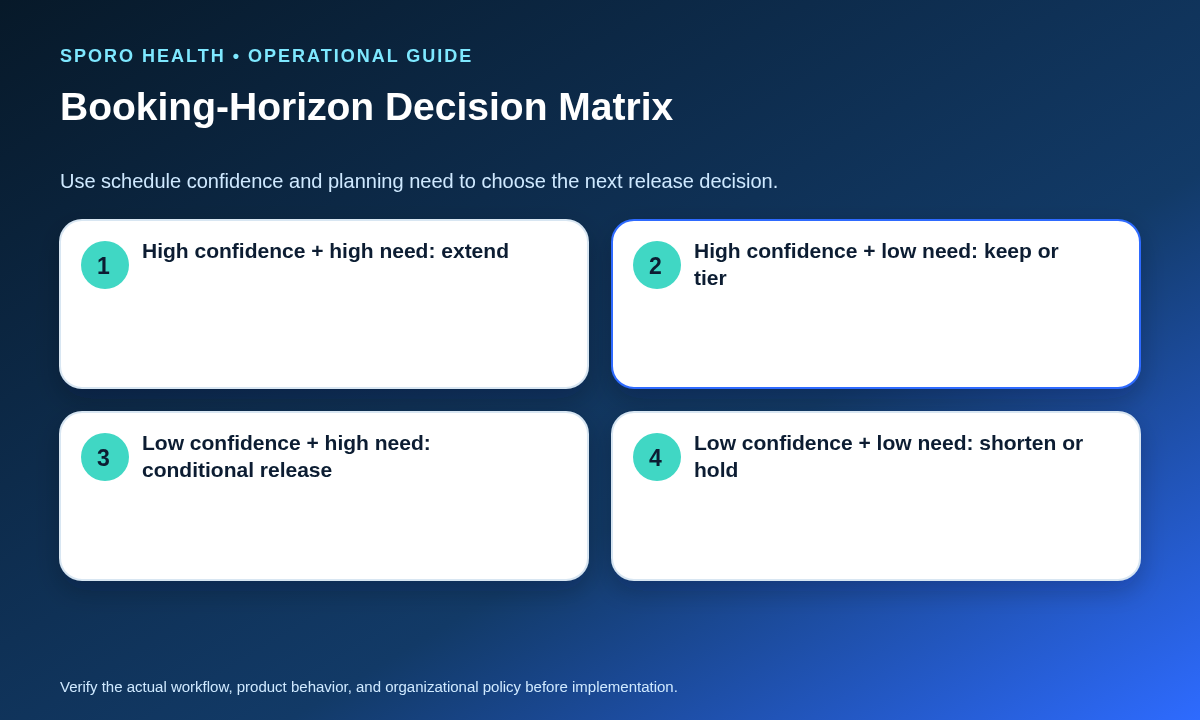
Compare future schedule confidence with the patient and operational need to plan ahead, then choose extend, keep or tier, conditionally release, or shorten and hold. Score the two dimensions for each unit card rather than for the practice as a whole.
| Schedule confidence | Planning need | Decision | Operating response |
|---|---|---|---|
| High | High | Extend | Open the next verified tranche after the release gate passes. |
| High | Low | Keep or tier | Retain the current boundary or use a shorter channel-specific window. |
| Low | High | Conditional release | Open only approved appointment classes or dates with named exception owners. |
| Low | Low | Shorten or hold | Stop new exposure until the underlying schedule becomes governable. |
Evidence supports treating lead time as a calibration factor, not as a universal prescription. A pediatric outpatient interrupted-time-series study associated a change from a 12-week to a four-week horizon with lower combined last-minute cancellations and no-shows. An earlier Veterans Health Administration study found cancellations increased as scheduling intervals lengthened. Different populations and workflows may behave differently, so practices should test their own bands.
What must be verified before another block of dates opens?
Verify the provider commitment, schedule rules, dependent resources, closures, booking surfaces, connected-calendar coverage, exception ownership, and rollback plan before release. A release should be a controlled change, not merely the passage of another week or month.
- Provider commitment: confirm working dates, hours, coverage, and any unresolved requests.
- Location: verify the department, physical or virtual site, time zone, and travel boundaries.
- Appointment rules: confirm types, durations, eligibility, release restrictions, and capacity limits.
- Resources: verify required rooms, equipment, support roles, or linked appointments.
- Closures: apply known leave, holidays, maintenance, and temporary service restrictions.
- Booking surfaces: test that staff and patient-facing channels expose the intended dates and no others.
- Calendar coverage: test a normal occurrence, an exception, and a date near the new boundary.
- Ownership and rollback: name the approver, verifier, exception owner, and reversal path.
When confidence is weak because the recurring baseline or a bounded hours change is unresolved, use the schedule template versus temporary change decision before opening more capacity.
Should patient self-scheduling and staff booking use the same horizon?
Not necessarily; a narrower patient-facing window can coexist with controlled staff exceptions. Record both boundaries on the unit card, state which appointment classes qualify, and test that staff do not mistake a hidden exception for generally available capacity. If another booking page is involved, use a booking-authority comparison for Google Calendar Appointment Schedules to prevent a second uncontrolled source of future slots.
Google Calendar recurring events can contain instance-level exceptions and use a defined recurrence time zone, while Microsoft Graph recurrence combines a pattern and range that may also carry time-zone behavior. Release testing should therefore cover an ordinary occurrence, a changed occurrence, the final date inside the tranche, and the first unreleased date. See the current Google Calendar event documentation and Microsoft Graph recurrence documentation.
How often should future dates be released?
Choose the fastest repeatable cadence the team can fully verify without extending beyond reliable schedule confidence. Daily, weekly, and monthly releases can all work; predictability and completed verification matter more than the label.
| Cadence | Best fit | Control requirement |
|---|---|---|
| Daily | Small tranches or frequently changing workflows | A lightweight daily gate with clear exception ownership |
| Weekly | Most active outpatient schedules | A fixed release day, named verifier, and channel checks |
| Monthly | Stable schedules with stronger advance-planning needs | A broader dependency review and explicit rollback scope |
Release punctuality should be measured, but punctuality must not override safety. If a scheduled release cannot pass the gate, record a hold and explain the affected unit instead of opening dates merely to meet the calendar.
Which booking-horizon exceptions need separate rules?
Create explicit exception classes for workflows whose planning need or schedule dependencies differ from routine visits. Use the booking-readiness gate for a new provider for initial exposure, and use the recurring patient appointment scope and closure process when a valid series must extend beyond the routine horizon.
| Exception | Horizon rule | Required evidence |
|---|---|---|
| Recurring care | Allow a governed series exception when approved | Every occurrence has a valid slot and owner |
| Procedures or resource-dependent visits | Release only through confirmed dependency coverage | Provider, room, equipment, and support availability |
| New providers | Use staged initial exposure before the rolling policy | Readiness gate and stabilization owner |
| Temporary coverage | Do not exceed the approved coverage end date | Home and host commitments are reconciled |
| Planned leave or closures | Stop release across affected dates | Booked appointments and reopening rules are classified |
| Location changes | Hold affected units until mappings are verified | Department, channel, resource, and calendar tests |
| Appointments beyond a revised horizon | Preserve valid commitments while stopping new exposure | Appointment census, disposition, and communication owner |
What should happen when the booking horizon is shortened?
Preserve valid existing appointments, stop releasing new slots beyond the revised boundary, and classify every exposed commitment before making changes. Shortening the horizon changes future availability policy; it does not automatically invalidate appointments already accepted.
- Record the new boundary and effective release date for each affected unit.
- Prevent additional slots from becoming bookable beyond that boundary.
- Build a census of existing appointments, recurring occurrences, holds, and offers outside it.
- Assign each commitment a preserve, review, move, communicate, or escalate disposition.
- Name owners for patient communication and dependent-resource changes.
- Verify every booking channel and connected calendar after containment.
Avoid mass cancellation or rescheduling without an approved disposition. If the shortening responds to uncertain provider availability, contain the future band while the underlying schedule decision is resolved.
How can a practice tell whether the horizon is too long or too short?
Measure instability and unmet planning need by future-date band, then compare results before extending, keeping, shortening, or holding the horizon. Feed resulting exceptions into daily athenahealth schedule reconciliation instead of allowing them to remain in informal lists.
| Measure | Definition | Signal |
|---|---|---|
| Provider-driven future changes | Approved provider changes affecting bookings in each date band | Rising far-band changes suggest excessive exposure |
| Horizon-related reschedules | Booked appointments moved because future capacity was not stable | Shows patient-facing consequences of weak confidence |
| Manual future-request volume | Requests held outside the bookable window | Persistent volume may indicate a horizon that is too short |
| Release punctuality | Planned releases completed only after the gate passed | Late releases reveal process or confidence constraints |
| Unresolved exceptions | Open issues grouped by near, middle, and far future bands | Concentration identifies where control deteriorates |
- Extend when confidence is high, planning need is material, and instability remains within practice-defined limits.
- Keep when the current window is stable and manual future requests are manageable.
- Shorten when provider-driven changes and horizon-related reschedules cluster in the far band.
- Hold when release-gate blockers or unowned exceptions remain unresolved.
Set thresholds from the practice’s baseline rather than borrowing an unsupported industry number. Review by scheduling unit so a stable workflow does not hide a fragile one.
Where do connected-calendar options fit?
Connected calendars can support visibility and verification, but they should not replace the practice’s booking-horizon policy, release authority, or exception ownership. If calendar connectivity is part of the operating model, review Sporo Health scheduling resources, the current athenahealth and Google Calendar product page, the athenahealth and Microsoft 365/Outlook product page, and the Sporo Health athenaConnect Marketplace listing. Treat product descriptions as vendor claims and validate the selected workflow in a bounded test.
The practical answer to how far in advance should athenahealth schedules open for booking is not a universal number. It is the farthest boundary each scheduling unit can release predictably, verify across approved channels, and govern without creating an avoidable future-change burden.
Frequently asked questions
How far in advance should athenahealth schedules open for booking?
Open only through the farthest date where provider hours, location, appointment types, resources, and coverage are sufficiently confirmed; use tiered horizons when certainty differs by workflow.
What is a booking horizon?
It is the farthest future date exposed for booking for a defined provider, department or location, appointment type, and channel. It is separate from minimum booking notice and the near-term schedule-change freeze window.
Should every appointment type use the same horizon?
No. Routine visits, recurring care, procedures, new-patient visits, and resource-dependent appointments may use different windows when the practice can administer and explain those differences consistently.
What must be confirmed before another block of dates opens?
Verify provider commitment, department or location, appointment rules, dependent resources, booking-channel mappings, known leave or closures, connected-calendar coverage, and exception ownership.
How often should future dates be released?
Choose a repeatable cadence the team can verify before each release. Daily, weekly, or monthly release can work if capacity appears predictably and does not extend beyond the period the practice can govern reliably.
Should patient self-scheduling and staff booking use the same horizon?
Not necessarily. A narrower patient-facing window can coexist with controlled staff exceptions, but the difference must be documented, testable, and visible to staff rather than becoming a hidden rule.
How can a practice tell whether the horizon is wrong?
A window may be too long when future bookings require frequent provider-driven changes; it may be too short when staff maintain manual future-request lists or patients cannot arrange approved recurring care.
What should happen when the horizon is shortened?
Preserve valid existing appointments, stop releasing new slots beyond the revised boundary, classify exposed commitments, assign communication owners, and avoid mass cancellation or rescheduling without an approved disposition.
Sources
- athenahealth Appointments documentation — open-slot and appointment-management workflow context.
- athenahealth complete API list — open and booked appointment endpoint inventory.
- Effects of Booking Horizon Reduction on Cancellation Rates — interrupted-time-series evidence from one pediatric outpatient setting.
- Relationship of Scheduling Interval to Missed and Cancelled Clinic Appointments — scheduling-interval evidence from Veterans Health Administration clinics.
- Google Calendar calendars and events documentation — recurrence exceptions and time-zone behavior.
- Microsoft Graph recurring-event documentation — recurrence patterns, ranges, and time-zone handling.