Launching a New Service Line in athenahealth: A Scheduling Readiness Checklist
An athenahealth scheduling checklist for launching a new medical service line should treat each bookable service pathway as the launch unit. Growing medical-group leaders should map appointment type, duration, provider, location, resources, booking channels, connected-calendar behavior, authority, exceptions, and fallback; then release each pathway in stages only after positive and negative tests pass.
This checklist is for adding a specialty or service inside existing locations. It separates configuration completion from operational readiness so practice operations executives, practice managers, and athenahealth scheduling administrators can make evidence-based opening decisions.
What must be ready before booking opens?
Do not open booking until every proposed pathway has approved appointment types, durations, eligible providers, locations, dependent resources, booking rules, staff authority, calendar representation, exception ownership, fallback procedures, and acceptance evidence. A completed configuration field is not proof that the full workflow is safe to release.
The federal health IT SAFER guidance emphasizes that implementation must account for technology, people, processes, integration, communication, and contingency planning—not software configuration alone. Use that broader boundary when defining readiness. Review the ONC Implementing Health IT guidance.
- Freeze the configuration version that will be tested.
- Name the person authorized to open, contain, delay, or close each pathway.
- Document what staff must do when a provider, room, channel, or calendar is unavailable.
- Require independent verification rather than relying only on the person who configured the pathway.
What is the correct launch unit?
Treat one appointment type combined with its providers, locations, resources, channels, calendar behavior, and exception rules as one bookable service pathway. A specialty may contain several pathways with different readiness results; opening one must not make the others implicitly available.
This differs from activating a physical site. Use the new-clinic scheduling go-live checklist when the location itself is new. For a service-line launch, keep the gate at the smallest bookable pathway so a failed resource or provider mapping does not delay unrelated pathways—or expose the failed one through a broad channel.
How should the scheduling bundle be mapped?
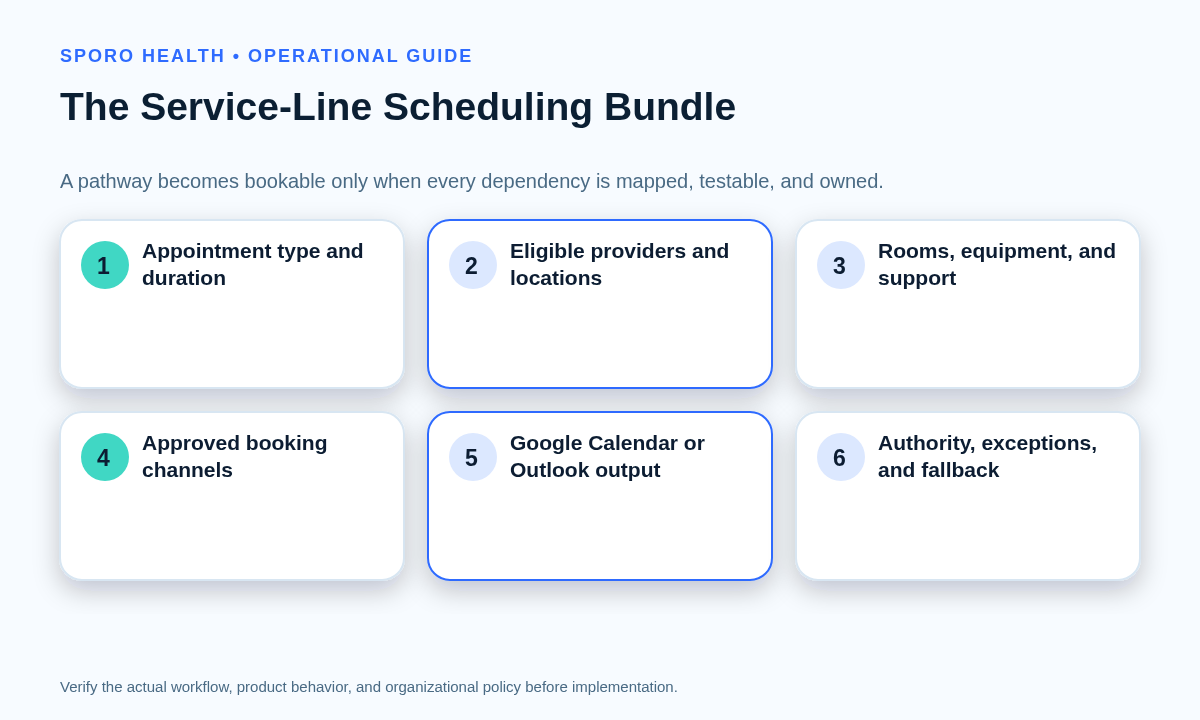
Record every allowed and prohibited combination of appointment type, provider, duration, location, resource, booking channel, calendar destination, effective date, owner, and verification method. The map should answer both what can be booked and what must remain unavailable.
Reuse mature rules only when they fit the new service. Guidance on standardizing provider schedule templates across locations can identify reusable baselines, while controlling variable appointment lengths helps define bounded duration exceptions.
| Bundle field | Required launch record | Blocking question |
|---|---|---|
| Appointment identity | Type, purpose, duration, effective date, and version | Could staff choose a similar but incorrect type? |
| Eligibility | Approved providers, locations, patient categories, and referral conditions | Is any unapproved combination exposed? |
| Dependencies | Rooms, equipment, support roles, preparation, and sequencing | Can the appointment exist without a required dependency? |
| Channels | Administrator, staff, request, portal, app, and partner surfaces | Does every channel apply the same pathway rules? |
| Calendar output | Approved destination, time, duration, location, recurrence, and removal behavior | Could an event appear outside approved scope? |
| Control | Owner, verifier, escalation route, fallback, and rollback action | Can the pathway be contained independently? |
Add explicit prohibited combinations to the map. An empty cell is ambiguous; a documented prohibition is testable.
When should booking channels be released?
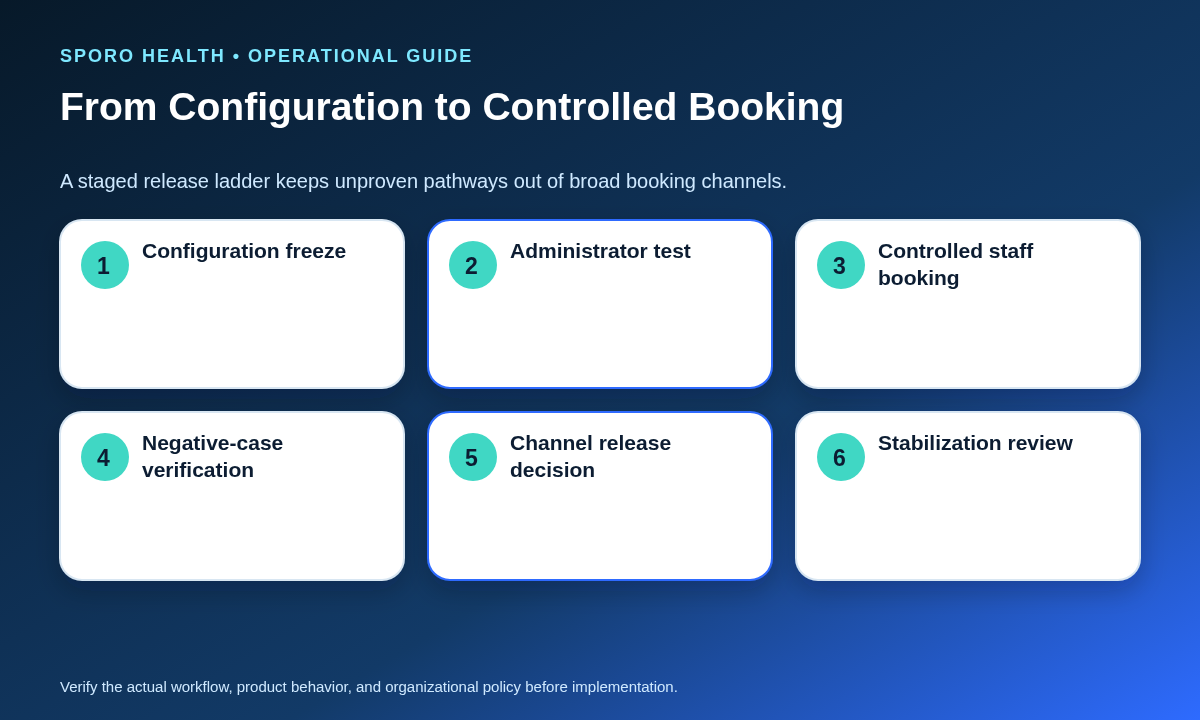
Release channels in stages, beginning with administrator testing and controlled staff booking, then expand only when each channel enforces the approved pathway rules. Do not treat staff booking, appointment requests, and patient self-scheduling as equivalent tests.
athenahealth’s current service description explains that practices can configure which visit reasons correspond to appointment types and which reasons patients may use. That configurability makes the patient-facing channel a separate release decision. See the current athenaOne Service Description.
| Release stage | Evidence gate | Permitted outcome |
|---|---|---|
| Administrator test | Configuration and negative cases verified | Proceed to named testers only |
| Controlled staff booking | Routine changes and escalation performed correctly | Release to approved staff group |
| Requested or assisted booking | Intake routes to the correct pathway and owner | Open the bounded request surface |
| Patient self-scheduling | Patient-facing eligibility, duration, location, and resource rules pass | Open only the proven pathways |
If a later channel fails, contain that channel without automatically closing a pathway that remains controlled through an earlier channel.
What should acceptance testing cover?
Test routine creates, reschedules, cancellations, provider absences, resource failures, recurring blocks, connected-calendar changes, competing edits, recovery, and combinations that must remain unbookable. A successful happy path cannot prove that invalid capacity is hidden.
Use one transaction-level method for coordinating multi-resource appointments. For two-system evidence capture, adapt the method for testing calendar synchronization before rollout without turning the service launch into a product pilot.
| Scenario | Positive test | Negative test |
|---|---|---|
| Create | Approved combination becomes bookable once | Ineligible provider or location remains unavailable |
| Reschedule | All dependencies move together | Old time and resource do not remain reserved |
| Cancel | Appointment and dependent holds are released | No orphaned calendar or resource item remains |
| Absence or failure | Authorized fallback or containment is applied | Unavailable capacity cannot be booked |
| Recurrence | Series and one-occurrence changes behave as approved | An exception does not alter unintended dates |
| Competing edit | Precedence and escalation rules produce one final state | Staff cannot silently close an unresolved conflict |
Record expected result, observed result, evidence location, tester, defect owner, retest status, and final acceptance for every case.
How should prebooked or requested appointments be controlled?
Place every referral, appointment request, provisional hold, and prebooked appointment in one launch ledger before normal scheduling begins. Each item needs one intended pathway, dependency status, owner, patient-communication requirement, final action, and independent verification.
- Classify: ready, awaiting dependency, needs reassignment, or must not proceed.
- Link the item to the exact pathway version and opening date.
- Record whether the patient has received confirmed information or only a provisional message.
- Close the item only after the final appointment state and any connected-calendar or resource state are verified.
What must staff readiness and fallback plans prove?
Staff must demonstrate permitted actions, prohibited actions, escalation, containment, patient communication, and fallback before receiving independent booking authority. Attendance at training is not equivalent to operational readiness.
Use scenario-based front-desk readiness training for the schedulers who will create, change, cancel, verify, or escalate the new appointments. Name who may override ordinary rules, who can stop a channel, and who reconciles work completed during a fallback period.
- Provide a pathway-specific quick reference rather than a general specialty summary.
- Require a successful routine booking and at least one failure scenario.
- Keep a manual change ledger available for downtime or uncertain integration behavior.
- Give new providers a separate onboarding, identity, permission, schedule, calendar, and lifecycle gate.
How should Google Calendar and Outlook fit the launch?
Use connected calendars only within the approved provider-calendar scope, verify each lifecycle state, and preserve the practice’s documented scheduling authority. Test time, duration, location, recurrence, changes, removals, competing edits, and events that must not be created.
The Google Calendar event model represents start and end time, location, recurrence, recurring-event identity, status, and cancellation behavior as distinct fields. Review the Google Calendar Events API. Microsoft Graph similarly separates start, end, locations, recurrence, series identity, event type, cancellation state, and transaction identifiers. Review the Microsoft Graph event resource. This supports field-by-field testing rather than a visual spot check.
The current Sporo vendor pages describe connections for athenahealth and Google Calendar and athenahealth and Microsoft Outlook. Treat those descriptions as vendor claims until exact provider scope, fields, permissions, exception behavior, and rollback are confirmed for the practice. The Sporo Health athenaConnect Marketplace listing is another current evaluation destination.
What decisions should the go-live gate produce?
Record one outcome for every service pathway: open, open with contained exceptions, delay, or roll back. Do not issue one broad service-line approval when pathways have different evidence or dependencies.
| Gate outcome | Use when | Required control |
|---|---|---|
| Open | All critical evidence passes | Release approved channels and begin observation |
| Open with containment | A bounded noncritical exception remains | Define scope, owner, temporary control, deadline, and closure test |
| Delay | A dependency or critical test is incomplete | Keep the pathway unavailable and schedule retesting |
| Roll back | The released state creates uncontrolled booking exposure | Restore the last verified state and reconcile transactions |
Set an exception budget before go-live: the maximum number and type of open exceptions, how long each may remain, and which conditions are automatic stop rules. Apply the stop at the smallest affected pathway or channel unless evidence shows broader exposure.
How should launch stabilization be measured?
Measure pathway-level accuracy with explicit denominators during a practice-defined observation window. Raw incident counts are insufficient because a pathway used twice is not comparable with one used hundreds of times.
| Measure | Suggested denominator | Review question |
|---|---|---|
| Pathway test coverage | Required test cases | Which planned cases remain untested? |
| Correct booking rate | Bookings sampled by pathway and channel | Were type, provider, location, duration, and resources correct? |
| Prohibited combinations blocked | Negative attempts executed | Did every invalid combination remain unavailable? |
| Calendar match rate | Appointments expected on connected calendars | Did time, duration, location, state, and identity match? |
| Exception closure | Exceptions opened during launch | How many closed with verified evidence? |
| Manual correction rate | Bookings reviewed | Which pathway creates repeated staff repair work? |
Segment the scorecard by pathway and channel. A combined service-line percentage can hide one unsafe appointment type behind several high-volume pathways that are working as intended.
How should teams apply the athenahealth scheduling checklist for launching a new medical service line?
Run the checklist as a controlled release plan with one record per bookable pathway. Configuration, training, testing, release, and stabilization should all point back to that record.
- List every pathway and assign its owner and verifier.
- Complete the scheduling bundle map, including prohibited combinations.
- Freeze the version that will enter acceptance testing.
- Run positive, negative, failure, calendar, and recovery cases.
- Reconcile the prelaunch demand ledger.
- Issue an open, contained-open, delay, or rollback decision.
- Release channels sequentially and monitor pathway-level denominators.
- Close stabilization only when exceptions are verified or formally accepted.
Use this athenahealth scheduling checklist for launching a new medical service line as evidence for controlled booking—not as a setup inventory. The desired outcome is a pathway that staff can book, change, contain, verify, and recover without relying on undocumented knowledge.
Practices evaluating connected-calendar support can review Sporo Health and its current product and Marketplace destinations above. Ask for a pathway-specific demonstration using the service line’s actual appointment types, channels, exceptions, and calendar scope rather than assuming a general product description proves launch readiness.
Frequently asked questions
Can an existing appointment type or template simply be copied?
Copying can provide a starting point, but it is not launch evidence. Revalidate eligibility, duration, resources, locations, channels, calendar behavior, and exceptions.
Should patient self-scheduling open on the first day?
Patient self-scheduling should open only after the same pathway passes controlled staff-booking tests. The patient-facing channel must also enforce the approved eligibility, location, duration, resource, and escalation rules.
Does a new provider require a separate readiness path?
Yes. Service-line readiness does not replace provider onboarding, identity, permissions, schedule configuration, calendar connection, training, or lifecycle checks.
What should be tested before opening a new athenahealth appointment type?
Test routine creates, reschedules, cancellations, absences, resource failures, recurring blocks, connected-calendar changes, competing edits, recovery, and prohibited combinations.
How should Google Calendar and Outlook be verified?
Verify approved provider-calendar scope, time, duration, location, recurrence, changes, removals, and negative cases while preserving the practice’s documented scheduling authority.
What if one provider, location, or resource is not ready?
Keep the affected pathway closed or contained. Assign an owner, temporary control, deadline, communication action, and a retest that proves the dependency is ready.
How long should launch stabilization continue?
Use a practice-defined observation window long enough to sample each released pathway and channel. End stabilization only after exceptions are closed or formally accepted.
Sources
- athenaOne Service Description, athenahealth.
- Google Calendar Events API, Google for Developers.
- Microsoft Graph event resource, Microsoft Learn.
- Implementing Health IT, ASTP/ONC.
- athenahealth Google Calendar Sync, Sporo Health.
- Connect athenahealth to Microsoft Outlook, Sporo Health.