How to Write an athenahealth Calendar Sync Pilot Charter: A Scope-and-Decision Workbook
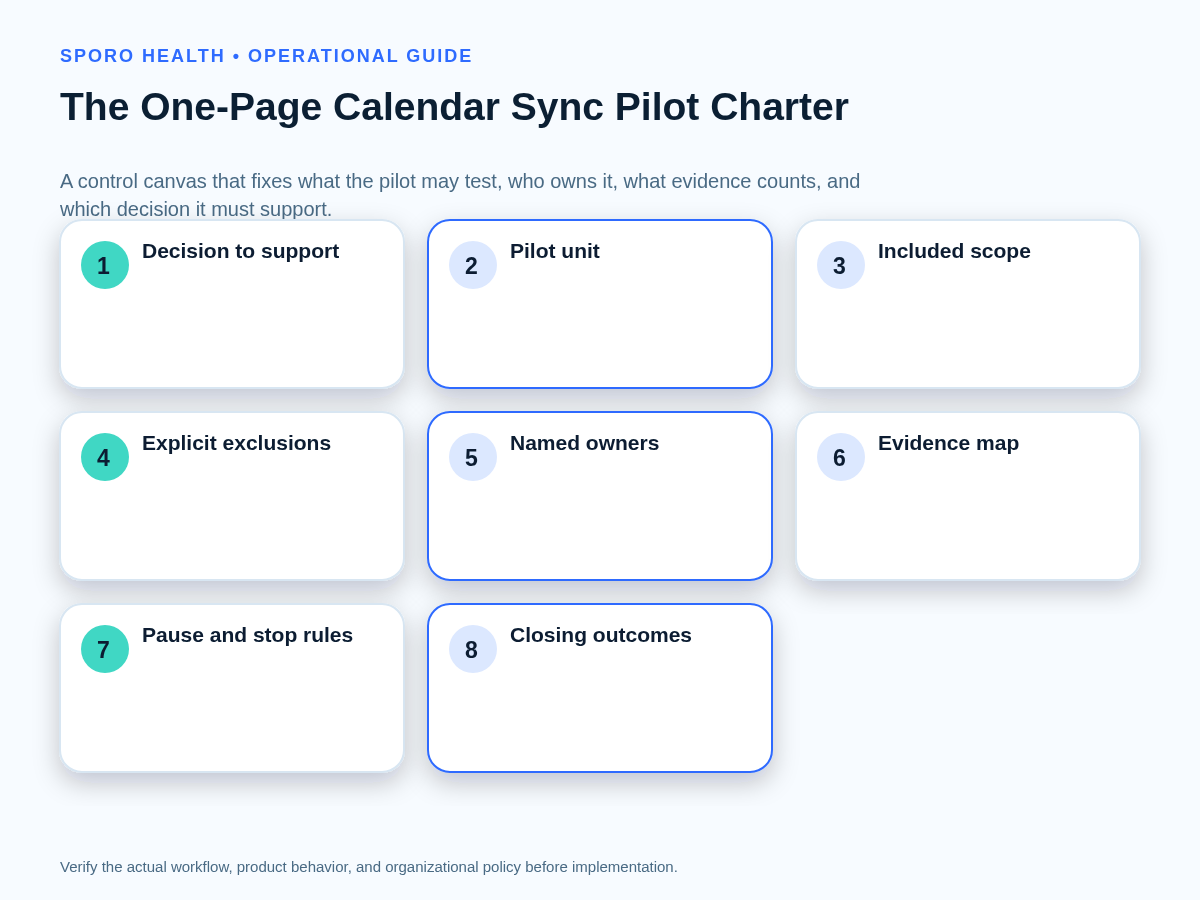
For practice managers asking how to write an athenahealth calendar sync pilot charter, start by approving the operating contract before any provider is enrolled or live schedule configuration changes. Fix one decision, a versioned provider-calendar-workflow scope, explicit exclusions, named owners, an evidence map, controlled change rules, pause and rollback conditions, and four closing outcomes: expand, extend, redesign, or stop.
How to write an athenahealth calendar sync pilot charter
A charter should convert one pilot question into a bounded, practice-owned decision contract. It is not the vendor project plan, test script, cohort scorecard, or rollout plan; it authorizes and connects those artifacts.
Write the charter so another approver can identify, without verbal context:
- the single business decision the pilot must support;
- the exact provider-calendar-workflow units authorized for testing;
- the workflows, systems, data, and lifecycle cases that are excluded;
- who may configure, test, verify, change, pause, roll back, and close the pilot;
- which evidence will count at entry and closure; and
- which outcomes are permitted when the pilot ends.
When should the charter be approved?
Approve the charter after prerequisites are evidenced but before participant enrollment, test execution, or live configuration changes. A missing permission, owner, rollback method, or workflow rule should remain an entry blocker rather than becoming a production experiment.
ONC describes health IT implementation as multistage work involving technology, workflows, people, processes, integration, and contingency planning. Its Health IT Playbook also recommends governance and a project plan during pre-implementation. Those principles support a formal charter gate before live activity. See ONC’s health IT implementation guidance and the Health IT Playbook.
Resolve vendor, permission, workflow, support, and recovery unknowns through proof-based vendor due diligence before a pilot. The charter should reference that evidence, not recreate the vendor evaluation.
What should the one-page decision contract contain?
The contract should tie one decision to one authorized boundary, named evidence, accountable owners, and four possible closing outcomes. Keep the controlling page concise, then attach detailed matrices as versioned appendices.
| Charter field | Required statement |
|---|---|
| Decision | Name the business choice the pilot must support and who owns it. |
| Pilot unit | Identify each provider, athenahealth department or location, calendar account, target calendar, workflow, and ruleset combination. |
| Authorized scope | List transactions, date window, booking channels, staff roles, and support coverage. |
| Exclusions | Name every platform, calendar, workflow, permission, field, and lifecycle case the pilot may not exercise. |
| Owners | Assign decision, configuration, test, operations-verification, support, and stop authority. |
| Evidence | Reference prerequisites, acceptance results, outcome measures, balancing measures, defects, and closure records. |
| Change control | Require a version, reason, affected unit, retest decision, and comparability assessment. |
| Safety and closure | Define pause, stop, rollback, and the expand, extend, redesign, or stop outcomes. |
The signed version is the control record. Meeting notes, tickets, and vendor plans may support it, but they should not silently alter it.
What belongs in scope, and what must be excluded?
Scope should define the complete provider-calendar-workflow unit, while exclusions should make unauthorized testing unmistakable. A provider name alone is not a sufficient boundary.
| Dimension | Include explicitly | Exclude explicitly |
|---|---|---|
| People and workflow | Named providers, staff roles, and approved use cases | Unapproved users, incomplete onboarding, or unsupported duties |
| Organization | Departments, locations, appointment pathways, and booking authority | Other sites, service lines, or shared workflows |
| Calendars | Account identity, owner, container, target calendar, and mapping | Secondary, shared, subscribed, or personal calendars not approved |
| Transactions | Create, update, reschedule, cancel, block, and recurring cases authorized for testing | Untested transaction classes and lifecycle states |
| Time | Baseline period, pilot dates, schedule horizon, time zone, and support hours | Dates or hours outside observed coverage |
| Channels | Staff booking, patient self-scheduling, and other approved surfaces | Channels without tested closure and reopening behavior |
| Data and access | Approved fields, permissions, reviewers, and recovery access | Unapproved fields, unresolved permissions, or unknown retention paths |
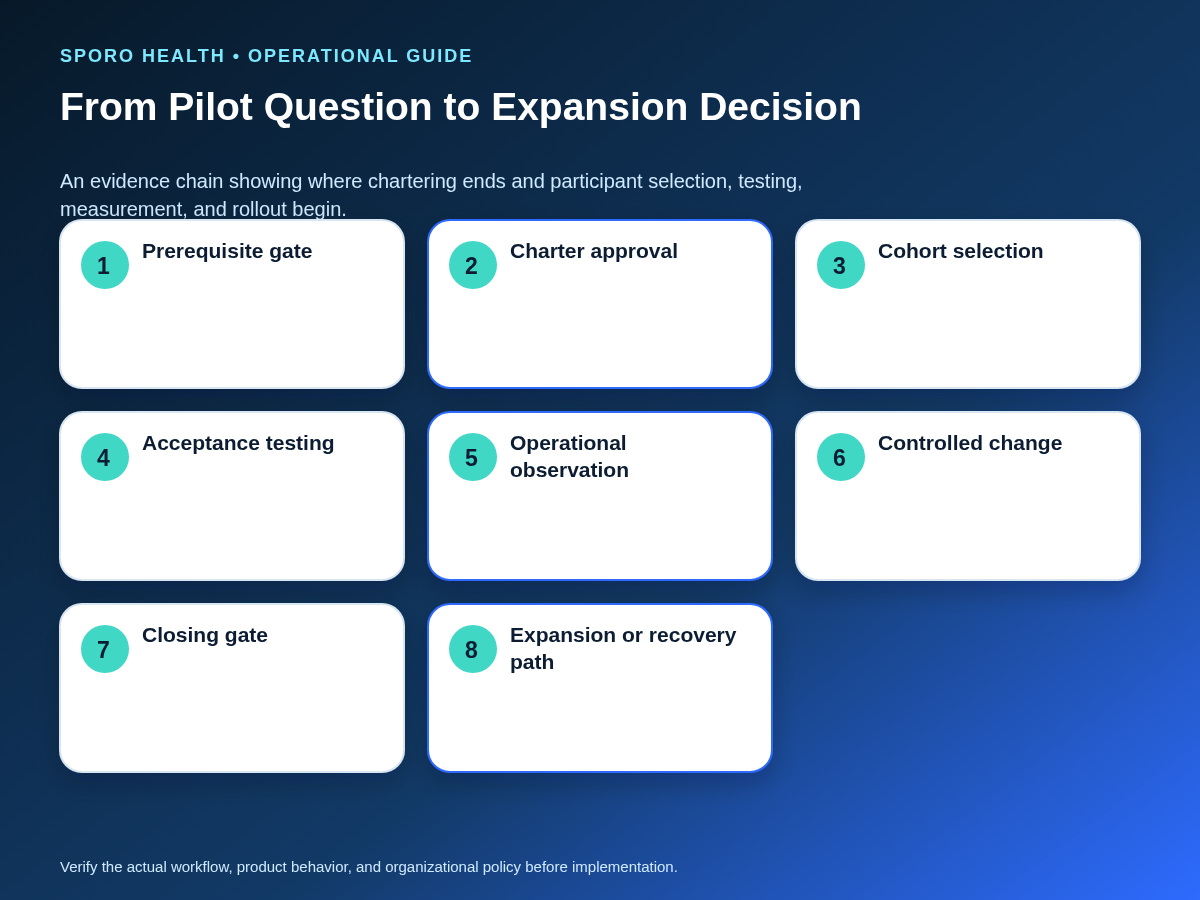
Once the boundary is approved, use it to choose provider-calendar configurations for the pilot cohort. Cohort selection should operate inside the charter rather than redefining it.
Who owns the pilot, and who may change it?
Only named owners should approve a charter change, and execution should remain separate from final verification where practical. The practice should retain business decision rights even when a vendor performs configuration or technical support.
Every proposed change needs a versioned envelope containing the reason, affected pilot unit, old and new state, evidence impact, retest requirement, baseline effect, approver, implementer, verifier, and effective time.
| Change class | Evidence treatment |
|---|---|
| Documentation correction | Version the charter; no retest if behavior and scope are unchanged. |
| Bounded configuration correction | Retest the affected transaction and dependent states. |
| New provider, calendar, or workflow | Add a pilot unit and repeat prerequisite and acceptance gates. |
| Mapping, ruleset, or platform change | Create a new baseline or separately analyzed segment. |
| Change that breaks comparability | Reset the affected pilot portion rather than combining incompatible results. |
How should requirements trace to pilot evidence?
Each requirement should point to the evidence class that proves it, the owner who retains it, and the decision it can influence. Do not treat a successful notification, API response, or demonstration as proof of the complete operational result.
athenahealth documents appointment operations and event topics including scheduling, updates, rescheduling, and cancellation, with current state retrieved through appointment endpoints. The charter should therefore require observable end-state evidence for every authorized lifecycle case. See the athenahealth appointment documentation and appointment event-notification topics.
| Evidence class | What it proves | Example retained artifact |
|---|---|---|
| Prerequisite | The authorized environment, access, mapping, owners, support, and rollback path exist. | Approved inventory, permission evidence, mapping record, support roster |
| Functional acceptance | Required transactions and negative cases behave as specified in both systems. | Timestamped test card, identifiers, observed states, pass or defect |
| Operational outcome | The bounded workflow changes schedule integrity or staff operations as intended. | Baseline and pilot measures with defined denominators |
| Balancing measure | Benefits are not accompanied by unacceptable false blocks, false openings, invitations, workload, or support burden. | Exception log, workload sample, incident and defect counts |
| Closure | Thresholds, cohort coverage, unresolved defects, and residual risk support one final outcome. | Signed closing decision with conditions and owners |
After charter approval, turn chartered requirements into a pilot acceptance matrix. Separately, measure calendar sync pilot outcomes with a practice-owned scorecard. Passing transactions and improving operations answer different questions.
Which pilot-entry decision applies?
The charter-completeness gate should produce ready, ready with conditions, hold, or no-go. Record the decision by pilot unit when configurations have materially different evidence.
| Decision | Use when |
|---|---|
| Ready | Scope, owners, prerequisites, evidence plan, support, and rollback are complete. |
| Ready with conditions | Only bounded, owned conditions remain and they do not weaken schedule authority or recovery. |
| Hold | Evidence is incomplete or a remediable dependency is unresolved. |
| No-go | The proposed workflow lacks defensible authority, permissions, containment, support, or rollback. |
Conditions need an owner, due date, evidence requirement, and expiration. An unbounded condition is a hold.
When should the pilot pause, stop, or roll back?
Pause when schedule authority, data boundaries, support coverage, or rollback confidence becomes uncertain; stop when the pilot can no longer answer its decision credibly or safely.
| Level | Trigger and response |
|---|---|
| Contain | Isolate one understood defect, protect affected capacity, and continue unaffected units. |
| Pause | Freeze live changes while ownership, scope, permissions, support, or recovery evidence is re-established. |
| Stop | End testing after repeated critical failure, failed containment, uncontrolled scope, or invalidated evidence. |
| Roll back | Restore the chartered pre-pilot state, reconcile the affected interval, and verify residual access and calendar state. |
Frontline staff should know the immediate containment action, but the charter must name who declares a formal pause, stop, restart, or rollback complete.
What should the closing gate decide?
The closing gate should compare chartered evidence with thresholds and choose expand, extend, redesign, or stop. A high pass percentage alone does not settle defects, cohort coverage, workload, or balancing measures.
| Outcome | Meaning |
|---|---|
| Expand | Evidence supports controlled use for the next approved configuration wave. |
| Extend | The design remains plausible, but more observation or cohort coverage is required. |
| Redesign | Scope, rules, ownership, platform configuration, or measurement must materially change. |
| Stop | Evidence does not support continued investment or acceptable operation. |
An expand decision should hand off to a separate plan to expand a successful pilot through controlled provider waves. Do not turn the pilot charter into a production rollout document.
Can Google Calendar and Outlook use the same pilot charter?
Yes, they can share one governance charter, but they need separate platform appendices. Keep the decision, scope model, owners, evidence classes, change controls, and closing outcomes consistent while documenting platform-specific behavior separately.
Google documents push channels that expire and notify an application that a watched resource changed; the notification does not contain the full change details, so the application must retrieve state. Google also documents incremental synchronization with stored sync tokens. See Google Calendar push notifications and incremental synchronization.
Microsoft Graph supports event change notifications for creation, update, and deletion, while calendar-view delta queries return incremental event changes. See Outlook change notifications and Microsoft Graph event delta queries.
For each platform, specify calendar containers, account ownership, authorization path, event states, recurrence cases, notification recovery, reconciliation method, denied paths, and rollback evidence. Do not combine platform results unless the charter explains why they are comparable.
Where do current Sporo destinations fit?
Place vendor destinations in an options section, not in the independent evidence chain. Review the Sporo Health homepage, the athenahealth and Google Calendar product page, the athenahealth and Microsoft Outlook product page, and the Sporo Health athenaConnect Marketplace listing. Treat product statements as vendor claims until the practice verifies its proposed configuration, responsibilities, data boundaries, support model, and recovery behavior.
How should practice managers put the charter into use?
Build the charter in sequence and refuse enrollment until one entry decision is recorded.
- Write one business decision the pilot must support.
- Inventory the proposed provider-calendar-workflow units.
- Define included and explicitly unauthorized cases.
- Attach prerequisite evidence and assign every owner.
- Trace each requirement to acceptance, outcome, balancing, or closure evidence.
- Approve the change envelope and pause-stop-rollback ladder.
- Record ready, ready with conditions, hold, or no-go.
- At closure, choose expand, extend, redesign, or stop.
The practical answer to how to write an athenahealth calendar sync pilot charter is to make every live action traceable to an approved boundary, owner, evidence requirement, and decision. Use the workbook in a focused approval meeting; if it is not ready, do not convert missing evidence into live testing.
Frequently asked questions
- Does a one-provider athenahealth calendar sync pilot need a charter?
-
Yes. A small cohort reduces exposure, but it does not define authority, exclusions, evidence, change rules, rollback, or the decision the pilot must support.
- When should the pilot charter be approved?
-
Approve it after vendor and platform prerequisites are evidenced but before providers are enrolled, test cases run, or live configuration changes.
- Can a vendor’s project plan replace the practice charter?
-
No. The practice must own the business decision, workflow scope, data boundaries, staff responsibilities, acceptance evidence, operational measures, and stop authority.
- How are acceptance tests different from pilot outcome measures?
-
Acceptance tests prove required transactions behave as specified; outcome measures assess whether the bounded workflow improves schedule integrity and staff operations without unacceptable tradeoffs.
- Can Google Calendar and Outlook use the same pilot charter?
-
Yes, at the governance level. Use one core charter, but add separate platform appendices for calendar containers, permissions, event states, notification and reconciliation behavior, and rollback.
- Who can pause or stop the pilot?
-
Only the named authority in the approved charter should pause or stop live use, with immediate containment available to designated incident owners when schedule authority or rollback confidence is uncertain.
Sources
Primary implementation and platform sources
- athenahealth Appointments documentation
- athenahealth Event Notifications Subscription Topics
- Google Calendar push notifications
- Google Calendar incremental synchronization
- Microsoft Graph Outlook change notifications
- Microsoft Graph event delta queries
- ONC Implementing Health IT
- ONC Health IT Playbook
Current vendor destinations reviewed