How to Rebook a Canceled Appointment in athenahealth: A Slot-Ownership Workflow
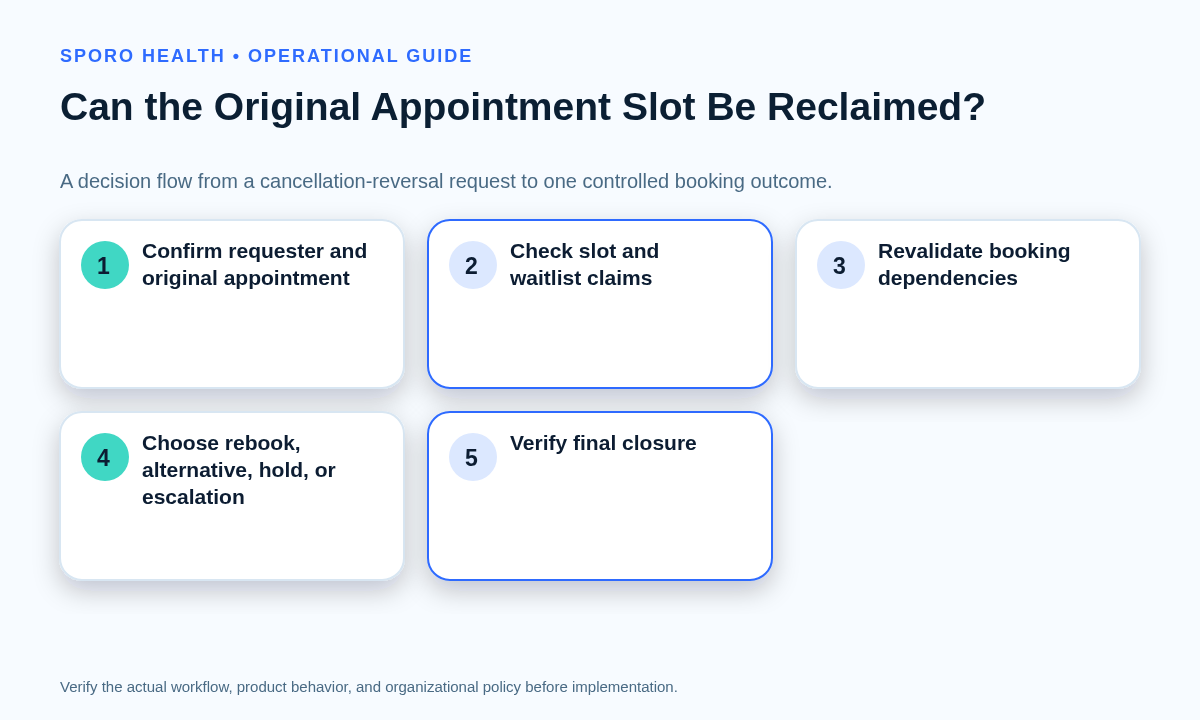
For front-desk leaders asking how to rebook a canceled appointment in athenahealth, the safe first move is to preserve the original cancellation and verify who owns the released slot now. Rebook only after confirming the slot and dependencies remain valid, no stronger claim exists, one patient message will control, and connected calendars can close to one intended event.
What should staff do first when a canceled appointment must be rebooked?
Preserve the original cancellation before trying to book anything. Confirm the requester, original appointment ID, cancellation reason and time, actor, messages already sent, whether the slot was released, and the appointment’s current state. Pause further slot edits and outreach while ownership is uncertain.
Use the existing front-desk reschedule and cancellation workflow for the original transaction record, but treat the reversal as a new adjudication. athenahealth documents separate appointment events for cancellation, rescheduling, scheduling, and updates, which supports checking the current record rather than relying on the requestor’s description alone: athenahealth event notification topics.
How to rebook a canceled appointment in athenahealth: which disposition applies?
Choose one of four dispositions: same-slot rebook, approved alternative, temporary hold, or escalation. Do not assume a universal restore command. The public athenahealth catalog separately lists cancellation, rescheduling, booked-appointment updates, open slots, waitlists, and appointment reports; that structure is a reason to verify the supported transaction path for the practice’s configuration. See the athenaOne API catalog and appointments documentation.
| Disposition | Use when | Required control |
|---|---|---|
| Same-slot rebook | The interval is valid, unclaimed, and fully revalidated. | Create or use the supported final booking path once, then verify it. |
| Approved alternative | The former slot is unavailable or no longer fits. | Offer only slots that satisfy the same dependency gate. |
| Temporary hold | Ownership or a required dependency is unresolved. | Give the hold an owner, expiry, reason, and release rule. |
| Escalation | Clinical, resource, check-in, authority, or competing-claim issues exist. | Route the case without asking scheduling staff to make an unauthorized decision. |
How do you prove the original appointment slot is still usable?
Revalidate every dependency as if the appointment were being booked for the first time. Confirm the provider, department, location, appointment type, duration, visit mode, required rooms or equipment, booking-channel exposure, and downstream check-in or encounter state.
- Confirm the interval is open in the authoritative scheduling workflow.
- Check whether the provider’s schedule or appointment rules changed after cancellation.
- Confirm every required resource is available for the full duration.
- Inspect staff booking, self-scheduling, waitlist, and other exposed channels.
- Escalate if check-in, encounter, or other downstream activity makes a new booking inappropriate.
If one dependency differs, the slot is not the same operational product merely because its date and time match the canceled appointment.
What if the released slot has already been booked or offered?
Do not displace a valid new claim to recreate the canceled appointment. Contain further edits, apply the practice’s documented precedence rule, and route the original patient to an approved alternative or an authorized exception.
The waitlist workflow for canceled appointment slots provides deeper controls for expiring offers and competing acceptances. Use this claim-precedence table to decide who must review the interval:
| Claim | Default treatment | Next action |
|---|---|---|
| Original patient requesting reversal | A request, not automatic ownership | Check every later claim before rebooking. |
| Open waitlist offer | Potentially controlling under local policy | Pause outreach and resolve the offer state. |
| Newly booked patient | Preserve the valid booking | Offer the original patient another approved slot. |
| Active recurring-series occurrence | Existing appointment claim | Do not overwrite it; verify occurrence identity. |
| Authorized exception | Valid only with named authority | Record the approver, rationale, and affected claims. |
What belongs in the cancellation-to-rebooking lineage card?
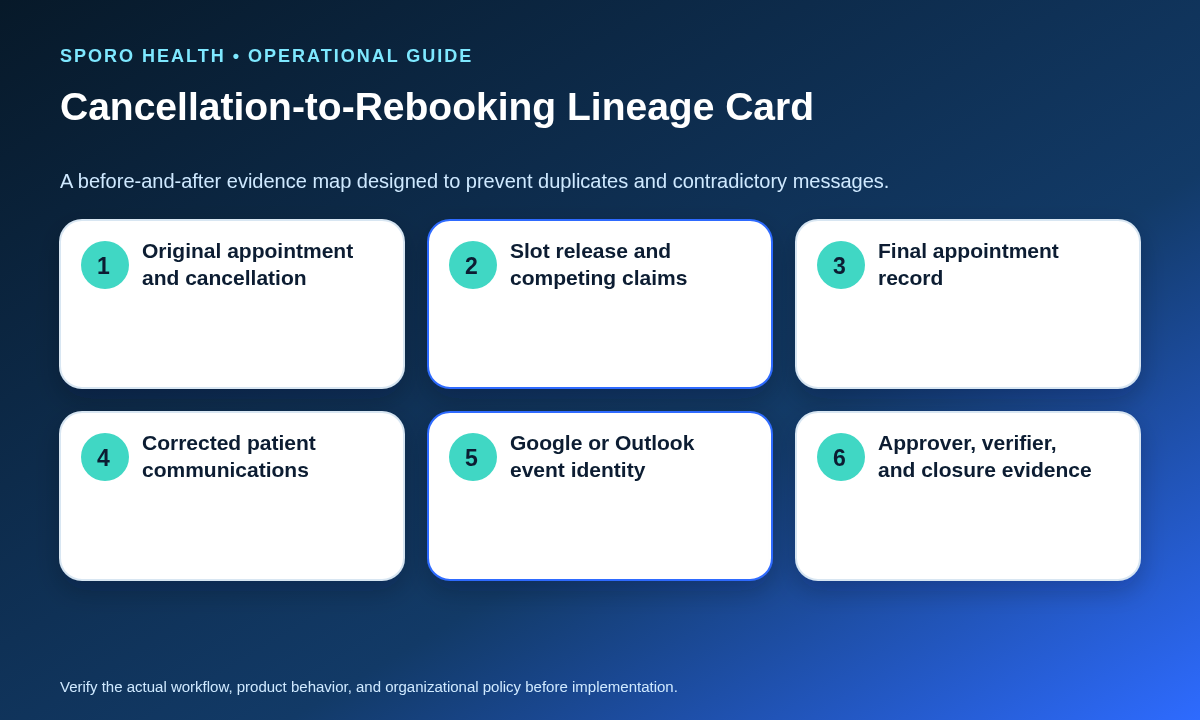
The lineage card should connect the canceled predecessor to the one final appointment without erasing either state. Keep one record containing:
- original appointment ID, patient-level transaction reference, cancellation reason, cancellation time, and actor;
- slot-release state and any waitlist offer, replacement booking, hold, or recurring-occurrence claim;
- communications already sent and the identity of the authoritative corrected message;
- final appointment ID, provider, department, location, type, duration, mode, and resources;
- Google or Outlook event identifiers available to the workflow;
- exception approver, executing staff member, independent verifier, and closure time.
This is not a second appointment record. It is the evidence chain showing why the final disposition was chosen.
How should one canceled occurrence in a recurring plan be handled?
Treat the canceled occurrence as a bounded transaction, not permission to recreate or edit the entire series. Identify the exact date, preserve unaffected appointments, and confirm that the new booking does not alter later visits.
Use the recurring appointment series scope guide for full-series controls. Google documents that a recurring instance is tied to its parent through recurringEventId and identified within the series by originalStartTime, even if moved; see Google Calendar recurring events. Verify the external calendar at occurrence level rather than judging only the series master.
How should Google Calendar or Outlook be reconciled?
Match the final active athenahealth appointment to one intended calendar event and preserve traceable evidence of the canceled predecessor. Do not create a second event merely to make the calendar look correct.
Google’s event model distinguishes confirmed, tentative, and canceled states and retains recurrence identifiers for canceled exceptions; see the Google Calendar Events reference. Microsoft Graph exposes fields such as iCalUId, isCancelled, seriesMasterId, and originalStart; see the Microsoft Graph event resource. Microsoft also documents delta queries for detecting added, updated, and deleted events in a calendar view: event delta query guidance.
Close the calendar check only when one intended event represents the final appointment and no stale cancellation, restored duplicate, orphaned event, or unintended recurring occurrence remains.
How should common rebooking failures be recovered?
Contain the affected interval first, then repair the smallest confirmed fault. Preserve identifiers and messages before deleting, recreating, or editing records.
| Failure | Recovery action | Closure evidence |
|---|---|---|
| Duplicate appointment | Stop further booking, identify the valid survivor, close the extra record through the approved path. | One active appointment and one slot owner. |
| Stale canceled calendar event | Match event identity to the final appointment before correcting it. | One intended event and retained predecessor evidence. |
| Conflicting patient messages | Stop parallel outreach and issue one superseding confirmation. | All current channels show the same details. |
| Unresolved waitlist offer | Freeze the interval and resolve the offer under the precedence policy. | No open offer can reclaim the slot. |
| Edits made in both systems | Compare timestamps, actors, identifiers, and current authoritative state. | The intended appointment and calendar representation agree. |
Use the duplicate calendar event troubleshooting guide when identity or replay defects remain. If the case cannot close during the working session, place it in the daily schedule reconciliation playbook with a named owner, next action, priority, and accepted handoff.
When should corrected patient communication be sent?
Send one authoritative confirmation only after the final appointment has been verified. State that it supersedes the earlier cancellation, provide the practice-approved appointment details, and identify any action the patient must take. Do not send a speculative confirmation while the slot, provider, resources, or approval remain unresolved.
Assign one communication owner. Other staff should add context to the same transaction record rather than starting parallel calls, portal messages, or texts that may describe different outcomes.
What proves the rebooking is complete?
Completion requires one valid active appointment and no unresolved competing state. The verifier should confirm:
- the original cancellation remains traceable;
- the final appointment has the correct dependencies;
- the slot and required resources have one owner;
- waitlist offers, holds, and replacement claims have final dispositions;
- patient-facing messages agree;
- Google Calendar or Outlook shows one intended final event.
The person who performed the booking should not silently close uncertainty they could not resolve; use the practice’s separation-of-duties rule where available.
How should practices measure cancellation reversals?
Measure both recovery outcomes and the defects created during recovery. Start with a baseline rather than adopting arbitrary targets.
| Measure | Definition | What it reveals |
|---|---|---|
| Reversal volume | Requests to reverse completed cancellations | Workload and policy demand |
| Same-slot reclaim rate | Verified same-slot closures divided by verified reversals | How often released capacity remains usable |
| Already-claimed slot rate | Requests blocked by a valid later claim divided by reversal requests | Claim-precedence pressure |
| Duplicate or orphan defect rate | Cases creating extra appointments, events, offers, or reservations | Transaction-control weakness |
| Communication correction rate | Cases requiring a superseding patient message | Outreach timing and ownership problems |
| Time to verified closure | Request time to documented final verification | Operational recovery effort |
Review recurring causes by team, channel, appointment type, and failure stage. Repeated same-cause cases should trigger a policy, configuration, or training review rather than more individual reminders.
Where do connected-calendar options fit?
Connected calendars can support visibility and reconciliation, but they do not decide slot ownership or appointment authority. Keep the workflow vendor-neutral and require product-specific evidence for cancellation, rebooking, recurrence, competing edits, and recovery.
Teams can review the Sporo Health overview, the current athenahealth and Google Calendar product page, the athenahealth and Microsoft 365/Outlook product page, and the Sporo Health athenaConnect Marketplace listing. Treat capability descriptions as vendor claims and request a witnessed cancellation-to-rebooking test before relying on them operationally.
How do you put the slot-ownership workflow into use?
Turn the four dispositions and lineage card into a short, approved front-desk procedure. Assign who may contain a slot, who resolves claim precedence, who approves exceptions, who sends the final message, and who verifies closure.
The practical answer to how to rebook a canceled appointment in athenahealth is controlled adjudication, not quick restoration: preserve the cancellation, prove slot ownership, revalidate dependencies, book once, reconcile messages and calendars, and close with evidence.
Frequently asked questions
Can a canceled athenahealth appointment be restored?
Do not assume that it can. Verify the supported transaction path, preserve the original cancellation record, and use same-slot rebooking, an approved alternative, a temporary hold, or escalation.
What if the canceled appointment slot has already been booked?
Do not displace the new patient. Apply the practice’s documented claim-precedence rule and offer the original patient an approved alternative unless an authorized exception owner directs otherwise.
How do you reverse an appointment cancellation without double booking?
Contain the interval, verify every active slot claim, create or update only one final appointment, and close only after no duplicate appointment, event, offer, or resource reservation remains.
How should one canceled occurrence in a recurring plan be rebooked?
Treat it as an occurrence-specific transaction. Preserve the unaffected appointments and verify that the rebooking does not recreate the series, change later visits, or leave an extra calendar occurrence.
When should a corrected patient cancellation notice be sent?
Send one authoritative confirmation only after the final appointment is verified. State that it supersedes the earlier cancellation and prevent parallel messages from presenting different appointment details.
How should Google Calendar or Outlook be reconciled after rebooking?
Match the final active athenahealth appointment to one intended event, retain traceable evidence of the canceled predecessor, and remove or escalate any stale, duplicate, or orphaned calendar state.
What proves a canceled appointment rebooking is complete?
One valid appointment is active, the cancellation remains traceable, the slot and resources have one owner, patient messages agree, connected calendars are reconciled, and no unresolved competing claim remains.
Sources