Centralized vs. Decentralized Scheduling for athenahealth Medical Groups: A Hybrid-Model Guide
For practice operations executives comparing centralized vs decentralized scheduling for multi-location medical practices, the best model is the one that centralizes repeatable decisions and preserves local judgment where written rules cannot capture the context. Score six operating conditions, assign every appointment-request class an owner, and pilot the boundary before moving staff, permissions, or routine booking authority.
How should leaders compare centralized vs decentralized scheduling for multi-location medical practices?
Centralized scheduling gives one team routine booking authority; decentralized scheduling leaves that authority with each clinic; hybrid scheduling divides authority by request class. The decision is therefore about who may make each booking decision, not simply which phone number, queue, or calendar staff use.
| Model | Default owner | Best-fit operating condition | Risk to test |
|---|---|---|---|
| Centralized | One cross-location team | Frequent cross-site demand and consistent booking rules | Local context gets lost or escalated too late |
| Decentralized | Each clinic team | Requests stay local and depend heavily on site knowledge | Transfers, uneven coverage, or inconsistent rules grow |
| Hybrid | Central owner plus named local exceptions | Routine requests are standard, but important exceptions remain local | Ambiguous boundaries create duplicate work |
An operations-research study explicitly compared centralized, decentralized, and hybrid appointment scheduling and found that the preferred configuration changed with the mix of appointment requests rather than following one universal rule (Aslani and Zhang). A peer-reviewed scheduling perspective also warns that centralized triage can become disconnected from the primary care team that knows the local context (Matulis and McCoy). These sources support evaluating fit, not assuming centralization is inherently superior.
Before scoring the choice, confirm the underlying multi-location athenahealth scheduling fundamentals: departments, provider templates, location constraints, appointment types, and shared operating definitions.
Which six factors determine the strongest scheduling model?
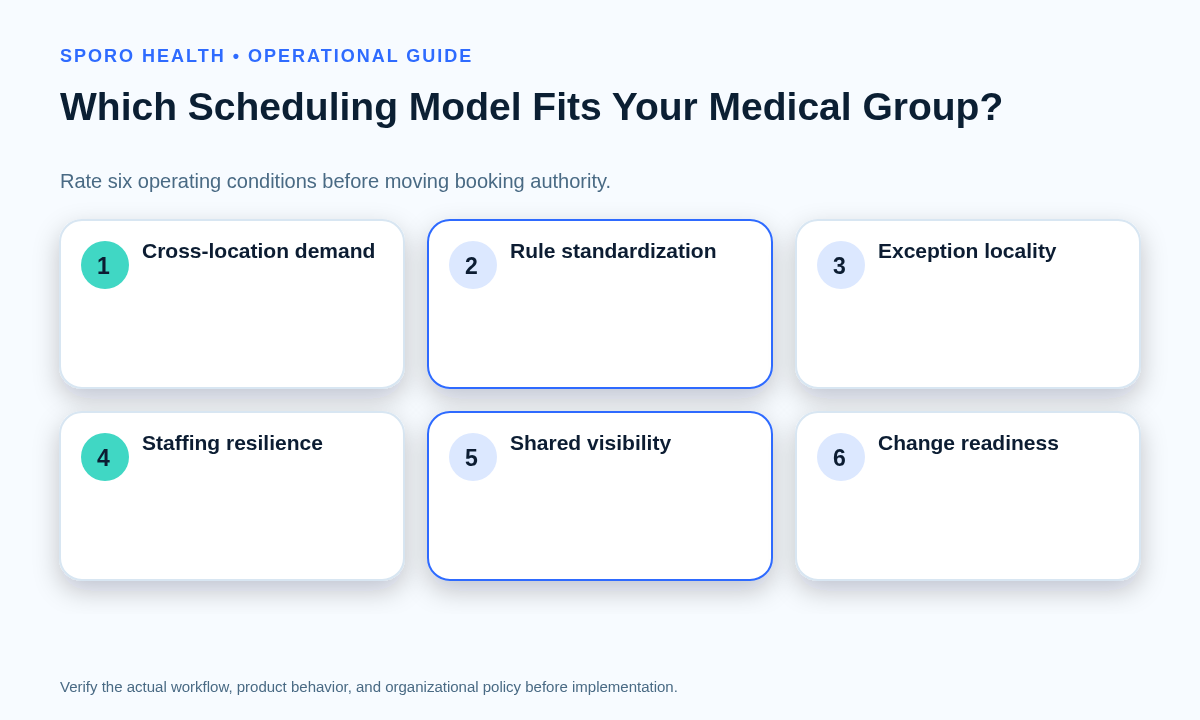
Compare cross-location demand, booking-rule standardization, exception locality, staffing resilience, shared visibility, and change readiness. Score each factor from 0 to 2 as a centralization-fit score; document evidence beside every number instead of relying on executive preference.
| Factor | 0 points | 1 point | 2 points |
|---|---|---|---|
| Cross-location demand | Requests stay within one clinic | Some cross-site searches | Cross-site choice is routine |
| Rule standardization | Rules vary by provider or site | Common core with exceptions | Most routine rules are shared |
| Exception locality | Local judgment is usually required | Mixed local and standard decisions | Most decisions can be represented reliably |
| Staffing resilience | Local coverage is stable | Coverage is occasionally uneven | Pooling work would address recurring gaps |
| Shared visibility | Availability views are fragmented | Visibility is partial | Teams can use a governed shared view |
| Change readiness | Owners and escalation are unclear | Some controls are documented | Roles, permissions, and fallback are ready |
Use 0–4 as a decentralized starting hypothesis, 5–8 as a hybrid hypothesis, and 9–12 as a centralized hypothesis. These are internal decision thresholds, not validated performance cutoffs. Before acting, compare the result with your documented athenahealth scheduling best practices and investigate any factor that leaders scored differently.
When should a medical group centralize appointment scheduling?
Centralization is a stronger candidate when patients, providers, appointment requests, and staffing capacity regularly cross clinic boundaries under rules that can be written and tested. It should reduce ownership ambiguity, not merely move the same ambiguity into a larger queue.
- Patients commonly ask for the earliest suitable appointment across several locations.
- Routine appointment types use consistent eligibility, duration, and routing rules.
- Local front desks repeatedly transfer calls or depend on another site’s availability.
- A central team can see the governed availability needed to complete the request.
Do not centralize a request class until the team can describe permitted actions, prohibited actions, and escalation triggers. High volume alone does not make an unclear process suitable for central control.
When is decentralized scheduling the stronger model?
Decentralized scheduling is stronger when important booking decisions depend on local knowledge that cannot yet be represented reliably in shared rules. Keeping authority local may be appropriate even when leadership standardizes intake, definitions, and reporting.
- Specialized resources or prerequisites differ materially by location.
- Provider judgment is frequently required before a slot can be offered.
- Same-day disruptions are best resolved by staff who can observe local conditions.
The warning sign is not local control itself. It is ungoverned variation: different answers for equivalent requests, weak backup coverage, undocumented provider preferences, or no way to compare performance across clinics.
How does a hybrid scheduling model for multi-location clinics work?
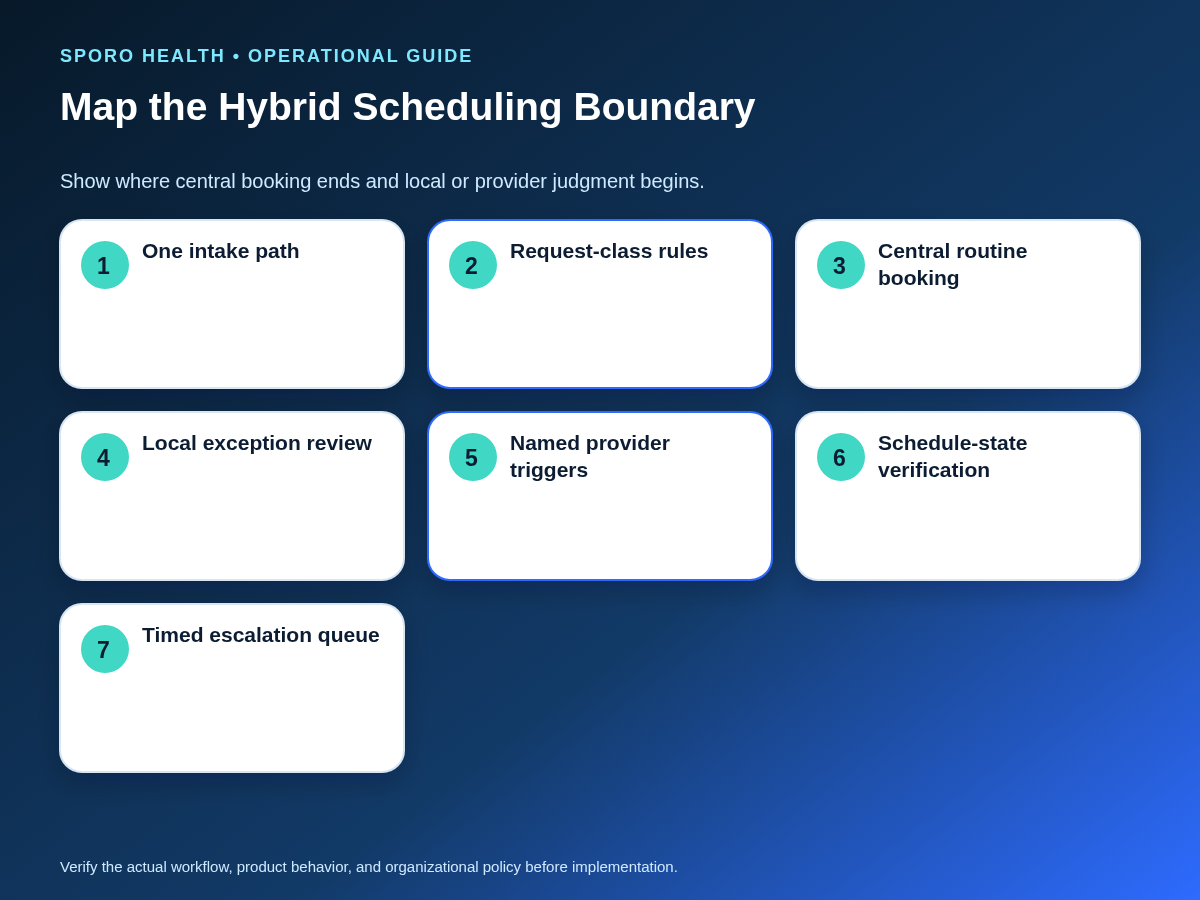
A hybrid model centralizes defined routine requests while reserving named exceptions for local approval, local booking, provider escalation, or manual containment. It works only when the boundary is explicit enough that two teams do not process the same request.
Suitable for standardized central handling:
- Routine new-patient or follow-up visits with common rules
- Cross-location searches for the earliest eligible slot
- Routine cancellations and clearly equivalent reschedules
- Requests that require no local resource confirmation
Suitable for local or provider review:
- Procedures, equipment-dependent visits, or linked appointments
- Provider-created blocks and exceptions that change bookable capacity
- Same-day disruptions, unusual overbooks, or unresolved competing edits
- Requests whose clinical or operational prerequisites cannot be encoded safely
Cross-site constraints also need a declared path. For example, use a documented provider travel-time buffer playbook rather than expecting central schedulers to infer whether a same-day location transition is feasible.
How should booking authority be divided across clinic locations?
Assign every request class a default owner, allowed action, approval trigger, escalation destination, response expectation, and verification requirement. The matrix below is a starting template; each medical group should replace the examples with its own approved rules.
| Request class | Default authority | Trigger for another owner | Closure evidence |
|---|---|---|---|
| Routine visit under common rules | Central booking | Rule conflict or missing eligibility data | Correct provider, department, location, type, and time |
| Earliest eligible cross-site visit | Central booking | Travel, continuity, or site restriction | Patient choice and location verified |
| Procedure or resource-dependent visit | Local booking or approval | Named provider decision | Resource and prerequisite confirmation |
| Routine cancellation or reschedule | Owner of the original request class | Appointment changes class or location | Old state closed and new state verified |
| Provider-created availability block | Local approval | Provider or operations escalation | Approved capacity change visible to schedulers |
| Same-day disruption | Local containment | Cross-location recovery is needed | Affected requests assigned and tracked |
| Unclassifiable or competing change | Manual containment | Named escalation deadline | One owner, one approved state, documented closure |
Once ownership is assigned, use a transaction-level front-desk reschedule and cancellation workflow to control edits, competing changes, and post-change verification.
What should the transition worksheet contain?
The worksheet should convert the chosen model into named owners, permissions, routing rules, escalation deadlines, fallback procedures, and a limited pilot scope. A model is not ready for implementation if any request class still depends on informal knowledge of who usually handles it.
- Scope: name the locations, providers, appointment types, channels, and request classes included.
- Owners: assign central, local, provider, technical, and executive decision owners.
- Permissions: record which roles may create, modify, cancel, approve, or only view each schedule state.
- Routing: define the intake path, classification rule, handoff fields, response expectation, and escalation deadline.
- Fallback: state how new work will be contained if staffing, permissions, routing, or connected visibility fails.
- Gate: identify who can expand, extend, pause, narrow, or reverse the pilot.
If the authority change accompanies an opening, carry these decisions into the new clinic location scheduling checklist. Keep the fallback active until permissions, handoffs, booking accuracy, and exception closure remain stable for the agreed observation period.
How should a centralized scheduling pilot be measured?
Measure whether the new authority model completes eligible requests accurately and closes exceptions, rather than judging it by appointment volume alone. Establish definitions, denominators, baseline periods, owners, and review intervals before the pilot starts.
| Measure | Working definition | What it tests |
|---|---|---|
| First-contact resolution | Eligible requests completed without transfer or recontact | Whether the default owner has enough authority |
| Transfer rate | Transferred requests divided by eligible requests | Whether boundaries or training are unclear |
| Booking rework | Completed bookings later corrected | Rule quality and booking accuracy |
| Location corrections | Bookings changed because the site was wrong | Cross-location selection control |
| Exception age | Elapsed time from queue entry to verified closure | Escalation responsiveness |
| Unresolved handoffs | Handoffs still open at the stated deadline | Ownership acceptance and closure |
| Cross-calendar mismatches | Mismatches divided by schedule states checked | Connected visibility and verification |
Review measures by request class and location so a strong aggregate result does not hide a failing exception path. Use the daily schedule reconciliation workflow to assign, prioritize, hand off, and verify unresolved items during the pilot. The result may support expansion, an extended pilot, narrower scope, or a return to the fallback; no outcome should be predetermined.
How should athenahealth, Google Calendar, and Outlook fit the authority model?
Keep athenahealth as the authoritative patient appointment record, and use external calendars only within an approved visibility and availability workflow. Centralization defines decision authority; it is not created by sharing one calendar.
The official athenahealth appointment API reference should remain the technical starting point for any appointment integration. The operating policy should specify which team is authorized to change patient appointments and how every change is verified in athenahealth.
Google Calendar represents events with fields such as identifiers, status, start and end times, recurrence, and visibility (Google Events reference). Its sharing model separately assigns free/busy, read, write, or owner-style access through calendar ACLs (Google Calendar sharing documentation). Visibility and write access therefore do not establish medical-group booking authority by themselves.
Microsoft Graph likewise exposes calendar events, free/busy functions, and calendar permissions (Microsoft Graph calendar overview), including access to appropriately shared or delegated calendars (shared and delegated Outlook calendar guidance). The practice must still decide who may act on that visibility.
Privacy, security, and regulatory conclusions depend on the actual configuration, contracts, access controls, selected fields, retention, organizational policies, and authorized review. Do not allow Google Calendar or Outlook to become an informal second patient-booking system.
If connected provider-calendar visibility is part of the chosen model, review Sporo Health scheduling resources, the current athenahealth and Google Calendar product page, the athenahealth and Microsoft 365/Outlook product page, and the Sporo Health listing in the athenaConnect Marketplace. Treat product descriptions as vendor claims and request configuration-specific mapping, permissions, fallback, and acceptance-test evidence.
What decision should medical-group leaders document?
Document the model by request class, not with a single organization-wide label. A sound decision on centralized vs decentralized scheduling for multi-location medical practices states what is centralized, what stays local, who approves exceptions, how quickly handoffs must be accepted, which record is authoritative, what the fallback is, and which pilot evidence permits expansion.
Frequently asked questions
- Is centralized scheduling the same as using one shared calendar?
-
No. Centralization defines who controls booking decisions and workflows; a shared calendar changes visibility but does not establish authority.
- Can clinics retain local control under a centralized model?
-
Yes. Local teams can retain defined approval or exception authority without informally duplicating the central team’s routine booking work.
- When is a hybrid scheduling model preferable?
-
A hybrid model fits when routine appointment types can follow common rules but specialized, procedure-based, or location-dependent requests still require local knowledge or provider judgment.
- Should reschedules and cancellations follow the same authority model?
-
Yes. The policy should state when a routine change stays with the default owner and when it becomes an exception requiring local approval, provider input, or containment.
- How should provider-created calendar blocks be handled?
-
Route provider-created blocks through the same authorization and verification rules used for other availability changes so central and local teams act on one approved schedule state.
- How should a centralized scheduling pilot be measured?
-
Measure first-contact resolution, transfer rate, booking rework, location corrections, exception age, unresolved handoffs, and cross-calendar mismatches, using stable definitions and denominators.
Sources
- athenahealth Appointment API
- Google Calendar Events API
- Google Calendar sharing
- Microsoft Graph calendar overview
- Shared or delegated Outlook calendars
- Centralized, decentralized, and hybrid scheduling-model research
- Patient-centered appointment scheduling perspective
- Sporo Google Calendar product page
- Sporo Outlook product page
- Sporo athenaConnect Marketplace listing