
Provider Location Signals for Multi-Location athenahealth Practices: A Booking-Authority Guide
Multi-location practice managers asking how to represent provider location across athenahealth and external calendars should separate four signals: the approved department or site assignment, event location metadata, working-location indicators, and busy or unavailable blocks. Patient booking should follow the practice-approved athenahealth schedule and availability controls; descriptive calendar labels should not change capacity unless the practice has deliberately assigned, tested, and documented that effect.
What is a provider-location signal?
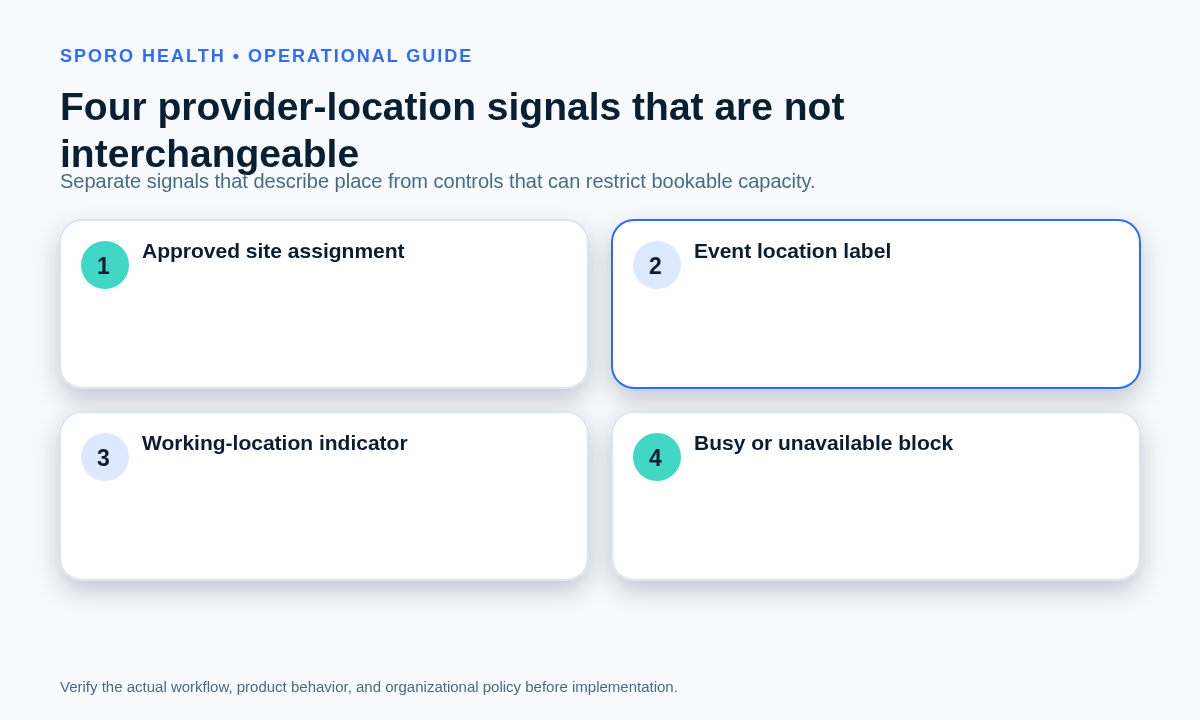
A provider-location signal is any schedule assignment, event location, working-location indicator, or time block suggesting where a clinician should be. Classify the signal before staff act because describing a place and controlling bookable capacity are different operational jobs.
This standard narrows the broader multi-location athenahealth scheduling foundations into four layers:
- Department or site assignment: the approved practice record for where a provider is assigned during an exact interval.
- Event location metadata: a label describing where one meeting, appointment, procedure, or other commitment occurs.
- Working-location indicator: a remote, office, building, or custom-location signal intended to communicate working context.
- Availability block: a busy, unavailable, or out-of-office interval intended to protect time when the configured workflow recognizes it.
Google separates an event’s free-form location from its transparency setting in the Calendar Events resource. Its working-location guidance requires working-location events to be transparent, reinforcing that a place indicator is not inherently a busy block.
Which provider-location signal should control patient booking in athenahealth?
Patient booking should follow the practice’s approved athenahealth schedule and availability controls. A location label or working-location indicator should not independently release or restrict capacity unless the practice explicitly assigns that authority and proves the behavior through representative testing.
Calendar integration owners should map the local scheduling configuration against the current athenahealth appointment API reference, but the practice must still document which configured record controls booking for each provider, department, and interval.
| Signal | Purpose and owner | Permitted scheduling effect | Interval and verification | Fallback |
|---|---|---|---|---|
| Approved site assignment | Defines expected site; operations or scheduling administrator | May control booking when embodied in approved athenahealth scheduling rules | Exact effective interval; inspect provider, department, and capacity | Contain uncertain slots |
| Event location | Describes one commitment; event owner or integration | None by itself | Event interval; compare label with schedule and availability | Treat as descriptive |
| Working location | Communicates work context; provider or account owner | None by default | Daily or timed interval; test separately from free/busy | Verify capacity independently |
| Busy or unavailable block | Protects time; authorized provider or scheduler | Restricts capacity only through an approved, tested workflow | Block interval and recurrence; verify both systems | Apply the practice’s manual restriction |
Record this matrix as policy, not as an assumption about any vendor. A system may store a location, display a status, or mark an event busy without becoming the practice’s booking authority.
Does a working-location indicator automatically make physician time unavailable?
No; treat external-calendar working-location indicators as descriptive until representative testing proves a scheduling effect. Staff should verify availability separately rather than assume that an office, remote, or building indicator blocks patient booking.
Google documents working-location events as transparent and allows overlapping location signals. Microsoft lets users publish recurring or daily work locations that appear in Outlook scheduling experiences, as described in its work hours and location guidance. Microsoft Graph also exposes a computed user work-location state, but that platform precedence is not a medical practice’s booking hierarchy.
When personal commitments also affect capacity, apply the separate physician personal-calendar conflict playbook. Test working location, event free/busy status, and athenahealth availability as distinct signals.
When should you use an event location label instead of a busy block?
Use an event location label to tell staff where a specific commitment occurs; use an availability block when the interval must not remain bookable. If both are needed, document both signals and identify which system controls each one.
- Location only: the provider remains available at the named site.
- Busy block only: the provider is unavailable, but staff do not need a destination.
- Both: the provider has a location-specific commitment that also removes capacity.
A correct destination does not reserve movement time. Use the provider travel-time scheduling buffer playbook when travel between sites requires a separate unavailable interval.
How should recurring split-location provider schedules be represented?
Record the approved site and effective interval, apply the change at the correct recurrence scope, preserve required travel buffers, and verify the first, middle, and final boundary. A bounded substitution should not silently replace the normal recurring pattern.
Use the schedule template versus temporary-change decision guide to choose baseline or exception scope. If the change is permanent, follow the provider department transfer continuity checklist rather than accumulating indefinite exceptions.
| Change | Representation | Required boundary test |
|---|---|---|
| Normal split-location pattern | Approved recurring scheduling baseline plus descriptive calendar representation | First, middle, and final sampled occurrences |
| One-day substitution | One-occurrence exception with an exact date | Prior day, changed day, and next normal day |
| Partial-day coverage | Timed site assignment plus any availability or travel block | Start, handoff, buffer, and end |
| Remote work | Descriptive remote indicator plus separately approved capacity controls | Remote interval and booking result |
| Permanent assignment change | Controlled baseline change with cutover and rollback | Last old-site and first new-site intervals |
Google treats a changed recurring instance as an exception and warns against editing many instances separately when a series-level change is intended; its recurring-event documentation also describes splitting a series for future changes. Outlook events likewise distinguish recurrence, occurrences, and exceptions in the Microsoft Graph event resource.
What should staff do when athenahealth and external calendars show different locations?
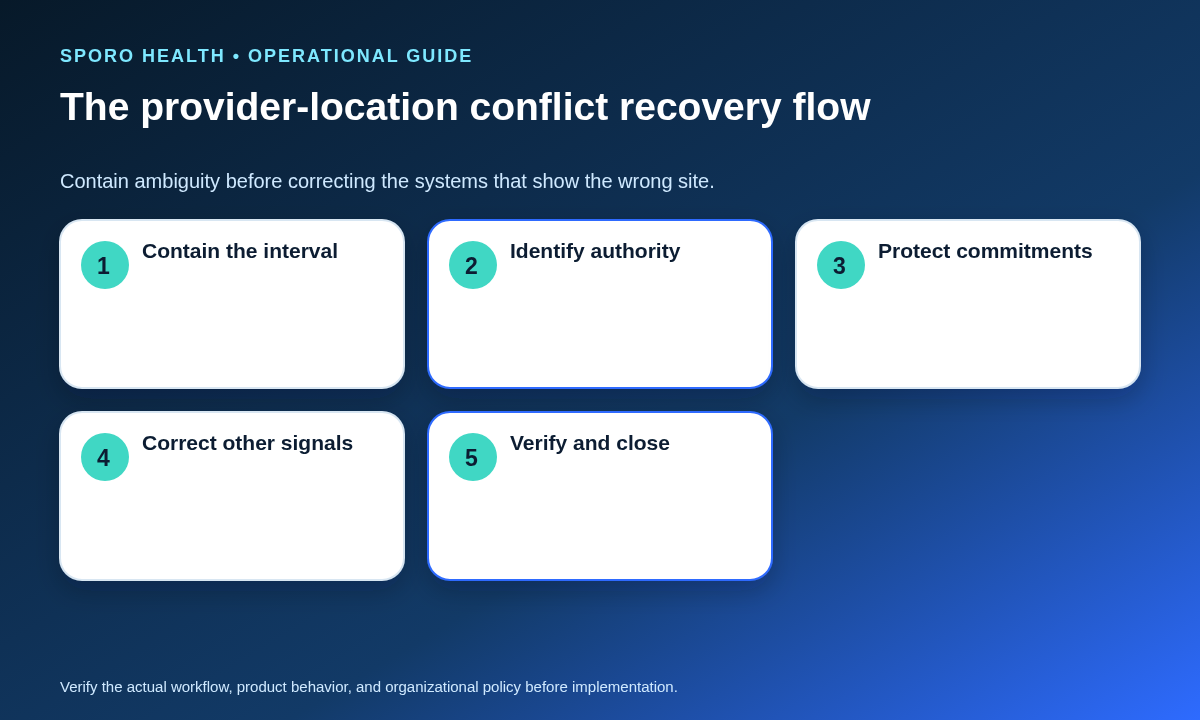
Contain uncertain capacity before deciding which display looks most plausible. Identify the authoritative assignment for the exact interval, resolve existing appointments before releasing slots, correct nonauthoritative signals, and verify every affected schedule view.
- Contain: stop new release or booking in the uncertain interval without deleting existing appointments.
- Identify authority: find the approved provider, site, interval, and booking instruction.
- Protect commitments: resolve booked appointments, coverage, resources, and travel before changing capacity.
- Correct: repair location labels, working-location indicators, blocks, or staff instructions that disagree.
- Verify and close: inspect athenahealth, Google Calendar or Outlook, staff views, and the next recurrence boundary.
The exception record should retain the conflicting values, affected intervals, decision owner, corrective actions, verification evidence, and whether the failure can repeat elsewhere.
How should temporary provider coverage at another clinic be recorded?
Use a bounded assignment with a named provider, site, effective interval, booking authority, required buffer, and expiration. Temporary cross-coverage should not silently overwrite the provider’s recurring location pattern.
The coverage record should also name the approver, affected appointments, resource or room dependencies, staff notification owner, external-calendar action, and restoration check. At expiration, verify that the temporary site no longer appears as active capacity and that the normal assignment has resumed.
What should acceptance testing prove?
Acceptance testing should prove both what each location signal displays and what it does to bookable capacity. Test normal patterns, exceptions, conflicts, boundary dates, travel buffers, existing appointments, and restoration after an exception ends.
If provider-location pairs cross zones, validate clock behavior separately with the time-zone and daylight-saving scheduling controls.
| Scenario | Expected booking result | Evidence and failure response |
|---|---|---|
| One-site day | Capacity and location match the approved assignment | Capture athenahealth and external-calendar views; contain mismatches |
| Split-location day | Each interval uses the correct site and travel buffer | Check both sites and every transition boundary |
| Temporary coverage | Only the bounded interval changes | Verify activation, expiration, and normal restoration |
| Recurring exception | The selected occurrence changes without unintended series edits | Inspect first, middle, final, and neighboring occurrences |
| Remote work or missing location | Capacity follows approved rules, not an inferred label | Run negative tests for blank, remote, and custom values |
| Conflicting signals | Uncertain slots remain contained | Prove the escalation and correction path |
| Existing appointment | No location correction silently strands the appointment | Resolve the appointment before reopening capacity |
How can a medical group measure provider-location mismatches?
Measure ambiguity, containment, correction, expiration, and recurrence—not merely whether calendar records exist. Review results by provider-location pair so repeated failures are not hidden by group-wide totals.
| Measure | Definition | Operational use |
|---|---|---|
| Conflicting signals | Intervals with two or more incompatible locations | Find mapping or ownership failures |
| Uncertain slots contained | Ambiguous slots held from release | Track immediate risk control |
| Appointment corrections | Booked appointments requiring location repair | Prioritize consequential failures |
| Expired exceptions active | Temporary assignments remaining after expiration | Improve restoration controls |
| Repeat pair failures | Repeated mismatches for the same provider and site | Trigger root-cause review |
An optional integrity pass rate can divide sampled intervals with no unresolved mismatch by all sampled intervals. Keep the underlying measures visible; one percentage should not conceal appointment corrections or expired coverage.
How do you put the provider-location standard into operation?
Start with authority and staff actions, then configure labels and integrations around the approved operating rule. Do not begin by assuming every available calendar field needs to control scheduling.
- Normalize provider, department, clinic, building, and remote-location names.
- Assign booking authority for each provider-location pair.
- Complete the four-row signal matrix and name each owner.
- Define recurrence scopes, bounded exceptions, expiration, and restoration.
- Write the five-step conflict response into the staff runbook.
- Execute the acceptance matrix with representative providers and sites.
- Review the integrity scorecard and correct repeated failure patterns.
How to represent provider location across athenahealth and external calendars
Use one documented hierarchy: approved athenahealth scheduling controls govern patient booking, while event locations and working-location indicators remain descriptive unless explicitly authorized and tested otherwise. Add separate unavailable blocks where capacity must be protected, scope exceptions narrowly, and contain disagreements before releasing slots.
Teams evaluating connected-calendar tooling can review Sporo Health, the current athenahealth and Google Calendar product page, the athenahealth and Outlook product page, and the Sporo Health athenaConnect Marketplace listing. Treat product descriptions as vendor claims and verify location mapping, booking effects, recurrence handling, and fallback behavior in your own representative workflow.
Frequently asked questions
Which provider-location signal should control patient booking in athenahealth?
Patient booking should follow the practice-approved athenahealth schedule and availability controls. Calendar labels may inform staff, but they should not independently release or restrict capacity unless that authority is documented and tested.
Does a working-location indicator automatically make physician time unavailable?
No. Google working-location events are transparent by design, and Outlook work location primarily communicates where someone plans to work; verify a separate busy, out-of-office, or schedule restriction before treating time as unavailable.
When should a practice use an event location label instead of a busy block?
Use an event location label to describe where a specific commitment occurs; use a busy or unavailable block when the interval must not remain bookable. When both facts matter, record both and name the controlling system.
How should recurring split-location provider schedules be represented?
Represent the normal split pattern in the approved scheduling baseline, then use bounded exceptions for substitutions. Verify the first occurrence, a middle occurrence, the final boundary, and restoration of the normal pattern.
What should staff do when athenahealth and an external calendar show different locations?
Contain the uncertain interval first. Then identify the authoritative assignment for that exact time, protect existing appointments and travel, correct nonauthoritative signals, and verify every affected schedule view before releasing capacity.
How should temporary provider coverage at another clinic be recorded?
Use a bounded coverage record with the provider, site, start and end, booking authority, required buffer, approver, and expiration. Do not overwrite the provider’s recurring location pattern unless the change is permanent.
Sources

2 Comments
Comments are closed.
[…] Each unit must have one provider, one clinic location, one effective interval, and one current capacity state. Do not treat a location label, staff permission, or busy calendar event as the allocation itself. Before assigning minutes, distinguish the ledger from provider-location signals that should control booking. […]
[…] the registry to separate provider-location signals from booking authority and to allocate provider capacity across clinic locations without making virtual or physical […]