Recurring Procedure Blocks in athenahealth: A Release-and-Recovery Playbook
For teams asking how to manage recurring procedure blocks in athenahealth scheduling, the answer is to treat each block as controlled capacity, not a permanent repeating event. Specialty-practice managers should assign an owner, confirm provider and operational readiness, set a release deadline, limit changes to the approved recurrence scope, and verify every approved calendar before closure.
How to manage recurring procedure blocks in athenahealth scheduling
Treat each recurring block as a controlled capacity record with an owner, status, dependencies, release deadline, approved change scope, and verification evidence. The repeating calendar pattern is only its representation. The operating record should identify the provider, location, time window, recurrence rule, operational purpose, approving owner, executing scheduler, authoritative schedule, external calendar views, and last verified state.
What is the six-state procedure-block lifecycle?
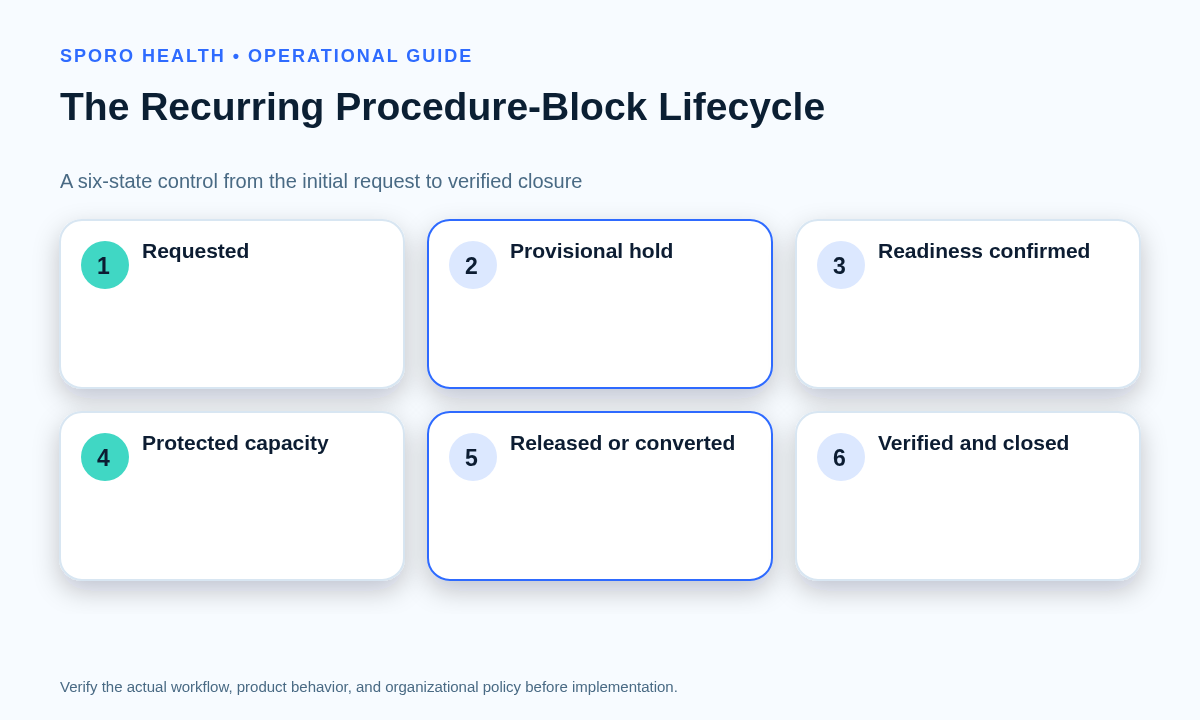
Move every occurrence through six explicit states rather than treating the whole series as permanently confirmed.
| State | Required control |
|---|---|
| Requested | Capture proposed provider, site, pattern, purpose, and requester. |
| Provisional hold | Reserve capacity without representing it as fully ready. |
| Readiness confirmed | Complete the provider and operational dependency gate. |
| Protected capacity | Prevent routine booking into the approved procedure window. |
| Released or converted | Reopen, shorten, or repurpose capacity under an approved rule. |
| Verified and closed | Confirm the intended state in every approved schedule view. |
Apply the state to each occurrence. A healthy parent series can still contain one provisional, released, or failed date.
When should a recurring block become protected?
Protect it only after the designated owner confirms the provider, location, required operational resources, timing, and authoritative schedule record for that occurrence. A provisional hold protects planning space while dependencies remain unresolved; it should not silently become permanent capacity.
Dependencies differ by specialty. The OB/GYN procedure-day scheduling guide provides one example of why procedure sessions may require more coordination than ordinary visit templates.
What must the readiness gate check?
The gate should confirm six operational dimensions and identify the owner of every unresolved item. This is an administrative control, not guidance about clinical suitability.
- Provider: approved availability and no known competing commitment.
- Location: correct department, site, and operating hours.
- Room or equipment: required capacity reserved by an authorized owner.
- Staffing: necessary operational coverage acknowledged.
- Timing: setup, turnover, cleanup, travel, and overrun buffers represented.
- Calendars: authoritative record and approved external views identified.
Multi-location practices can use the provider travel-buffer playbook when same-day movement affects whether the session is feasible.
When should unused procedure time be released?
Use a practice-defined decision point, confirm that no approved commitment still depends on the block, authorize the release, update the authoritative schedule, and verify the resulting bookable capacity. The deadline should reflect local lead times rather than an arbitrary universal rule.
Published operating-room research describes facilities using preset release windows, sometimes 24 to 72 hours before a block, but that range is context evidence rather than a default for an outpatient practice. See the block-scheduling study.
Which release decision applies?
| Block state | Decision | Verification |
|---|---|---|
| Confirmed capacity | Keep protected. | Readiness remains complete. |
| Tentative capacity | Escalate at the decision point. | Owner records protect-or-release decision. |
| Clearly unused | Release or convert. | Bookable time appears as intended. |
| Approved late addition | Preserve only the needed window. | Dependencies and affected bookings rechecked. |
| Unsafe to reopen operationally | Keep contained temporarily. | Named issue and next review time recorded. |
- Review commitments and unresolved dependencies.
- Obtain the approval required by policy.
- Change the smallest necessary time window in the authoritative schedule.
- Verify the new capacity before announcing it as available.
How should one occurrence or a recurring series be changed?
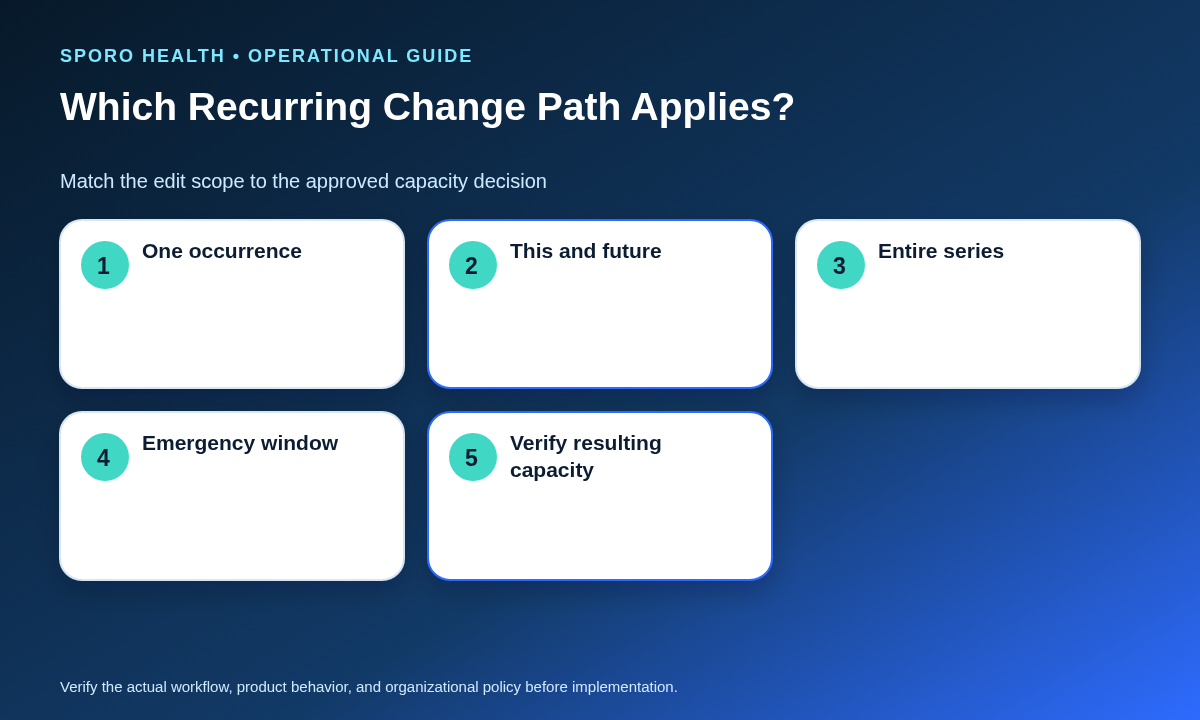
Choose the smallest approved scope: one occurrence, this and future occurrences, the entire series, or a contained emergency window. Preserve the parent series when the operational decision concerns only one date, and record who authorized broader changes.
Google Calendar documents individual instances as exceptions and warns against editing many instances separately when the intended change affects the series; changing this and future instances splits the series. Microsoft Graph likewise distinguishes a series master, occurrence, exception, and canceled occurrence. See the official Google recurring-events guide and Microsoft event resource.
Which recurrence-scope path applies?
Select the path that matches the approved operational decision, not the fastest edit offered by a calendar interface.
- One occurrence: create a dated exception, preserve the parent series, and verify that date.
- This and future: close the old pattern at a defined boundary, create the approved future pattern, and inspect both sides of the boundary.
- Entire series: require explicit series-level approval, check future bookings and dependencies, then verify a representative sample across the horizon.
- Emergency window: contain only the affected dates, stop new bookings, and defer permanent series edits until the operating decision is clear.
Who should approve procedure block changes?
Providers may request changes, but the practice should separate approval, execution, verification, and technical exception ownership. Separation prevents a casual request or calendar edit from becoming an unreviewed capacity decision.
| Role | Responsibility |
|---|---|
| Requester | States the requested date, scope, and reason. |
| Approving owner | Accepts the capacity and dependency consequences. |
| Executing scheduler | Makes the approved authoritative change. |
| Verifier | Checks consequential releases and series changes. |
| Integration owner | Investigates technical mismatches or failed propagation. |
Small practices may assign multiple roles to one person, but the approval and verification steps should remain visible.
What belongs in a procedure-day scheduling checklist for specialty clinics?
The checklist should prove that protected capacity is ready, accurately represented, and supported by a defined release and exception path.
- Confirm occurrence status and approving owner.
- Recheck provider, site, room or equipment, staffing, and timing dependencies.
- Review booked appointments and any unfilled protected time.
- Apply the release deadline and late-addition rule.
- Inspect setup, turnover, travel, and overrun buffers.
- Compare athenahealth with every approved external calendar view.
- Name the same-day escalation owner and fallback communication path.
If a block change creates patient-level appointment work, route those transactions through the front-desk reschedule and cancellation workflow rather than treating the block edit as completion.
What should happen if a provider or resource becomes unavailable?
Contain the affected window, stop new bookings, identify impacted appointments, assign a response owner, update approved systems, and reconcile the window before reopening capacity. Avoid deleting or rebuilding the entire recurring series while the scope is still uncertain.
When provider loss is an absence rather than a routine block adjustment, use the separate physician out-of-office control workflow.
Which failure-and-recovery path applies?
Classify the failure first, contain its scheduling effect, and reopen capacity only after the intended state is verified.
| Failure | Immediate control | Closure evidence |
|---|---|---|
| Provider unavailable | Freeze affected window. | Appointments and capacity reconciled. |
| Room or equipment unavailable | Keep time nonbookable pending an authorized plan. | Replacement or release confirmed. |
| Staffing loss | Escalate readiness status. | Coverage decision recorded. |
| Procedure-day overrun | Protect downstream buffer and notify owner. | Remaining schedule revalidated. |
| Competing edits | Pause further edits and compare timestamps. | Authoritative state restored. |
| Duplicate blocks | Identify the legitimate series or occurrence. | Duplicate removed without opening capacity. |
| Stale released capacity | Correct the view that still shows protection. | All approved views agree. |
| Cross-calendar mismatch | Contain booking if availability is uncertain. | Mismatch corrected and verified. |
How should external calendars represent procedure blocks?
Represent the approved time commitment and availability state with only the fields and visibility needed for the operating purpose. Google Calendar distinguishes events that block time from transparent events, while Microsoft exposes free, tentative, busy, out-of-office, and related availability values. Review the Google Events API and the Microsoft Graph event documentation.
Do not assume that a private label, busy state, or synchronization connection settles privacy governance. HHS describes minimum necessary decisions as purpose- and role-based organizational assessments. Use authorized review and the field-level calendar data minimization worksheet to define permitted titles, fields, viewers, retention, and exceptions. See the HHS Privacy Rule guidance.
What must post-change verification prove?
Verification must prove that the intended occurrence and capacity state appear correctly in the authoritative schedule and every approved external view.
- Correct date, start, end, provider, and site.
- Correct protected, tentative, released, or converted state.
- Correct recurrence scope with neighboring dates unchanged.
- No duplicate, orphaned, or stale event.
- Expected booking behavior after a release or containment action.
Routine sampling through the calendar sync drift sampling framework can help find mismatches that were not visible during the original change.
How should procedure-block reliability be measured?
Track readiness completion, on-time release decisions, stale-block age, correction touches, unresolved exceptions, and post-change mismatches. Use local baselines instead of importing a benchmark from a different specialty or facility.
Published block-allocation research measures underused time, overused time, in-block work, and out-of-block work, reinforcing the need to examine more than a single utilization percentage. See the endoscopy block-allocation study.
| Measure | Worksheet definition |
|---|---|
| Readiness completion | Protected occurrences with completed gates divided by occurrences due. |
| On-time release decisions | Eligible blocks decided by the policy deadline. |
| Stale-block age | Time from approved change until all views agree. |
| Correction touches | Manual actions needed after the initial edit. |
| Unresolved exceptions | Open failures without an owner or next review time. |
| Post-change mismatches | Incorrect states found after creation, release, or series edits. |
Review measures by provider, site, block type, and change scope. Investigate repeated failure patterns rather than rewarding release volume alone.
Where can connected calendar visibility help?
Connected visibility can support the control, but it cannot replace ownership, readiness, release, recurrence, or recovery rules. Practices evaluating a connection can start at Sporo Health, then review the current athenahealth and Google Calendar product page, athenahealth and Microsoft Outlook product page, and Sporo Health listing in the athenaConnect Marketplace.
Treat those pages as vendor materials. Before adoption, test one-occurrence changes, this-and-future changes, releases, late additions, cancellations, duplicate prevention, mismatch detection, and recovery against the practice’s written policy.
Frequently asked questions
How do you manage recurring procedure blocks in athenahealth scheduling?
Treat each block as controlled capacity with an owner, status, dependencies, release rule, approved change scope, and verification evidence. The recurring calendar pattern is only the representation of that operating control.
When should unused procedure time be released?
Use a practice-defined decision point, confirm no approved commitment still depends on the block, authorize the release, update the authoritative schedule, and verify the reopened capacity.
How should one occurrence of a recurring provider block be changed?
Create the smallest possible exception for that date, preserve the parent series, verify the occurrence in every approved view, and record the authorizer.
Who should approve procedure block changes?
Providers may request changes, but the practice should name an approving owner, executing scheduler, verifier for consequential changes, and integration owner for technical exceptions.
Can calendar synchronization replace a procedure-block policy?
No. Synchronization can improve visibility, but it cannot confirm resources, set release deadlines, assign authority, or prove that recurring exceptions were handled correctly.
How should procedure-block reliability be measured?
Track readiness completion, on-time release decisions, stale-block age, correction touches, unresolved exceptions, and mismatches found after creation, release, or series changes.
Put the playbook into practice
If your team is deciding how to manage recurring procedure blocks in athenahealth scheduling, begin with one recurring series. Assign its owner, apply the six states, define the readiness and release gates, test every recurrence path, and measure mismatches until the control works reliably before expanding it.
Sources