Daily athenahealth Schedule Reconciliation: An Exception-Queue Handoff Playbook
A daily athenahealth schedule reconciliation checklist gives practice managers one controlled queue for every known schedule exception. Review today’s active risk, next-business-day readiness, and forward-dated coverage issues at set times; assign each item an owner and deadline; contain booking risk; require an acknowledged handoff; and close only after athenahealth and the connected calendar have been checked and the result recorded.
Clinic administrators and medical-practice operations leaders can use this playbook as a steady-state control routine. It is not a full technical synchronization audit or an outage runbook. Its purpose is to make visible exceptions manageable across shifts, locations, providers, and external calendars without relying on memory, chat threads, or personal lists.
What is the daily schedule-control standard?
Use one shared exception queue, fixed review windows, named owners, explicit deadlines, and recorded verification. The queue should contain known discrepancies and unresolved risks—not every normal appointment—and each entry must have one current disposition.
- Name a daily queue owner and backup.
- Publish opening, booking-cutoff, and shift-handoff times.
- Use four dispositions: resolve now, contain and verify, accepted handoff, or incident escalation.
- Define status terms so “edited,” “verified,” and “closed” cannot be confused.
- Keep patient-specific work in the authorized system rather than copying unnecessary detail into the queue.
The practice should document which schedule is authoritative for each type of change and which roles may edit each system. Implementation owners can consult the current athenahealth appointment API reference for technical details, while operational staff follow the written control policy. Use broader athenahealth scheduling best practices to align templates, booking rules, visibility, and periodic audits around this daily routine.
Which three review horizons should the team use?
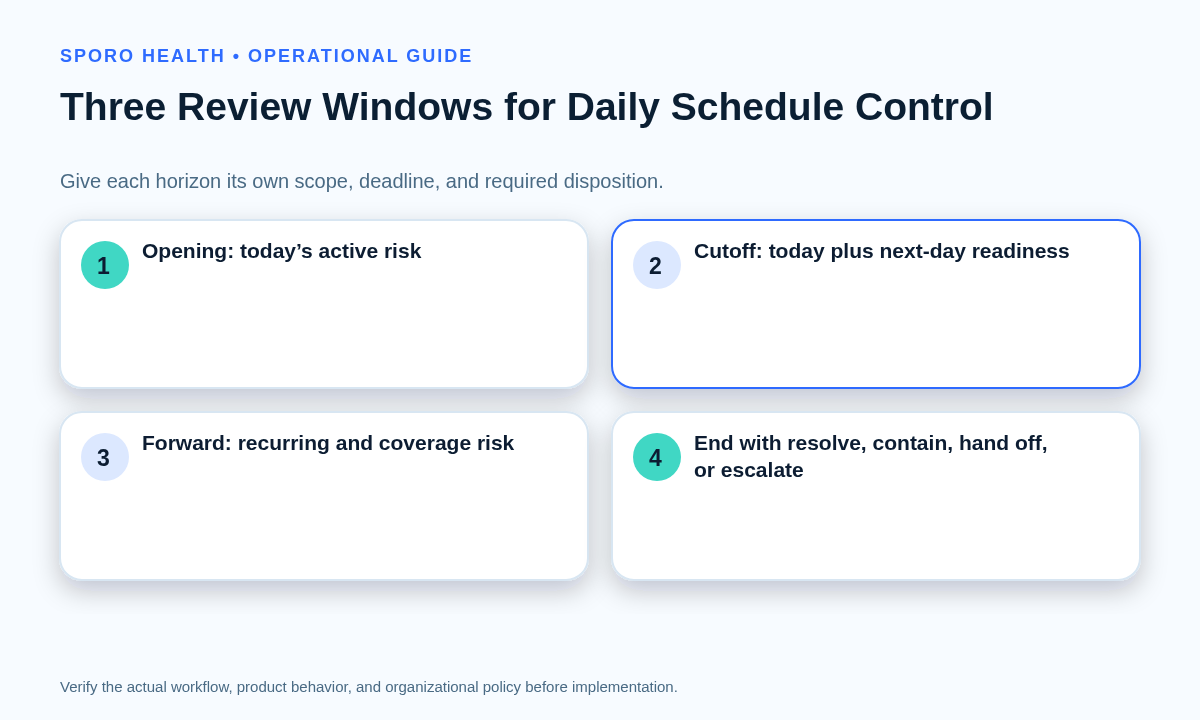
Separate today’s active schedule, next-business-day readiness, and forward-dated operational risk. Mixing all dates into one list makes distant issues compete with exceptions that can affect imminent booking or provider availability.
| Review window | Scope | Required output |
|---|---|---|
| Opening review | Today’s provider, location, appointment-change, and calendar readiness | Owner, due time, containment, and disposition |
| Cutoff review | Unresolved same-day items plus next-business-day readiness | Verified closure, accepted handoff, or escalation |
| Forward review | Recurring blocks, leave, coverage, travel, and cross-location risk | Planned action, accountable owner, and next review date |
Set the exact times around local opening hours, booking patterns, and shift structure. Forward review does not mean postponing urgent work: an absence that creates same-day exposure immediately moves into the active horizon. Route absence-related entries to the detailed physician out-of-office availability workflow.
What should the exception-queue worksheet include?
Capture enough operational context to assign, contain, verify, and close the item without recreating a patient record. The worksheet should describe the schedule problem and its control state rather than becoming a second clinical or registration system.
Where the HIPAA minimum necessary standard applies, HHS says covered entities generally must take reasonable steps to limit PHI use, disclosure, and requests to what is needed for the purpose, subject to stated exceptions. Apply that principle with authorized privacy and legal review when designing the queue. See the HHS minimum necessary guidance.
- Identity: non-PHI exception ID, detection time, and reporting channel.
- Scope: affected provider, location, time window, and systems involved.
- Classification: availability, appointment change, coverage, location, duplicate, stale entry, or suspected integration issue.
- Control: current containment, owner, due time, next action, and escalation state.
- Evidence: verification result, verifier, verification time, and handoff status.
If the class involves a reschedule, cancellation, recurring change, duplicate, or competing edit, use the reschedule and cancellation reconciliation workflow for the transaction itself, then return its result to the daily queue.
How should medical-practice scheduling exceptions be prioritized?
Prioritize by booking horizon first and operational scope second, then select a defined disposition. Same-day exposure across several providers, locations, or calendars generally needs earlier containment than an isolated forward-dated mismatch.
| Horizon and scope | Default disposition | Control expectation |
|---|---|---|
| Same day; multiple operational units | Incident escalation | Contain booking risk and appoint an incident owner |
| Same day; isolated item | Resolve now | Correct and verify before the affected slot or cutoff |
| Next business day; deadline at risk | Contain and verify | Protect capacity and finish verification before cutoff |
| Forward dated; isolated item | Accepted handoff | Assign a due time and require receiver acknowledgment |
| Recurring or repeatedly reopened | Escalated review | Contain the instance and investigate the repeated class |
Within a row, sort by the nearest irreversible booking consequence, the number of operational units affected, and whether the item has reopened. Do not assign priority from an unsupported revenue estimate; use observed scheduling exposure and deadlines.
When is a scheduling handoff or closure complete?
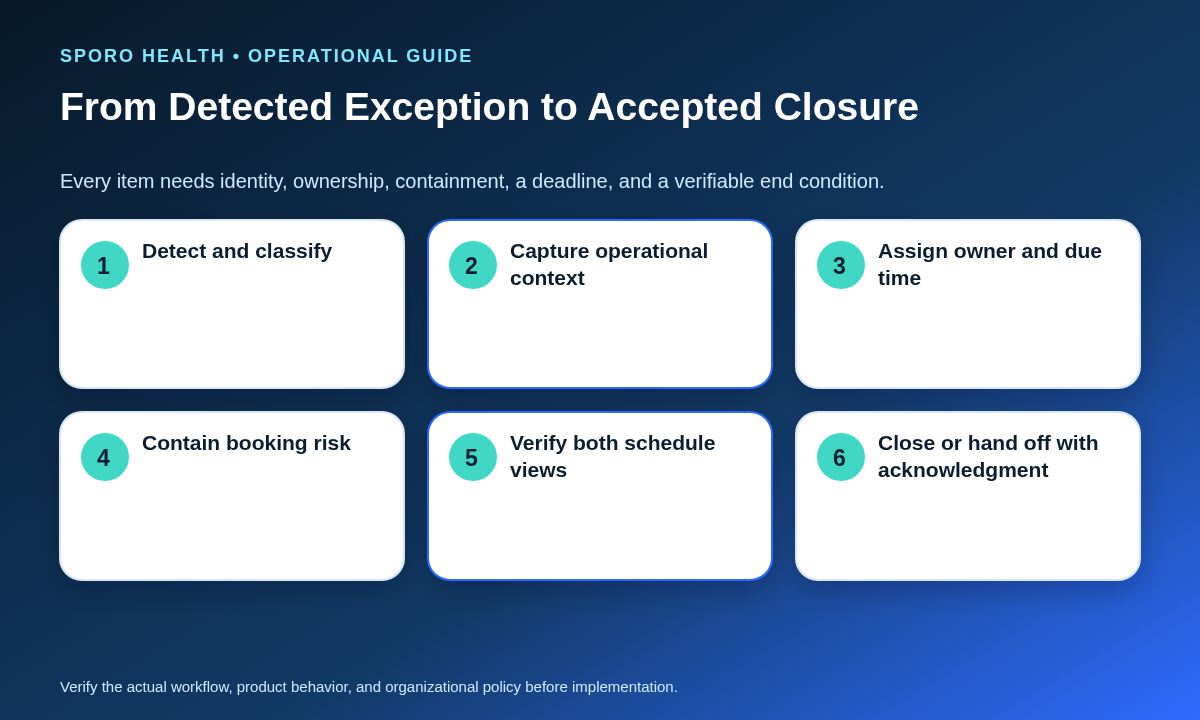
A handoff is complete only when the receiver accepts responsibility, and closure is complete only when the result is verified. Sending a message, changing an assignee, or completing an edit does not establish either condition.
AHRQ’s TeamSTEPPS handoff guidance says responsibility remains with the sender until the receiver understands and accepts the transfer. Adapt that closed-loop principle to scheduling operations—not clinical decision-making—by requiring acknowledgment of the exception, current risk, deadline, containment, next action, and evidence still needed. See the AHRQ handoff tool.
- The sender reviews the queue entry for completeness.
- The receiver acknowledges the item and states any question or constraint.
- The queue records the receiver, acceptance time, and next due time.
- Until acknowledgment occurs, the status remains “handoff awaiting acceptance” and the sender remains accountable.
To close an exception, check the authoritative schedule, check the connected calendar when one is involved, confirm that booking risk is removed or explicitly accepted, and record the verifier and result. If any check fails, reopen the item rather than treating the edit as proof of closure.
When should a mismatch move to drift monitoring or outage recovery?
Daily reconciliation manages visible exceptions; drift monitoring searches for silent mismatches; outage recovery governs broad service failure. The queue must define the trigger that moves an item from normal operations into technical investigation or incident control.
- Work reported or visible exceptions in the daily queue.
- Use a separate calendar sync drift sampling framework to find unreported discrepancies.
- Route broad or persistent failure to the calendar integration outage recovery runbook.
Platform evidence differs. Google’s incremental synchronization guidance says change results include deleted entries, while an invalid sync token can require a full synchronization; its error guidance describes the related 410 recovery path. Microsoft Graph’s calendar-view delta guidance covers added, updated, and deleted events, and each calendar view is tracked separately. Microsoft also says a missed lifecycle notification can require resynchronization in its lifecycle-notification guidance.
Escalate when an exception threatens same-day capacity, spans multiple providers or locations, cannot be verified before cutoff, repeatedly reopens, or suggests broader change-flow failure. If verification cannot finish, use this recovery sequence:
- Contain new booking or conflicting edits in the affected scope.
- Preserve timestamps, identifiers, status messages, and relevant screenshots without unnecessary patient detail.
- Check the authoritative schedule and connected calendar.
- Escalate with the affected scope, cutoff, containment, and evidence.
- Obtain explicit acceptance from the next owner.
- Reverify after recovery, reconcile the affected window, and record closure.
What metrics show daily schedule reconciliation is under control?
Measure queue age, cutoff performance, false closure, handoff acceptance, and repeated exception classes. These measures reveal control quality without assuming savings, clinical effects, or technical performance that has not been demonstrated.
| Measure | What it tests |
|---|---|
| Open exceptions by age and priority | Whether risk is accumulating faster than the team resolves it |
| Percentage closed before cutoff | Whether review windows and deadlines are realistic |
| Reopened items | Whether edits are being mistaken for verified closure |
| Handoffs awaiting acknowledgment | Whether responsibility is becoming ambiguous at shift changes |
| Repeated exception classes | Where process, configuration, training, or integration review is needed |
Establish a baseline before setting targets. Review both the count and the operational context: a low total can still hide one repeatedly reopened, multi-location exception.
How do Google Calendar and Outlook fit the same control model?
Use the same ownership, priority, handoff, containment, and closure principles, but follow platform-specific evidence and recovery guidance. A practice policy should not assume that identical user interfaces produce identical technical evidence.
If connected-calendar support is under review, start with Sporo Health’s healthcare-automation overview, its current athenahealth and Google Calendar product page, the athenahealth and Microsoft Outlook product page, and the Sporo Health athenaConnect Marketplace listing. These destinations contain vendor descriptions; validate actual behavior, data choices, permissions, contracts, fallback procedures, and acceptance tests for the intended configuration.
Synchronization may reduce some manual comparison, but it does not replace written edit authority, exception ownership, acknowledged handoffs, outage thresholds, or verified closure.
How do you put the daily athenahealth schedule reconciliation checklist into practice?
Start with one queue and one operating unit, run the control loop, and refine it from observed exceptions. Avoid launching multiple status systems or changing technical tools before ownership and cutoff rules are clear.
- Designate the authoritative queue, daily owner, and backup.
- Set opening, booking-cutoff, forward-review, and shift-handoff times.
- Publish exception classes, status definitions, priorities, and four dispositions.
- Configure the worksheet to exclude unnecessary patient detail.
- Train staff to contain risk before investigating root cause.
- Test sender accountability and receiver acknowledgment at handoff.
- Document outage triggers and the failed-verification recovery flow.
- Baseline the five schedule-control measures for at least one operating cycle.
A daily athenahealth schedule reconciliation checklist works when every known exception has a visible state, owner, deadline, containment, and verifiable end condition. Run the routine for five business days, review repeated classes and missed cutoffs, then decide whether policy, training, configuration, or connected-calendar evaluation should change.
Frequently asked questions
What should a daily athenahealth schedule reconciliation checklist include?
It should include one exception queue, three review horizons, named owners, due times, containment, acknowledged handoffs, and recorded verification. Every item should end in resolve now, contain and verify, accepted handoff, or incident escalation.
How should medical-practice scheduling exceptions be prioritized?
Prioritize by booking horizon first and operational scope second. Same-day items affecting multiple providers, locations, or calendars should move ahead of isolated forward-dated discrepancies, especially when verification cannot finish before a booking or shift cutoff.
Who owns unresolved schedule exceptions at a shift handoff?
The outgoing owner remains accountable until the incoming owner acknowledges the exception, risk, deadline, containment, and next action. A sent message or queue assignment without acceptance is an unaccepted handoff, not a completed transfer.
When should a calendar mismatch be escalated as an outage?
Escalate when the mismatch threatens same-day capacity, spans multiple operational units, cannot be verified before cutoff, repeatedly reopens, or indicates a broader integration failure. A single isolated mismatch that can be contained and verified usually remains a daily exception.
What metrics show daily schedule reconciliation is under control?
Track open exceptions by age and priority, the percentage closed before cutoff, reopened items, handoffs awaiting acknowledgment, and repeated exception classes. Establish a baseline before estimating financial impact or setting improvement targets.
Does calendar synchronization replace daily schedule reconciliation?
No. Synchronization can reduce some manual comparison, but it does not replace written edit authority, exception ownership, cutoff rules, accepted handoffs, fallback procedures, or verification of the authoritative schedule and connected calendar.
Sources
- athenahealth Appointment API
- Google Calendar synchronization guidance
- Google Calendar API error guidance
- Microsoft Graph calendar-view delta guidance
- Microsoft Graph lifecycle-notification guidance
- AHRQ TeamSTEPPS handoff tool
- HHS minimum necessary guidance
- Sporo Health Google Calendar product page
- Sporo Health Outlook product page
- Sporo Health athenaConnect Marketplace listing