Testing Manual Fallback for athenahealth Calendar Sync: A Tabletop Exercise Guide
Practice managers asking how to test an athenahealth calendar sync fallback plan should run a bounded exercise—not create a live outage. The exercise must prove staff can detect synchronization loss, protect near-term schedules, record each manual change once, manage workload, and reconcile the outage window before reopening normal workflows. Use this checklist to design, facilitate, score, and retest that capability.
How do you test an athenahealth calendar sync fallback plan safely?
Run a bounded scenario against explicit objectives, and never create production risk merely to make the exercise feel realistic. Start with a tabletop or shadow exercise; authorize a technical component test only when it is necessary, reversible, supported, and governed by stop conditions.
A tabletop is a discussion-based exercise for examining roles, coordination, decisions, and plan viability without deploying operational resources, according to NIST SP 800-84. If the fallback plan is part of the practice’s contingency procedures, the current 45 CFR 164.308 includes an addressable specification for periodic contingency-plan testing and revision. The practice should obtain authorized legal, privacy, and security review for its actual obligations and configuration.
Use the existing calendar sync failure triage matrix to create realistic detection signals without repeating the live production response procedure.
What must the fallback-plan test prove?
The exercise must prove that staff can preserve schedule control from the first credible failure signal through verified reopening. A polished discussion is not enough if changes become unowned, near-term schedules remain exposed, or participants cannot demonstrate the surviving state.
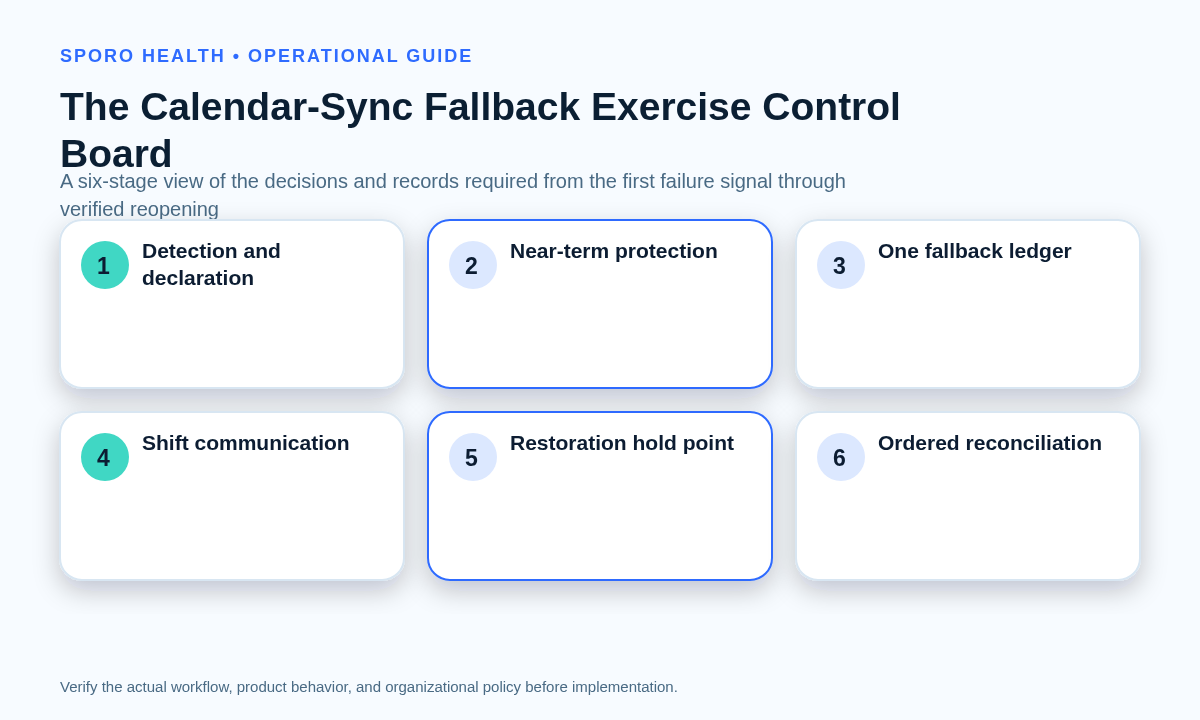
- Detect: recognize suspected synchronization loss and establish a defensible outage start time.
- Protect: identify affected provider-calendar pairs and restrict uncertain near-term edits.
- Capture: record every create, reschedule, cancellation, and external block once.
- Coordinate: assign owners, communicate restrictions, and complete an accepted shift handoff.
- Absorb: measure whether trained staff can verify incoming changes before the backlog becomes unsafe.
- Recover: reconcile the bounded outage window, preserve event identity, and verify both systems before reopening.
Score demonstrated decisions and evidence, not whether participants remembered the facilitator’s preferred wording.
Which exercise format fits the practice?
Use a tabletop for decisions and roles, shadow mode for the manual workflow, or a controlled component test for one approved technical recovery step. Select the least disruptive format that can produce the required evidence.
| Format | Primary objective | Operational risk | Evidence strength | Prerequisites | Stop condition |
|---|---|---|---|---|---|
| Tabletop | Decisions, roles, escalation, restrictions | Low | Observed reasoning and records | Approved runbook and trained participants | Scenario leaves chartered scope |
| Shadow exercise | Ledger, workload, handoff, reconciliation | Low if no production writes occur | Timed workflow artifacts | Simulated records and clear separation from live work | Participant could affect a real schedule |
| Controlled component test | One recovery or notification control | Higher | Direct technical validation | Approval, rollback, monitoring, vendor support | Unexpected scope, impact, or failed rollback |
A fallback exercise complements rather than replaces the pilot acceptance matrix for calendar sync. The pilot tests expected transactions; this exercise tests continuity when synchronization is unavailable or uncertain.
What belongs in the exercise charter?
The charter must define the tested boundary, permitted actions, required evidence, stop conditions, and ownership before the facilitator releases an inject. Ambiguous scope turns a continuity exercise into improvisation.
- Scope: provider-calendar pairs, departments, scheduling horizon, systems, and excluded workflows.
- People: participants, facilitator, observers, decision authority, and after-action owner.
- Assumptions: simulated failure time, available communications, vendor availability, and source-of-truth rule.
- Prohibited actions: unauthorized production edits, real patient contact, credential changes, or unapproved disconnection.
- Success criteria: critical decisions, complete change capture, handoff quality, reconciliation accuracy, and reopening evidence.
- Evidence: timestamps, ledger records, communications, observer notes, before-and-after states, and decision approvals.
CISA’s tabletop package documents provide facilitator, evaluator, feedback, and after-action templates. Participants should first meet their individual competency requirements through a scenario-based front-desk readiness checklist. Observers may prompt only under the chartered rules; they must not silently complete participant tasks.
Which scenario injects should the drill include?
Use injects that force decisions about detection, transaction control, workload, handoff, restoration, and late-discovered recovery debt. Each inject should name the behavior to observe and the evidence required.
| Inject | Decision to observe | Minimum evidence |
|---|---|---|
| Delayed detection | Who declares the outage and bounds its start? | Timestamp and affected-scope statement |
| New appointment | Accept, defer, or restrict the create? | One owned ledger item |
| Reschedule | How are old and new states preserved? | Linked states and event identity |
| Cancellation | How is near-term exposure prioritized? | Cancellation verification owner |
| External-calendar block | Which source governs availability? | Approved disposition and dependency |
| Competing edits | Which edit survives and who contains the conflict? | Conflict decision and rationale |
| Provider disconnection | Is the failure local or broader? | Provider-calendar scope evidence |
| Broad outage | When are nonessential changes restricted? | Capacity decision and communication |
| Shift handoff | Does the incoming owner accept every open item? | Named acceptance and backlog age |
| False restoration | What prevents premature reopening? | Failed restoration gate |
| Late-discovered change | How is reconciliation reopened safely? | New debt item and revised closure |
The facilitator should release injects in a sequence that tests the objective without overwhelming participants before their baseline process can be observed.
How should staff record changes during the simulated outage?
Use one authoritative fallback ledger with a unique item for every simulated manual change. The ledger must preserve enough context to reconstruct what was requested, what happened during the gap, and what ultimately survived.
Record the affected appointment or schedule reference, provider-calendar pair, original state, requested change, change type, timestamp, actor, owner, verification status, dependencies, scheduling horizon, conflict status, and final disposition. Personal notes may support memory, but they must be transferred into the ledger rather than becoming a parallel record.
Observers should seed known transactions and compare that control list with the final ledger. Missing, duplicated, or unowned items are findings even when participants believe the schedule looks correct.
How should fallback workload capacity be evaluated?
Compare incoming change volume with the team’s verified processing capacity, then project backlog growth separately for same-day, next-day, and later schedules. Counting available staff without accounting for verification and handoffs overstates capacity.
Effective capacity = trained staff × verified changes per staff-hour × handoff factor. Estimate incoming creates, reschedules, cancellations, and blocks per hour; time the full record-and-verification cycle; reduce capacity for escalation, provider communication, breaks, and shift transitions; then calculate projected backlog age.
- Restrict nonessential changes when near-term items cannot be verified before their operational deadline.
- Add trained support only when roles, permissions, and handoff rules are already defined.
- Do not treat raw data entry as throughput if another person must still verify the result.
How should recovery be reconciled?
Bound the outage window, freeze uncontrolled edits, and close each ledger item only after its surviving state is verified in both systems. Restoration of a connection is a recovery input, not proof that the schedule is reconciled.
- Confirm the last trusted state and the restoration time.
- Hold untracked edits while reconciliation ownership is assigned.
- Compare every ledger item with athenahealth and the approved external calendar.
- Prioritize cancellations, same-day changes, and conflicts before lower-risk creates.
- Preserve the existing event or mapping identity where the approved workflow requires it; do not recreate items merely because matching is difficult.
- Resolve dependencies such as provider blocks, recurring series, locations, or linked changes.
- Record verification evidence and the final disposition before closing the item.
The live calendar integration outage recovery runbook provides the production procedure that this exercise is intended to validate.
| Recovery-debt tier | Typical characteristics | Disposition |
|---|---|---|
| Immediate | Near-term cancellation, high conflict potential, several dependencies, or unverified competing edit | Resolve before reopening affected capacity |
| Same shift | Confirmed change with moderate conflict or handoff exposure | Assign named owner and deadline |
| Controlled backlog | Later-horizon item with low conflict and known surviving state | Queue with verification date |
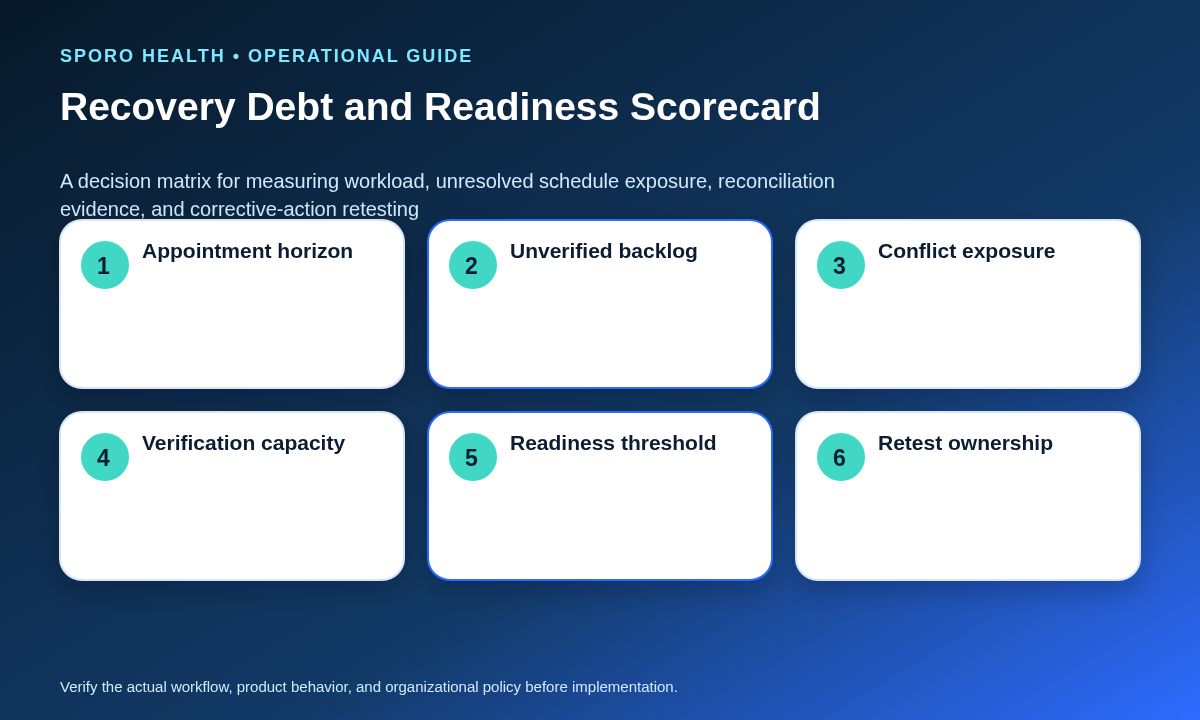
Rank debt by appointment horizon, change type, conflict potential, dependency count, and verification status rather than processing it strictly in arrival order.
How should Google Calendar and Outlook scenarios differ?
Keep the operational objectives consistent, but require platform-specific evidence for authorization, notification continuity, recurrence, event status, identifiers, missed-change recovery, and provider-calendar mapping. A passing Google scenario does not prove an Outlook deployment behaves the same way.
| Evidence area | Google Calendar exercise | Outlook exercise |
|---|---|---|
| Authorization | Verify the approved identity, calendar, and narrowly selected Calendar API scopes. | Verify the current tenant authorization and subscription configuration for the approved mailbox and calendar. |
| Notifications | Test channel expiration and retrieval after a notification, because Google push messages do not contain the detailed event change. | Test renewal and the documented reauthorization, removed-subscription, and missed-notification lifecycle paths. |
| Missed changes | Demonstrate incremental synchronization and the full-sync response to an invalid token described in the Google synchronization guide. | Demonstrate the approved recovery using event delta queries or the vendor’s documented alternative. |
| Recurrence | Evidence parent and instance handling with recurring event identifiers and original start time. | Evidence series masters, occurrences, exceptions, and canceled occurrences. |
| Event state | Check relevant status, cancellation, and availability fields in the Google event resource. | Check relevant type, cancellation, recurrence, and show-as fields in the Microsoft Graph event resource. |
| Mapping | Prove the approved provider-calendar pair, event-identity strategy, exclusions, and owner rather than inferring them from matching names. | |
Practices evaluating Sporo can review the current commercial descriptions for athenahealth and Google Calendar and athenahealth and Microsoft Outlook, along with the athenaConnect Marketplace listing. These pages are vendor destinations, not independent proof of behavior in a specific deployment; request current tenant-specific evidence.
What is the readiness gate after the exercise?
Classify the result as pass, conditional pass, or fail, and do not average a critical failure into an acceptable overall score. The gate should consider decisions, complete capture, handoffs, reconciliation, unresolved exposure, and adherence to source-of-truth rules.
| Result | Required finding | Next step |
|---|---|---|
| Pass | All critical decisions were correct; every seeded or generated change was accounted for; reconciliation and evidence were complete. | Approve the tested scope and retain improvement observations. |
| Conditional pass | No critical failure occurred, but bounded noncritical gaps require restrictions, owners, due dates, and targeted retesting. | Keep conditions visible until acceptance evidence passes. |
| Fail | A change was lost or unowned; an unauthorized edit occurred; an observer rescued the workflow; the source-of-truth rule was bypassed; near-term exposure remained; or reopening occurred before verification. | Contain the affected scope, correct the control, and retest it. |
The evidence packet should contain the charter, inject log, fallback ledger, capacity worksheet, communications, observer notes, reconciliation records, scorecard, decisions, and signed corrective-action assignments.
How should exercise findings be closed?
Give every gap an owner, corrective action, due date, acceptance evidence, and retest method. A critical finding remains open until the failed workflow or control is exercised again successfully.
Write corrective actions around observable behavior: revise the restriction authority, rebuild the handoff, add a missing ledger field, clarify provider-calendar mapping, or change the recovery gate. The calendar sync incident postmortem template offers useful action-closure discipline, but an exercise review evaluates simulated performance rather than reconstructing a real incident.
Documentation edits may be necessary, but they are not acceptance evidence by themselves. Retest the smallest scope that can prove the corrected control, then update the overall readiness decision.
Put the fallback exercise into use
Start with one provider-calendar pair, one scheduling horizon, and a scenario that includes detection, several transaction types, a handoff, uncertain restoration, and ordered reconciliation. This is how to test an athenahealth calendar sync fallback plan without manufacturing a production outage: bound the exercise, capture evidence, protect the schedule, and require failed controls to pass a retest before expanding scope.
If the practice is also evaluating connected-calendar options, review Sporo Health only after the practice-owned fallback workflow, source-of-truth rules, and acceptance evidence are defined. A product demonstration should support those controls rather than substitute for them.
Frequently asked questions
- Must the integration be intentionally disconnected?
-
No. A discussion-based or shadow exercise can validate most operational decisions without interrupting live synchronization; any technical interruption should be separately approved, bounded, reversible, and supported by the vendor.
- Who should participate?
-
Include the roles that detect failures, schedule patients, approve restrictions, communicate with providers, administer calendars, escalate to the vendor, authorize restoration, and verify reconciliation. Observers should not silently perform participant tasks; if they do, score the affected objective as failed.
- Can a tabletop replace a technical recovery test?
-
No. A tabletop validates decisions, roles, and escalation, but it does not prove that an approved technical recovery action works. Use a separately authorized component test when technical operability is the objective.
- What is the authoritative record during the exercise?
-
Use one fallback ledger for every simulated manual change. Personal notes may support memory, but they must not become competing records or bypass the assigned owner.
- How should backlog capacity be judged?
-
Compare incoming change volume with verified staff throughput by scheduling horizon. Restrict nonessential changes when the projected near-term backlog cannot be verified before the practice’s operational deadline.
- Can Google Calendar and Outlook use identical evidence?
-
No. The operational objectives can match, but authorization, notifications, recurrence, status, identifiers, and missed-change recovery must be evidenced for the actual platform and tenant.
- When can a critical finding be closed?
-
Only after the failed workflow or control is exercised again and the acceptance evidence passes. Editing documentation alone does not prove that staff can perform the corrected process.
Sources
- NIST SP 800-84: Guide to Test, Training, and Exercise Programs for IT Plans and Capabilities
- CISA Tabletop Exercise Package documents
- 45 CFR 164.308 administrative safeguards
- Google Calendar API authorization scopes
- Google Calendar push notifications
- Google Calendar incremental synchronization
- Google Calendar event resource
- Microsoft Graph lifecycle notifications
- Microsoft Graph event delta queries
- Microsoft Graph event resource