Provider Travel Time Between athenahealth Locations: A Scheduling Buffer Playbook
For multi-location practice managers asking how to manage provider travel time between athenahealth locations, the answer is to treat the entire transition—not just drive time—as nonbookable capacity. Set an approved buffer for each location pair and time band, test every same-day move through a five-gate feasibility check, restrict overrides, and measure breaches so recurring failures change the rule.
Travel is only one source of schedule variability, but it is predictable enough to control. Research on outpatient scheduling emphasizes that variability and uncertainty should be represented in capacity decisions, while physician time-constraint research recommends aligning schedule structures with actual work and adding appropriate slack. See research on outpatient scheduling variability and this physician time-constraint study.
How to manage provider travel time between athenahealth locations?
Turn every same-day site change into a capacity decision rather than treating the gap as automatically free. Available time begins when the provider can realistically leave the origin and ends when the provider must be ready at the destination. This transaction-level control complements the broader multi-location athenahealth scheduling model.
Define the required transition as five components: release allowance, transit, parking or building access, destination setup or handoff, and contingency. A travel block protects active working time; it is not an absence, lunch placeholder, or informal note. The gap remains bookable only when it covers the approved total and passes the exception rules below.
How do you build a location-pair buffer matrix?
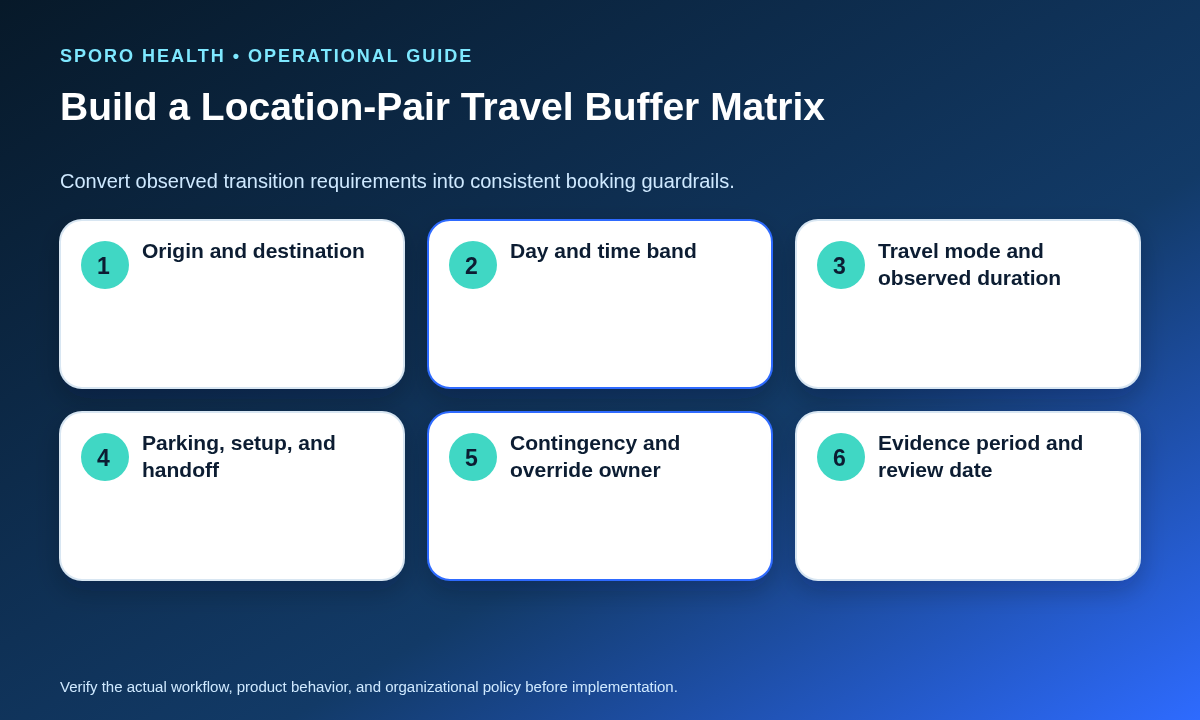
Record one approved rule for each material origin, destination, direction, and time band. Use the matrix alongside provider-template and front-desk scheduling best practices so individual schedulers do not estimate travel differently.
| Field | What to record | Why it matters |
|---|---|---|
| Route | Origin, destination, direction | Opposite directions may differ |
| Time band | Day and departure window | Separates predictable congestion |
| Transit | Mode and observed duration | Establishes the route baseline |
| Release | Typical clinic overrun allowance | Prevents an unrealistic departure |
| Access | Parking, walking, entry | Covers time outside the vehicle |
| Readiness | Setup and required handoff | Measures destination-ready time |
| Contingency | Approved additional allowance | Absorbs normal variation |
| Governance | Owner, evidence period, review date | Keeps the rule accountable |
A traffic-aware route estimate may inform the transit row, but it should not replace observed release, parking, or setup data. The Google Maps Routes API documentation shows that route matrices can use origins, destinations, departure times, travel modes, and traffic-aware duration settings.
Which travel-buffer model should you use?
Choose one documented model per location pair based on route stability and the practice’s ability to maintain evidence. Do not let schedulers switch models during booking.
| Model | Use when | Tradeoff |
|---|---|---|
| Fixed | Route performance is stable and transition volume is low | Simple, but can hide time-of-day variation |
| Time-band | Congestion or access varies predictably | More realistic, but requires maintained bands |
| Observed-history | Transition volume supports regular measurement | Adapts to operations, but needs clean data and review |
What should the transition-feasibility gate check?
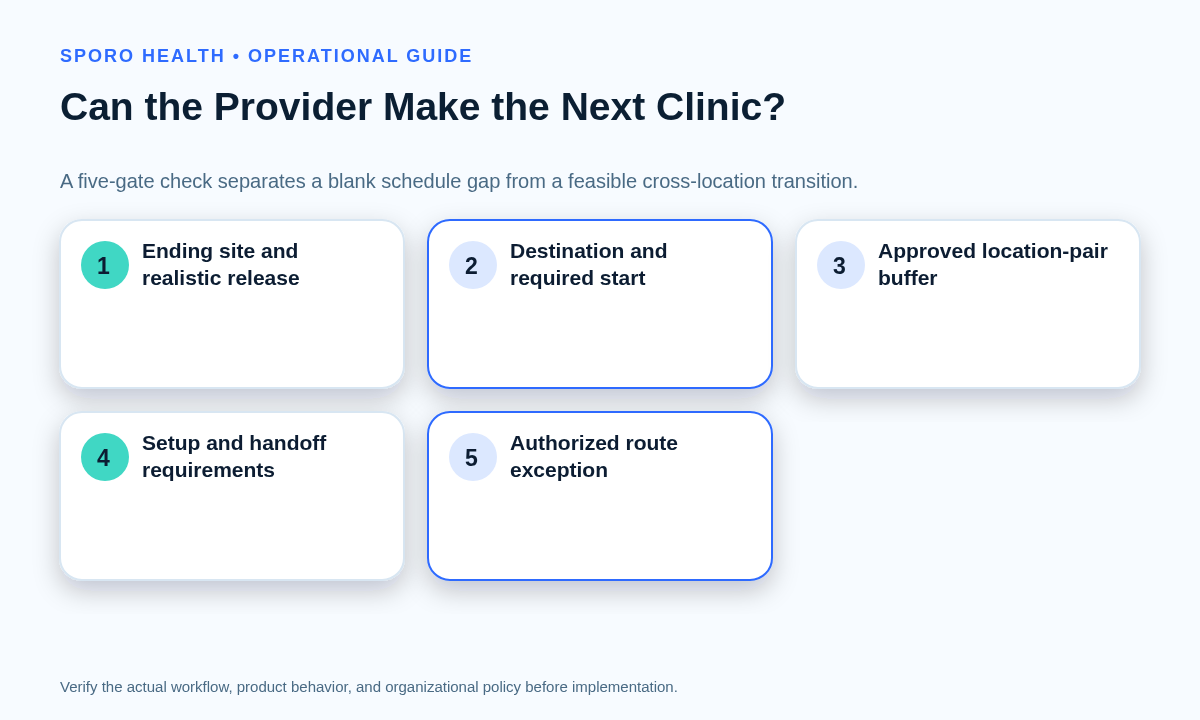
A downstream slot remains bookable only after five facts establish that the provider can be ready on time. Apply the same sequence to template design, manual bookings, reschedules, and overrides.
- Ending site and release: Confirm where the provider will actually finish and the realistic release time, not just the appointment end.
- Destination and start: Confirm the next physical site, appointment start, and any earlier readiness requirement.
- Approved buffer: Select the correct location pair, direction, day, and time band.
- Setup and handoff: Check equipment, room, staff, building-access, or handoff requirements included in readiness.
- Authorized exception: Determine whether a location swap, telehealth conversion, provider confirmation, or named override changes the route.
Feasibility rule: The time from realistic release to required destination readiness must be at least as long as the approved buffer. If any gate is unknown, hold the slot or escalate it rather than assuming feasibility.
Where should travel blocks be represented?
The designated scheduling source should carry the nonbookable constraint, while connected calendars should reflect the intended state according to documented authority rules. Travel blocks share control principles with the physician out-of-office availability-control workflow, but they protect movement between active sites rather than an absence from work.
Verify the exact appointment and availability behavior supported by the practice’s athenahealth configuration against the current athenahealth appointment API reference. Do not infer tenant behavior from a generic playbook.
For external views, Google Calendar events expose start, end, location, recurrence, and transparency fields; opaque events block time in the calendar interface. Microsoft Graph events expose start, end, locations, recurrence, and showAs values such as busy. See the Google Calendar Events reference and Microsoft Graph event reference. Those fields describe representation, not which system should govern scheduling.
How should travel blocks be verified?
Verify both operational meaning and cross-system state before closing the change. If connected calendars are part of the workflow, adapt the calendar sync drift reconciliation framework to check approved travel constraints.
- Confirm provider, origin, destination, date, start, end, and recurrence scope.
- Confirm the block is nonbookable in the authoritative workflow.
- Check each approved external view for a missing, duplicated, shortened, or stale block.
- Record who verified the state and when the next review is due.
How should staff handle a same-day travel delay?
Protect the downstream window first, then authorize one corrective plan and reconcile every affected schedule representation. When appointments must move, use the front-desk reconciliation workflow for reschedules and cancellations rather than making disconnected edits.
- Mark the transition at risk and stop new bookings in the downstream window.
- Confirm actual release time, route conditions, destination readiness, and affected appointments.
- Select one authorized response: extend the block, move downstream appointments, swap locations, or use an approved alternative workflow.
- Do not convert a visit to telehealth unless the practice’s approved clinical and administrative process permits it.
- Communicate the selected plan through approved channels and assign one edit owner.
- Reconcile the authoritative schedule and connected views, then close the exception with timestamps and evidence.
Which exception-and-recovery path applies?
Use the trigger to choose a containment action, owner, and closure test instead of improvising a new rule. The table keeps common travel exceptions distinct.
| Trigger | Immediate action | Closure evidence |
|---|---|---|
| Clinic overrun | Extend protection and assess downstream appointments | Actual release and revised readiness recorded |
| Route delay | Hold the destination window | Final arrival and schedule reconciliation |
| Location swap | Replace the old route with the new pair | Old block removed; new route verified |
| Telehealth conversion | Remove travel only after authorized conversion | Visit mode and schedule states confirmed |
| Same-day reschedule | Recompute both adjacent transitions | Appointments and blocks match the new sequence |
| Competing edits | Pause changes and identify the governing edit | One reconciled state with a named owner |
| Stale travel block | Verify the rotation changed before reopening time | Block removed from every required view |
How should a practice measure the control?
Measure failures by provider and location pair so repeated exceptions lead to a revised buffer, route, or template. Define each measure consistently before comparing periods.
| Measure | Definition |
|---|---|
| Transition count | Completed same-day cross-site movements |
| Buffer-breach rate | Transitions ready after the protected window divided by measured transitions |
| Authorized-override rate | Named overrides divided by scheduled transitions |
| Downstream disruption count | Appointments moved or otherwise operationally changed after a breach |
| Stale-block rate | Invalid travel blocks divided by reviewed travel blocks |
| Exception-closure time | Median time from detection to verified reconciliation |
Review the measures by direction and time band. A route that succeeds in the morning may fail regularly near evening congestion, while a high stale-block rate may indicate weak rotation maintenance rather than inadequate travel time.
What should the implementation checklist include?
Implementation should produce an approved matrix, booking gate, authority model, recovery path, and review cycle. Use this checklist before applying the standard broadly.
- Inventory material location pairs in both directions.
- Separate recurring time bands where route or access conditions differ.
- Observe transit, release, parking, setup, and handoff components separately.
- Approve one buffer model and one accountable owner per pair.
- Represent the constraint as nonbookable capacity in the designated source.
- Name who can edit, verify, override, and restore the standard rule.
- Test routine transitions and every exception in the recovery map.
- Review breach, override, disruption, stale-block, and closure measures.
Where can connected calendar visibility help?
Connected calendars can help display approved travel constraints, but they do not replace the operating standard or authority model. The current Sporo pages describe its athenahealth and Google Calendar connection and athenahealth and Outlook connection as bidirectional offerings. Treat those descriptions as vendor claims and confirm travel-block mapping, recurrence exceptions, override behavior, and stale-block recovery in the deployed configuration.
Teams evaluating fit can review Sporo Health’s healthcare automation overview and its athenaConnect Marketplace listing. A useful demonstration should follow one location-pair transition from rule creation through verification, override, delay recovery, and final reconciliation.
Frequently asked questions
How do you manage provider travel time between athenahealth locations?
Treat the full transition as nonbookable capacity, use an approved location-pair buffer, test feasibility before booking, restrict overrides, and reconcile every affected schedule view.
Is a provider free whenever one appointment ends before the next begins?
No. A cross-location transition is feasible only when the gap also covers realistic release, travel, parking, setup, and required handoff time.
Should every clinic pair use the same travel buffer?
No. Direction, time of day, route, parking, building access, and setup needs can differ, so each material location pair needs an approved rule.
Can recurring travel blocks be copied indefinitely?
Recurring blocks are useful for stable rotations, but exceptions and actual route performance must be reviewed separately so outdated assumptions do not create stale unavailable time or unsafe transitions.
Who may override a provider travel block?
Only a named role should approve an override after checking transition feasibility, downstream appointments, provider confirmation, and the evidence required to restore the standard rule.
Should Google Calendar or Outlook become the scheduling source of truth?
Not by default. Document one authoritative scheduling source and define each external calendar as a controlled input, output, or view according to the approved workflow and deployed configuration.
Put the travel-buffer playbook into practice
The practical answer to how to manage provider travel time between athenahealth locations is not a universal number of minutes. It is a governed location-pair rule supported by evidence, represented as unavailable capacity, checked before every transition, changed only by named authority, and measured after use. Start with the highest-volume route, test the complete control loop, and expand only after routine and exception paths can be verified.
Sources
- athenahealth appointment API reference
- Google Calendar Events reference
- Microsoft Graph event resource
- Google Maps Compute Route Matrix reference
- Primary Care Physicians’ Experiences With and Adaptations to Time Constraints
- An application of computable biomedical knowledge to transform patient centered scheduling
- Sporo Health athenahealth and Google Calendar product page
- Sporo Health athenahealth and Outlook product page