Variable Appointment Lengths in athenahealth Specialty Clinics: A Duration-Control Playbook
For specialty-practice managers asking how to manage variable appointment lengths in athenahealth specialty clinics, the practical answer is to use a practice-approved duration registry, limit exceptions by role and range, scan future bookings before changing a default, and verify the resulting interval across provider schedules, dependent resources, booking channels, and connected calendars. Measure drift and fragmentation, not schedule fullness alone.
How to manage variable appointment lengths in athenahealth specialty clinics
Use three documented operating models: fixed appointment-type lengths, controlled variable lengths, and one-appointment exceptions. Assign one model to every appointment type so schedulers know whether they are applying a baseline, selecting an approved category, or requesting an exception.
Do not turn scheduling research into a universal clinical rule. A systematic review of ambulatory consultation duration found sparse, outdated, and low-confidence evidence for a minimum or optimal visit length. Physicians and clinical governance should therefore approve service definitions; operations should implement and monitor those decisions.
Operational evidence does support accounting for heterogeneous service times. Research on outpatient scheduling with heterogeneous durations describes grouping appointments by expected service time, while an ophthalmology scheduling-template study used EHR data to evaluate adherence to predicted exam lengths. These studies support measurement and classification, not a clinically optimal number of minutes.
| Operating model | Use it when | Required control |
|---|---|---|
| Fixed appointment-type length | Work is predictable enough for one approved baseline. | Published minutes, owner, effective date, and review trigger. |
| Controlled variable length | Defined categories reliably require different intervals. | Named categories, permitted range, selection rule, and eligible roles. |
| One-appointment exception | An isolated case needs a nonstandard interval. | Approver, reason, exact scope, dependent-resource check, and verification. |
Keep appointment duration separate from provider working hours. The related guide to choosing between a recurring template change and a bounded exception addresses availability patterns; this playbook governs how much of that available time one patient appointment consumes.
What belongs in the appointment-duration registry?
The registry should define the approved interval, allowable variance, dependencies, authority, and lifecycle for every appointment type. It becomes the practice-owned reference used by schedulers, physicians, administrators, and workflow owners.
Record at least:
- Appointment type and approved service definition
- Baseline minutes and permitted range
- Eligible providers, locations, and sessions
- Required rooms, equipment, or support roles
- Patient-facing and staff-facing booking channels
- Who may select a variable category
- Who approves an out-of-range exception
- Effective date, version, and accountable owner
- Review triggers, including repeated overrides or resource conflicts
Do not let free-text habits become an unofficial standard. If a duration depends on a room, device, technician, or location, connect the registry to the practice’s workflow for coordinating appointments that require several resources.
Which duration-change scope should the practice choose?
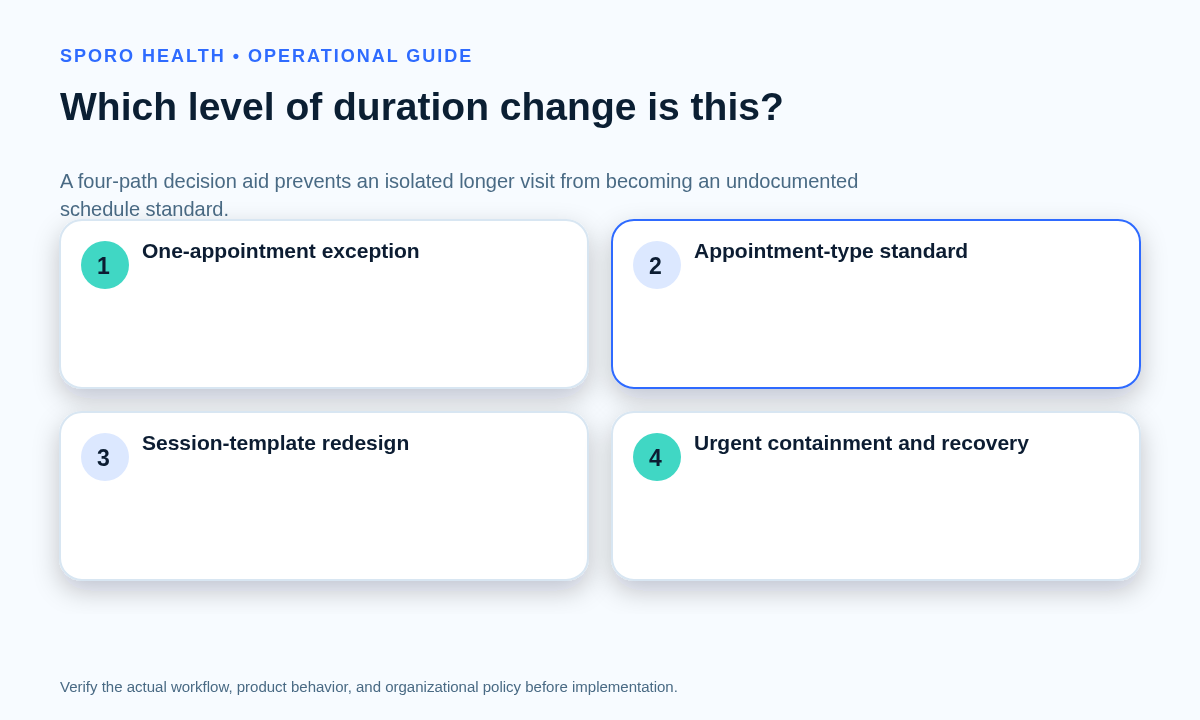
Route each request to the smallest scope that safely addresses the need: one appointment, one appointment-type standard, an entire session template, or urgent containment. Repeatedly using narrow exceptions for a predictable pattern creates an undocumented shadow standard.
| Path | Decision signal | Control action |
|---|---|---|
| One-appointment exception | The need is isolated and does not redefine future work. | Approve, document, change one booking, and verify downstream capacity. |
| Appointment-type standard change | The pattern is repeatable across comparable appointments. | Approve a new registry version and scan future bookings before activation. |
| Session-template redesign | The new duration mix changes session capacity, sequencing, or resource use. | Model the full session, preserve existing commitments, test, and roll out as a governed template change. |
| Urgent containment and recovery | A late change has already created or may create a collision. | Contain the interval, assign an owner, resolve affected bookings, and reconcile every system. |
A useful escalation rule is frequency plus consequence. Escalate repeated overrides when they consume meaningful capacity, create unusable gaps, affect dependent resources, or force staff to reinterpret the same appointment type differently.
What must be checked before changing a default duration?
Inventory every future commitment and booking surface exposed to the old duration before activating the new default. Do not assume that editing an appointment-type setting safely updates appointments that are already booked.
- Already-booked appointments using the affected type
- Waitlist entries and offers tied to old slot assumptions
- Provider sessions whose capacity or sequencing will change
- Rooms, equipment, locations, and support-role reservations
- Patient self-scheduling and staff booking channels
- Google Calendar, Outlook, exports, and other schedule views
Use the current athenahealth Appointment API reference and tenant-specific testing to confirm supported behavior. The practice should classify each exposed booking as retain, review, individually change, or process through a vendor-supported controlled method. Preserve a count before and after the change so no appointment silently disappears from the review population.
When longer work occupies protected specialty sessions, combine the impact scan with the separate controls for managing recurring procedure capacity.
How should a late appointment-duration change be contained?
Protect the affected interval first, then identify collisions, obtain approval, update the authoritative booking once, and verify every dependency. The owner should keep the exception open until downstream appointments, resources, and calendars agree.
- Identify the requested start, end, reason, and effective appointment.
- Freeze conflicting edits while the impact is assessed.
- Find downstream overlaps, shortened bookings, and hidden open capacity.
- Confirm the required approver and patient-contact owner.
- Apply one authoritative change and update dependent reservations.
- Verify the final interval and assign any unresolved effect to a named owner.
Recovery should explicitly search for overlaps, orphaned resource reservations, unusable gaps, patient bookings shortened without review, and external-calendar intervals that still show the prior length.
Use the established workflow for controlling same-day appointment exceptions when the request also adds capacity, and use the playbook for recovering the active clinic schedule when visits run long when actual clinic delay—not the planned duration standard—is the problem.
How should Google Calendar or Outlook represent appointment duration?
Connected calendars should reflect the practice-approved start and end interval for visibility and verification, not independently redefine the patient appointment. Booking authority, exception approval, and resource control should remain documented in the practice workflow.
The current athenahealth FHIR appointment definition distinguishes appointment start, end, duration, and filled slots. Google Calendar events likewise use an inclusive start and exclusive end in the Google Calendar Events API, while the Microsoft Graph event resource represents start and end with date, time, and time-zone values. Verification should compare the full interval, not merely the event title or presence.
For each changed appointment, compare provider, date, start, end, time zone, location where relevant, and expected event identity. A mismatch should enter an exception queue rather than being corrected independently in several systems.
Practices evaluating connected-calendar options can review Sporo Health, the athenahealth and Google Calendar product page, the athenahealth and Microsoft Outlook product page, and Sporo Health’s athenaConnect Marketplace listing. Treat product pages as vendor descriptions and require acceptance testing for the practice’s approved scenarios.
Which measures reveal appointment-duration drift?
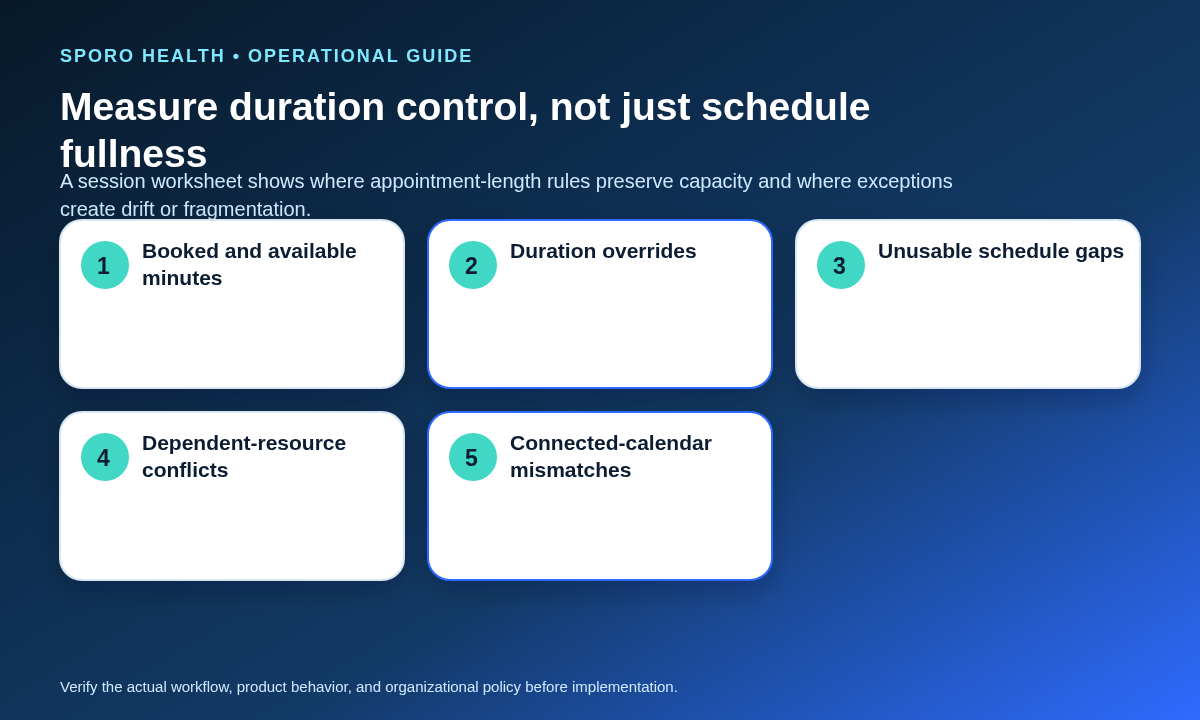
Use a scorecard that measures overrides, mismatches, collisions, fragmented capacity, resource conflicts, and unresolved discrepancies. Schedule fullness alone can hide whether the duration standard is being followed or whether apparently open minutes are actually usable.
| Measure | Practice definition |
|---|---|
| Override rate | Appointments outside baseline divided by appointments eligible for the baseline. |
| Duration-mismatch rate | Sampled appointments whose approved interval differs from the authoritative booking or connected-calendar interval. |
| Late-change collisions | Duration changes made inside the practice’s cutoff that create a downstream conflict. |
| Unusable gap minutes | Open minutes that cannot accept an approved appointment type because of fragmentation or dependencies. |
| Dependent-resource conflicts | Appointments whose provider interval and required resource interval do not match. |
| Unresolved discrepancies | Cross-system duration exceptions still open at the defined review boundary. |
Define each denominator before the pilot and stratify results by appointment type, provider-session group, and change path. Set local review thresholds from baseline evidence rather than presenting one universal target. Review the exceptions behind the rate: a low override rate can still conceal one high-consequence resource or patient-booking conflict.
How should the practice pilot the duration standard?
Pilot one bounded provider-session group with representative appointment types, exceptions, resources, and connected calendars. Expand only after staff can apply the registry, select the correct change scope, and reconcile every tested schedule state.
- Capture the current registry, templates, future bookings, and baseline measures.
- Select common fixed lengths, variable categories, and one difficult exception.
- Test new bookings, existing bookings, late changes, cancellations, and reschedules.
- Verify provider capacity, required resources, patient-facing channels, and calendars.
- Rehearse rollback to the prior registry version and schedule state.
- Choose expand, extend, redesign, or stop using documented evidence.
Training should include who may choose a permitted variance, who approves an out-of-range request, where the reason is recorded, and what proof closes the change. Repeated uncertainty is a design defect to correct before expansion, not a reason to rely on informal coaching indefinitely.
Put the duration standard into operation
This is how to manage variable appointment lengths in athenahealth specialty clinics without turning every unusual visit into a permanent rule: approve the baseline, document controlled variance, choose the correct scope, protect future commitments, verify intervals, and measure drift.
Start with one registry owner and one bounded pilot. If connected-calendar verification is part of the workflow, ask the vendor to demonstrate representative duration changes, existing-booking treatment, exception recovery, and final interval reconciliation before relying on the connection in routine operations.
Frequently asked questions
- Can front-desk staff choose a longer or shorter appointment?
- Yes, but only when the approved duration standard delegates that decision, defines the permitted range, and requires documentation plus post-change verification.
- Does changing an appointment-type default update existing appointments?
- Do not assume it does. Inventory future bookings, test current athenahealth behavior, and decide whether each affected appointment remains unchanged, requires review, or can be changed through a supported controlled process.
- When should a one-off duration exception become a new standard?
- Change the appointment-type standard when the same justified pattern recurs often enough to be predictable, physician-approved, operationally supportable, and safer to govern as a baseline than as repeated overrides.
- Should Google Calendar or Outlook control patient-appointment duration?
- No. Connected calendars should display the practice-approved interval for visibility and verification; they should not independently redefine duration or become an undocumented booking authority.
- Which metrics show appointment-duration drift?
- Track override rate, duration-mismatch rate, late-change collisions, unusable gap minutes, dependent-resource conflicts, and unresolved cross-system discrepancies with explicit denominators.
- Is a longer appointment always clinically better?
- Current experimental evidence does not establish one universal optimal ambulatory consultation length. Physicians and clinical governance should approve service definitions; this playbook addresses operational control, not medical advice.
Sources
- athenahealth Appointment API reference
- athenahealth Appointment definitions
- Google Calendar Events API
- Microsoft Graph event resource
- Evaluating and Improving an Outpatient Clinic Scheduling Template Using Secondary Electronic Health Record Data
- An Adaptive Decision Support System for Outpatient Appointment Scheduling with Heterogeneous Service Times
- Does the Duration of Ambulatory Consultations Affect the Quality of Healthcare?