Cross-Location Patient Reschedules in athenahealth: A Destination-Verification Workflow
For front-desk leaders asking how to move a patient appointment between athenahealth locations, treat the change as a controlled transfer—not a calendar edit. Verify destination fit, choose update-in-place or linked cancel-and-rebook, preserve one transaction record, close source residue, reconcile dependent resources and connected calendars, and require a named verifier before the move is complete.
How to move a patient appointment between athenahealth locations?
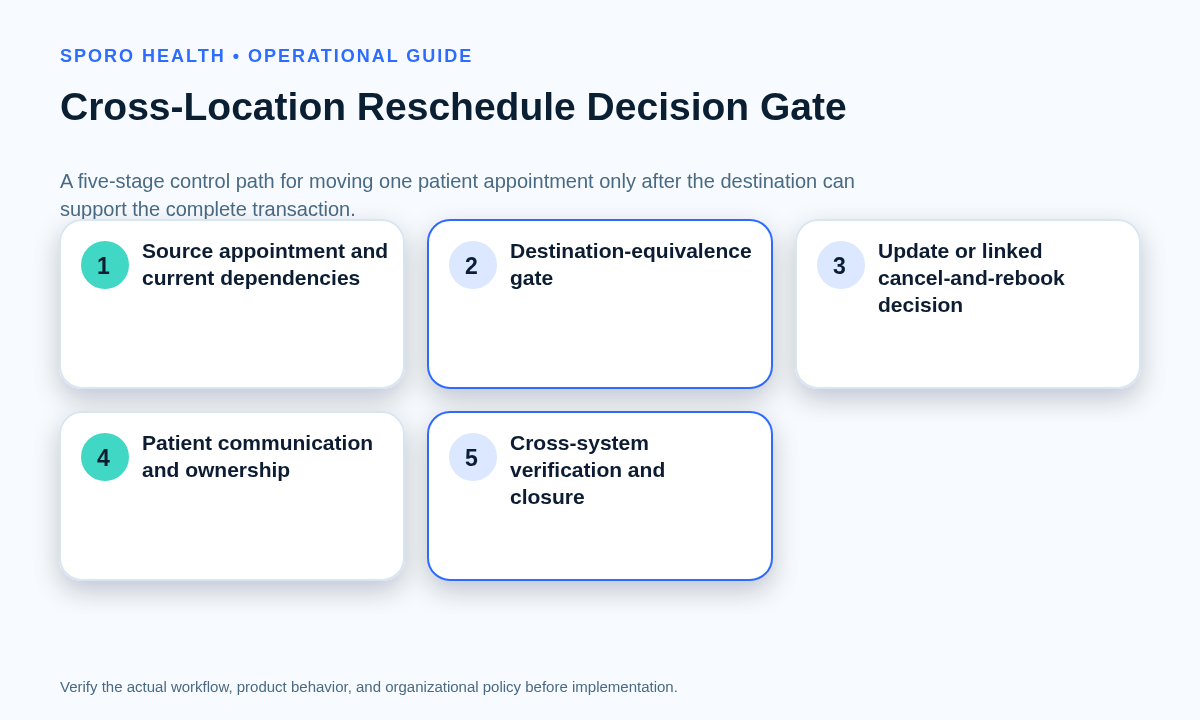
Use one controlled transfer with a single owner and a separate verifier. Move the transaction through six states: source captured, destination cleared, path authorized, change executed, dependencies reconciled, and closure verified. An unresolved dependency stops the transfer rather than becoming cleanup work later.
- Capture: Record the original appointment identifier, provider, department or location, time, type, status, and known dependencies.
- Clear: Prove that the proposed destination can support the same operational transaction.
- Authorize: Select update-in-place or linked cancel-and-rebook under the practice’s approved athenahealth procedure.
- Execute: Make the authoritative change once and record who made it.
- Reconcile: Resolve patient communication, resources, slots, reminders, booking channels, and connected calendars.
- Verify: Have a named person confirm one correct destination appointment and no active source residue.
Use the athenahealth reschedule and cancellation reconciliation workflow as the baseline for ordinary changes; the controls below add destination equivalence and cross-site residue checks.
What must the destination-equivalence gate prove?
The destination must support the complete appointment, not merely show an open time. Check every operational dependency before changing the source. The FHIR R4 appointment model separately represents status, service type, appointment type, and participants, including a location or healthcare service participant; that separation is a useful control concept, although local athenahealth behavior still depends on the approved implementation. See the HL7 FHIR R4 Appointment specification.
| Gate | Evidence required | Stop condition |
|---|---|---|
| Provider | Correct provider is active and available at the destination. | Provider assignment or authority is uncertain. |
| Location | Correct active department or clinic is selected. | A label conflicts with booking authority. |
| Time | Duration, buffers, and local time are feasible. | The interval overlaps another obligation. |
| Appointment type | Destination permits the required type and duration. | A substitute type would change the workflow. |
| Resources | Rooms, equipment, and support roles are ready. | Any required resource remains unconfirmed. |
| Visit mode | In-person or virtual requirements match the destination. | Access or physical readiness is incomplete. |
| Booking authority | The scheduler has permission or documented approval. | Approval or edit ownership is unclear. |
| Patient communication | An owner and approved contact path are assigned. | The patient cannot be informed as required. |
| Calendar representation | The expected connected-calendar outcome is defined. | Staff would have to infer success from a calendar alone. |
How should staff verify location authority?
Confirm the authoritative department or schedule assignment rather than trusting a descriptive location label. The provider-location booking-authority guide explains how to separate labels, working-location indicators, availability blocks, and actual booking controls.
What if the transfer affects travel or linked resources?
Clear those dependencies before releasing the source appointment. Apply the provider travel-time scheduling buffer playbook when a provider changes sites that day, and use the multi-resource appointment coordination playbook for rooms, equipment, or support roles.
Should the appointment be updated or canceled and rebooked?
Choose update-in-place only when the approved workflow preserves the required appointment state and dependencies. If the destination cannot be applied safely to the existing record, create an explicitly linked replacement and prove that only the replacement remains active.
Consult the current athenahealth Appointment API documentation and the practice’s configured user workflow before defining this rule. Public documentation does not establish which operation, permissions, or downstream behaviors are enabled in a particular tenant.
| Path | Use when | Required proof |
|---|---|---|
| Update in place | The approved workflow can change the destination while retaining valid identity, status, reminders, and dependencies. | The same appointment remains authoritative and every dependent view reflects the change. |
| Linked cancel-and-rebook | Local procedure requires a replacement, or destination constraints cannot be safely applied to the original. | Original and replacement identifiers are linked, the original is closed, and only the replacement is active. |
| Stop and escalate | Identity, authority, capacity, patient contact, or resource behavior is unresolved. | An authorized owner resolves the issue before either location is changed further. |
Appointment identity means traceable lineage, not merely retaining the same number. If replacement is necessary, preserve the original identifier, replacement identifier, reason, authorizer, timestamps, scheduler, and final surviving record.
What belongs on the cross-site reschedule transaction card?
The card must separate authorization, execution, communication, verification, and closure. It should contain enough evidence for another staff member to reconstruct the transfer without relying on memory or a calendar screenshot.
- Source: original appointment identifier, provider, location, time, type, status, and captured timestamp.
- Destination: proposed provider, location, time, appointment type, visit mode, resources, and booking-authority evidence.
- Control: reason, authorizer, scheduler, selected change path, execution timestamp, and recovery action.
- Dependencies: patient-contact status and owner, resource results, slot expectation, reminder or waitlist effect, and connected-calendar expectation.
- Closure: final active identifier, verifier, verification timestamp, evidence reviewed, and unresolved exception owner.
For higher-risk transfers, avoid having the same person both execute and verify the transaction. When staffing requires one person to perform both roles, add a later reconciliation review.
How should staff execute the transfer?
Make the smallest approved authoritative change, then verify outward from that record. Do not start by editing Google Calendar, Outlook, a room calendar, or a reminder list.
- Capture the source state and pause competing edits.
- Run the destination-equivalence gate and record its evidence.
- Obtain any required authorization and name the transaction owner.
- Apply the approved update-in-place or linked replacement path in athenahealth.
- Complete patient communication and reconcile resources, slots, reminders, waitlists, and booking surfaces.
- Compare the destination and source views, then record verifier evidence.
How should Google Calendar or Outlook reflect the move?
Use connected calendars as visibility and verification layers unless the practice has explicitly approved another booking-authority model. A calendar change alone does not prove that the patient appointment, source slot, resources, reminders, or communications moved correctly.
Google Calendar events expose an event identifier, status, time, and optional location; updates address a specific event ID, while incremental synchronization includes changed and deleted entries. Microsoft Graph similarly updates an event by ID and offers delta queries for added, changed, or deleted events. These platform capabilities can support identity-aware verification, but they do not establish athenahealth transaction authority. See Google’s event update reference and incremental synchronization guide, plus Microsoft’s event update reference and calendar-view delta guide.
The current Sporo athenahealth and Google Calendar product page and athenahealth and Microsoft 365/Outlook product page describe bidirectional connections. Treat those descriptions as vendor claims and require a witnessed cross-location test, including the intended event identity, time, cancellation, and location-visibility behavior.
What should the residual-state scan cover?
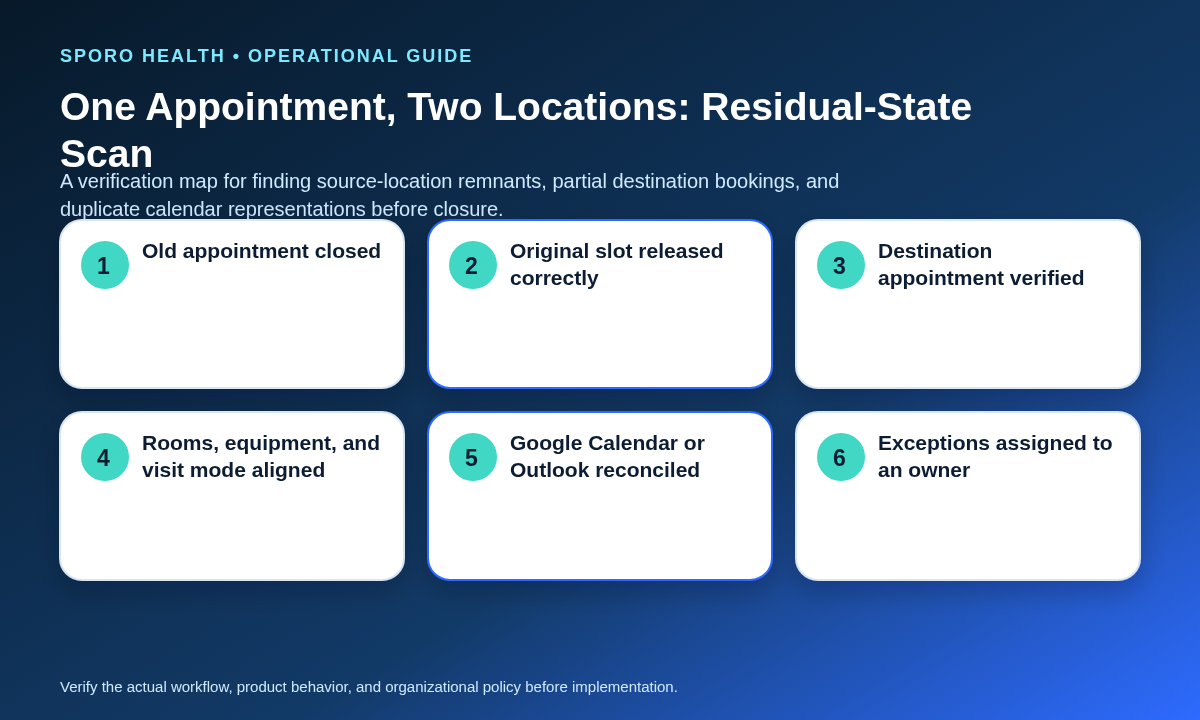
Scan every place where the source appointment could remain active, visible, reserved, or actionable. Closure requires more than finding the replacement at the destination.
- The original appointment is closed, moved, or otherwise in the approved final state.
- The source slot is released or retained exactly as policy requires.
- The destination appointment has the correct provider, location, time, type, status, and mode.
- Rooms, equipment, and support reservations are moved or released.
- Provider calendar events show one intended representation without an orphaned source copy.
- Patient reminders and communication tasks reference the intended appointment.
- Self-scheduling, waitlist, and other booking channels do not expose stale source capacity.
- Every unresolved handoff has a named owner and deadline.
Route residue that cannot be closed during the original transaction into the daily athenahealth schedule reconciliation process rather than leaving it in email, chat, or an informal callback note.
What should staff do when the old location still shows the appointment?
Contain further edits, compare identifiers, correct the authoritative record, and rerun the entire residual-state scan. Do not delete whichever representation looks older until the surviving appointment and its dependencies are identified.
- Freeze nonessential edits and assign one recovery owner.
- Compare the original appointment, proposed destination, active athenahealth record, calendar event IDs, resource reservations, and timestamps.
- Repair the authoritative transaction, clear source residue, update patient communication if needed, and obtain fresh verification evidence.
When is a cross-location reschedule complete?
The transfer is complete only when the destination is correct, the source is closed, dependencies are resolved, calendars show the intended representation, and a named verifier records evidence. “The patient is on the new schedule” is not sufficient if the old clinic, resource, reminder, or calendar event remains active.
| Measure | Definition | Why it matters |
|---|---|---|
| Verified completion rate | Verified complete transfers divided by transfers attempted. | Shows end-to-end closure, not clicks completed. |
| Destination rejection rate | Transfers stopped by the destination gate divided by attempts. | Reveals weak pre-transfer screening or capacity rules. |
| Source residue rate | Transfers with active source remnants divided by attempts. | Detects incomplete closure. |
| Duplicate or orphan rate | Transfers with multiple or unmatched representations divided by attempts. | Highlights identity and reconciliation failures. |
| Patient-contact exception rate | Transfers with incomplete required contact divided by attempts. | Separates communication failures from booking errors. |
| Correction time and cause | Time from detection to verified correction, grouped by recurring cause. | Supports targeted workflow improvement. |
How should practice managers put the workflow into operation?
Start with one appointment type and one location pair, then test normal transfers and deliberate failures. If connected-calendar visibility is part of the design, review Sporo Health, compare the Google and Outlook product pages above, and inspect the Sporo Health athenaConnect Marketplace listing. Ask the vendor to demonstrate this exact transaction against written acceptance criteria before expanding scope.
Frequently asked questions
How to move a patient appointment between athenahealth locations?
Treat it as one controlled transfer, not two unrelated edits. Capture the source, verify the destination, execute the approved path, close the old state, update dependencies, and record final verification.
What should staff verify before moving an athenahealth appointment to another location?
Verify the destination provider, location, time, appointment type, required resources, visit mode, booking authority, communication owner, and travel constraints. Stop if any dependency is unresolved.
Should a cross-location appointment be updated or canceled and rebooked?
Use update-in-place only when the approved athenahealth workflow preserves required state and dependencies. Otherwise use a linked cancel-and-rebook path and verify that only the replacement remains active.
How do you preserve appointment identity during an athenahealth location change?
Preserve the original appointment identifier whenever the approved workflow supports it. If replacement is required, record both identifiers, the reason, authorizer, timestamps, and final surviving record.
How should Google Calendar or Outlook reflect a cross-location patient reschedule?
Use Google Calendar or Outlook as a visibility and verification layer unless another authority model is explicitly approved. A calendar change by itself does not prove the patient appointment moved correctly.
What should staff do when the old clinic still shows the appointment?
Contain further edits, compare source and destination identifiers, correct the authoritative appointment, clear dependent residue, and rerun the residual-state scan before closing the transaction.
When is a cross-location appointment reschedule complete?
Completion requires a correct destination appointment, closed source state, resolved resources and communications, intended connected-calendar representation, and evidence recorded by a named verifier.
How should medical practices measure cross-location reschedule errors?
Use transfers attempted and completed as denominators. Track destination rejections, source residue, duplicate or orphaned representations, correction time, patient-contact exceptions, and recurring failure causes.
Sources
Primary technical references:
- athenahealth Appointment API documentation
- HL7 FHIR R4 Appointment specification
- Google Calendar Events: update
- Google Calendar incremental synchronization guide
- Microsoft Graph: Update event
- Microsoft Graph calendar-view delta guide
Commercial references, treated as vendor claims rather than independent evidence: