When to Create a New athenahealth Department: A Scheduling-Boundary Decision Guide
For growing medical-group leaders asking, “when should a medical group create a new athenahealth department for scheduling?” the practical rule is to create one only when material operational boundaries cannot be governed cleanly inside the current department. Otherwise, reuse the existing department and make bounded provider-, template-, appointment-type-, permission-, or view-level changes after authorized review.
A department decision affects more than a name. It can change booking authority, patient destinations, staff access, reports, integrations, connected calendars, and the treatment of future appointments. Use the following canvas and scorecard before anyone builds schedules or exposes booking.
What does an athenahealth department represent?
An athenahealth department represents a location or organizational place-of-service boundary, not merely a convenient label for every new provider or service. The current athenahealth department definition describes departments as locations or organizational entities associated with places where services are registered or rendered. The proposed structure should therefore be verified with athenahealth and the practice’s authorized operations and billing owners.
The athenaOne service description also distinguishes provider groups, departments, individual providers, schedule templates, and user permissions. That separation supports a key decision principle: do not create a department when a smaller, controlled scheduling change can represent the growth accurately.
When should a medical group create a new athenahealth department for scheduling?
Create a separate department when material differences in place of service, registration, time zone, scheduling rules, access, booking channels, reporting, or integrations cannot be governed cleanly inside the current department. Reuse the current department when the same operational boundary remains valid and provider-level controls can represent the added work without ambiguous booking authority or recurring correction.
| Growth situation | Reuse is favored when | Separation or hold is favored when |
|---|---|---|
| New provider | The provider follows the existing location, registration, access, and booking rules. | The cohort requires a materially different operating boundary. |
| New physical address | Authorized owners confirm that existing organizational controls still apply. | The site creates distinct place-of-service, registration, time-zone, or access dependencies. |
| New service line | Appointment types, templates, permissions, and views separate the pathway clearly. | Patient destinations, authority, reporting, or integrations become ambiguous. |
| Changed capacity | Location-specific sessions can be governed without changing the organizational boundary. | Staff repeatedly transfer bookings or bypass the approved structure. |
Before creating another department, determine whether the practice can standardize provider schedule templates across locations or allocate provider capacity by clinic location within the existing structure.
What belongs in the department-boundary canvas?
The canvas should document every dependency that would gain, lose, or inherit authority from the proposed department. Complete it for both the current and proposed states so reviewers can see what actually changes.
| Canvas field | Evidence to record |
|---|---|
| Address, place of service, and registration | Approved operational and billing interpretation; unresolved assumptions. |
| Providers and provider groups | Eligible providers, ownership, coverage, and cross-department work. |
| Appointment types and templates | Permitted combinations, durations, resources, and recurrence rules. |
| Time zone | Clinic clock, provider-calendar clock, and daylight-saving tests. |
| Booking surfaces | Staff booking, patient-facing booking, links, directories, and call-center views. |
| Permissions and saved views | Who can view, book, edit, override, approve, and verify. |
| Connected calendars | Provider, department, Google Calendar, and Outlook mappings. |
| Reports, notifications, and integrations | Filters, recipients, identifiers, routing, and downstream consumers. |
| Future appointments | Counts, destination eligibility, exceptions, outreach, and disposition owner. |
| Lifecycle and rollback | Accountable owner, effective date, stop authority, rollback state, and closure proof. |
Unknowns are not blank cells. Mark them as unresolved dependencies with a named owner and an approval requirement.
How does the reuse-versus-separate scorecard work?
Score the materiality of each boundary difference, then let hard gates override the total. Rate each criterion 0 for shared, 1 for bounded difference, or 2 for structural difference, and multiply by its weight. These ranges are workshop starting points, not athenahealth rules.
| Criterion | Weight | A structural difference means |
|---|---|---|
| Place of service and registration | 5 | Different authoritative registration or service boundary. |
| Booking authority and channels | 5 | Different people or surfaces may release capacity. |
| Future appointments and rollback | 5 | Bookings need a separate disposition or recovery path. |
| Permissions and access | 4 | Existing controls cannot constrain the required roles. |
| Scheduling rules | 4 | Templates and appointment types cannot prevent ambiguity. |
| Time zone and location behavior | 3 | The unit needs independent clock or destination control. |
| Calendars, reports, and integrations | 4 | Existing mappings cannot isolate the new unit reliably. |
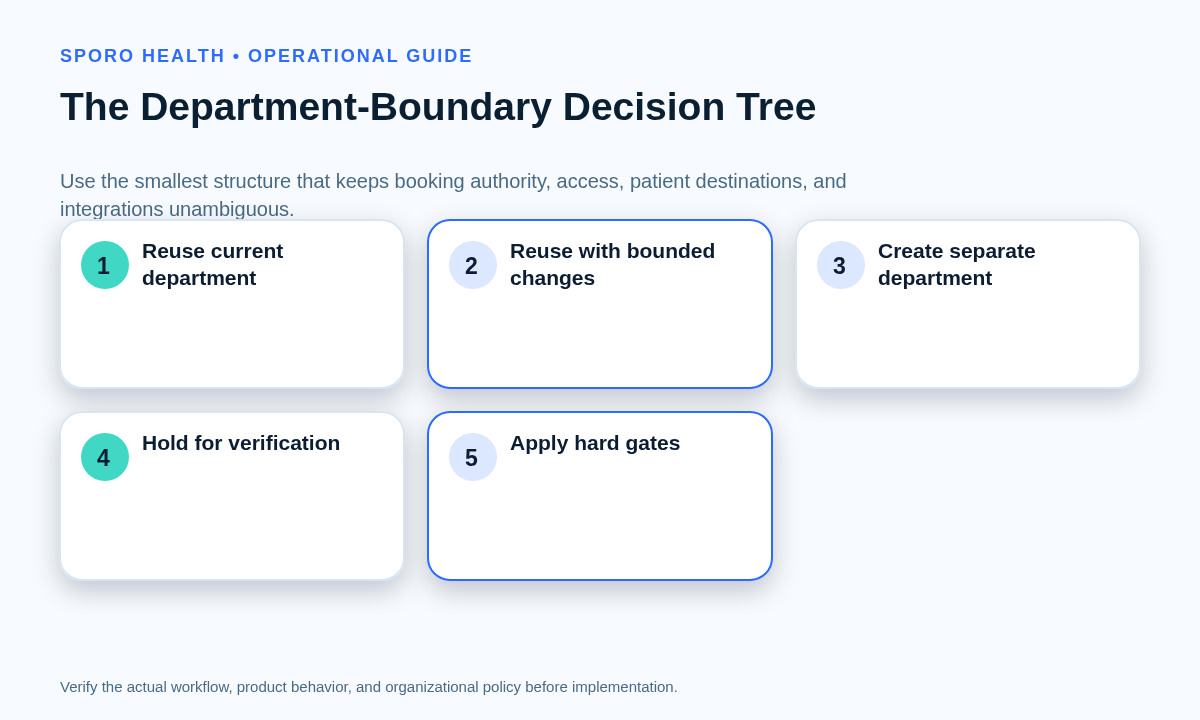
- Reuse the current department: a low score with no hard gate and one continuing operational boundary.
- Reuse with bounded schedule changes: moderate differences that named provider, template, appointment-type, permission, or view controls can contain.
- Create a separate department: several structural differences with approved ownership, migration, testing, and rollback.
- Hold: any unresolved hard gate, regardless of score.
Hard gates include unidentified booking authority, missing operational ownership, unexplained future-appointment handling, unconstrained staff access, unmapped integrations, or an untested rollback. Do not configure around these gaps.
What dependencies move when the boundary changes?
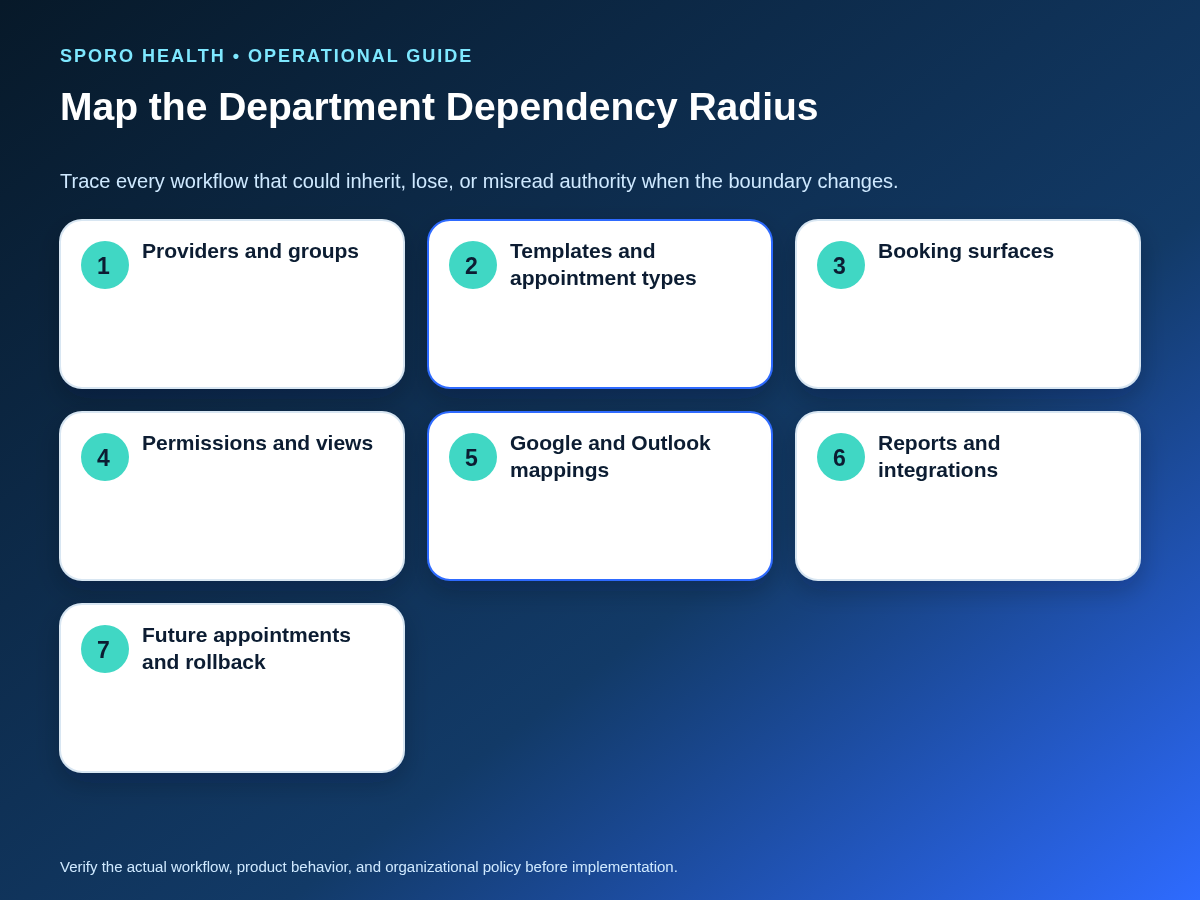
A department change has a radius that extends from schedule configuration to every workflow that interprets the department. Review five rings before approving the target state:
- Schedule core: providers, groups, templates, appointment types, resources, and recurring availability.
- Access: permissions, saved views, local and central teams, override rights, and verification roles.
- Patient-facing: booking pages, destination labels, instructions, rescheduling, and cancellation paths.
- Connected systems: calendars, reports, notifications, routing rules, interfaces, and downstream identifiers.
- Continuity: future appointments, open requests, residual capacity, fallback, and rollback.
The Google Calendar Events resource and Microsoft Graph event resource expose calendar properties such as location, time zone, recurrence, and availability status. Operationally, those properties can communicate schedule context but do not establish athenahealth department authority. Keep the department boundary separate from the group’s centralized, decentralized, or hybrid scheduling model.
How should future appointments and residual exposure be controlled?
Classify future appointments before moving, copying, or retiring any schedule. The approved department boundary does not by itself determine whether each existing booking remains valid.
| Disposition | Use when | Closure evidence |
|---|---|---|
| Stay | The original department remains valid for the booking. | Appointment and patient destination are unchanged and verified. |
| Move | The booking is eligible for the approved destination. | Destination, provider, time, dependencies, and source removal are verified. |
| Rebook or reconfirm | The new boundary changes a patient-facing commitment. | Authorized outreach and final booking state are recorded. |
| Hold | Eligibility, capacity, ownership, or consent is unresolved. | A named reviewer and next action exist; booking is not exposed. |
| Close | The appointment cannot remain valid under approved policy. | Authorized disposition and required communication are complete. |
After transition, scan the original department for residual templates, open slots, patient-facing links, staff permissions, calendar mappings, reports, and integrations. If the approved design moves an active clinician between existing boundaries, use the dedicated checklist to move a provider between athenahealth departments.
What must acceptance testing prove before booking opens?
Testing must prove both permitted workflows and denied actions across every in-scope booking surface. A successful login or one test appointment is not sufficient evidence.
- Book an eligible appointment through staff workflows and each patient-facing channel in scope.
- Reschedule and cancel it while checking source and destination departments for residue.
- Test recurring availability, provider-location changes, time zones, and future effective dates.
- Verify permitted roles, prohibited roles, saved views, overrides, and out-of-scope actions.
- Check Google Calendar or Outlook mappings, reports, notifications, integrations, rollback, and restored booking state.
Once the boundary passes, use the new clinic location scheduling go-live checklist for an approved site or the scheduling readiness checklist for a new service line for pathway implementation. Those workflows follow this structural decision; they do not replace it.
How should boundary drift be measured after launch?
Measure signals that show people or systems are routing work around the approved department boundary. Define each denominator, owner, review cadence, threshold, and closure rule before launch.
| Signal | What it can reveal |
|---|---|
| Wrong-department bookings | Misleading destinations, permissions, views, or staff rules. |
| Manual transfers | A boundary that does not match routine demand. |
| Residual booking exposure | Open capacity, links, or templates left in the source. |
| Calendar-mapping exceptions | Missing, duplicated, or stale provider-department relationships. |
| Permission defects | Users who can book, edit, or view outside approved scope. |
| Unresolved future appointments | Transition records without a final accountable disposition. |
| Bypass requests or missing ownership | Pressure to create a shadow operating model. |
Review patterns, not only incidents. Repeated correction may mean the boundary, schedule design, staff authority, or booking surface needs redesign.
What should leaders do next?
Document one decision record that names the outcome, evidence, approvals, dependencies, tests, effective date, stop authority, and post-launch measures. If any hard gate remains unresolved, choose hold rather than building an ambiguous department.
After the structure is approved, leaders can review Sporo Health, the current athenahealth and Google Calendar product page, the athenahealth and Microsoft Outlook product page, and the Sporo Health athenaConnect Marketplace listing. Treat product descriptions as vendor claims and request written confirmation of department mapping, access scope, acceptance behavior, lifecycle handling, and rollback for the practice’s environment.
The practical answer to “when should a medical group create a new athenahealth department for scheduling?” is to create the boundary only when it removes material ambiguity across several controlled dependencies, not merely because growth occurred.
Frequently asked questions
Does a new clinic location need its own athenahealth department?
No. A new physical address does not automatically require a new department; evaluate place of service, registration, scheduling rules, access, time zone, reporting, and integrations together, then verify the proposed structure with athenahealth and authorized operations and billing owners.
Should a new medical service line use a separate athenahealth department?
Not always. Keep the service line in the existing department when appointment types, templates, permissions, views, and booking channels can separate the work without ambiguous authority or repeated manual correction.
Can different provider templates exist inside one department?
Yes. Provider-level templates and appointment types can represent justified differences when the same operational boundary still applies, but the practice should govern those variations and test booking outcomes.
How should future appointments be handled when a new department is created?
Classify every future appointment before moving anything. Preserve valid bookings, define destination eligibility, place unresolved records on hold for authorized review, and scan the original department for residual schedules or links.
How should Google Calendar and Outlook map to athenahealth departments?
Use an explicit, approved mapping for each provider, department, calendar, and direction of change. Calendar names, event locations, and labels may communicate context, but they should not establish athenahealth booking authority.
What should stop department configuration?
Stop when booking authority, operational ownership, future-appointment handling, staff access, integration mappings, acceptance evidence, or rollback cannot be explained and approved.
How do you prevent wrong-department bookings after launch?
Monitor wrong-department bookings, manual transfers, residual booking exposure, calendar-mapping exceptions, permission defects, unresolved future appointments, and repeated bypass requests; assign each signal an owner and closure rule.
Sources
- athenahealth Department, Athena Core Implementation Guide
- athenaOne Service Description
- Google Calendar Events API resource
- Microsoft Graph event resource
- Sporo Health athenahealth and Google Calendar product page
- Sporo Health athenahealth and Outlook product page
- Sporo Health listing in the athenaConnect Marketplace